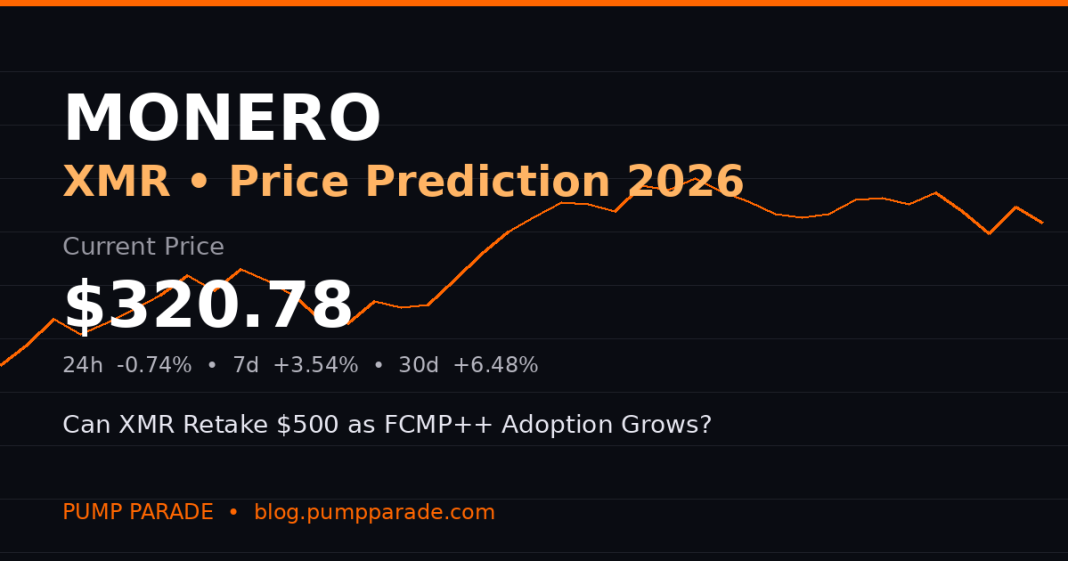
Monero (XMR) trades at $320.78 today, down roughly 60% from its January 2026 all-time high of $797.73. Volume has cooled to $103 million a day, and the 60-day chart is red. Yet week over week, XMR is up 3.5%, hashrate is holding, and privacy-coin discourse is louder than it has been in years.
So what is the real Monero price prediction 2026 now that the FCMP++ upgrade is live, the Kraken delistings are extending into new jurisdictions, and Zcash keeps stealing the privacy-coin spotlight? Below, we walk through the data, the bull case, the bear case, and the specific triggers that would flip our view.
Key Takeaways
- Current price: $320.78, market cap $6.02B, rank #19 (CoinGecko, July 2026).
- ATH drawdown: XMR is 59.8% below its January 2026 peak, the deepest correction of the FCMP++ cycle.
- Bull case: A privacy-narrative revival and a hashrate breakout could push XMR back to $500-$600 in H2 2026, with a stretch scenario near $900.
- Bear case: More exchange delistings and continued rotation into Zcash could pin XMR in the $220-$260 range.
- Base case (30-day): $300-$360 with a volatility skew to the upside if BTC holds $60K.
- Key catalyst: FCMP++ user activation, ATOMIC swap growth, and any surprise from the EU AMLR implementation timeline.
Where Monero Stands Today
Monero has spent the last six months digesting one of the most technically ambitious upgrades in privacy-coin history. FCMP++, or Full-Chain Membership Proofs, went live on the mainnet in January 2026 and pushed the coin briefly to $797.73. Since then, the market has been unwinding that catalyst into a broader risk-off tape and a fresh round of exchange pressure.
Here is the snapshot right now:
| Metric | Value |
|---|---|
| Price (USD) | $320.78 |
| 24-hour change | -0.74% |
| 7-day change | +3.54% |
| 30-day change | +6.48% |
| 60-day change | -23.09% |
| Market cap | $6.02B |
| 24-hour volume | $102.7M |
| CoinGecko rank | #19 |
| All-time high | $797.73 (Jan 14, 2026) |
| % from ATH | -59.8% |
| Circulating supply | 18.77M XMR |
Two things stand out. First, the 7-day and 30-day columns are both green. That is not the profile of a coin in freefall, it is the profile of a coin trying to base. Second, volume at $103 million is thin for a top-20 asset. Any real narrative shift will move XMR fast in either direction. Data is pulled from CoinGecko as of the time of writing.
Why is Monero Range-Bound Right Now?
Zoom out. The current chop is the natural after-effect of a “sell the news” event stacked on top of a structural liquidity problem.
The FCMP++ upgrade was fully priced in by the January peak. Traders who front-ran the hardfork are rotating out. At the same time, XMR liquidity keeps thinning on regulated venues. Kraken pulled Monero access for Canadian and Indian users in April 2026, on top of earlier removals in the European Economic Area. That reduces marginal demand from the exact investor cohort that would otherwise be adding after a 60% drawdown.
The offset is on-chain. Atomic-swap volumes between XMR and BTC have climbed steadily, and non-KYC venues like Haveno and TradeOgre continue to absorb flow. The market is not disappearing. It is migrating.
What is the Bull Case for Monero in 2026?
1. FCMP++ finally starts mattering to users, not just researchers
FCMP++ expanded the Monero anonymity set from 16 outputs per transaction to more than 100 million outputs, essentially the entire unspent output set on the chain. That is a step change in unlinkability. So far, the market has treated it as a headline. Real adoption, especially by merchants and darknet-market analytics teams that publicly flag XMR as untraceable, is a slower story that plays out over 2026 and could rerate the coin as the “privacy standard” narrative gets recycled.
2. Zcash is doing the marketing for the entire category
ZEC rallied to $585 in May 2026 after Multicoin Capital disclosed a large position, and Pump Parade covered the run in our Zcash 2026 price prediction. That is bullish for XMR. Every privacy-coin headline expands the addressable audience, and Monero remains the largest and most battle-tested asset in the vertical. If ZEC keeps grinding higher, XMR historically catches a rotation bid within 4-6 weeks.
3. Regulatory uncertainty is a slow-burn tailwind
Yes, delistings hurt short-term liquidity. But they also drive Monero’s core value proposition. Every AI-surveillance headline, every new AMLR implementation guideline, and every data breach reminds the crypto-native audience why permissionless privacy still matters. If a single high-profile event, say a major stablecoin freeze or a bank-CBDC integration, forces a wallet-level privacy discussion, XMR is the coin that captures that flow first.
What is the Bear Case for Monero in 2026?
1. Delistings are structural, not cyclical
The EU Anti-Money Laundering Regulation takes full effect for regulated crypto asset service providers on July 1, 2027. Between now and then, expect a rolling wave of jurisdiction-specific delistings across Kraken, OKX, Bitstamp and others. Every delisting shrinks the pool of investors who can even buy XMR without leaving a compliant venue.
2. Zcash is stealing the institutional bid
The uncomfortable truth for Monero maximalists: Zcash sits at a higher market cap than XMR right now, and Coinbase, Robinhood, and Phemex all still list ZEC. When Multicoin and other institutional allocators want privacy-coin exposure, they can express the trade on regulated venues in ZEC. XMR, by contrast, requires a KuCoin, MEXC, or DEX workflow that most funds cannot use.
3. Hashrate is stable, not surging
A rally without a hashrate breakout is fragile. If mining economics do not improve as the price recovers, security-driven demand from institutional custody providers stays capped. That is a headwind for any story about XMR reclaiming $500.
Monero Price Prediction 2026: Targets by Timeframe
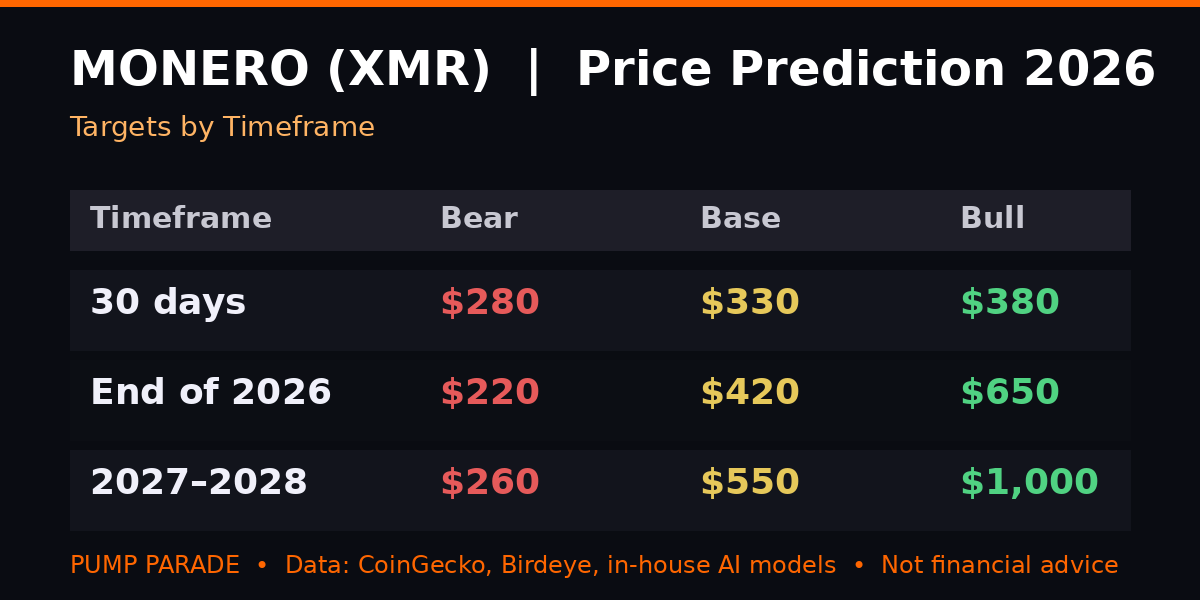
Our approach: anchor the base case to on-chain velocity plus the current BTC beta, then stress-test the extremes. These are not price guarantees. They are the ranges that the current data supports.
30-Day Outlook (July to August 2026)
- Bear: $280. Loss of the $300 psychological level triggers a stop-run to the May low.
- Base: $330. Continued range trade with buyers defending $300 and sellers capping the tape near $360.
- Bull: $380. A privacy-narrative catalyst plus a BTC push above $65K, XMR reclaims the descending trendline from January.
6-Month Outlook (End of 2026)
- Bear: $220. Compounding delistings, no fresh narrative, XMR retests the May 2025 lows.
- Base: $420. FCMP++ user growth reaccelerates, atomic-swap volume prints new highs, XMR reclaims half its January drawdown.
- Bull: $650. A privacy-focused geopolitical event or a data-breach cycle pushes XMR back toward its ATH neighborhood.
Long-Term Outlook (2027 and Beyond)
The 2027-2028 range is where the analyst spread gets wild. Changelly’s model targets $472 average and $556 high for 2026, then higher through 2028. Coincub and Cryptopolitan sit closer to a $500-$900 range for the same window. Our own AI-blended base case is $550 by end of 2027 assuming AMLR ramps as scheduled and Zcash keeps drawing capital into the vertical. The stretch bull case, $1,000 XMR, requires both a market-wide privacy pivot and a fresh institutional wrapper (a ZEC-style ETF workaround, a compliant privacy-DeFi primitive, or a sovereign wealth adoption story). None of those are impossible. None are obviously coming this year.
How Does Monero Compare to Zcash in 2026?
Zcash is the only credible peer. Here is how the two stack up right now:
| Metric | Monero (XMR) | Zcash (ZEC) |
|---|---|---|
| Price (USD) | $320.78 | $444.78 |
| Market cap | $6.02B | $7.5B |
| Privacy model | Private by default (RingCT, FCMP++) | Optional privacy (zk-SNARKs, shielded pools) |
| Anonymity set | 100M+ outputs (post FCMP++) | Depends on shielded-pool usage |
| Consensus | RandomX Proof of Work | Equihash Proof of Work |
| Supply cap | No hard cap (tail emission) | 21M ZEC hard cap |
| Coinbase listing | No | Yes |
| Robinhood listing | No | Yes |
The takeaway: Zcash wins on distribution, Monero wins on privacy by default. In a bull market, distribution matters more. In a regulatory-shock scenario, privacy by default matters more. Investors picking one side of this trade are effectively choosing which of those two scenarios they want exposure to.
What Would Change Our View
Three explicit triggers would move us off the neutral-to-mildly-bullish base case:
- Bullish trigger: XMR reclaims $400 with volume above $200M per day, coincident with a fresh Multicoin or a16z Crypto privacy-vertical position disclosure. That combination unlocks the $500-$650 path.
- Bearish trigger: A major non-EU jurisdiction (US, Japan, or Singapore) proposes an explicit prohibition on privacy-coin custody by regulated financial institutions. That would compress the addressable market and drop the bear-case floor to $180.
- Neutral trigger, watch closely: An FCMP++ implementation vulnerability. Highly unlikely given the audit process, but any credible bug report resets the entire privacy narrative for 6-12 months.
Frequently Asked Questions
Will Monero reach $1,000 in 2026?
Unlikely in the base case. A move from $320 to $1,000 in six months would require a privacy-narrative rerating plus a fresh institutional wrapper. Analysts including Changelly and Coinpedia flag $1,000 as a 2028-2030 target unless a black-swan privacy event lands sooner. Our base case for year-end 2026 is $420, with a bull-case top around $650.
Is Monero a good investment in 2026?
Monero fits a specific portfolio role: a small, high-conviction satellite position for investors who want direct exposure to the “financial privacy” narrative and can tolerate regulatory tail risk. It is not a broad-market beta trade. Sizing matters more than timing here, and most allocators cap XMR at 1-3% of a crypto sleeve.
Why is Monero being delisted from exchanges?
Because MiCA, the EU Anti-Money Laundering Regulation, and FATF Travel Rule guidance make anonymity-enhancing coins operationally incompatible with regulated exchange obligations. Delistings are compliance decisions by exchanges, not government bans on the asset itself. Owning and transacting XMR remains legal in the US, EU, UK and Canada as of July 2026.
What is FCMP++ and does it matter for the XMR price?
FCMP++ is Monero’s biggest privacy upgrade since RingCT in 2017. It expanded the anonymity set from 16 outputs to more than 100 million outputs per transaction, which makes chain-analysis heuristics effectively useless. It matters for price long-term because it entrenches Monero’s category-defining privacy claim. Short-term, the market already digested the upgrade.
Where can I still buy Monero after the delistings?
Non-KYC venues like KuCoin, MEXC, Gate.io, and TradeOgre still list XMR spot pairs. Decentralized options include atomic swaps via Haveno, Serai, and BasicSwap. Investors in restricted jurisdictions typically use a BTC-to-XMR swap rather than a direct fiat rail. Fees and slippage are higher than on regulated venues.
How does Monero compare to Zcash right now?
Zcash is trading at a higher market cap ($7.5B vs $6.0B) and retains listings on Coinbase and Robinhood. Monero has a stronger privacy guarantee by default. In a bull market, ZEC’s distribution edge tends to lead. In a regulatory shock, XMR tends to catch a bid first. See our Zcash 2026 price prediction for the sibling analysis.
The Honest Take
Monero in July 2026 is a coin caught between two forces that will not resolve quickly. On one side, the FCMP++ upgrade delivered exactly what the community promised, and the fundamental case for private-by-default money is arguably stronger than it has been in any other cycle. On the other side, exchange access is contracting on a scheduled timeline, and the institutional bid is flowing to Zcash instead.
That is a real setup, not a hype trade. The 3.54% weekly gain and the still-shrinking exchange balances suggest patient buyers are quietly building positions. But without a fresh catalyst, XMR does not have a clear path back to $500 before Q4. Position size accordingly.
For readers building a broader privacy-coin sleeve, our recent Zcash breakdown covers the ZEC bull case in detail, and our Bitcoin Cash 2026 outlook touches on the older “sound money” narrative that shaped the privacy vertical’s early history.
Disclaimer: This article is for informational and educational purposes only and should not be construed as financial, investment, or trading advice. Cryptocurrency markets are highly volatile, and past performance does not guarantee future results. The price predictions and analyses presented here are based on AI models, technical indicators, and available data at the time of writing, they are not guarantees. Always conduct your own research (DYOR) and consult with a qualified financial advisor before making any investment decisions. Pump Parade and its authors do not assume liability for financial losses incurred based on information provided in this article.