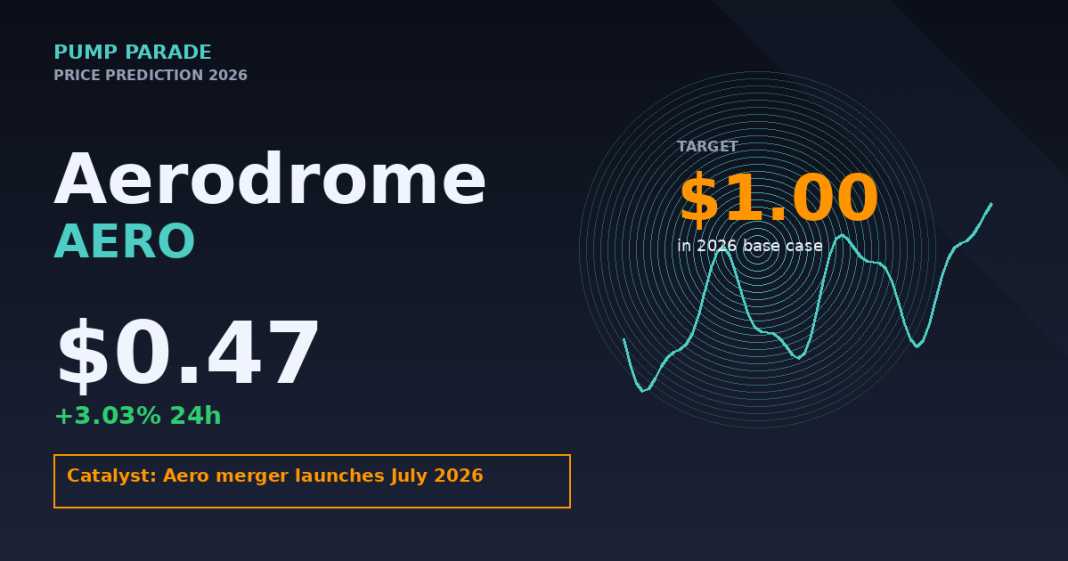
Aerodrome Finance’s AERO token trades at $0.47 at time of writing, up 3% in the last 24 hours but down 9% on the week. The AERO price prediction 2026 conversation just got more interesting: the Aerodrome and Velodrome merger into a single cross-chain protocol called “Aero” launches this month, and 190 million AERO tokens have already been retired through the buyback program.
Here is the setup. Aerodrome sits 79% below its December 2024 all-time high of $2.32, yet it still processes roughly 70% of all decentralized exchange volume on Coinbase’s Base network, with over $1.3 billion in total value locked and around $17 billion in monthly volume. That kind of dominance rarely stays this cheap for long.
This article breaks down the current setup, the bull case built on the Velodrome merger and OP Superchain expansion, the bear case that markets have already started pricing in, and where our AI model sees AERO landing over the next 30 days, 6 months, and beyond.
Key Takeaways
- Current price: AERO trades at $0.47, market cap $453M, ranked #110.
- Primary catalyst: Aerodrome and Velodrome merger into “Aero” launches July 2026, with 94.5% of the new token distribution allocated to AERO holders.
- Bull thesis: Base ecosystem dominance plus Predictive Allocation upgrade plus 190M AERO already bought back and burned.
- Bear thesis: Liquidity migration risk, VELO holder dilution, and 7-day price action suggests market skepticism.
- 2026 targets: Bear $0.35 / Base $0.75 / Bull $1.20 by end of Q4.
Where AERO Stands Today
Real-time data from CoinGecko and Birdeye shows AERO in a period of quiet accumulation after a punishing six months. The token is up 16.6% over the last 30 days despite the broader market’s drawdown, which is unusual and worth noting.
| Metric | Value |
|---|---|
| Price (USD) | $0.47 |
| 24h Change | +3.03% |
| 7d Change | -9.11% |
| 30d Change | +16.63% |
| Market Cap | $453M |
| 24h Volume | $23.8M |
| CoinGecko Rank | #110 |
| All-Time High | $2.32 (Dec 2024) |
| % From ATH | -79.6% |
| Circulating Supply | 957.7M / 1.93B |
The story that jumps off the page: AERO is up on the month, down on the week. That divergence tells you the June rally from the Predictive Allocation announcement (30% pop on June 16) has been giving back gains as traders reduce exposure ahead of the actual merger execution risk in July.
Why is AERO consolidating right now?
Two competing forces are keeping AERO range-bound. On the bull side, the Aero merger with Velodrome is objectively one of the more meaningful DeFi consolidations of 2026. It rolls up two of the largest ve(3,3) DEXs, unifies governance across Base and Optimism, and hands AERO holders 94.5% of the new token distribution. That is a rare “everything gets better” event in a sector that usually fragments.
On the bear side, there are execution questions. Liquidity providers have to migrate to new MEV-resistant pools. Governance mechanics change entirely. VELO holders, however small their allocation, still represent new sellers. And the broader crypto market has been in a 20% drawdown for the last 30 days, so token-specific catalysts have to fight tape headwinds.
The result is a coiled setup. When a token holds up better than the market during a broad drawdown while a known catalyst approaches, the resolution tends to be violent in one direction.
What’s driving the AERO bull case?
Catalyst 1: The Aero merger closes in July 2026
Aerodrome (on Base) and Velodrome (on Optimism) are consolidating into “Aero,” a single cross-chain DEX spanning the OP Superchain with planned expansion to Ethereum mainnet and Circle’s new Arc network. Dromos Labs, the entity behind both protocols, has confirmed the July launch and platform upgrades are already in flight.
The token math matters. AERO holders get 94.5% of the new native token, VELO holders 5.5%. Existing AERO exposure translates almost 1-to-1 into exposure to a materially larger protocol with more chains, more liquidity, and more fee capture. CoinCodex’s model puts AERO’s 2026 average at $4.42 in the bull scenario, which assumes successful execution.
Catalyst 2: Predictive Allocation goes live
The Predictive Allocation Model, unveiled on June 17, 2026, replaces the standard weekly gauge-voting system with a prediction-market-based allocator. In plain terms: instead of veAERO holders voting on where next week’s emissions go based on lobbying, the protocol allocates liquidity incentives to pools where demand is forecast to appear. This is a real efficiency upgrade for LPs and a subtle signal that Aerodrome is willing to iterate on ve(3,3) rather than just inherit it.
The market’s initial response was telling. AERO rallied 30% on June 16 as the announcement leaked, and while much of that has retraced, the underlying mechanism launches with the merger.
Catalyst 3: Base ecosystem tailwind and buybacks
Aerodrome captures 100% of protocol fees back to token holders through vote-escrow mechanics. As Base has grown, so has that fee stream. The buyback program has already retired 190 million AERO tokens, a supply reduction that keeps compounding as long as Base DEX volume grows. Coinbase’s ongoing push to make Base its primary consumer chain (via the token launchpad and MetaMask-competing wallet features) creates a structural tailwind that most competing DEXs do not enjoy.
What could sink AERO in 2026?
Risk 1: Migration and execution risk
Not all mergers work. LPs have to actively migrate funds to new pool contracts to continue earning rewards. Some fraction will forget, get confused, or wait too long, temporarily fragmenting liquidity. If migration takes longer than expected, TVL numbers could dip in the transition, which would spook holders who use TVL as a proxy for health.
Risk 2: Base ecosystem dependence
Aerodrome’s fortunes are structurally tied to Base’s volume. If Coinbase throttles Base development, if a competing L2 draws liquidity, or if Base itself suffers a regulatory or technical setback, AERO’s fee stream shrinks fast. The token is a leveraged bet on Base, which cuts both ways.
Risk 3: The broader market is not cooperating
Bitcoin sits at $58,808, down 19% on the month per CoinGecko data. Ethereum is down 20%. DeFi tokens historically underperform in Bitcoin-led drawdowns because rotation flows out of higher-beta positions first. Even a well-executed merger cannot fully offset a 30% Bitcoin correction if one materializes. Our recent Uniswap price analysis shows the same pattern hitting other DEX tokens.
AERO Price Prediction 2026: Targets by Timeframe
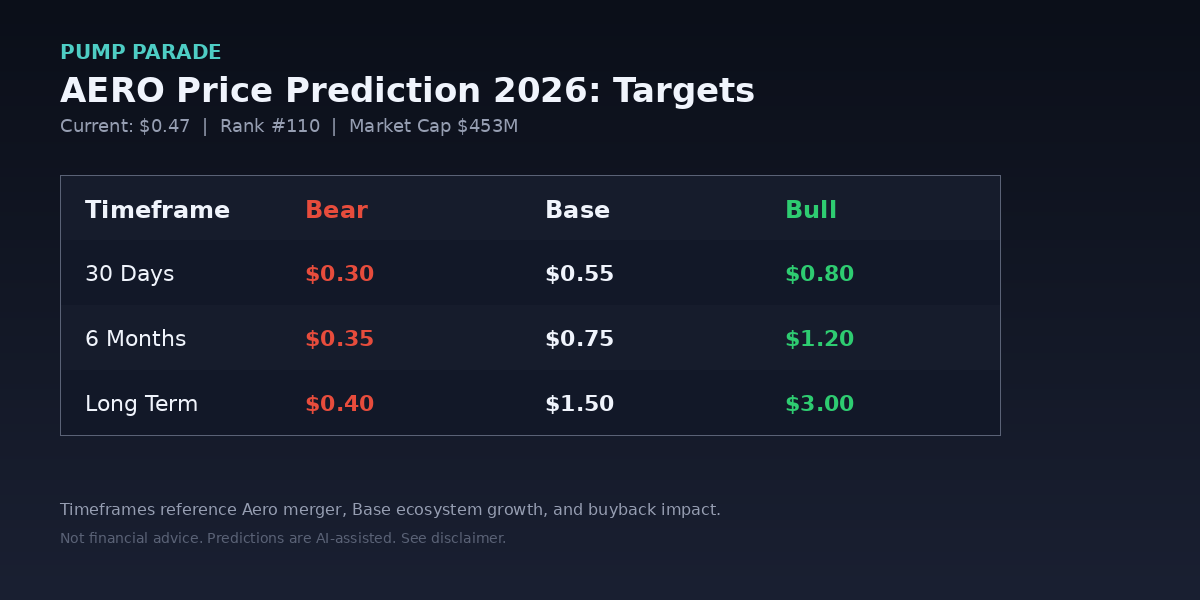
Our hybrid AI model synthesizes technical indicators, on-chain data, and catalyst-weighted scenarios. The AERO price prediction 2026 output splits into three timeframes.
30-day outlook (through end of July 2026)
The Aero merger execution window is the dominant variable. If the July launch proceeds smoothly and TVL holds, expect a re-rating attempt toward $0.80. If the market wobbles or migration hiccups, $0.30 to $0.35 is where prior support kicks in. Base case: $0.55, roughly 17% above current levels.
6-month outlook (through end of 2026)
Post-merger, the story becomes about proving that unified Aero can defend market share and grow into the Ethereum and Arc expansions. Standard Chartered’s DeFi coverage models generally require sustained 3-month TVL growth before institutional flows pick up. Bull case here: $1.20, driven by successful cross-chain rollout and Base volume expansion. Base case: $0.75. Bear case: $0.35 if the merger disappoints.
Long-term outlook (2027 to 2028)
Long-term, AERO is a bet on Base becoming a top-3 chain by volume and on Aero maintaining DEX dominance across the OP Superchain. If both happen, comparisons to Uniswap’s FDV become defensible, implying a bull target of $3.00. Base case: $1.50. Bear case: $0.40 if a competing DEX captures share.
For context, Changelly’s 2026 projection sits between $0.55 and $3.50, and CoinCodex’s average 2026 target is $4.42. Our targets are meaningfully more conservative because we weight execution risk and macro drawdown probability higher than pure trend extrapolation.
How AERO Compares to Uniswap (UNI)
UNI is the incumbent DEX token everyone compares against. Here is how the fundamentals stack up.
| Metric | AERO | UNI |
|---|---|---|
| Price | $0.47 | $2.76 |
| Market Cap | $453M | $1.71B |
| Primary Chain | Base (soon: OP Superchain) | Ethereum + L2s |
| Fee Capture to Token | 100% | Fee switch pending |
| Tokenomics | ve(3,3) with buybacks | Governance token |
| 30d Performance | +16.6% | -7.1% |
| % From ATH | -79.6% | -93% |
The distinction that matters most: AERO already flows 100% of protocol fees back to holders. UNI still has to pass a fee switch vote. That single mechanic gives AERO holders a claim on real revenue today, while UNI holders are pricing in a future decision. In a market that increasingly rewards cash-flowing tokens, that is a durable edge. For a deeper comparison of DEX aggregator dynamics, our Jupiter vs 1inch breakdown covers how fee capture translates into token value across ecosystems.
What Would Change Our View
Three specific triggers would force us to update these targets.
1. Merger execution fails or delays past August. If Dromos pushes the launch or if TVL drops more than 20% during migration, the base case shifts down to $0.35 and the bear case reopens toward $0.25.
2. Base captures 15%+ of Ethereum L2 volume by Q4. That kind of sustained share gain would justify raising the base case to $1.00 and bull to $1.80, because AERO’s fee stream scales roughly linearly with Base volume.
3. A spot DeFi ETF gets filed with AERO as a component. Bitwise and others are already filing single-asset altcoin ETFs. A basket product that includes Aerodrome would create the kind of passive bid that changed the entire trajectory for tokens like Ondo (ONDO) earlier this cycle.
Frequently Asked Questions
Will AERO reach $1 in 2026?
Our base case puts AERO at $0.75 by end of 2026, with a bull scenario at $1.20. Reaching $1 requires the Aero merger to execute cleanly in July and Base to continue growing its DEX volume share. Not the most likely outcome, but well within the plausible range if catalysts align.
Is Aerodrome Finance a good investment?
AERO is a high-conviction, high-risk DeFi bet. It has real revenue (100% of fees flow to holders), a dominant position on Base (roughly 70% share), and a well-defined near-term catalyst in the Velodrome merger. It also has meaningful execution and ecosystem-dependence risk. Suitable for risk-tolerant investors who understand DeFi.
What is the AERO price prediction for 2026?
Our AI model output: 30-day base $0.55, 6-month base $0.75, long-term base $1.50. Bull scenarios extend to $1.20 and $3.00 respectively. External analysts range from $0.39 (conservative) to $5.02 (aggressive). Always weigh predictions against execution risk.
How does the Aero merger affect AERO price?
The merger consolidates AERO and VELO into a single new token, with AERO holders receiving 94.5% of the new supply. This effectively expands AERO’s economic footprint to include Optimism and the broader OP Superchain, materially increasing the addressable fee pool with minimal dilution.
What is Aerodrome’s TVL?
Aerodrome holds over $1.3 billion in total value locked as of early 2026, representing roughly 70% of all DEX liquidity on Base. Monthly volume runs around $17 billion. Both metrics make Aerodrome the single most important DeFi protocol on Base by a wide margin.
When is the Aerodrome Velodrome merger?
The Aero launch is scheduled for July 2026. Platform upgrades and pool migrations are already underway. Liquidity providers should follow official Aerodrome communications to ensure smooth migration and avoid missing rewards during the transition.
The Honest Take
AERO is one of the more interesting DeFi setups on the board right now. It has real revenue, real dominance in its ecosystem, a clean near-term catalyst, and it is priced 80% below its all-time high. That is the kind of asymmetric setup that occasionally works spectacularly.
What it is not: risk-free. Mergers create migration friction. Base’s fortunes are not fully in Aerodrome’s hands. And the broader crypto market is in a corrective phase that could last months. Our base case of $0.75 by year-end reflects those tensions honestly. The bull case exists and is defensible; so does the bear case.
For traders, the July merger completion is the pivot event to watch. For longer-term holders, the question is whether Aero can become the default DEX for the OP Superchain. If yes, the token re-rates. If no, it stays a mid-cap DeFi token trading on Base sentiment. Both outcomes remain live.
Disclaimer
Disclaimer: This article is for informational and educational purposes only and should not be construed as financial, investment, or trading advice. Cryptocurrency markets are highly volatile, and past performance does not guarantee future results. The price predictions and analyses presented here are based on AI models, technical indicators, and available data at the time of writing, they are not guarantees. Always conduct your own research (DYOR) and consult with a qualified financial advisor before making any investment decisions. Pump Parade and its authors do not assume liability for financial losses incurred based on information provided in this article.