If you live on Ethereum, Base, Arbitrum, or any of the dozens of EVM chains, the wallet you choose is the single biggest decision you make about your safety. MetaMask has been the default answer for years. Rabby Wallet has quietly become the favorite of DeFi power users who got tired of squinting at hex-encoded confirmation popups.
So which one should you actually install in 2026? We compared both wallets head-to-head on fees, security, supported chains, UX, and trust signals. Here is what we found.
TL;DR: Quick Verdict
- Best for beginners and broad ecosystem support: MetaMask. It still has the largest user base, the deepest dApp integrations, and now supports Bitcoin, Solana, and TRON alongside EVM chains.
- Best for active DeFi users and security-conscious traders: Rabby Wallet. Pre-transaction simulation, automatic network switching, and annual audits from SlowMist and Cure53 make it the safer day-to-day signer.
- Overall pick if you can only use one: Rabby, if you do more than buy and hold. MetaMask, if you mostly stake, swap occasionally, and want one familiar app across mobile and desktop.
Quick Snapshot of Both Wallets
MetaMask launched in 2016 as a browser extension from ConsenSys. It now reports roughly 30 million monthly active users as of 2026, making it the most widely installed self-custodial wallet in crypto. It runs as a browser extension, mobile app on iOS and Android, and a Portfolio web dashboard.
Rabby Wallet is built by the team behind DeBank, the well-known multi-chain portfolio tracker. It launched in 2021 as a desktop browser extension focused on EVM DeFi users. Rabby added a mobile app in 2023 and has since become the go-to wallet for people who interact with complex smart contracts every day.

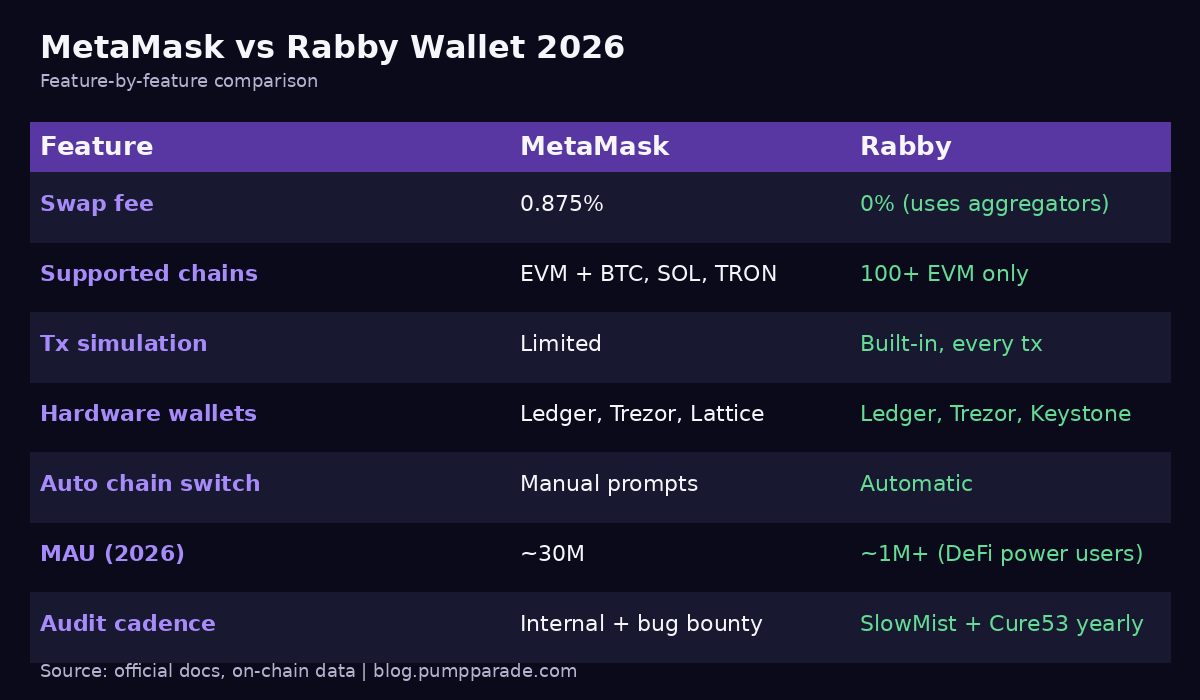
Feature Comparison Table
Fees and Pricing
MetaMask Swap Fees
MetaMask charges a 0.875% service fee on in-wallet swaps, layered on top of the underlying DEX spread. Fiat on-ramps add a 1% markup. ETH staking through the Validator Staking integration takes a 15% cut of rewards (10% on some other integrations), which is higher than most native staking routes.
On the plus side, MetaMask now has a Gas Station feature that lets you pay gas in the token you are swapping, so you do not need to keep dust ETH on every L2. That is genuinely useful for L2 hoppers.
Rabby Fees
Rabby itself takes no swap fee. It routes through DEX aggregators and surfaces the best route across multiple sources. You pay the aggregator’s fee plus gas, but Rabby does not skim a wallet markup on top. For active swappers, that 0.875% saving on MetaMask compounds fast.
Rabby also has no built-in fiat ramp markup, because it does not offer a first-party ramp. You bridge in or buy elsewhere, then move the funds.
Who wins on fees?
Rabby, unambiguously, if you swap or trade often. For staking, the picture is less clear cut: MetaMask makes the action one click but charges for the convenience.
Security and Trust
This is where the two wallets diverge the most.
Rabby’s Security Model
Rabby’s flagship feature is pre-transaction simulation. Before you sign anything, Rabby runs the transaction in a virtual environment and shows you the actual balance changes that will occur. If a malicious site asks you to approve unlimited spending of your USDC, Rabby tells you in plain English. If a contract is going to drain a specific NFT, you see it before you sign.
On top of simulation, Rabby ships with:
- Risk scanning that flags approvals to known malicious contracts and unusual permission requests.
- A built-in approval manager so you can revoke old token allowances without leaving the wallet.
- Open-source code with annual third-party audits from SlowMist and Cure53, two of the most respected firms in the space.
- Hardware wallet support for Ledger, Trezor, and Keystone.
MetaMask’s Security Model
MetaMask has improved a lot in the last two years. It now ships with Blockaid-powered phishing alerts on by default, has a paid Transaction Shield tier that adds protection and faster customer support, and integrates with hardware wallets like Ledger, Trezor, and GridPlus Lattice.
Where it falls short is granular pre-transaction simulation. MetaMask shows you what method you are calling and what tokens move at a high level, but it does not consistently surface the full balance delta or contract-level risk profile the way Rabby does. For routine swaps that is fine. For complex DeFi positions and approvals, Rabby simply gives you more signal.
Who wins on security?
Rabby, especially for users who routinely sign contract interactions outside of well-known dApps. MetaMask is safe enough for mainstream use, but Rabby is engineered for the moments that actually matter.
Supported Chains
MetaMask historically focused on EVM chains and lets you add any custom RPC. In 2026, MetaMask expanded into multichain accounts that include Bitcoin, Solana, and TRON alongside Ethereum and its L2s. That is a major shift and arguably catches MetaMask up to wallets like Phantom and Backpack for users who want one app across ecosystems.
Rabby stays focused. It supports over 100 EVM chains out of the box, automatically switches to the correct network when you visit a dApp, and does not pretend to be a non-EVM wallet. If you live on Solana, Rabby is not for you. If you live on Ethereum and its L2s, Rabby’s chain handling is significantly smoother than MetaMask’s, where you still get popups asking permission to switch networks.
Who wins on chain support?
MetaMask if you want one wallet across Bitcoin, Solana, TRON, and EVM. Rabby if your activity is EVM-only and you value friction-free chain switching.
User Experience
UX is subjective, but a few things are objectively true.
- MetaMask’s mobile app is more mature, with millions of installs and stable performance across iOS and Android. Rabby’s mobile app exists and is solid, but the polish gap remains.
- Rabby’s desktop extension is the better DeFi cockpit. Multi-account batch view, gas-fee history, pending transaction tracking, and the simulation pane all live inside the popup.
- MetaMask has a richer Portfolio dashboard for non-traders who want to see their NFTs, staking positions, and balances in one place.
- Rabby starts up fast. MetaMask has slowly grown heavier with each release and can feel sluggish on older laptops.
Pros and Cons
MetaMask
Pros
- Massive ecosystem support, every dApp works on day one.
- Strong mobile app with biometric login and good push notifications.
- Multichain accounts now cover Bitcoin, Solana, and TRON.
- Built-in fiat on-ramp and staking in a single click.
- Hardware wallet support including GridPlus Lattice.
Cons
- 0.875% swap fee adds up fast for active traders.
- Weaker pre-transaction simulation than Rabby.
- Manual network switching for dApps.
- 15% cut on validator staking rewards.
Rabby Wallet
Pros
- Pre-transaction simulation shows exactly what will happen before you sign.
- Zero in-wallet swap markup, routes through aggregators.
- Automatic chain switching across 100+ EVM networks.
- Annual third-party audits from SlowMist and Cure53.
- Built-in approval manager.
- Open-source code.
Cons
- EVM-only, no Bitcoin or Solana support.
- No first-party fiat on-ramp.
- Smaller user base means a handful of dApps still default to MetaMask’s connector first.
- Mobile app is good but not as feature-complete as the extension.
Which Wallet Should You Use?
Use MetaMask if you:
- Are new to crypto and want one app that works with everything.
- Want a single wallet for Bitcoin, Solana, TRON, and EVM chains.
- Mostly buy, hold, and stake, and value mobile-first design.
Use Rabby if you:
- Trade and swap on EVM chains more than once a week.
- Sign contract interactions outside of well-known protocols.
- Want the strongest pre-signing safety net available in a hot wallet.
- Are tired of manually switching networks for every dApp.
Many serious DeFi users keep both: MetaMask as the secondary connector for stubborn dApps, Rabby as the primary signer. Hardware wallet behind both, ideally.
Final Verdict
If you are an active EVM user in 2026, Rabby is the safer, cheaper, and more thoughtful wallet. Pre-transaction simulation is no longer a luxury, it is the floor for what a self-custodial signer should do, and Rabby was built around it from day one.
MetaMask still has its place as the universal default and now has a real multichain story with Bitcoin and Solana support. For pure DeFi safety, though, Rabby wins.
Our rating:
- MetaMask: 4.0 / 5
- Rabby Wallet: 4.6 / 5
If you are still figuring out the right wallet stack for the rest of your portfolio, check out our deep dive on Phantom vs Backpack for Solana and our breakdown of Ledger vs Trezor for cold storage.
FAQ
Is Rabby Wallet safer than MetaMask?
For complex DeFi interactions, yes. Rabby’s pre-transaction simulation and risk scanning surface threats MetaMask does not consistently catch. For basic swaps inside well-known dApps, the practical safety difference is smaller.
Does Rabby Wallet support Solana?
No. Rabby is EVM-only. If you need Solana, use Phantom, Backpack, or Solflare. MetaMask added Solana support in 2026 if you want one cross-ecosystem wallet.
Can I import my MetaMask seed phrase into Rabby?
Yes. Rabby supports importing from a seed phrase, private key, or hardware wallet. Your address stays the same. Many users do this to test Rabby while keeping MetaMask installed as a backup.
Does MetaMask still charge a swap fee in 2026?
Yes, 0.875% on swaps inside the wallet. Rabby does not charge a wallet-level swap fee.
Are Rabby Wallet and MetaMask both non-custodial?
Yes. Both are self-custodial. You hold your private keys. Neither company can access your funds, freeze your wallet, or recover a lost seed phrase for you.
Disclaimer: This article is for informational purposes only and does not constitute financial advice. Always do your own research and use a hardware wallet for significant balances.