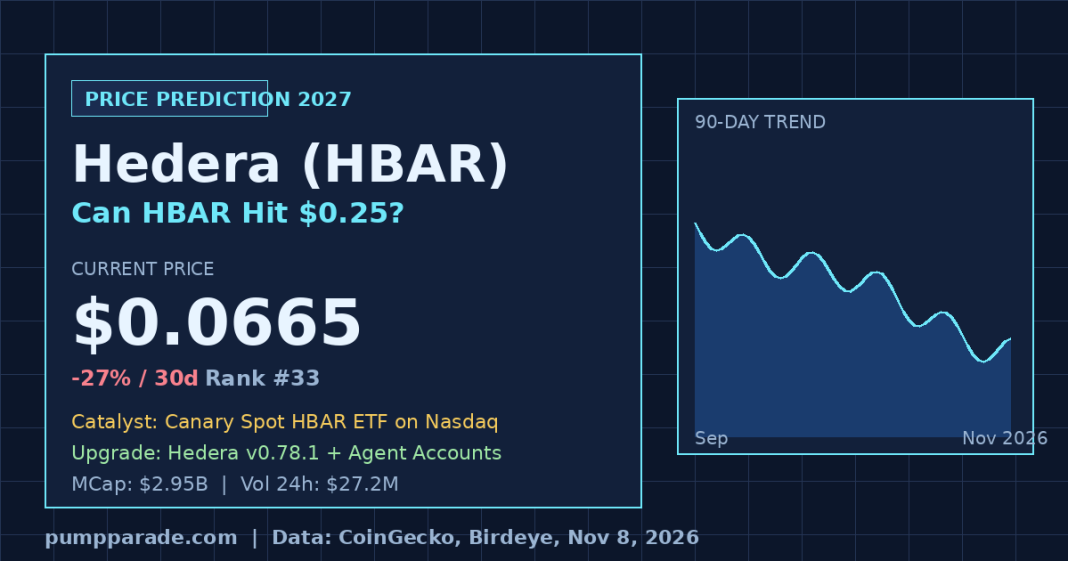
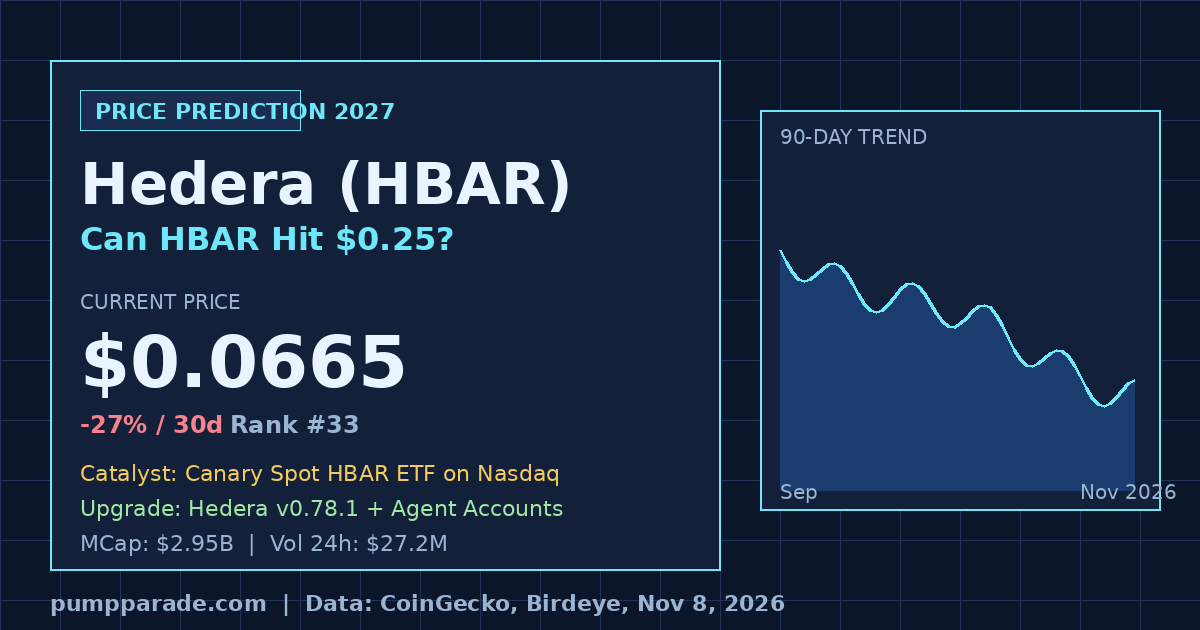
Hedera (HBAR) trades at $0.0665 as of November 8, 2026, down 27% over the past 30 days and roughly 88% below its all-time high of $0.569 set back in September 2021. For a network that now counts Google, IBM, Dell, Boeing, and LG among the council members running its nodes, that gap between enterprise traction and token price has become the whole story.
The Hedera price prediction 2027 debate is no longer just about Hashgraph technology. It is about whether the Canary spot HBAR ETF listed on Nasdaq, the October mainnet upgrade to v0.78.1, and the new Agent Accounts feature can finally translate on-chain adoption into price. Below we lay out the data, the bull case, the bear case, specific targets by timeframe, and the honest take on where HBAR goes next.
Key Takeaways
- Current state: HBAR sits near $0.0665, pressed against the macro support zone at $0.062. A break below opens $0.047.
- Bull catalyst: The Canary HBAR ETF trades live on Nasdaq, Hedera v0.78.1 shipped October 22, and Agent Accounts is now on mainnet.
- Bear catalyst: Supply inflation is real. Only 44.3B of the 50B max supply circulates, and treasury unlocks continue to drip into the market.
- 2027 base case: $0.17, roughly a 2.5x from current levels, driven by ETF inflows and RWA pipeline deployments.
- 2027 bull case: $0.30, which would still leave HBAR 47% below its 2021 ATH.
- The honest take: HBAR has the fundamentals and now the ETF rails. It still needs a credible revenue story before the market will pay for the utility narrative.
Where Hedera Stands Today
The market data paints a bruised but not broken picture. HBAR has given back most of its 2025 rally and is now trading in the same zone where major institutional accumulation showed up in the first half of 2026.
| Metric | Value |
|---|---|
| Price (Nov 8, 2026) | $0.0665 |
| 24h change | -1.8% |
| 7-day change | -7.3% |
| 30-day change | -26.9% |
| Market cap | $2.95B |
| 24h volume | $27.2M |
| Market cap rank | #33 |
| All-time high | $0.569 (Sep 2021) |
| % from ATH | -88.3% |
| Circulating supply | 44.33B HBAR |
| Max supply | 50B HBAR |
Two things stand out. First, 24-hour volume of $27.2M against a $2.95B market cap is thin. That ratio (under 1%) is low for a top-50 asset and tells you professional traders are not fighting over HBAR right now. Second, the Relative Strength Index on the daily chart sits near the bottom of its range, which is the kind of reading that preceded the previous two reversals in this asset over the last 18 months.
Why Is HBAR Trading Below $0.07 Right Now?
Three forces are pinning HBAR to the lower band. The broader altcoin market is in a liquidity drought (BTC is itself down 8% on the month, dragging smaller caps harder). Hedera treasury unlocks continue to add roughly 300 million HBAR per month to circulation at current schedules, which is real sell pressure even if the council is methodical about it. And the HBAR ETF, while a structural win, has pulled in modest flows so far, not the LTC or BTC style wave the token needed to break out.
Analysts at Brave New Coin flagged the $0.062 zone as the make-or-break support test on the higher timeframe. A clean loss opens the macro trendline near $0.047, roughly 28% lower. A reclaim of $0.075, then $0.080, would put the structure back in play.
What is the Bull Case for HBAR in 2027?
The Canary Spot HBAR ETF is now live on Nasdaq
Canary Capital, led by former Valkyrie co-founder Steven McClurg, launched the first spot HBAR ETF on Nasdaq in October 2025. HBAR is one of only four cryptocurrencies (alongside Bitcoin, Ethereum, and Litecoin via Canary’s parallel product) to hold a US spot ETF wrapper. That matters for three reasons: RIA and advisor channels can finally allocate, prime brokers can lend against the shares, and new catalyst narratives now have an obvious vehicle to express them.
Inflows have been slower than Bitcoin or Ethereum, but the fund is accumulating. If institutional flows pick up in 2027 as Hedera’s enterprise pipeline matures, the ETF becomes a mechanical bid. A similar dynamic is playing out for Injective (INJ), whose ETF filings have put a floor under sentiment even before product launch.
Agent Accounts and Network MCP reposition Hedera for the AI era
The October 22 mainnet upgrade to v0.78.1 shipped Agent Accounts, a wallet primitive that lets users (and increasingly, AI agents) define spending limits and audit trails per transaction. Hedera is also running Network MCP on testnet, their implementation of the Model Context Protocol that connects LLM agents to on-chain actions. Translation: Hedera is positioning itself as the chain where AI agents can transact with enterprise-grade controls. If even 10% of the “agentic payments” narrative lands on Hedera rather than Solana or an Ethereum L2, HBAR demand changes shape.
Enterprise adoption keeps compounding in the background
The Hashgraph Association added Bron, a self-custody platform, to its ecosystem in late October. Hedera also joined the UK’s wholesale digital markets initiative. The Hedera Council (Google, IBM, Dell, Boeing, Deutsche Telekom, Standard Bank, LG Electronics, Nomura, Chainlink Labs, and others) continues to push real-world asset tokenization pilots through the network. Cofounder Leemon Baird’s aBFT hashgraph consensus delivers roughly 10,000 TPS with 3 to 5 second finality, which is the kind of profile that enterprise treasurers actually underwrite.
Is Hedera Dead? The Bear Case for HBAR
Supply inflation is a permanent headwind until 2030
Only 44.33B of the 50B max supply currently circulates, meaning 5.67B HBAR (roughly 12.8% of max) is still to come online. Hedera’s treasury unlock schedule drips tokens into ecosystem grants, council rewards, and market-making every month. Historically, every rally into resistance has been met with treasury-related distribution. Until the market absorbs the remaining supply or the Council announces a structural burn, this acts as a soft ceiling.
Low on-chain fee revenue weakens the value accrual thesis
Here’s the uncomfortable number: Hedera’s fee revenue is a fraction of chains with far smaller market caps. Even with billions in enterprise pilots, very few of them pay meaningful HBAR-denominated fees on-chain. If you believe token value should reflect economic activity routed through the asset, HBAR is expensive. If you believe it should reflect the strategic optionality of a chain with Fortune 500 governance, it is cheap. The bear camp has the data on their side today.
Narrative competition from Solana, Sui, and the AI L1 category
The agentic-chain narrative is a crowded room. Solana ships AI-focused tooling at pace, Sui’s object model is well-suited to agent workflows, and specialized L1s like Bittensor and Fetch have already captured the imagination of the AI-crypto crowd. Hedera’s enterprise messaging is accurate but often gets drowned out. For HBAR to break out, the market has to care about enterprise-grade hashgraph consensus more than it cares about the next AI agent meme.
Hedera Price Prediction 2027: Targets by Timeframe
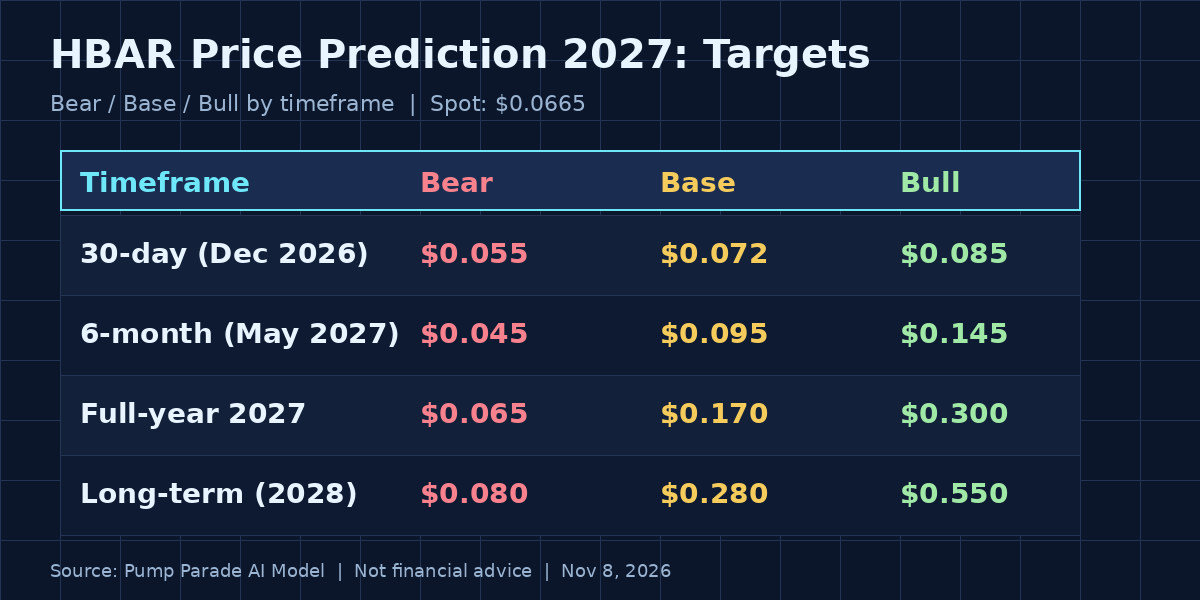
Our hybrid model combines on-chain supply dynamics, ETF flow assumptions, technical structure, and comparable enterprise-L1 valuations. Here is the breakdown.
| Timeframe | Bear | Base | Bull |
|---|---|---|---|
| 30-day (Dec 2026) | $0.055 | $0.072 | $0.085 |
| 6-month (May 2027) | $0.045 | $0.095 | $0.145 |
| Full-year 2027 | $0.065 | $0.170 | $0.300 |
| Long-term (2028) | $0.080 | $0.280 | $0.550 |
Short term (next 30 days)
Expect chop. The $0.062 support zone has held three times in the past six weeks. If HBAR reclaims $0.072, the next liquidity pocket sits around $0.085. A loss of $0.062 on volume opens the move to $0.047 quickly. The 30-day base case assumes range-bound behavior.
Six months (mid-2027)
By May 2027 the market will have digested the next few Hedera Council meetings and the ETF flow picture will be clearer. Our base case of $0.095 requires sustained weekly ETF inflows above $10M and at least one named Fortune 500 real-world asset deployment on Hedera. The bull case of $0.145 assumes a broader altcoin rotation plus two or more enterprise RWA tokenizations.
Full-year 2027 and long-term
Our 2027 base case is $0.17, implying a 2.5x from current levels. For reference, Standard Chartered has historically modeled Hedera upside at the $0.20 to $0.25 range by late 2027, and KuCoin’s published range runs from $0.12 (bear) to $0.45 (bull). Our bull case of $0.30 would still leave HBAR 47% below its 2021 peak. The $0.55 long-term bull sits right at the previous ATH, which is where structural resistance lives on every timeframe.
How Does Hedera Compare to XRP and Stellar?
HBAR’s closest comparables are the other enterprise-oriented payments and settlement chains: XRP and Stellar. Here is how they stack up today.
| Metric | Hedera (HBAR) | XRP | Stellar (XLM) |
|---|---|---|---|
| Price | $0.0665 | $1.16 | $0.15 |
| Market cap | $2.95B | $73.6B | $5.31B |
| Consensus | aBFT Hashgraph | Federated Byzantine | Federated Byzantine |
| Throughput | ~10,000 TPS | ~1,500 TPS | ~1,000 TPS |
| Finality | 3-5 sec | 3-5 sec | 3-5 sec |
| Governance | Council (40 orgs) | Ripple + validators | Stellar Foundation |
| Spot US ETF | Yes (Canary) | Yes (multiple) | Filings pending |
| % from ATH | -88% | -66% | -80% |
The read: HBAR has the best technology profile of the three on paper and the rarest enterprise governance setup, but it trades at a fraction of XRP’s market cap and roughly half of Stellar’s. For more on the payments-chain thesis, see our deep dives on XRP’s 2027 setup and Stellar’s road to $0.50.
What Would Change Our Hedera Price Forecast?
Three scenario triggers would force us to re-anchor these targets:
- Weekly ETF inflows above $25M sustained for a month. That would signal RIA adoption has turned mechanical, not speculative, and would support the bull case.
- A loss of $0.047 on daily closes. That would invalidate the multi-year accumulation structure and push our bear case toward $0.03.
- A named Fortune 100 real-world asset tokenization settling more than $500M in volume on Hedera. That would re-rate HBAR from “optionality” to “cashflow asset” and trigger an upward revision of the 2027 base case.
Frequently Asked Questions
Will HBAR reach $1 by 2027?
Reaching $1 by 2027 would require a 15x rally from current levels, which puts HBAR’s market cap near $44B at the current circulating supply. That is not our base case. Our bull case targets $0.30 by year-end 2027, and $1 would most likely slip into the 2028 to 2030 window if ETF flows and enterprise adoption both accelerate.
Is Hedera a good investment in 2027?
Hedera offers the rare combination of real enterprise governance, an approved US spot ETF, and a technology stack that enterprises actually pilot. The downside is slow on-chain revenue and ongoing supply inflation. It is a credible long-term accumulation candidate for investors comfortable with 12 to 24 month horizons, less so for short-term traders chasing momentum.
What is the HBAR price prediction for 2027?
Our base case is $0.17, bull case $0.30, bear case $0.065. Standard Chartered’s historical modeling and KuCoin’s published range both cluster between $0.12 and $0.45, placing our base near the midpoint of mainstream analyst estimates.
Why is HBAR dropping in November 2026?
Three factors: broader altcoin market weakness (BTC down 8% on the month), continued treasury-related supply from Hedera’s unlock schedule, and ETF inflows that are positive but still modest. None of these are Hedera-specific red flags. They are macro and mechanical.
Can the HBAR ETF push the price higher?
Yes, but only if flows ramp. Spot ETF demand creates a mechanical bid: for every dollar of inflow, the custodian must acquire HBAR on the market. Bitcoin’s 2024 ETF launch showed the model works when inflows sustain. HBAR needs weekly inflows above $10M to measurably move price given current liquidity.
How does HBAR compare to XRP?
XRP is 25x the market cap and has deeper exchange liquidity. HBAR has faster finality, higher throughput, and a broader enterprise governance council. If you believe enterprise consensus matters, HBAR is undervalued relative to XRP. If you believe exchange and remittance partnerships matter more, XRP is the safer bet.
The Honest Take
Hedera has quietly built the kind of foundation most crypto projects pretend to have. The Council is real. The ETF is real. The technology is real. What is missing is the market’s willingness to pay for enterprise optionality in a cycle that keeps rewarding memecoins and AI narratives.
That gap is the opportunity and the risk. HBAR at $0.0665 is priced like the market expects nothing to come of the ETF or the Agent Accounts launch. Any meaningful uptick in either (weekly inflows, a named RWA deployment, a Council-sponsored burn proposal) and the asset re-rates fast, because sentiment is already that low. The flip side: if the market is right and enterprise crypto never becomes a reflexive bid, HBAR grinds sideways with the rest of the sector.
For traders, the setup is simple. Watch $0.062. It holds, you have a defined risk long to $0.10 and then $0.15. It fails, step aside and let the macro trendline near $0.047 do its work. For longer-term accumulators, sub-$0.07 HBAR is historically the zone where disciplined sizing has outperformed. We would want to see the fundamentals keep compounding before adding beyond 2% of a portfolio, though. If you are tracking on-chain flows, Birdeye’s analytics suite is a useful companion for watching ETF-related wallet activity.
External references worth bookmarking: CoinGecko’s Hedera page for live market data and Hedera’s official roadmap for the Council’s publicly disclosed milestones.
Disclaimer: This article is for informational and educational purposes only and should not be construed as financial, investment, or trading advice. Cryptocurrency markets are highly volatile, and past performance does not guarantee future results. The price predictions and analyses presented here are based on AI models, technical indicators, and available data at the time of writing, they are not guarantees. Always conduct your own research (DYOR) and consult with a qualified financial advisor before making any investment decisions. Pump Parade and its authors do not assume liability for financial losses incurred based on information provided in this article.