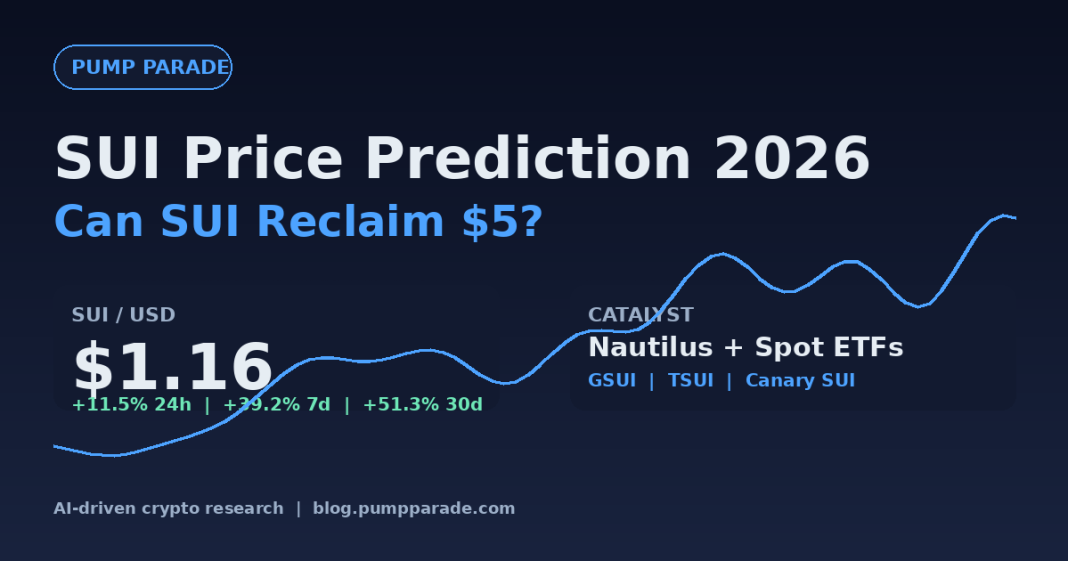
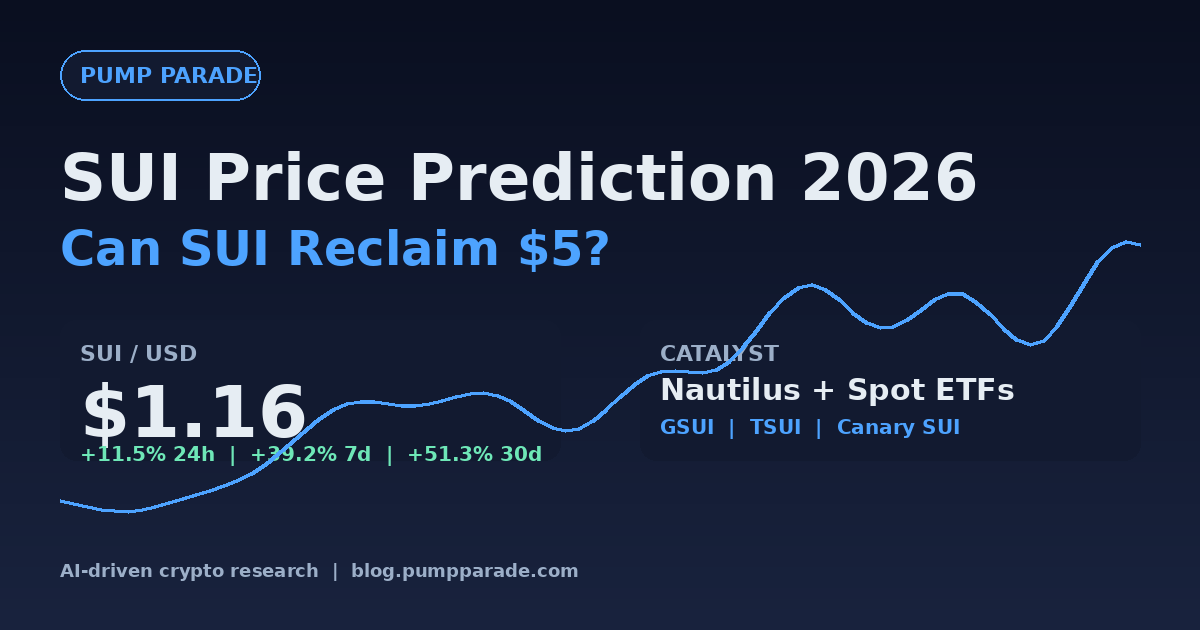
Sui (SUI) trades at $1.16 at time of writing, up 11% in the last 24 hours, 39% over the past week, and 51% over the past 30 days. That is one of the sharpest reversals in the Layer 1 market this quarter, and it is happening after two catalysts that changed the SUI narrative: the launch of confidential transfers on mainnet, and the first US-listed spot SUI ETFs from Grayscale, Canary Capital, and 21shares. The Sui price prediction 2026 conversation looks very different from where it stood in July.
Sui still trades 78% below its January 2025 all-time high of $5.35. That gap is what makes the setup interesting. Real technology is shipping, real institutional plumbing is being built, and a token unlock schedule keeps supply pressure honest. Below we walk through where SUI stands, why it is moving, and what the bull, bear, and base cases look like for the next 12 months.
Key Takeaways
- SUI trades at $1.16 with a $4.77B market cap, up 51% in 30 days on the back of Nautilus privacy tech and spot ETF listings.
- Grayscale’s GSUI staking ETF and Canary Capital’s spot SUI ETF are the first two regulated wrappers in the US, both live on NYSE Arca.
- Sui TVL hit a record $2.6B in late 2025 and DEX volume on Bluefin and Cetus continues to compound.
- Base case for 2026: $2.20. Bull case: $5.00 (a full ATH reclaim). Bear case: $0.75 if unlocks outpace demand.
- Token unlocks through 2030 remain the largest structural headwind and are the swing factor for every scenario.
Where does SUI stand today?
Before the forecasting, the current-state receipts. All numbers below are from CoinGecko at time of writing.
| Metric | Value |
|---|---|
| Price | $1.16 |
| 24h change | +11.5% |
| 7d change | +39.2% |
| 30d change | +51.3% |
| Market cap | $4.77B |
| 24h volume | $1.61B |
| Rank | 27 |
| Circulating / Max supply | 4.10B / 10.00B |
| All-time high | $5.35 (Jan 4, 2025) |
| % from ATH | -78.2% |
A few things stand out. Volume of $1.6B on a $4.8B cap is a 34% daily turnover, real participation, not a thin-book squeeze. The token is still deep in drawdown, which leaves headroom for mean reversion. And only 41% of the total supply is circulating. The rest hits the market on a scheduled cadence through 2030, and that is the single most important number for anyone modeling SUI.
Why is SUI rallying right now?
Three things are working at the same time, which is rare in altcoin markets.
The first is the Nautilus release. Mysten Labs, the primary developer of the Sui network, shipped confidential transfers to mainnet in Q3 2026. In plain terms, users can now move value on-chain without revealing amounts to the public block explorer, while validators can still verify the transaction is valid. The pitch is “free, private payments at scale,” and it puts Sui in a very short list of L1s offering native privacy on the base layer rather than through a rollup or mixer. The market treated the news as a legitimate product event, not a marketing beat, and SUI rallied roughly 40% in the two weeks after the announcement.
The second is the ETF wave. In February 2026, 21shares listed the first spot SUI ETF on Nasdaq under the ticker TSUI. Grayscale followed with a staking ETF, GSUI, on NYSE Arca that passes a portion of on-chain staking yield to holders. Canary Capital rounded out the group. This is the first altcoin outside of Bitcoin, Ethereum, and Solana to receive multiple US-listed spot products, and the staking wrapper in particular is a template other Layer 1 tokens will try to replicate.
The third is DeFi traction. Sui TVL hit a record $2.6B in late 2025 and has held above $2B since, with Bluefin and Cetus splitting most DEX volume. That gives the network real fee revenue, which any long-term price thesis eventually leans on. The pattern is similar to what Solana did during its 2023-2024 recovery, when on-chain volume growth led price.
The Bull Case for SUI
Institutional access is now real, not hypothetical
Every previous SUI price prediction had a placeholder for “institutional adoption.” That line item is no longer speculative. GSUI, TSUI, and Canary’s SUI ETF exist, they trade, and they can be held by registered investment advisers who could never touch a self-custody wallet. The staking wrapper is the most interesting piece. It routes network yield (currently in the 2 to 3% annualized range) into the ETF, which means TradFi allocators get exposure to both price and productive yield in a single ticker. If GSUI follows even a fraction of the inflow trajectory of the Solana ETFs after their US launch, it becomes a persistent bid.
Privacy tech opens a genuinely new market
Confidential transfers matter because the market for on-chain payments that do not leak business data to competitors is large and almost entirely unserved. Payroll, B2B invoicing, gaming assets, and any stablecoin flow between corporate treasuries all fit here. Sui’s implementation preserves programmability, so DeFi protocols can compose against private balances rather than being locked out. If even one high-volume stablecoin issuer settles a real payments corridor on Sui in 2026, the narrative rerates fast.
Move VM and the parallel execution advantage
The Move programming language and Sui’s object-centric data model let the network process independent transactions in parallel. In practice, that means Sui can execute a swap on Bluefin and a mint on a gaming app in the same slot without one blocking the other, at sub-second finality. That is a real engineering edge, and it is the same architectural bet that Solana made with Sealevel and that many other L1s including NEAR are still trying to catch. As consumer apps get built (SuiPlay handheld, wallet-native games), throughput demand is the metric to watch.
The Bear Case for SUI
Unlocks, unlocks, unlocks
The single biggest risk is mechanical. Only 4.1 billion of the 10 billion max supply is circulating. The rest is scheduled to hit the market through 2030 across allocations to early contributors, the Sui Foundation, community programs, and investors. Every month, new SUI enters the float. If demand from the ETF wrappers, retail speculation, and DeFi usage does not outpace those unlocks, the price rerates lower even if fundamentals hold. This is not a hypothetical: the January 2025 ATH gave way to a 78% drawdown in large part because unlocks kept feeding supply while narrative demand cooled.
Layer 1 competition is not standing still
Sui competes for developer mindshare and liquidity with Solana, Aptos, Base, and a lengthening list of high-throughput chains. Solana in particular has a five-year head start on ecosystem, a much deeper memecoin economy, and its own upcoming Alpenglow upgrade targeting sub-150ms finality. If Solana consolidates the “fast L1” trade, Sui becomes a rounding error in that thesis. The Move-based sibling Aptos also draws from the same technical talent pool, and its own ETF filings are working through the pipeline.
ETF flows can go the other way
The staking ETF is a two-way street. If SUI grinds lower and holders start rotating out of GSUI, redemptions force the fund to sell spot into a falling market. Bitcoin ETFs had a similar dynamic during their late-2024 pullback, and Solana ETFs saw net outflows for several weeks after their launch honeymoon. There is no reason to assume SUI ETFs get a permanent bid; the first six months of flow data will tell the real story.
Sui (SUI) Price Prediction 2026: Targets by Timeframe
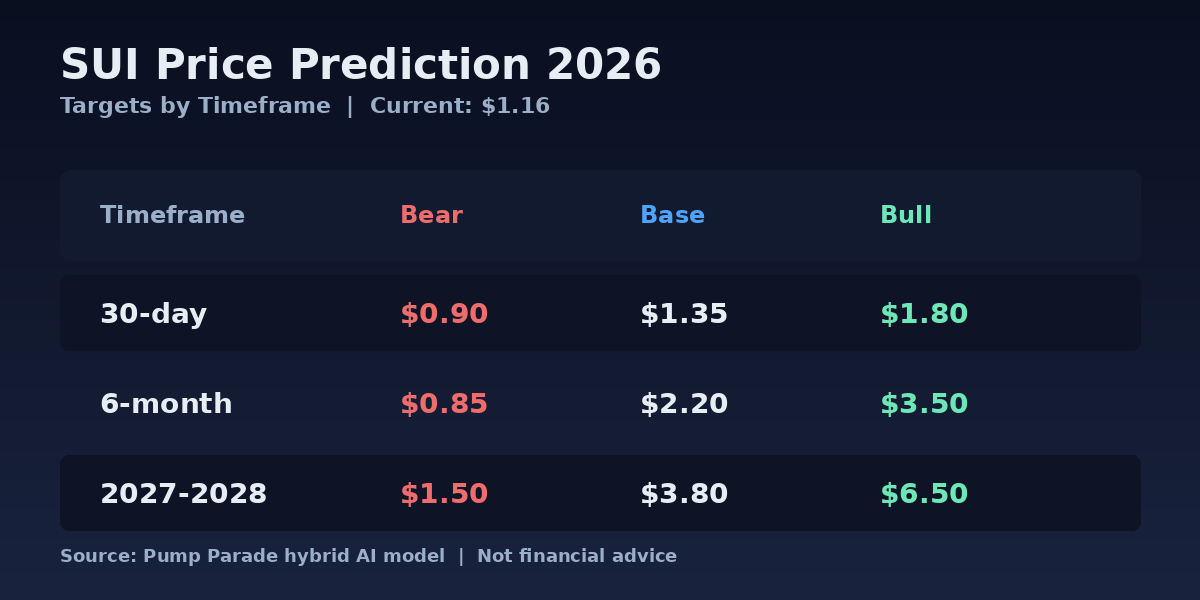
Our targets below combine on-chain data, unlock schedule modeling, and current ETF flow trajectory. Ranges are wider than a typical equity forecast because crypto volatility justifies it. All numbers are conditional, and the conditions matter more than the numbers themselves.
| Timeframe | Bear | Base | Bull |
|---|---|---|---|
| 30-day | $0.90 | $1.35 | $1.80 |
| 6-month | $0.85 | $2.20 | $3.50 |
| Long-term (2027 to 2028) | $1.50 | $3.80 | $6.50 |
Short-term (next 30 days)
Sui just broke above the $1.05 to $1.10 resistance zone that capped the July and August rallies. That level now flips to support. If it holds, a run at $1.35 to $1.50 is the base path, matching the November 2025 swing high. A failure back below $1.05 opens a mean-reversion move toward $0.90. The bull scenario at $1.80 assumes another ETF flow week north of $50M net inflows plus continued Nautilus momentum.
Six-month outlook
The March 2027 target of $2.20 in the base case assumes ETF flows compound modestly, Sui TVL crosses $3.5B, and no major unlock cliff surprises the market. The bull case at $3.50 requires a broader risk-on backdrop in crypto plus a marquee corporate payments announcement on Nautilus. The bear case at $0.85 is what unlocks-outpacing-demand looks like, roughly a 25% drawdown from current price.
Long-term (2027 to 2028)
For comparison, Changelly’s model puts 2028 SUI in a $0.91 to $1.78 band, which we consider too bearish given the ETF and privacy catalysts. Coincub’s base case reaches $6.50 by 2027, which we consider aggressive because it assumes near-perfect unlock absorption. Our $3.80 base for 2027 to 2028 sits between the two: it prices in continued ETF inflows and DeFi share gains, but it also respects the diluted supply that will be circulating by then. A full ATH reclaim to $5.35 or above is possible in a bull scenario; a $6.50 print requires Sui to become a top-15 crypto by market cap, which is not our base case.
How does SUI compare to Solana?
Sui’s closest competitor is Solana. Both target sub-second finality, both prioritize parallel execution, both are pushing consumer-app narratives, and both now have US spot ETFs. The differences matter for anyone deciding where to put capital.
| Metric | Sui (SUI) | Solana (SOL) |
|---|---|---|
| Price | $1.16 | $120 |
| Market cap | $4.77B | $70.5B |
| Virtual machine | Move (Sui variant) | Sealevel (SVM) |
| Finality | ~450ms | ~400ms (Alpenglow target: 150ms) |
| TVL | $2.1B | $11.4B |
| US spot ETFs live | 3 (TSUI, GSUI, Canary) | Multiple |
| Native privacy | Yes (Nautilus) | No |
| Circulating supply share | 41% | ~85% |
Solana is 15 times larger and has a proven ecosystem. Sui is smaller, earlier, and carries more supply overhang. On a catch-up trade, SUI has more upside beta if the parallel-L1 narrative works. On an “own the winner” trade, Solana is safer. Portfolios that hold both are treating them as different bets on the same thesis.
What would change our view?
Three specific triggers would move us out of the current base case.
First, if net ETF flows into GSUI, TSUI, and the Canary product cross $250M in a single month, the base case moves up to $3.00 for the six-month target. That would signal SUI has entered the “TradFi is buying” phase of its cycle.
Second, if a scheduled unlock lands on the market and price fails to hold $1.00 within 30 days of the release, our bear case becomes the base case. We would then model $0.85 as the anchor rather than $2.20.
Third, if a top-five stablecoin issuer announces settlement on Sui via Nautilus, we upgrade the long-term target to $7.50 in the bull case and $5.00 in the base case. That single event would validate the privacy thesis in a way no roadmap post can.
Frequently Asked Questions
Will SUI reach $5 by 2026?
Our base case for 2026 is $2.20, so a $5 print by year-end would require our bull case to play out in full: sustained ETF inflows, a marquee Nautilus enterprise deployment, and a broader crypto risk-on backdrop. It is possible but not our central expectation. A $5 target is more realistic on a 2027 to 2028 timeframe, coinciding with the next cyclical peak.
Is SUI a good investment in 2026?
SUI is a high-volatility Layer 1 with real technology, real institutional wrappers, and real supply overhang. It fits a growth-tilted crypto portfolio for investors who can size the position small, tolerate 40% drawdowns, and hold through unlock cycles. It does not fit a portfolio that needs stable exposure or short-term liquidity.
What is the SUI price prediction for 2026?
Our base case has SUI trading between $1.35 and $2.20 through 2026, with a bull scenario as high as $3.50 and a bear scenario as low as $0.75. The single largest swing factor is how well ETF inflows and DeFi demand absorb the ongoing token unlocks.
How does the Grayscale SUI ETF work?
GSUI holds spot SUI and stakes a portion of it via network validators. Staking rewards, net of fees, accrue to the fund’s net asset value, giving holders exposure to both price and yield in one ticker. GSUI trades on NYSE Arca and is available through most US brokerage accounts.
Will SUI reach $10?
A $10 SUI implies a fully diluted valuation of roughly $100B at current supply schedules, which would put SUI in the top five of all crypto assets. That is possible in a full 2027 to 2028 bull cycle if Sui captures material share of consumer on-chain apps and stablecoin settlement, but it is a low-probability outcome in any 2026 timeframe.
What is Nautilus?
Nautilus is Mysten Labs’ name for Sui’s native privacy stack, including confidential transfers that hide transaction amounts while remaining verifiable by validators. It launched on mainnet in 2026 and is positioned as free, private payments at scale, with programmability preserved so DeFi apps can compose against private balances.
The Honest Take
SUI is one of the more interesting Layer 1 setups going into 2026. The Nautilus release is the kind of shipped-product event that separates a network from its slide-deck competitors. The ETF stack is real and gives TradFi a clean way to buy the story. The DeFi footprint is compounding rather than shrinking. Those are all things that were absent or aspirational a year ago.
The counterweight is supply. Sui’s token schedule is the biggest reason competent analysts keep base cases below $3. Every month the unlocks arrive, and every month the ecosystem has to prove it can absorb them. So far the answer has been yes. Going forward it depends on whether ETF flows persist and whether Nautilus drives real fee revenue.
Our base case for 2026 is a $2.20 anchor with a realistic path to $3.50 and a defensible floor at $0.85. That is a range, not a promise. The next six months of ETF flow data and the pace of Nautilus adoption will decide which end of the range gets tested first. For anyone comparing across L1s, the AVAX and SOL setups are also worth reviewing before sizing SUI: our full AVAX outlook covers the closest ETF-driven analog.
Disclaimer: This article is for informational and educational purposes only and should not be construed as financial, investment, or trading advice. Cryptocurrency markets are highly volatile, and past performance does not guarantee future results. The price predictions and analyses presented here are based on AI models, technical indicators, and available data at the time of writing. They are not guarantees. Always conduct your own research (DYOR) and consult with a qualified financial advisor before making any investment decisions. Pump Parade and its authors do not assume liability for financial losses incurred based on information provided in this article.