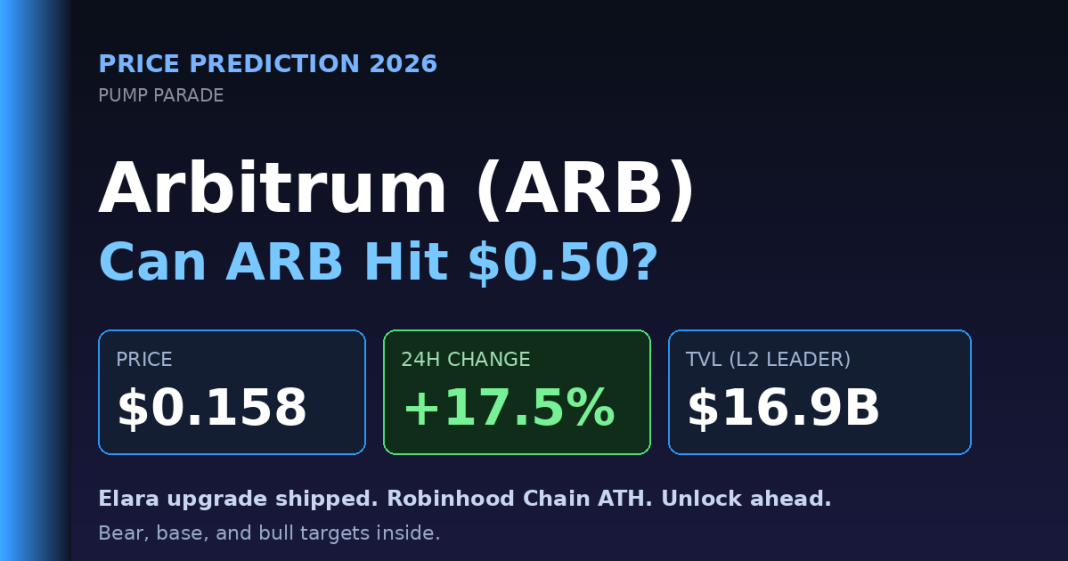
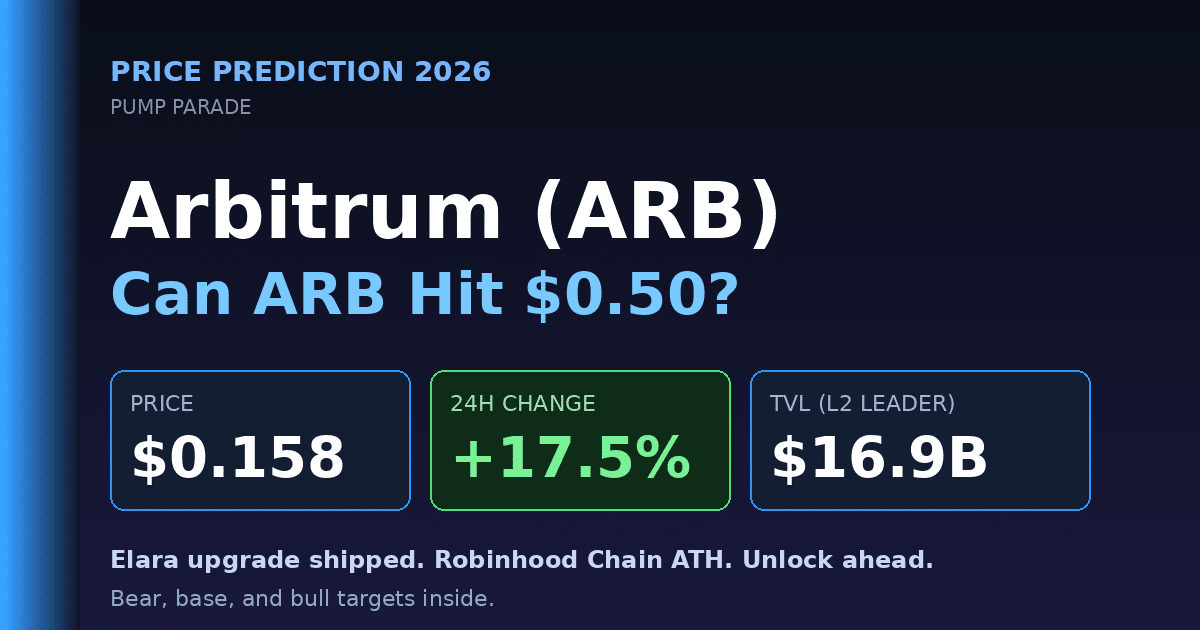
Arbitrum (ARB) trades at $0.158, up 17.5% in the past 24 hours, snapping months of grinding decline. The ARB price prediction 2026 conversation has flipped overnight from “is the L2 dead?” to “how much of this rally is real?” Unique daily wallets jumped 36% in 24 hours. Robinhood Chain, built on Arbitrum’s Orbit stack, just set an all-time high for L2 DEX volume at $874.8 million on August 30. And the ArbOS 61 “Elara” upgrade shipped on August 20, boosting Stylus smart-contract capacity in a way that finally gives Rust developers a real reason to deploy here.
The token still sits roughly 93% below its January 2024 all-time high of $2.40. So the setup is the classic Layer 2 debate: leading TVL, huge institutional pipeline, but relentless token unlocks and a market that has punished governance tokens without fee capture. This piece walks through where ARB stands today, the bull case, the bear case, price targets by timeframe, how Arbitrum compares to Optimism, and what would change our view. No moon math. Just the data.
Key Takeaways
- ARB trades at $0.158 with a market cap near $1.06 billion on a circulating supply of 6.68 billion tokens.
- Arbitrum leads all Ethereum L2s in TVL with roughly $16.9 billion, about a 44% market share.
- The ArbOS 61 “Elara” upgrade (August 20, 2026) expanded Stylus capacity and added protocol-level compliance filtering.
- Robinhood Chain, running on Arbitrum Orbit, hit a record $874.8M in daily DEX volume and shares 10% of chain revenue back to Arbitrum.
- A 139 million ARB unlock on September 23, 2026 (about 1.4% of supply) is the near-term overhang.
- Analyst 2026 targets cluster in a wide $0.06 to $1.20 band; our base case lands at $0.32 with a bull case at $0.55.
Where Arbitrum Stands Today
Before the forecast, the state of play. Arbitrum One is the largest optimistic rollup on Ethereum by TVL, the highest-throughput L2 for DeFi settlement, and now the settlement layer of choice for tokenized real-world assets from Franklin Templeton and others. The ARB token itself governs the Arbitrum DAO and its treasury, though it does not yet capture sequencer fees, a point that remains central to every bear thesis.
| Metric | Value |
|---|---|
| Current Price | $0.158 |
| 24h Change | +17.5% |
| Circulating Market Cap | ~$1.06B |
| Fully Diluted Value | ~$1.58B |
| 24h Volume | ~$63.7M |
| Circulating Supply | 6.68B ARB |
| Total Supply | 10.00B ARB |
| All-Time High | $2.40 (Jan 2024) |
| % From ATH | -93.4% |
| Total Holders | 2.38 million |
| TVL on Arbitrum One | ~$16.9B (44% of L2 share) |
Note the disconnect. The chain itself is thriving. The token is not. This gap is the entire ARB investment thesis in one sentence.
Why is Arbitrum Rallying Right Now?
Three signals broke at once. First, on-chain activity confirmed itself: 24-hour unique wallets on Arbitrum One climbed 36% versus the previous day, and buy volume outpaced sells in the last four hours by more than two to one on major venues. This is not a wick from thin liquidity. Real wallets are transacting.
Second, the Robinhood Chain flywheel keeps compounding. Robinhood Chain is an Arbitrum Orbit L3 that Robinhood launched to route its retail order flow on-chain. On August 30 it hit $874.8M in daily DEX volume and briefly out-earned Ethereum on 24-hour application revenue. Ten percent of Robinhood Chain fees flow back to the Arbitrum DAO. Every trader who onboards to Robinhood’s crypto product now generates a tiny recurring stream of ARB-denominated revenue.
Third, positioning was cleaned out. ARB spent Q2 and most of Q3 grinding sideways-to-down as long-only funds capitulated. When a chain leads on fundamentals but the token trades near cycle lows, mean reversion tends to be violent. That is what showed up on the tape today.
What’s Driving the Bull Case for Arbitrum in 2026?
1. The Robinhood Chain and Orbit revenue share
This is the biggest structural change in the ARB thesis in 18 months. Arbitrum Orbit lets brands and applications spin up their own L3 chains that settle back to Arbitrum One. Each Orbit chain pays a fee share to the Arbitrum DAO. Robinhood Chain is the flagship case, but Franklin Templeton, several gaming chains, and multiple RWA platforms are already live or in test. If Orbit becomes the “AWS of app-chains,” the ARB token starts capturing real cash flows instead of just governance rights.
2. Stylus and the developer wedge
Stylus lets developers write smart contracts in Rust, C, or C++, running alongside Solidity contracts in a shared execution environment. ArbOS 61 “Elara” (activated August 20, 2026) dramatically increased Stylus contract capacity. This matters because it opens Arbitrum to the entire Rust ecosystem, the same talent pool that ships production-grade code for Solana and Sui. If even a modest fraction of that developer base picks Arbitrum for their EVM-native app, deployment velocity accelerates.
3. Real-world asset settlement
Arbitrum One is quietly becoming the go-to venue for institutional tokenized funds. Franklin Templeton runs its FOBXX benchmark on Arbitrum. Robinhood is tokenizing US equities on Arbitrum tech. The RWA subsector on Arbitrum reportedly exceeds $874 million and is growing faster than the overall L2 category. Institutions pick chains for compliance tooling and predictability, and Elara’s protocol-level compliance filtering was designed precisely for them.
What Are the Biggest Risks to the ARB Price in 2026?
1. The unlock overhang
Roughly 139.15 million ARB unlocks on September 23, 2026 (about 1.4% of total supply). Of that, 53.8% flows to team and insiders, 35% to private investors. Unlocks happen monthly through 2027. Structural sell pressure is a fact, not a fear. Any rally into the unlock window historically prints local tops.
2. No fee capture yet
ARB holders vote on Arbitrum DAO decisions but do not receive sequencer revenue. Ethereum’s L2 sequencer economics remain one of the most contested topics in crypto governance. Until the DAO passes a credible fee-switch or buyback, ARB is priced on hope rather than earnings. Uniswap’s UNI trades on a similar overhang. Both tokens languish for the same reason.
3. L2 fragmentation and Base pressure
Base, Coinbase’s OP Stack rollup, keeps stealing consumer app share. Optimism’s Superchain thesis gives smaller chains a shared sequencer and interop. If a Base or a Superchain chain becomes the default consumer L2, Arbitrum’s DeFi dominance may not be enough to lift the token. See our Optimism (OP) price prediction 2026 for the parallel view.
Arbitrum Price Prediction 2026: Targets by Timeframe
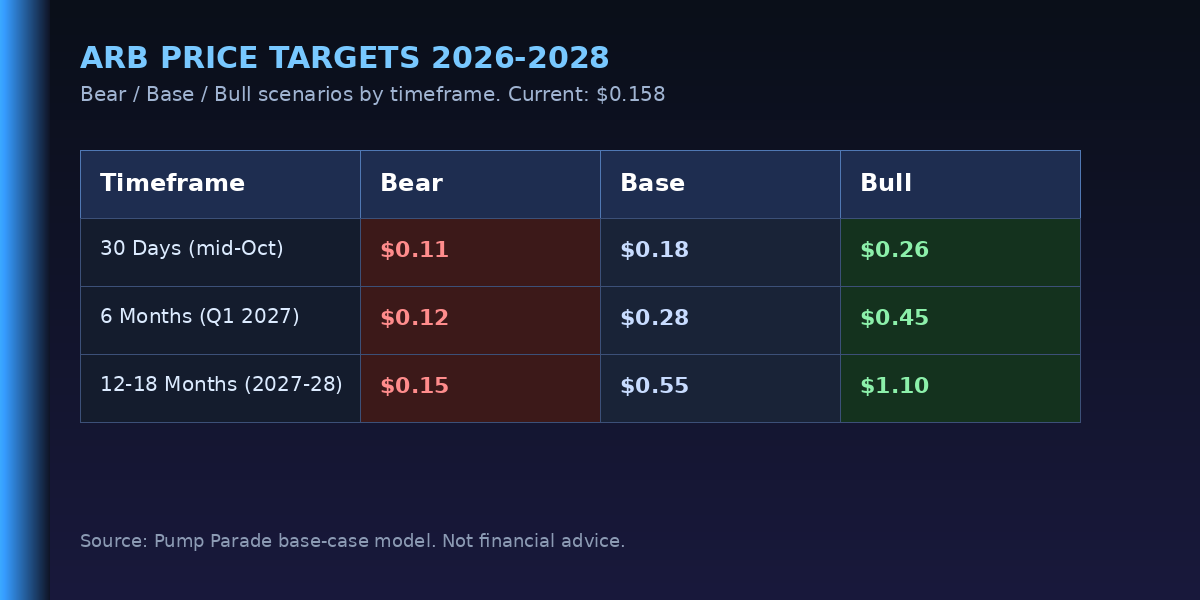
The next 12 months split cleanly into three windows: the immediate reaction to today’s rally, the mid-cycle window through Q1 2027, and the longer 12- to 18-month view where the RWA thesis has to prove itself or die.
30-Day Outlook (through mid-October 2026)
The September 23 unlock is the near-term choke point. In our base case, ARB consolidates between $0.14 and $0.22 as the market absorbs new supply against the fresh momentum. A close above $0.22 on daily volume above $150M would open $0.28 quickly. A break of $0.135 invalidates the rally structure and puts $0.10 back on the table.
- Bear: $0.11
- Base: $0.18
- Bull: $0.26
6-Month Outlook (through Q1 2027)
By Q1 2027, three data points should be visible: the run rate of Robinhood Chain fee share flowing to the DAO, whether Stylus adoption has produced any breakout Rust-native application, and whether the DAO has moved on any form of fee capture. If two of three go well, mid-cycle re-rating targets $0.40 to $0.55 range. If none do, ARB likely tests the $0.10 support again.
- Bear: $0.12
- Base: $0.28
- Bull: $0.45
12- to 18-Month Outlook (2027-2028)
The long view depends on category-level questions. Does Ethereum L2 activity aggregate to a few winners or fragment further? Do tokenized RWAs settle on public L2s or migrate to private chains? Does the Arbitrum DAO turn on fee capture? Cryptopolitan projects a 2026 high near $0.31; Coinpedia sees $0.70 to $1.20; Changelly’s multi-year model reaches $6 by 2030. Our own base case for late-2027 is $0.55, with a bull scenario of $1.10 if RWAs and Orbit both scale.
- Bear: $0.15
- Base: $0.55
- Bull: $1.10
How Does Arbitrum Compare to Optimism?
Arbitrum and Optimism are the two original optimistic rollups, but their strategies have diverged. Arbitrum bets on deep DeFi liquidity and Orbit L3s. Optimism bets on the Superchain, a shared-sequencer alliance that includes Base, World Chain, Mode, Zora, and Sonic.
| Metric | Arbitrum (ARB) | Optimism (OP) |
|---|---|---|
| TVL (settlement layer) | ~$16.9B | ~$0.9B |
| L2 Market Share | ~44% | ~3% |
| Custom Execution | Stylus (Rust, C, C++) | EVM-only |
| App-Chain Stack | Arbitrum Orbit | OP Stack / Superchain |
| Flagship App-Chain | Robinhood Chain | Base (Coinbase) |
| Revenue to Token | DAO treasury only | DAO treasury only |
| Governance Model | Arbitrum DAO | Optimism Collective |
Both tokens have the same fundamental problem, they govern but do not capture. The difference is Arbitrum has 18x the DeFi liquidity to bargain with when the fee-capture debate finally gets serious. If you believe DeFi settlement value is where L2 tokens eventually accrue, ARB has the stronger hand. If you believe the future is consumer apps, OP’s Superchain is the better structural bet.
What Would Change Our View
Three explicit triggers that would move our base case up or down:
- Upgrade to bull ($0.60+): The Arbitrum DAO passes a fee-switch or a formal ARB buyback funded by sequencer revenue in the next two quarters.
- Upgrade further to $1+: A second Robinhood-scale enterprise (a major broker, exchange, or bank) launches an Orbit L3 with revenue share to the DAO.
- Downgrade to bear ($0.10 or below): ETH breaks $2,000 to the downside and the overall L2 category loses more than 20% of TVL over 60 days. Or the September unlock recipients hit the bid harder than expected and volume dries up below $30M daily for two weeks.
Frequently Asked Questions
Is Arbitrum (ARB) a good investment in 2026?
ARB is a high-risk asymmetric bet. The chain leads all Ethereum L2s in TVL and has real fee-generating catalysts through Robinhood Chain and Orbit. The token itself does not yet capture sequencer revenue, so it trades on governance value and hope. Suitable for investors comfortable with L2 volatility and structural unlock pressure through 2027.
Will Arbitrum reach $1 in 2026?
Reaching $1 in 2026 requires ARB to gain roughly 530% from current levels of $0.158. Our base case does not project $1 until 2027 at the earliest, and only in a bullish scenario where the DAO passes fee capture and Orbit adoption compounds. Coinpedia targets $0.70 to $1.20; most other analysts stay below $1.
Why did Arbitrum go up today?
ARB rallied roughly 17% on September 16, 2026, driven by three factors: record Robinhood Chain DEX volume ($874.8M on August 30), the ArbOS 61 “Elara” upgrade shipping on August 20, and heavily oversold positioning after months of decline. Unique daily wallets climbed 36% in 24 hours, confirming real demand.
What is the Arbitrum price prediction for 2026?
Analyst 2026 targets range widely, from $0.06 (bearish) to $1.20 (bullish). Cryptopolitan projects a high of $0.31, Coinpedia sees $0.70 to $1.20, and Flitpay models an average of $0.17. Our base case lands at $0.32 with a bull scenario at $0.55, assuming the September unlock is absorbed and Orbit adoption continues.
Is the ARB token unlock bearish?
Yes, in the near term. The September 23, 2026 unlock releases about 139 million ARB (1.4% of supply), of which 53.8% goes to team and insiders and 35% to private investors. Monthly unlocks continue through 2027. Expect concentrated sell pressure in the two weeks around each unlock date, followed by relief rallies if buyers absorb the supply.
How does Arbitrum make money?
Arbitrum generates revenue through sequencer fees (users pay to submit transactions), MEV capture, and revenue share from Orbit L3 chains like Robinhood Chain. Currently, most of this revenue flows to the Arbitrum Foundation and DAO treasury rather than to ARB token holders directly, which is the central governance debate for 2026 and 2027.
The Honest Take
Arbitrum is the strongest Layer 2 chain by fundamentals with one of the weakest performing L2 tokens. That gap is the trade. If you believe the DAO eventually turns on fee capture, or that Orbit revenue growth forces the market to price ARB on earnings rather than governance vibes, today’s price is a coiled spring. If you believe governance tokens without cash flows never rerate no matter what the underlying chain does, ARB is a $0.10 asset with periodic 50% rips.
Our position: the setup is favorable through Q1 2027 if the Robinhood Chain flywheel keeps compounding and the DAO shows any signal on fee capture. The September unlock is a real risk but a known one, and known risks usually get priced in early. A $0.55 target 12 to 18 months out is a 3.5x from here. Not a lottery ticket, but a defensible base case for a top-3 L2 rebuilding a bid.
The chain works. The upgrade shipped. Robinhood is a real customer. Now the market has to decide whether the token is allowed to reflect any of that. For related coverage, see our Uniswap (UNI) fee-switch analysis (same governance-without-cash-flow debate), our earlier July ARB writeup at the $0.25 target, and the Aave review covering the largest lender on Arbitrum. External data via Arbitrum Foundation and CoinMarketCap.
Disclaimer: This article is for informational and educational purposes only and should not be construed as financial, investment, or trading advice. Cryptocurrency markets are highly volatile, and past performance does not guarantee future results. The price predictions and analyses presented here are based on AI models, technical indicators, and available data at the time of writing. They are not guarantees. Always conduct your own research (DYOR) and consult with a qualified financial advisor before making any investment decisions. Pump Parade and its authors do not assume liability for financial losses incurred based on information provided in this article.