Solana staking used to be simple. You picked a validator, locked your SOL, waited for epochs to tick over, and collected roughly 6% a year in native rewards. In 2026, that math looks quaint. The largest liquid staking token on Solana now pushes yields north of 7% by capturing something that used to leak out of the network entirely: MEV.
That protocol is Jito, and if you hold SOL and are not using it, you are almost certainly leaving basis points on the table. This review breaks down how JitoSOL works, what it actually pays, what the fees look like, and whether it deserves the top spot in your Solana yield stack.
Quick Verdict: Is Jito Worth It in 2026?
Rating: 4.5 / 5
Jito is the default choice for anyone who wants liquid, MEV-boosted staking on Solana. Yields land in the 7.2% to 7.8% range, roughly 20 to 30% higher than plain native staking, and JitoSOL is the most deeply integrated liquid staking token across Solana DeFi. The 4% management fee on rewards is fair for the infrastructure Jito Labs runs, and the protocol has a multi-year track record with no exploits.
The one caveat is that Jito Labs and the Jito-Solana validator client now dominate the network, which concentrates MEV infrastructure in one team’s hands. If that concerns you philosophically, spread stake across Marinade and other LSTs. For everyone else, JitoSOL is the answer.

What Is Jito?
Jito is two closely related things: a Solana MEV infrastructure company and a liquid staking protocol. The company (Jito Labs) builds and maintains the Jito-Solana validator client, which by early 2026 was running on the majority of Solana’s active stake. That client includes a block-building auction, letting searchers pay tips to include their transactions in specific positions inside a block. Those tips are MEV, and Jito Labs recycles them back to the network instead of letting validators keep the entire cut privately.
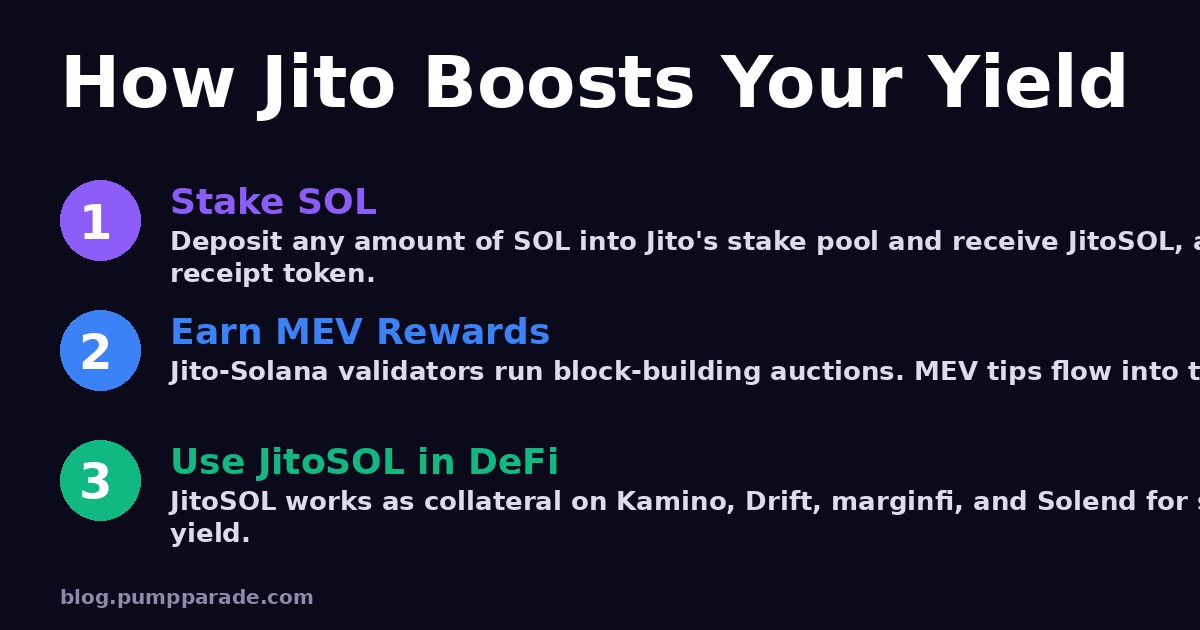
The liquid staking side is the retail-facing product. You send SOL to the Jito stake pool and receive JitoSOL in return. JitoSOL is a standard SPL token that quietly accrues both the base staking rewards and a share of the MEV tips captured by pool validators. The exchange rate against SOL rises over time, so a single JitoSOL is worth more SOL every epoch.
According to DeFiLlama, the JitoSOL stake pool holds roughly $788 million in TVL as of July 2026, with more than 14 million SOL staked. That makes it the single largest liquid staking token on Solana by a comfortable margin.
Features Deep Dive
MEV-Boosted Yield
The headline feature is MEV capture. On Solana, every block leader chooses which transactions to include and in what order. Sophisticated searchers pay tips through the Jito Block Engine to guarantee their trades land in a specific slot, and those tips are auctioned in real time. Validators running the Jito client hand a share of that MEV revenue back to the stake pool, which flows through to JitoSOL holders.
The practical effect is a yield uplift of roughly 100 to 150 basis points over vanilla staking, depending on network activity. During memecoin frenzies or high-volume weeks, the MEV component spikes noticeably. During quiet weeks, JitoSOL still earns the base rate.
Liquid Staking Token (JitoSOL)
Unlike native staking, which locks your SOL for at least one epoch (about two to three days) before you can withdraw, JitoSOL is instantly tradable. You can swap it back to SOL on any Solana DEX at any time, subject to a small pool discount if you skip the direct unstake path.
JitoSOL trades at roughly $101 per token in July 2026, which reflects both the underlying SOL price and the accumulated yield since JitoSOL launched. As rewards compound, that price drifts higher against SOL, so simply holding is enough. There is no manual claim step.
DeFi Integrations
This is where JitoSOL earns its reputation as a productivity asset. It is accepted as collateral or a yield-bearing deposit on essentially every major Solana money market and perp DEX. That includes Kamino, marginfi, Drift, and Solend. You can borrow stablecoins against JitoSOL, LP it into JitoSOL/SOL pools for extra fees, or use it to collateralize a leveraged perp position. See our Kamino vs marginfi comparison for how the two lending venues price JitoSOL collateral.
The composability is the real reason to hold JitoSOL over plain staked SOL. You keep earning yield while your capital does something else in the background.
Jito Block Engine (For Developers and Searchers)
Retail users will not touch this, but it matters for the story. The Jito Block Engine is the piece of infrastructure that runs the MEV auction. It receives bundles from searchers, sorts them by tip, and hands them to Jito-client validators to include atomically. It is the reason MEV on Solana has any structure at all rather than the chaotic every-validator-for-themselves environment that existed before Jito shipped.
Fees and Pricing
Jito’s fee model is one of the cleaner ones in DeFi.
- Management fee: 4% of total rewards. Nothing on principal. If the pool earns 7.5% APY gross, you keep roughly 7.2% net after the fee is deducted from the reward stream.
- Withdrawal fee: 0.1% when unstaking directly through the Jito website. This is often avoidable by swapping JitoSOL for SOL on Jupiter or another aggregator, which typically prices tighter than the direct unstake path.
- Deposit fee: None. Staking SOL to receive JitoSOL costs only the Solana network fee (fractions of a cent).
- Network fees: Standard Solana transaction fees, plus optional priority fees or Jito tips if you want your stake or unstake to land instantly during high-load periods.
Compared to Ethereum liquid staking, where Lido charges 10% of rewards, 4% is competitive. Compared to Marinade Finance (2% fee), Jito is slightly more expensive on the fee line but usually more than makes it back through MEV.
JitoSOL by the Numbers (July 2026)
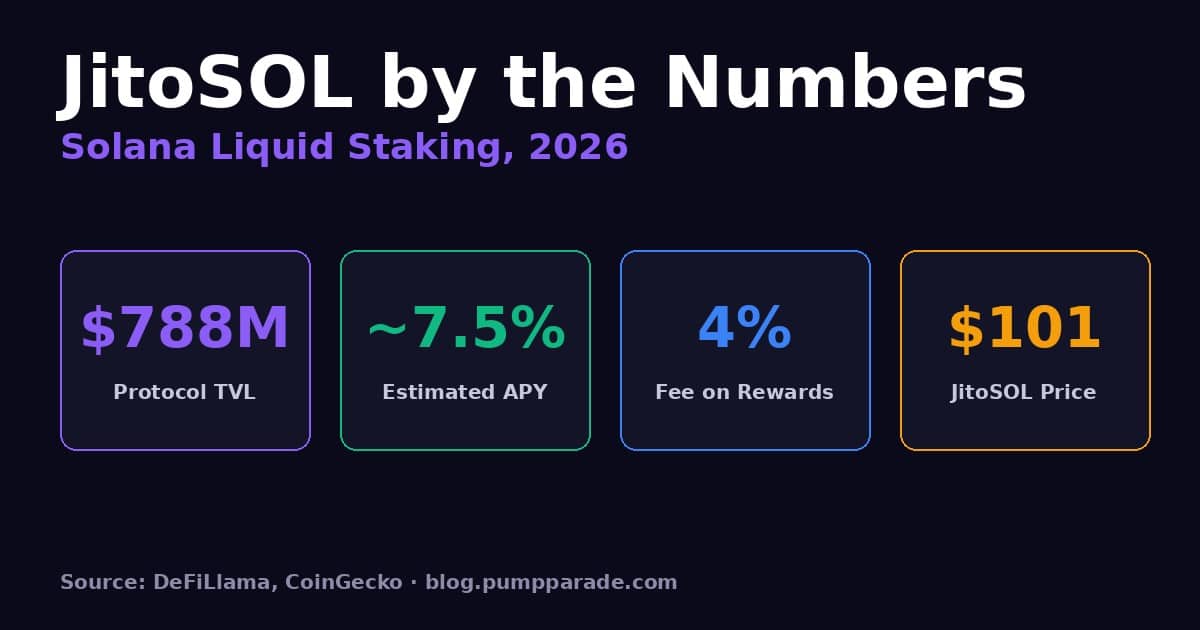
| Metric | Value |
|---|---|
| Protocol TVL | ~$788M |
| SOL staked | 14M+ SOL |
| Estimated APY | 7.2% to 7.8% |
| Management fee | 4% of rewards |
| Withdrawal fee | 0.1% (direct unstake) |
| JitoSOL price | ~$101 |
| JTO token price | ~$0.62 |
| Chains supported | Solana only |
Source: DeFiLlama, CoinGecko, Jito Foundation.
Pros and Cons
Pros
- Best-in-class Solana yield: MEV capture reliably adds 100 to 150 bps over native staking and other non-MEV LSTs.
- Deep DeFi composability: Accepted as collateral on every major Solana lending market and perps venue.
- Instant liquidity: Swap JitoSOL for SOL on Jupiter at any time, no epoch wait.
- Battle-tested: Multi-year track record, no exploit, well-audited stake pool contracts.
- Auto-compounding: Rewards accrue into the JitoSOL exchange rate. No manual claiming.
- Transparent MEV economics: The Jito Block Engine surfaces MEV that would otherwise be captured privately or lost.
Cons
- Centralization concern: Jito-Solana client dominates the network. Concentration of MEV infrastructure in one team is a philosophical risk.
- JTO token is separate from yield: Holding JitoSOL earns staking yield, but does not entitle you to JTO governance rewards. You need to hold JTO separately.
- Not the highest APY on the market: Newer restaking-flavored LSTs occasionally beat Jito by a few basis points, though usually with more risk.
- Solana-only: If you want cross-chain LST exposure, this is not the product.
Security and Trust
Jito’s stake pool contracts are a fork of the audited Solana Program Library stake pool code, which has been battle-tested across Marinade, Lido on Solana (now retired), and several smaller pools. Jito Labs has published multiple third-party audits and runs a bug bounty. The team is public, headed by Lucas Bruder and Zano Sherwani, and operates out of San Francisco.
There has never been a smart contract exploit against JitoSOL. The main risk vectors are validator misbehavior (slashing exposure, though Solana slashing is currently limited) and the concentration risk mentioned above. The stake pool delegates across many validators, so any single bad actor is diluted.
The JTO governance token gives holders a voice in protocol parameters like fee levels and validator selection. JTO trades around $0.62 in July 2026, with a $309M market cap and 501M tokens circulating out of a 1B total supply. It is well below its December 2023 all-time high of $6.01.
User Experience
Staking on Jito takes about 30 seconds. Connect a Solana wallet (Phantom, Backpack, Solflare, or Ledger), pick an amount, and click stake. The site shows the current exchange rate, the estimated APY, and a clear breakdown of what fees apply. There are no hidden confirmations or wall-of-text terms.
Unstaking is where users occasionally trip up. The direct-unstake path takes one epoch (about two to three days) but only costs the 0.1% withdrawal fee. The instant-unstake path is a swap on Jupiter, which is faster but priced by the JitoSOL/SOL pool depth (typically a 5 to 15 bps spread). Most users end up using Jupiter for anything under a few thousand SOL, and direct unstake for institutional-size positions.
Mobile support works through wallet mobile apps rather than a native Jito mobile client. That is fine but not exceptional.
How Jito Compares
The two most common alternatives are Marinade Finance and native staking:
- vs Marinade (mSOL): Marinade charges 2% instead of 4% but does not capture MEV. Net yield lands roughly 30 to 60 bps below JitoSOL. Marinade has better validator diversity (100+ validators) but weaker DeFi integrations.
- vs native staking: Native staking has no LST wrapper, so no smart contract risk and no fees. Yield is roughly 100 to 150 bps below JitoSOL, and your SOL is locked. Best for long-term holders who never touch DeFi.
- vs newer restaking LSTs: Some 2026-era restaking tokens promise higher headline APYs by layering additional yield sources. Most add smart contract complexity that JitoSOL does not have. Fine as a satellite position, not a core one.
If Solana appreciates in dollar terms as many analysts expect (see our SOL price prediction for 2026), the compounding effect of an extra 1% APY becomes substantial over multi-year horizons.
Verdict
Jito is the best product in its category on Solana, and it is not particularly close. The combination of MEV-boosted yield, deep DeFi composability, instant liquidity, and a clean fee model makes JitoSOL the default choice for anyone holding SOL who wants that capital to work. The 4% fee is fair for what the protocol delivers, and the multi-year track record removes most execution-risk concerns.
The centralization argument against Jito is real but overstated for most users. If you are custodying institutional-scale SOL, spread across a couple of LSTs. If you are a retail user with a normal position, park it in JitoSOL and get on with your life.
FAQ
Is JitoSOL safe?
The stake pool contracts are audited forks of well-tested Solana Program Library code, and Jito has run production for multiple years without an exploit. The primary risks are smart contract risk (low but nonzero, as with any DeFi) and validator concentration risk.
How is JitoSOL taxed?
In most jurisdictions, receiving JitoSOL for SOL is a like-kind swap that may or may not be a taxable event depending on your local rules. The rising exchange rate is not a claim event, which many users find advantageous compared to LSTs that pay rewards in a separate token. Consult a crypto tax professional for specifics.
What is the difference between JitoSOL and JTO?
JitoSOL is the liquid staking receipt token. It represents your staked SOL and accrues yield. JTO is the governance token for the Jito DAO. They are separate assets. Holding JitoSOL does not give you JTO, and vice versa.
Can I unstake JitoSOL at any time?
Yes. You can either use the direct unstake path (one-epoch wait, 0.1% fee) or swap JitoSOL for SOL on Jupiter instantly for a small pool spread.
Does Jito work outside Solana?
No. Jito is a Solana-only protocol. It does not support any other chain.
What APY should I actually expect?
Expect somewhere in the 7% to 8% range in normal market conditions. During heavy network activity (memecoin cycles, major launches), MEV tips push the number toward the top of that range. During quiet periods, you land closer to 7%.