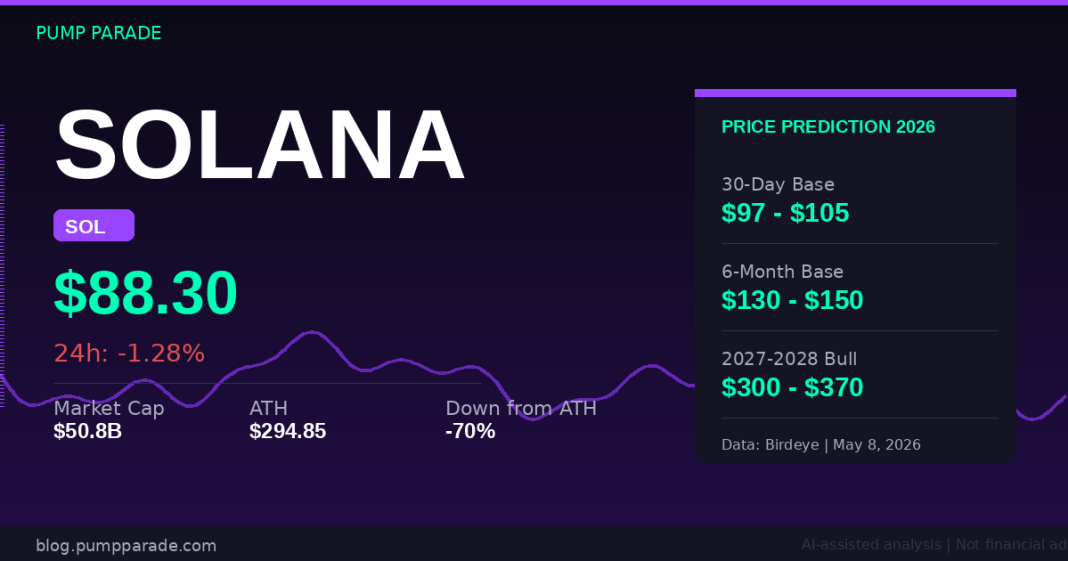
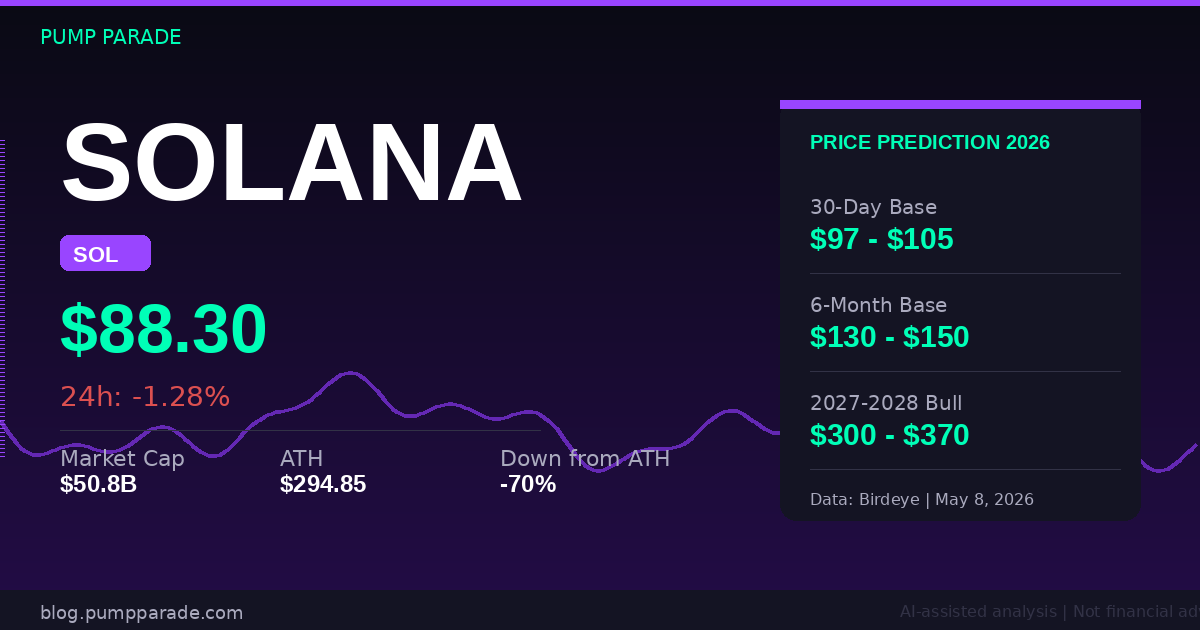
Solana is trading at $88.30 as of May 8, 2026. That is down roughly 70% from its all-time high of $294.85, set in January 2025. The network has had a rough year: on-chain fees have dropped, total value locked (TVL) has pulled back, and spot ETF inflows hit their weakest monthly figure since launch in April.
And yet, something shifted this week. SOL climbed from $83.75 on May 2 to a seven-day high of $90.45, a move of nearly 8% in six days. The catalyst? Solana co-founder Anatoly Yakovenko confirmed at Consensus Miami 2026 that the Alpenglow consensus upgrade is on track for Q3 2026. The technical implications are significant. The market appears to be pricing them in, at least partially.
This article breaks down the current setup for SOL: the technicals, the bull case, the bear case, and where our AI model puts the price targets for 2026, 2027, and 2030.
What Is Solana?
Solana is a high-performance Layer 1 blockchain designed for speed and low transaction costs. It can process tens of thousands of transactions per second, with fees typically under a fraction of a cent. That combination made it the dominant chain for memecoins, DeFi trading, and consumer apps in the 2024-2025 cycle.
The network has a circulating supply of approximately 576 million SOL and a current market cap of around $50.8 billion, placing it among the top five cryptocurrencies by market cap. Unlike Ethereum, Solana has no hard supply cap, so inflation dynamics are an ongoing consideration for long-term holders.
Solana’s ecosystem includes major protocols like Raydium, Jupiter, and Kamino, along with a thriving memecoin culture that drove massive retail engagement during the last bull cycle. The ecosystem also supports a healthy liquid staking market: if you are holding SOL long-term, platforms like those covered in our Marinade vs Jito liquid staking comparison let you earn yield while you wait. For a broader look at how to navigate Solana’s trading ecosystem, our guide on Solana memecoins and high-potential opportunities is a solid starting point.
The Alpenglow Upgrade: Why It Matters
This is the most important catalyst for SOL right now, and it deserves a proper explanation.
Solana’s current consensus mechanism achieves finality in roughly 12 seconds. That sounds fast. Compared to Bitcoin or Ethereum, it is. But for institutional trading desks, high-frequency market makers, and applications requiring real-time confirmation, 12 seconds is a long time.
Alpenglow changes that. According to Yakovenko at Consensus Miami 2026, the upgrade replaces Solana’s Proof-of-History (PoH) and Tower BFT mechanisms with two new components: Votor and Rotor. The result is a two-tier finality system. If 80% or more of staked validators participate in the first voting round, a block achieves finality in 100 to 150 milliseconds. If participation drops to 60 to 80%, a secondary round kicks in, still settling in under 250 milliseconds.
In plain terms: Solana goes from a 12-second blockchain to a sub-second blockchain. That unlocks a new category of applications, including institutional-grade trading infrastructure, real-time DeFi primitives, and payment systems that can compete with traditional financial rails.
Yakovenko said the release is “basically due sometime this year, I think next quarter.” That puts the mainnet launch window in Q3 2026.
Technical Analysis: Where SOL Stands Right Now
The technical picture for SOL is cautiously constructive. Not wildly bullish, but not broken either.
Key levels to know:
- Current price: $88.30
- Immediate support: $84 to $85 (held multiple times in the past two weeks)
- First resistance: $95 to $97 (previous consolidation zone)
- Second resistance: $110 to $120 (major structure from Q1 2026)
The RSI (Relative Strength Index, a momentum indicator that runs from 0 to 100) is sitting at approximately 54. That puts it squarely in neutral territory, meaning the recent rally has not pushed the token into overbought conditions. There is room to run before sellers are likely to step in aggressively.
More encouraging: both the 50-day and 200-day moving averages are now trending upward. The 200-day MA began rising in early February 2026, which is a significant structural shift after a long period of declining averages. When both major moving averages point up together, it tends to signal a durable improvement in trend, not just a short-term bounce.
The recent candles are also forming a pattern of higher lows since early May. SOL put in a low near $83.23 on May 4, then a higher low around $86.04 on May 6. That is not a confirmed breakout, but it is the right kind of price action for bulls to be watching.
Volume has been consistent throughout the move, ranging from 143 million to 177 million SOL per day in on-chain trading activity. That is not a volume spike, but it suggests sustained buying interest rather than a low-liquidity pump.
The Bull Case for SOL in 2026
The bull case rests on three pillars: the Alpenglow upgrade, a potential broader market recovery, and Solana’s structural position in the ecosystem.
Alpenglow as a re-rating event. Sub-second finality fundamentally expands what can be built on Solana. If the mainnet launch proceeds in Q3 as expected, it could trigger a wave of new project deployments, capital migration from other chains, and renewed institutional interest. Markets tend to front-run these kinds of catalysts. If SOL has not already moved significantly by the time Alpenglow goes live, history suggests the price could move sharply on confirmation.
Bitcoin macro tailwinds. BTC is currently trading around $82,000 and showing signs of momentum toward the $85,000 to $90,000 range. In previous cycles, sustained Bitcoin strength has been a leading indicator for altcoin rotation. Solana, as one of the largest and most liquid altcoins, tends to benefit early in those rotation phases.
Cumulative ETF inflows still growing. While monthly ETF inflows for SOL have slowed significantly (April 2026 brought in just $39.93 million, down from a high of $419 million in November 2025), the cumulative figure is approaching $975 million. The infrastructure for institutional access is in place. A macro improvement or a technical catalyst like Alpenglow could restart the inflow trend.
The Bear Case for SOL in 2026
The bear case is real, and it should not be glossed over.
TVL and fee revenue are down. Solana’s on-chain activity metrics have contracted meaningfully in 2026. Total value locked has fallen from its cycle highs, and daily fee revenue, which was a major narrative in 2024 and early 2025, has declined. The network generated much of its excitement during the memecoin supercycle. That cycle has cooled. You can see this dynamic play out in the muted performance of Solana DeFi tokens like ORCA, which reflects the broader pullback in on-chain activity.
ETF inflows are decelerating fast. Six consecutive months of declining monthly ETF inflows is a warning sign. It suggests the institutional buying that drove SOL’s 2025 rally is not currently expanding. If that trend continues, one of the main structural supports for the price disappears.
Broad altcoin headwinds. The overall altcoin market remains under pressure. The Fear and Greed Index is sitting near neutral (50), and the broader sentiment reading for Solana specifically is approximately 65% bearish. In that environment, any stumble in BTC or macro conditions could push SOL back toward its $75 to $80 support band or lower.
Upgrade risk. Alpenglow is bullish if it ships on time and works as intended. Blockchain upgrades carry execution risk. A delay, a testnet issue, or a security concern discovered during the rollout could flip the narrative quickly.
Solana (SOL) Price Prediction Summary (2026)
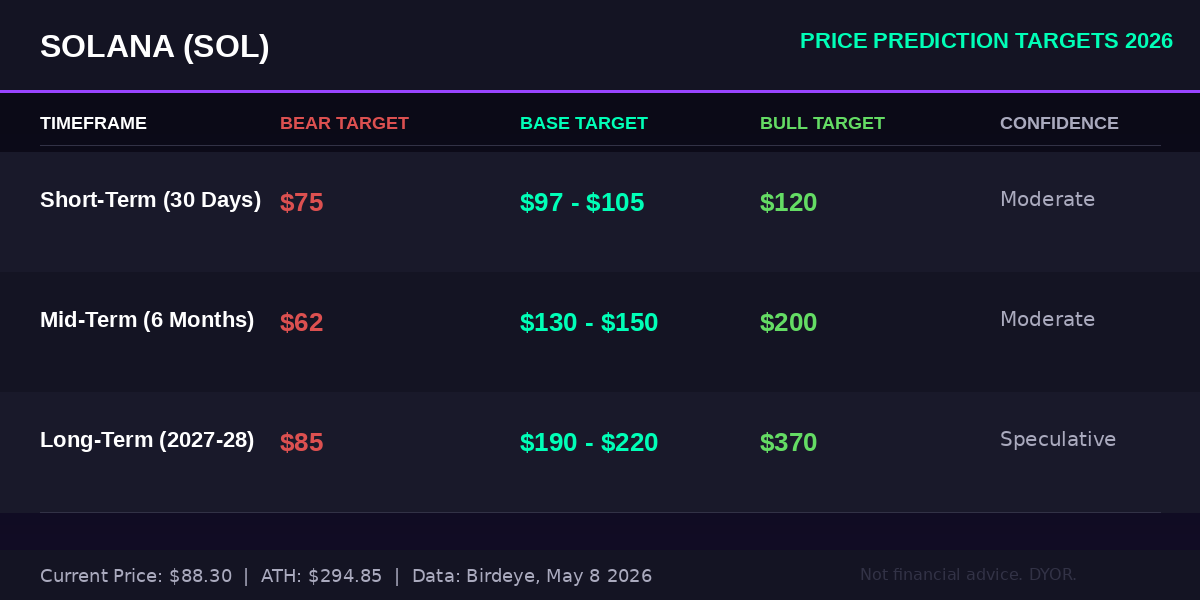
Our hybrid AI model combines technical indicators, on-chain metrics, and momentum signals to generate probabilistic price targets. Here is the current output, framed across three timeframes.
Short-Term: Next 30 Days
The setup favors a continued grind toward $95 to $105 if BTC holds its ground and the Alpenglow narrative stays positive. The $84 to $85 support zone has held consistently in recent sessions. A break below $83 would shift the short-term picture negative and open a path toward $75.
- Bear target: $75
- Base target: $97 to $105
- Bull target: $120
Mid-Term: 6 Months (Q4 2026)
By Q4 2026, the Alpenglow upgrade should be live on mainnet. If it delivers on its promise and the broader market avoids a macro shock, SOL could realistically push toward the $130 to $150 range. The bull target of $200 would require both a strong BTC cycle and a material pickup in ETF inflows. The bear scenario of $62 assumes a deteriorating macro environment and continued ecosystem outflows.
- Bear target: $62
- Base target: $130 to $150
- Bull target: $200
Long-Term: End of 2026 to Early 2027
Longer-term predictions within the 2026 cycle carry more uncertainty. If Solana successfully upgrades to Alpenglow and maintains its developer ecosystem, SOL has a credible path toward its previous ATH range and potentially beyond. The base case assumes it remains a top-three smart contract platform by developer activity and TVL.
- Bear target: $85
- Base target: $190 to $220
- Bull target: $370
SOL Price Prediction 2027 to 2030
Many readers are looking further ahead. Here is a concise extended outlook based on our AI model and historical cycle analysis. These figures carry more uncertainty the further out they go.
SOL Price Prediction 2027
If the next Bitcoin halving cycle follows the pattern of previous cycles, markets typically begin pricing in the event 12 to 18 months in advance. That puts 2027 in a potential pre-halving accumulation phase. Our base target for SOL in 2027 is $180 to $250, assuming Alpenglow is live on mainnet and the broader altcoin market has recovered from its 2026 lows. The bear case is $90 if macro conditions deteriorate significantly. The bull case of $350 would require a full altcoin season and strong institutional demand.
SOL Price Prediction 2030
Four-year predictions carry substantial uncertainty. With that caveat stated clearly: if Solana maintains its position as a top-three smart contract platform, expands institutional adoption post-Alpenglow, and benefits from multiple Bitcoin halving cycles, our long-range model suggests the following range for 2030.
- Bear target: $80 to $120 (if Solana loses ground to newer competitors)
- Base target: $250 to $350 (continued ecosystem growth, mainstream adoption)
- Bull target: $400 to $600 (full institutional adoption, dominant L1 position)
What to Watch
Here is a practical framework for tracking this setup over the coming months.
- Alpenglow testnet progress. Watch for official announcements from Solana Labs and the core development team. Testnet deployment will be the signal that mainnet is getting close. Any major issues at that stage will show up in price first.
- $90 to $95 reclaim. SOL hit $90.45 briefly on May 7. A sustained close above $95 would confirm the breakout and target the $110 to $120 resistance band. Failure to hold above $86 on a weekly close is a yellow flag.
- Monthly ETF inflow data. If May 2026 shows a reversal in the declining inflow trend, that is a meaningful signal that institutional buyers are returning ahead of the upgrade.
- BTC direction. Solana does not trade in isolation. If Bitcoin breaks below $75,000, expect SOL to revisit the $75 to $80 range regardless of project-specific news.
The Bottom Line
SOL at $88 is not the obvious buy that it might have looked like at $50. But it is also not the obvious avoid that it might look like given the 70% drawdown from ATH. The Alpenglow upgrade is a genuine, technically significant catalyst with a credible timeline. The on-chain data shows a network still generating real activity. And the technical structure, with rising moving averages and neutral RSI, gives the setup room to develop without being immediately overextended.
The risk is real too. ETF inflows have been weak. Sentiment is tilted bearish. And upgrade execution always carries uncertainty.
The probability-weighted base case has SOL somewhere between $97 and $150 by end of 2026. Getting there will depend on whether Alpenglow ships on schedule and whether BTC holds its macro momentum. Both are worth watching closely.
Frequently Asked Questions
What will Solana (SOL) be worth in 2026?
Our AI model’s base case for SOL in 2026 is $130 to $150, assuming the Alpenglow upgrade ships on schedule in Q3 2026 and Bitcoin maintains momentum above $80,000. The bull case target is $200, which requires a strong macro environment and a pickup in SOL ETF inflows. The bear case is $62 if broader market conditions deteriorate significantly.
Can SOL reach $200 in 2026?
Reaching $200 in 2026 is possible but not our base case. It would require Alpenglow to launch without issues, a significant recovery in Solana ETF inflows (which have declined for six consecutive months), and Bitcoin holding above $90,000. If all three conditions are met, $200 is within reach by Q4 2026. Our AI model places the probability of this outcome at roughly 20 to 25%.
What is the Alpenglow upgrade and why does it matter for SOL price?
Alpenglow is Solana’s most significant consensus overhaul to date. It replaces Proof-of-History and Tower BFT with two new components called Votor and Rotor. Transaction finality drops from roughly 12 seconds to 100 to 150 milliseconds. That opens Solana to institutional trading desks, high-frequency market makers, and real-time DeFi applications. Co-founder Anatoly Yakovenko confirmed at Consensus Miami 2026 that mainnet launch is expected in Q3 2026.
What will SOL be worth in 2030?
Our long-range model puts SOL in a $250 to $350 range for 2030 in the base case, $400 to $600 in a bull scenario, and $80 to $120 in a bear scenario. These figures carry significant uncertainty given the four-year timeframe. They assume Solana retains its position as a top smart contract platform and benefits from multiple Bitcoin halving cycles.
Is Solana (SOL) a good investment in 2026?
This is not financial advice. Whether SOL suits any individual portfolio depends entirely on personal risk tolerance and goals. What the data shows: SOL is down 70% from its ATH, has a major technical upgrade on the near-term horizon, and sits in neutral technical territory with rising moving averages. Crypto markets are volatile, and SOL could fall further or rise significantly. Always conduct your own research and consult a financial advisor before making any investment decisions.
Disclaimer: This article is for informational and educational purposes only and should not be construed as financial, investment, or trading advice. Cryptocurrency markets are highly volatile, and past performance does not guarantee future results. The price predictions and analyses presented here are based on AI models, technical indicators, and available data at the time of writing. They are not guarantees. Always conduct your own research (DYOR) and consult with a qualified financial advisor before making any investment decisions. Pump Parade and its authors do not assume liability for financial losses incurred based on information provided in this article.
About our AI predictions: Pump Parade’s price predictions are generated by machine learning models that analyze technical indicators, on-chain data, and market sentiment. These models have limitations and cannot account for black swan events, regulatory changes, or sudden market shifts. Use AI predictions as one input among many in your research.