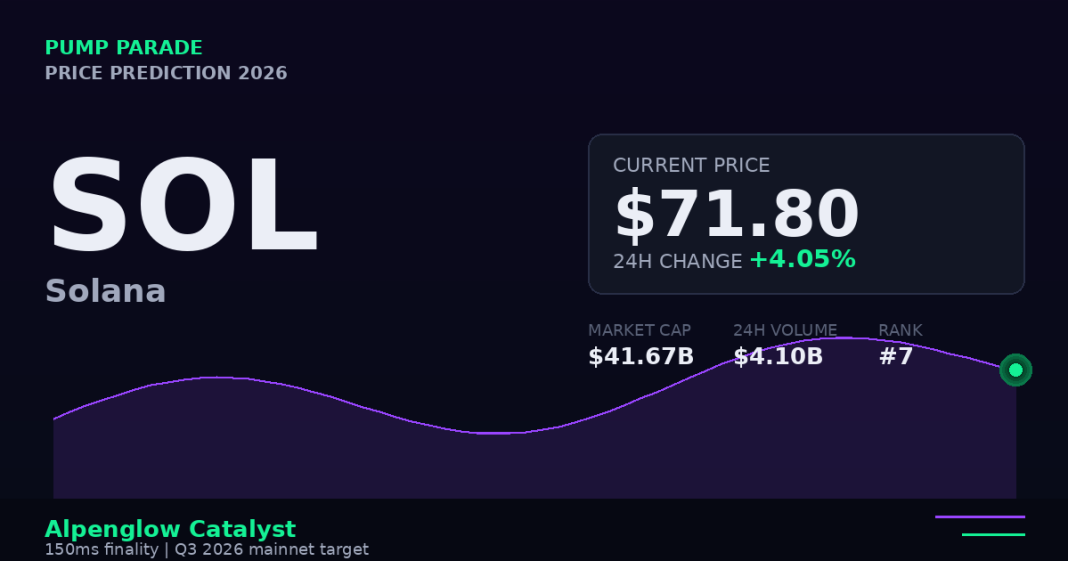
Solana just crossed 100 billion lifetime transactions. No other chain except Internet Computer has hit that number. And yet SOL trades at $71.80 today, roughly 65% below its January 2025 high near $260. Volume is loud. Price is not.
That gap is the whole story. The network is busier than it has ever been. Spot SOL ETFs are live in the US. The Alpenglow consensus rewrite is weeks from mainnet. Standard Chartered still carries a $250 SOL target for end of 2026. But ETF flows turned slightly negative this week, and SOL has spent most of June pinned in a tight range. Bulls and bears are both arguing the same chart.
This piece walks through what the data actually says: where SOL trades today, the catalysts in play, the bear arguments worth respecting, and a price prediction band for 30 days, 6 months, and 2027 to 2028. It is built on live Birdeye market data and verified network developments, not vibes.
Where SOL Stands Right Now
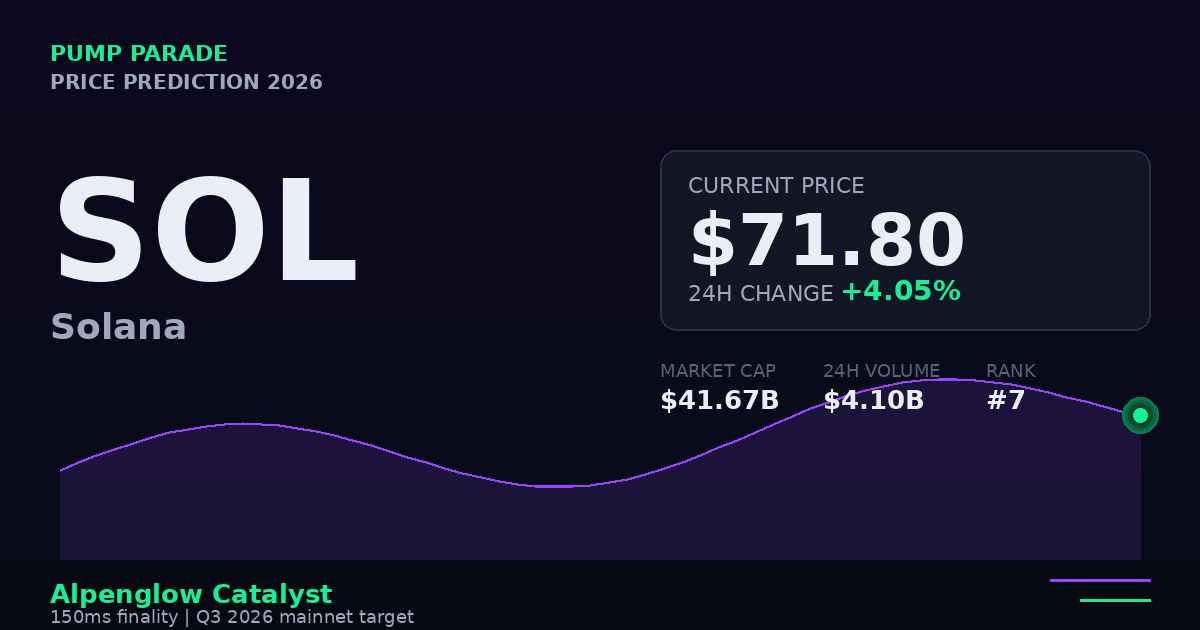
According to CoinGecko market data, Solana is trading at $71.76 with a market cap of $41.67 billion. That keeps SOL at #7 in crypto by market cap, behind BNB and ahead of TRON. The token is up 4.05% in the last 24 hours.
The on-chain story is louder than the price suggests. Birdeye is showing $4.10 billion in 24 hour SOL trading volume across Solana DEXs, the highest of any token on the network. Pool liquidity for the main SOL pair sits near $4.59 billion. Stablecoin supply on Solana keeps grinding higher. None of that screams “dead chain.”
The macro setup is mixed. Bitcoin is back above $60,000. ETH has reclaimed $1,580. Risk appetite is creeping back into majors. But altcoin breadth is still narrow, and SOL has not yet broken out of its multi-month range.
The Bull Case: Three Catalysts That Actually Matter
1. Alpenglow Is Close
Alpenglow is the biggest consensus overhaul Solana has shipped. It targets a finality time of roughly 150 milliseconds, down from the 12 second range that SOL has lived with for years. For context, Ethereum’s slot time is 12 seconds. Visa settles in seconds. Alpenglow lands the chain in the milliseconds.
The Solana Foundation is targeting a Q3 2026 mainnet activation. If that schedule holds, the upgrade goes live in roughly two months. Faster finality unlocks two things: real time payments at scale, and high frequency on-chain trading that currently lives off-chain or on app specific chains like Hyperliquid. Both are real revenue stories, not narratives.
2. Firedancer Reliability
Solana’s reputation problem has always been outages. Firedancer is the second validator client, built by Jump Crypto, and its job is to fix that. The hybrid version, Frankendancer, is already live on a meaningful share of the validator set. Full Firedancer rollout continues through 2026.
Two independent clients running the same network is the standard institutional checklist item for treating a chain as serious infrastructure. Once Firedancer is fully active, that box is checked.
3. Spot ETF Pipes Are Open
US spot Solana ETFs are live. Cumulative net inflows have crossed $1.13 billion since launch. That is real, sticky institutional capital, even if recent days have shown small outflows of around $3.94 million.
The flow direction matters less than the existence of the rails. ETFs have given pension funds, RIAs, and corporate treasuries a path to SOL exposure that does not require touching a wallet. That structural change does not show up in a single week of net flows. It shows up in the slow grind of cost basis over quarters.
The Bear Case: What Could Break
A balanced take requires looking at what could go wrong. Three risks deserve real weight.
Revenue gap with ETH. Solana processes more transactions per day than Ethereum, by a wide margin. But network revenue, the fees the chain actually captures, still trails ETH. If that gap stays open, the bullish “Solana eats Ethereum” thesis runs into a wall of TradFi fundamental investors who care about cash flow more than throughput.
Technical support is thin. Analysts watching the weekly chart point to the $60 to $65 zone as the line that matters. A weekly close below that band opens the door to a fast move toward $25 to $30. That is roughly 65% downside from current levels. The catalyst for that move would likely be a broader crypto risk off event, not anything Solana specific.
L2 and app chain competition. Hyperliquid keeps eating perp DEX volume. Base keeps pulling consumer apps. If high value DeFi activity migrates to specialized chains, Solana could be left handling memecoin churn and stablecoin payments, both lower margin businesses than what bulls are modeling.
Technical Outlook
SOL is range bound. The token has held above $65 for most of June and has rejected from the $80 to $85 zone several times. That price action defines two clean levels.
Upside: a confirmed weekly close above $85 likely opens a path to $120, the next significant supply zone from late 2025. From there, the $150 level becomes the test of whether SOL is in a real cycle.
Downside: losing $65 on a weekly close is the bear trigger. The $40 to $45 region would be the next demand zone. Below that, the chart is open back toward $25.
RSI on the daily is neutral. Funding rates on perps are roughly flat. There is no clear positioning bias right now, which usually means the next move comes from a catalyst, not from technical exhaustion.
Price Predictions: 30 Days, 6 Months, 2027 to 2028
The forecast band below blends current price action, Alpenglow timing, ETF flow assumptions, and broader market scenarios. Each row shows a bear, base, and bull case.
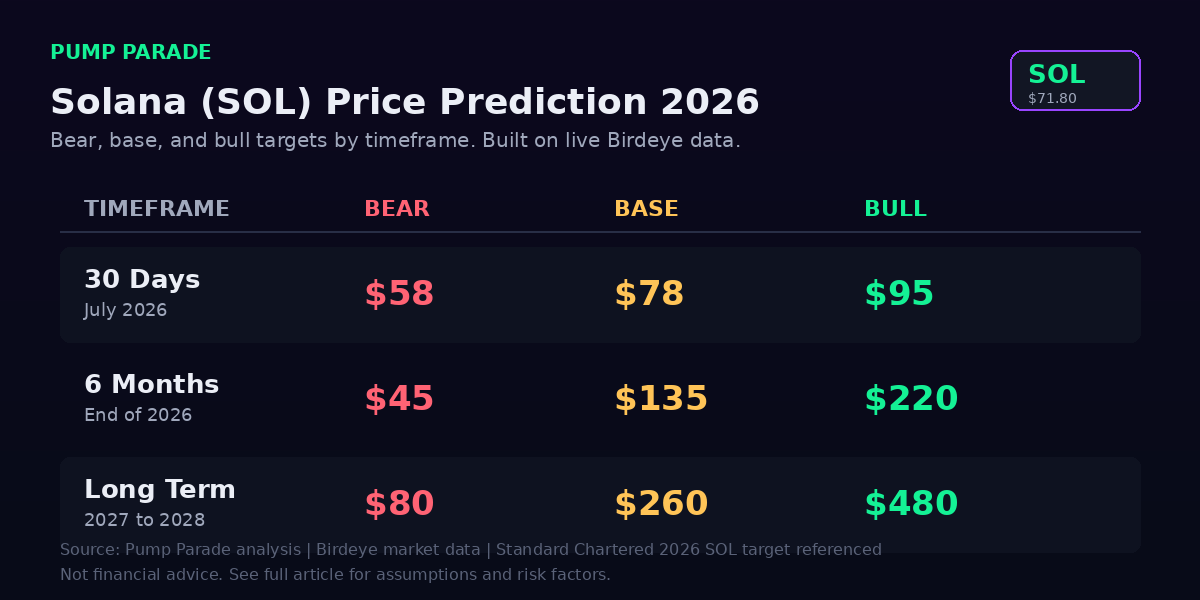
30 day view (July 2026): Bear $58, Base $78, Bull $95. The base case assumes range continuation with a modest grind higher into Alpenglow anticipation. The bull case requires a clean break of $85 on Alpenglow news. The bear case is a broad crypto pullback that drags SOL with it.
6 month view (end of 2026): Bear $45, Base $135, Bull $220. The base case assumes Alpenglow ships, ETF inflows resume, and altcoin breadth improves. The bull case approaches Standard Chartered’s $250 target. The bear case is a deeper macro reset and a failed Alpenglow rollout.
2027 to 2028 view: Bear $80, Base $260, Bull $480. The long term base case assumes Solana retains its position as the leading high throughput L1 and captures a meaningful share of on-chain payments and consumer apps. The bull case requires Solana to genuinely close the revenue gap with Ethereum. The bear case is sustained L2 and app chain pressure plus regulatory friction on staking.
For ecosystem context, Jupiter’s role as the dominant Solana DEX aggregator matters here. Our recent Jupiter (JUP) price prediction covers the same flow data that drives SOL fees. The two move together more than the price action suggests.
What Would Change Our View
Three things would force a rewrite of the base case.
First, an Alpenglow delay past Q4 2026 would knock the 6 month target down by roughly 20%. The market is already pricing in some of the speed upgrade. A slip pushes that premium out.
Second, a sustained week of ETF outflows above $50 million per day would suggest the institutional thesis is breaking. That has not happened. If it does, the 2027 base case moves toward the bear band.
Third, a clean weekly close above $100 would mean the range is broken and the bull case is in play. At that point, the question becomes how fast SOL gets to $150, not whether it can.
The Honest Take
Solana is one of the most interesting risk reward setups in crypto right now. The network is doing more volume than ever. The two biggest technical risks, finality and validator reliability, are both being fixed in real time. ETF rails are live. And the price is roughly flat on the year while the fundamentals have improved.
That is the bull pitch in a sentence. It is also why the bear pitch matters. The same setup that looks like a coiled spring can look like a value trap if Alpenglow disappoints, ETF flows stall, and the broader market refuses to rotate into alts.
SOL is a setup worth watching closely through Q3 2026. It is not a “buy now or miss it” trade. It is a positioning decision with clear levels: $85 changes the upside math, $65 changes the downside math. Size accordingly.
Disclaimer: This article is for informational and educational purposes only and should not be construed as financial, investment, or trading advice. Cryptocurrency markets are highly volatile, and past performance does not guarantee future results. The price predictions and analyses presented here are based on AI models, technical indicators, and available data at the time of writing. They are not guarantees. Always conduct your own research (DYOR) and consult with a qualified financial advisor before making any investment decisions. Pump Parade and its authors do not assume liability for financial losses incurred based on information provided in this article.