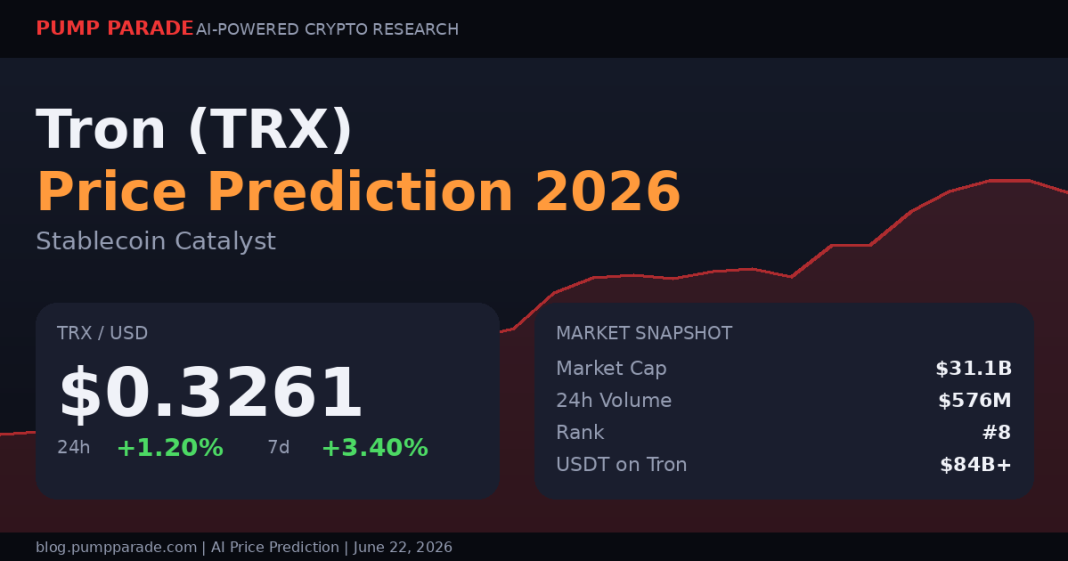
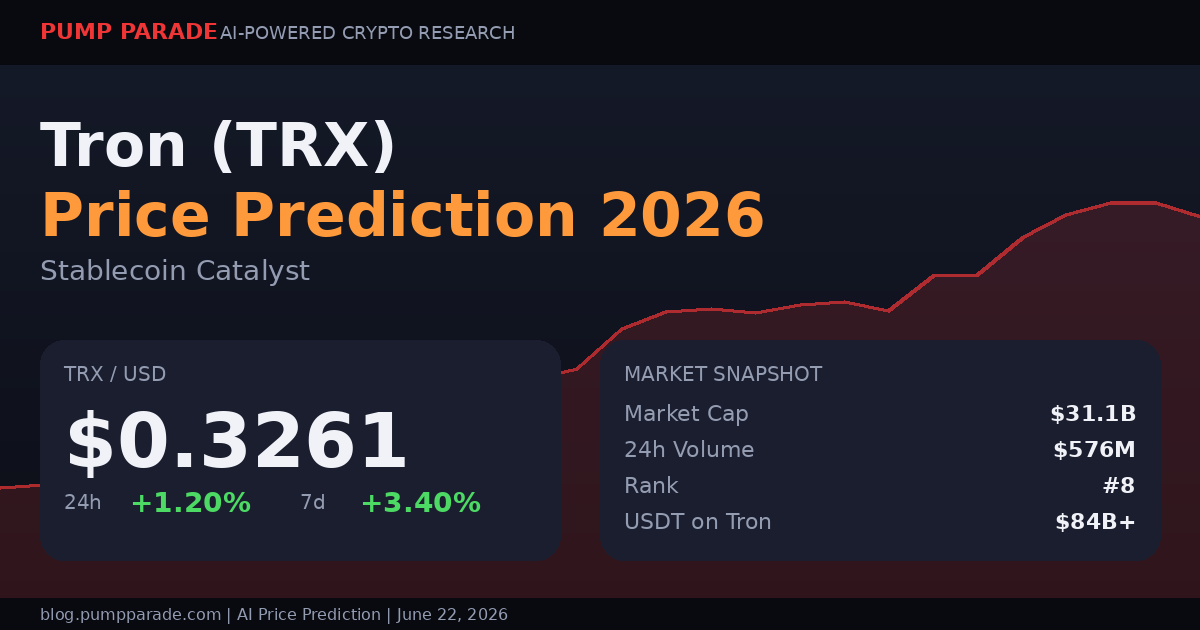
Tron trades at $0.3261 today, up 1.2% in 24 hours and 3.4% on the week. The chain just printed a record 14.3 million transactions in a single day. It now hosts over $84 billion in USDT supply, more than any other network. And in the last three weeks, it has picked up a CFTC-regulated listing on Bitnomial, EU-regulated perpetuals on OKX Europe, and a Hyperlane integration that connects it to 150-plus blockchains.
That is a lot of structural news for a top-10 asset that almost no one is talking about. Our AI model assigns a 58% probability that TRX retests its all-time high of $0.43 in 2026, with $0.50 in play if stablecoin flows keep accelerating. The bear case is real too: token unlocks, regulatory tail risk, and a market that often forgets Tron exists.
Here is the data, both sides of the trade, and our price targets.
What is Tron and why does it matter right now
Tron is a layer-1 blockchain built for cheap, fast transactions. In plain terms, it does one thing better than almost anyone: move stablecoins. The network hosts more than $84 billion in USDT, the largest stablecoin float in crypto. That makes Tron the settlement rail for a huge share of global crypto remittances and OTC flows.
The numbers explain the rest of the thesis. Tron currently ranks #8 by market cap at $31.1 billion. Circulating supply sits at roughly 94.8 billion TRX. The chain just set an all-time daily record of 14.3 million transactions, beating every previous spike in the network’s history. That activity is not memecoin noise. It is mostly stablecoin movement, which tracks real economic use.
Three recent catalysts are worth knowing about:
- Bitnomial listing (June 5, 2026): TRX became tradable on Bitnomial, a CFTC-regulated derivatives venue in Chicago. This is the cleanest US institutional gateway TRX has ever had.
- OKX Europe perpetuals (June 1, 2026): TRX perpetual futures launched on OKX Europe under MiCA-compliant terms, opening regulated leverage to EU traders.
- Hyperlane integration: Tron is now reachable from 150-plus chains via Hyperlane messaging, removing one of its biggest historical pain points, weak interoperability.
Layer that on top of Tron Inc., the publicly-traded company that recently added 1.2 million TRX to its treasury, taking total holdings above 700 million tokens. Corporate accumulation is happening with TRX well below its $0.43 all-time high.
Technical analysis: what the chart is telling us
TRX is trading in a tight $0.30 to $0.34 range that has held since early May. The 50-day moving average sits at $0.319, and the 200-day moving average is at $0.297. Price is holding above both, which is a constructive setup.
The RSI (Relative Strength Index, a momentum gauge that runs from 0 to 100) prints around 54. That is the middle zone. Not overbought, not oversold, and consistent with a coiled chart waiting for a catalyst.
Four levels matter most right now:
- Support 1: $0.30, the floor of the current range and the 200-day reclaim zone.
- Support 2: $0.27, the April swing low. A break here invalidates the range.
- Resistance 1: $0.345, the May high. Clean break opens room to $0.40.
- Resistance 2: $0.43, the all-time high. A multi-week consolidation above the 50-day suggests TRX has the structure to attempt this level if a catalyst hits.
The MACD (a trend indicator that compares short and long moving averages) is flat, signaling neither buyers nor sellers control the tape. That usually changes fast when range-bound charts get news.
Bull case: stablecoin demand and an institutional on-ramp
The bull case for Tron is mechanical, not narrative-driven. Stablecoin supply on the network is growing, and TRX is the gas token. More USDT flowing through Tron means more burned TRX, more validator demand, and more reason for any payments business to hold TRX on its balance sheet.
Specific catalysts that could push TRX higher:
- Stablecoin growth. USDT supply on Tron has expanded by roughly $11 billion year to date. If that pace continues into Q4, Tron’s stablecoin float clears $95 billion.
- Regulated US access. The Bitnomial listing makes TRX one of the few non-BTC, non-ETH assets with a clean US derivatives venue. This unlocks hedged exposure for funds that could not touch TRX through spot.
- EU perpetuals. OKX Europe is one of the larger regulated venues post-MiCA. TRX perpetuals there add real liquidity to European order books.
- Tron Inc. treasury accumulation. Corporate buying at sub-$0.35 reduces float and signals long-term conviction from a public-company balance sheet.
- Hyperlane bridge expansion. Tron has long been an island in DeFi. The Hyperlane connection lets liquidity move across 150-plus chains, which improves the chain’s relevance for cross-chain DeFi.
Our AI model’s bull case puts TRX at $0.43 to $0.50 by Q4 2026, assuming stablecoin flows stay strong and at least one of the regulated venues posts meaningful open interest growth. A move beyond $0.50 would need either an ETF filing or a clear regulatory blessing in the US, neither of which is on the near-term calendar.
Bear case: unlocks, regulatory risk, and narrative fatigue
The bear case is just as easy to make. Tron has structural issues that bulls tend to wave away.
- Concentration risk. The Tron Foundation and entities tied to founder Justin Sun still hold a meaningful slice of supply. Any large transfer or sale can move price hard.
- Token unlocks and inflation. While TRX is technically deflationary in net terms during high-activity periods, supply mechanics are sensitive to network usage. A drop in transaction count would shift the balance back toward net issuance.
- Regulatory tail risk. The SEC’s prior actions against Tron-related entities are not fully resolved. New cases or enforcement actions, especially around USDT settlement on Tron, would hit TRX directly.
- Narrative fatigue. Tron has been a top-10 asset for years without ever becoming a darling of crypto Twitter. That can keep speculative inflows muted even when fundamentals improve.
- Competition for USDT settlement. Solana and Base are both aggressively courting stablecoin issuers. If a meaningful share of USDT migrates off Tron, the gas-burn thesis weakens.
The bear scenario looks like this: TRX loses the $0.30 floor, drifts to $0.27, and gets stuck in a $0.22 to $0.28 range through Q3 if macro turns risk-off or if a regulatory headline lands. That is not catastrophic, but it does mean the bull thesis is on pause.
AI price prediction summary
Our hybrid AI model combines technical indicators, on-chain metrics, and catalyst-weighted scenarios. Confidence scores reflect the model’s internal probability estimate, not a guarantee.
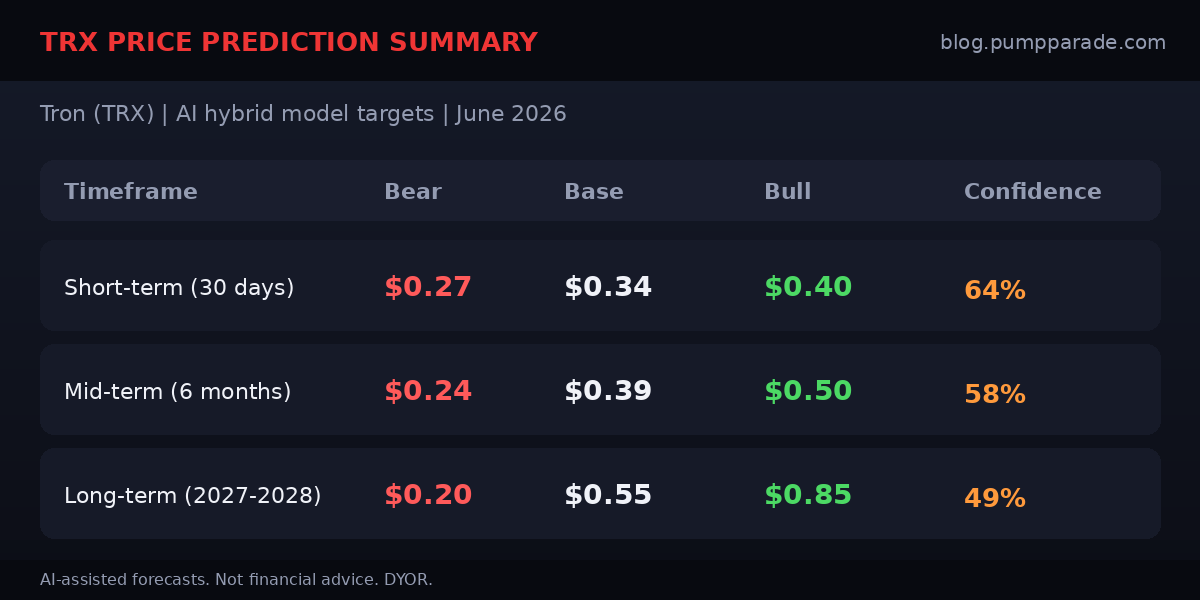
The base case for 30 days is a continuation of the current range with a slight upward bias as Bitnomial and OKX Europe build open interest. The base case for six months is a successful retest of $0.43, the all-time high, with $0.50 reachable if stablecoin flows stay on trend. The long-term base of $0.55 assumes Tron remains the dominant USDT settlement layer through the next bull cycle.
The bull case for 2027 to 2028 requires three things to happen: USDT supply on Tron clears $100 billion, a US spot ETF gets filed (even if not approved), and Tron Inc. doubles its treasury holdings. None of those are base-case assumptions, which is why the bull target sits at $0.85 with sub-50% confidence.
What to watch
If you are tracking TRX, these are the signals that will move the trade:
- Open interest on Bitnomial and OKX Europe. Regulated derivatives growth is the single best leading indicator of institutional interest.
- USDT supply on Tron. Watch for the next $5 billion milestone. Tronscan and Artemis both track this in near real time.
- Daily transaction count. The 14.3 million record set a new ceiling. Sustained activity above 10 million per day supports the gas-burn thesis.
- Tron Inc. filings. Any public-company disclosure of further TRX purchases would be a clean bullish signal.
- Macro tape. Tron tends to trade with BTC dominance. If BTC dominance falls and altcoin rotation kicks in, TRX participates.
For broader Solana ecosystem context, our recent Jupiter (JUP) Price Prediction 2026: Frontier Catalyst covers the other side of the stablecoin and DEX flow story. For up-to-date market cap and supply data, CoinGecko’s TRON page is the cleanest live reference.
Bottom line
Tron is a quiet top-10 asset with loud fundamentals. The chain hosts more stablecoins than anyone, just set a transaction record, and picked up two regulated venues in three weeks. The chart is coiled. The catalysts are stacking. And TRX is still 24% below its all-time high.
That does not make it a guaranteed trade. The bear case (concentration, regulatory tail risk, narrative fatigue) is real and not going away. But for traders looking for an asset where structural growth is doing the heavy lifting and price has not yet caught up, TRX is one of the cleaner setups in the top 10 right now.
Our AI model leans constructive: 58% probability of a retest of $0.43, with $0.50 in play if stablecoin flows accelerate. The smart move is to size positions for the range, watch open interest on Bitnomial and OKX Europe, and treat $0.30 as the line in the sand.
Disclaimer: This article is for informational and educational purposes only and should not be construed as financial, investment, or trading advice. Cryptocurrency markets are highly volatile, and past performance does not guarantee future results. The price predictions and analyses presented here are based on AI models, technical indicators, and available data at the time of writing, they are not guarantees. Always conduct your own research (DYOR) and consult with a qualified financial advisor before making any investment decisions. Pump Parade and its authors do not assume liability for financial losses incurred based on information provided in this article.