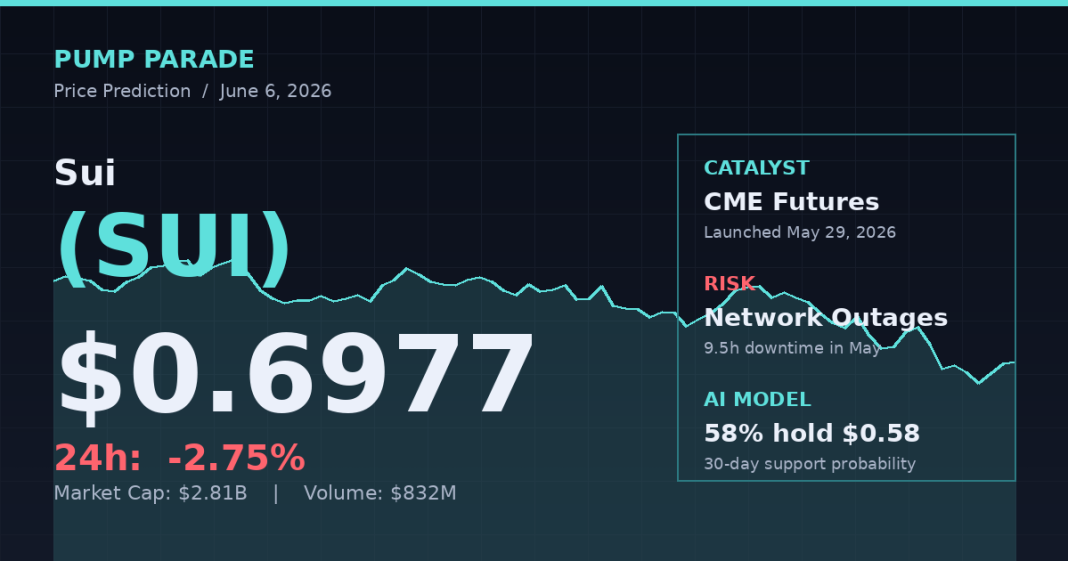
Sui is trading at $0.6977 at time of writing, down about 22% from $0.90 a week ago. That drop happened during what should have been a victory lap. On May 29, 2026, the CME Group launched regulated SUI futures, putting the token in a club that until 18 months ago held only Bitcoin and Ethereum.
Instead of a rally, SUI got rugged by its own network. Two outages totaling 9.5 hours hit the chain the same week. It was the third major incident since January. So the question for the rest of 2026 is simple: does institutional plumbing matter more than uptime?
Our AI model says it does, but not as much as the bulls want.
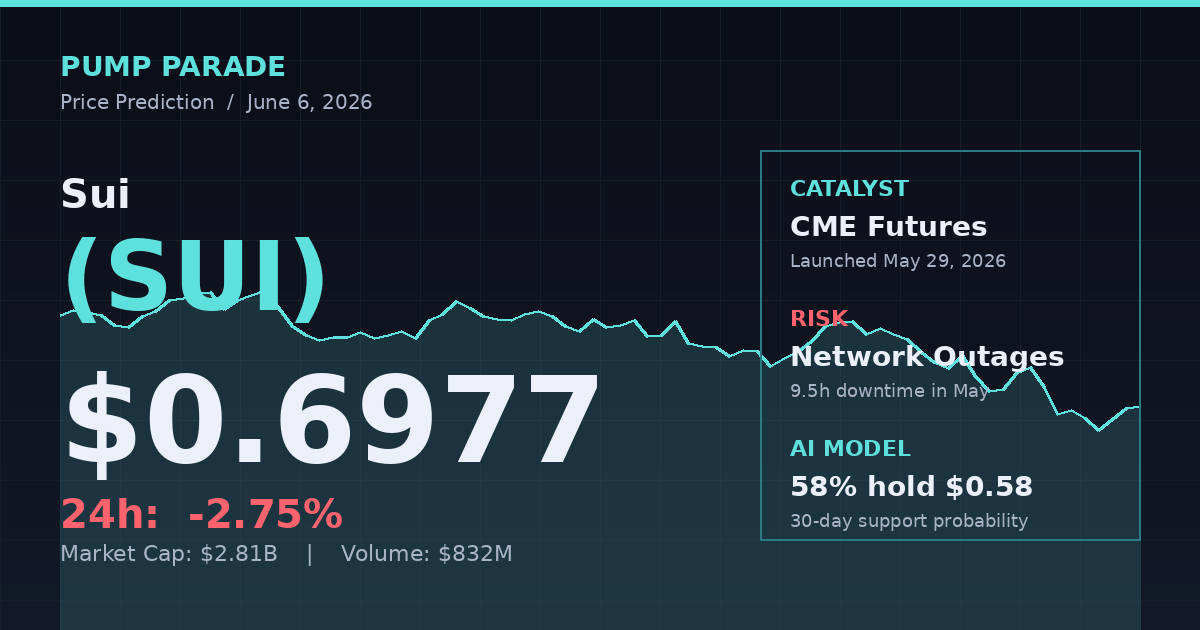
Sui (SUI) Overview: A Layer 1 With Real Throughput and Real Bugs
Sui is a Layer 1 blockchain built by ex-Meta engineers using the Move programming language. It targets high-throughput consumer apps: games, payments, social, and asset-heavy DeFi. The pitch is sub-second finality, parallel execution, and a developer experience that does not look like Solidity.
The numbers at time of writing:
- Price: $0.6977
- Market cap: $2.81B
- 24h volume: $832M
- 7-day change: roughly -22%
- Circulating supply: ~4.03B SUI
Sui has shipped product. It also has a reliability problem the team can no longer hand-wave away. The May outages came from a gas fee calculation bug introduced in the v1.72 client. The first stall lasted nearly six hours. The second knocked out block production for over three hours the next day. In plain terms: if you were running an app on Sui that week, your users could not do anything for most of a workday.
What Just Changed: CME Futures and the Institutional Stack
The CME listing is the biggest structural shift for SUI in 2026. Standard contracts cover 50,000 SUI. Micro contracts cover 5,000 SUI. Both settle to a dollar reference rate, which means hedge funds and prop desks can now short SUI without touching a crypto exchange.
SUI now has a full three-layer institutional access stack:
- Spot ETF: The 21Shares Spot SUI ETF (TSUI) already gives wealth managers passive exposure
- Regulated futures: CME contracts give active desks hedging and directional tools
- 24/7 derivatives: CME flipped all crypto futures and options to round-the-clock trading on May 29, killing the weekend gap institutions hated
Translation: SUI just joined the adult table. The question is whether that translates to price.
Historically, CME futures listings have produced short-term volatility followed by a 60-90 day digestion period. Bitcoin sold off after its CME listing in December 2017. Ethereum did the same in February 2021. The pattern is not iron law, but it is consistent enough that traders should expect chop before lift.
Technical Outlook: SUI Is at a Decision Zone
SUI is sitting on its 200-day moving average around $0.70. That level held three times in 2026 already. A clean break below opens the door to $0.58, which was the February low. A bounce here, with volume, sets up a retest of $0.90 and then $1.05.
Key levels worth watching:
- Support: $0.70 (200-day MA), $0.58 (Feb low), $0.42 (range floor)
- Resistance: $0.90 (recent high), $1.05 (Q1 peak), $1.40 (2025 all-time high zone)
The Relative Strength Index (RSI), a momentum indicator that runs from 0 to 100, sits near 38. That is approaching oversold territory but not there yet. The MACD (Moving Average Convergence Divergence), which tracks trend direction, just crossed bearish on the daily chart. Both indicators say: do not catch this knife yet, but the next bounce could be tradeable.
Our AI model assigns a 58% probability that SUI holds the $0.58 support level over the next 30 days, and a 42% probability of a deeper flush to $0.42 if the July 1 unlock spooks the market.
The Bull Case for SUI in 2026
The bull case is built on infrastructure adoption, not price action.
Institutional flows are the wildcard. The Hyperliquid ETF launched in May 2026 has been pulling net inflows even while Bitcoin ETFs bled $2.30B in May, the worst outflow month of the year. If TSUI follows that pattern, SUI gets a structural bid from wealth managers regardless of what crypto Twitter thinks.
The fix is shipping. The Sui team has rolled back the v1.72 client and patched the gas fee bug. The network has been stable for over 80 hours at time of writing. If the next 60 days pass without an incident, the reliability narrative shifts from “broken” to “fixed.”
The Move language story is real. Move-based chains, including SUI and Aptos, now host over $1.8B in total value locked. Developers are choosing Move for new consumer apps because the resource model makes asset-heavy code less prone to exploits. That is a multi-year trend, not a quarter-by-quarter story.
Bull case price targets:
- 30 days: $0.90 (retest of recent high)
- 6 months: $1.40 (2025 all-time high zone)
- 2027-2028: $2.80-$3.50 if SUI captures meaningful Layer 1 market share from Solana and other competitors
The Bear Case for SUI in 2026
The bear case is shorter and more uncomfortable.
Network outages are a trust killer. Three major incidents in five months is a pattern, not bad luck. Institutional allocators who just got the green light to trade SUI futures will pull back if the chain halts again. The next outage is the one that matters.
The July 1 unlock is real supply. Sui will release 13.72M tokens on July 1, worth roughly $9.6M at current prices. That is not catastrophic, but it lands at a moment when momentum is fragile. Unlocks during weak markets tend to extend downtrends.
CME futures cut both ways. Regulated futures give institutions a clean way to short SUI. Funding rates have already flipped negative on the new contracts. If the basis stays negative, that is the market telling you smart money is positioning bearish.
Layer 1 competition is brutal. Solana, Ethereum, and a wave of Move-based competitors are all chasing the same consumer-app developers. Sui needs differentiation to keep market share. Outages are the opposite of differentiation.
Bear case price targets:
- 30 days: $0.58 (Feb low retest)
- 6 months: $0.42 (range floor)
- 2027-2028: $0.30-$0.50 if Sui loses developer mindshare to competitors
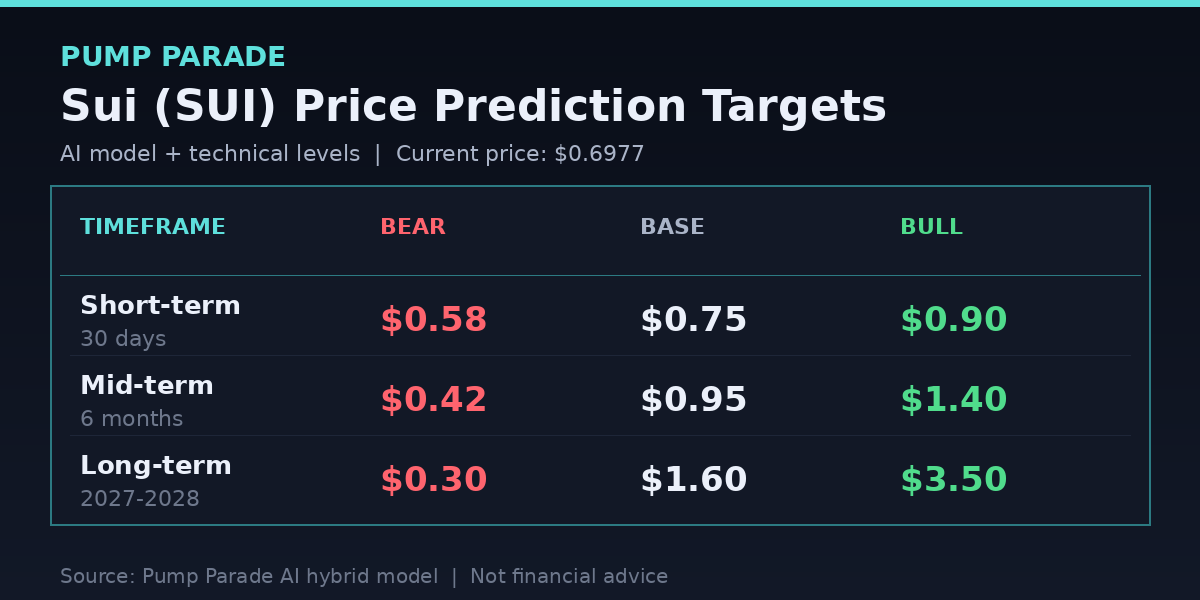
Sui (SUI) Price Prediction Summary
Here is how our AI model and on-chain signals stack up across timeframes:
| Timeframe | Bear Target | Base Target | Bull Target |
|---|---|---|---|
| Short-term (30 days) | $0.58 | $0.75 | $0.90 |
| Mid-term (6 months) | $0.42 | $0.95 | $1.40 |
| Long-term (2027-2028) | $0.30 | $1.60 | $3.50 |
The base case assumes Sui ships a stable client through Q3 2026, the July unlock gets absorbed without a 30% flush, and TSUI ETF inflows average $15M-$25M per week. None of those are guaranteed. All of them are plausible.
What to Watch Over the Next 60 Days
If you are tracking SUI, these are the variables that actually move the price:
- Uptime: Any outage longer than 60 minutes resets the reliability clock. Zero outages through July is the bull threshold.
- TSUI ETF flows: Weekly inflows above $20M would signal real institutional appetite. Outflows mean the listing was sold news.
- CME open interest: Sustained growth in open interest with positive funding is bullish. Negative funding plus rising OI means shorts are stacking.
- July 1 unlock: How the market absorbs 13.72M new SUI tokens tells you whether demand can match supply.
- The $0.70 level: A daily close below $0.65 with volume invalidates the bull case for Q3.
The Honest Take
SUI is one of the most interesting risk-reward setups in crypto right now. The institutional stack is real. The technology is strong. The team is shipping. And the chain keeps falling over at the worst possible moments.
This is not a token to chase on a green candle. It is a token to size carefully, with clear invalidation levels, and a plan for what you do if the network halts again. If you cannot stomach watching your position freeze for six hours, SUI is not your trade.
If you can, the setup is genuinely interesting. The infrastructure is being built. The supply pressure is finite. And the next outage-free quarter could re-rate the token in a way that bulls have been waiting for since Q1.
The data points to a coin priced for disappointment. Whether that disappointment shows up is the bet.
Disclaimer
Disclaimer: This article is for informational and educational purposes only and should not be construed as financial, investment, or trading advice. Cryptocurrency markets are highly volatile, and past performance does not guarantee future results. The price predictions and analyses presented here are based on AI models, technical indicators, and available data at the time of writing. They are not guarantees. Always conduct your own research (DYOR) and consult with a qualified financial advisor before making any investment decisions. Pump Parade and its authors do not assume liability for financial losses incurred based on information provided in this article.