The $317 billion stablecoin market is splitting along a fault line nobody expected — and two regulatory deadlines in July could make it permanent.
USDC now processes more transaction volume than USDT — despite having less than half the market cap.
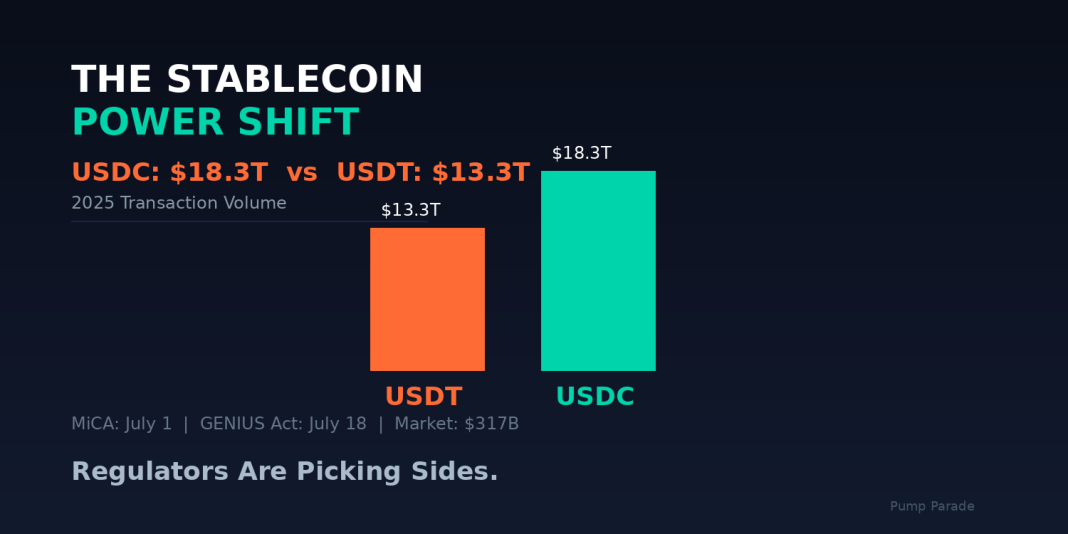
That’s not a typo. Circle’s stablecoin handled $18.3 trillion in transactions in 2025, compared to Tether’s $13.3 trillion. In 2026, the gap has widened: USDC captured 64% of adjusted volume between the two in Q1, processing roughly $2.2 trillion versus USDT’s $1.3 trillion in the same period. The stablecoin that spent six years as the clear #2 is now #1 by the metric that arguably matters most — actual usage.
And two regulatory deadlines hitting simultaneously in July 2026 could turn this volume flip into a structural shift that reshapes the entire $317 billion stablecoin market.
What the Volume Flip Actually Means
Market cap and transaction volume tell different stories, and both matter.
USDT still dominates supply: $184 billion in market cap versus USDC’s $77.5 billion. That’s a 2.4x gap. Tether has more tokens in circulation, more trading pairs on more exchanges, and deeper liquidity in most markets — particularly in Asia and emerging economies where it functions as a de facto dollar substitute.
But volume tells you who’s using stablecoins, not just who’s holding them. And the shift toward USDC in volume is driven by a specific cohort: institutions.
| Metric | USDT | USDC |
|---|---|---|
| Market Cap (Apr 2026) | ~$184B | ~$77.5B |
| 2025 Transaction Volume | $13.3T | $18.3T |
| Q1 2026 Adjusted Volume Share | ~36% | ~64% |
| Stablecoin Market Share (by supply) | ~58% | ~24.5% |
| MiCA Compliant | No | Yes |
| GENIUS Act Positioned | Unclear | Yes |
The divergence between market cap dominance and volume dominance isn’t a contradiction — it’s a signal. USDT is where retail holds dollars. USDC is where institutions move them. And as regulation arrives, that distinction is about to matter a lot more.
Why Institutions Chose USDC
Three factors explain the institutional preference, and none of them are about technology.
Regulatory posture. Circle is a US-based company, publicly traded on the NYSE (ticker: CRCL) since June 2025. Its reserves are audited by Deloitte, held in cash and short-term US Treasuries, and disclosed monthly. For institutional compliance teams, USDC checks every box. Tether, by contrast, operates from the British Virgin Islands, has faced persistent questions about reserve transparency, and has never completed a full independent audit — only periodic attestations.
Infrastructure integration. Coinbase, the largest US exchange, co-founded the Centre Consortium that created USDC. Every major US-regulated exchange and custodian supports USDC natively. For institutions already using Coinbase Prime or similar platforms, USDC is the path of least resistance.
European access. This is the emerging differentiator. USDC has obtained the Electronic Money Institution (EMI) authorization required under MiCA, the EU’s comprehensive crypto regulation. USDT has not. As of early 2025, Coinbase Europe, Binance, and other major exchanges have already delisted USDT for European Economic Area users. Circle’s compliance head start in Europe is now a concrete competitive advantage.
The GENIUS Act: When Banks Become Stablecoin Issuers
On February 25, 2026, the Office of the Comptroller of the Currency (OCC) published proposed rulemaking to implement the GENIUS Act — the Guiding and Establishing National Innovation for U.S. Stablecoins Act, signed into law in July 2025.
The proposed rules would create a comprehensive federal framework for “payment stablecoin issuers,” establishing requirements for licensing, reserves, custody, capital, redemption, and reporting. Issuers must maintain high-quality liquid assets — cash or short-term Treasuries — and honor redemption at par within two business days.
Here’s the part that changes the competitive landscape: the framework explicitly allows national banks to issue their own stablecoins.
JPMorgan already operates JPM Coin for institutional transfers. BNY Mellon has been expanding its digital asset custody capabilities. Under the GENIUS Act framework, these institutions — and dozens of other nationally chartered banks — could launch regulated, dollar-backed stablecoins that compete directly with USDC and USDT.
The comment period closes May 1, 2026. Final regulations are due by July 18, 2026. The Act takes full effect on January 18, 2027, or 120 days after final rules — whichever comes first.
For Circle, this is a double-edged sword. The GENIUS Act validates the regulated stablecoin model that Circle pioneered, but it also opens the door to competitors with deeper pockets and existing banking relationships. For Tether, the framework creates a compliance standard that its current structure doesn’t meet — and the clock is ticking.
MiCA’s July 1 Deadline: The European Squeeze
While the US builds its framework, Europe is enforcing one.
MiCA — the Markets in Crypto-Assets Regulation — entered force in stages starting December 2024. The final transition deadline arrives July 1, 2026, when all grandfathering periods expire. After that date, no crypto-asset service provider can operate in the EU without full MiCA authorization.
For stablecoins specifically, MiCA requires issuers of electronic money tokens (EMTs) to hold an EMI license in an EU member state, maintain segregated reserves, submit to ongoing supervision, and meet stringent transparency requirements.
Tether has not obtained an EMI license in any EU member state. The consequences are already visible: USDT has been delisted from EU-facing platforms including Coinbase Europe (December 2024) and Binance EEA (March 2025). After July 1, remaining holdouts lose their grace period.
USDC, by contrast, is MiCA-compliant. Circle obtained the necessary authorizations and positioned USDC as the default compliant stablecoin for European markets. In a region where regulatory compliance isn’t optional, that’s not a feature — it’s a moat.
The timing is striking: MiCA full enforcement on July 1. GENIUS Act final rules due July 18. Two regulatory frameworks, two deadlines, one month. The stablecoin market enters July 2026 one way and exits it another.
The Third Contender: Ethena’s USDe
While USDC and USDT dominate the headlines, a third model is quietly gaining traction.
Ethena’s USDe is a synthetic stablecoin — it doesn’t hold dollar reserves at all. Instead, it maintains its peg through a delta-neutral strategy: holding crypto assets (primarily ETH and BTC) while shorting equivalent perpetual futures positions. The yield from funding rates gets passed to holders, making USDe a yield-bearing stablecoin.
USDe surged to over $14 billion in market cap during 2025, capturing nearly 5% of the total stablecoin market at its peak. A deleveraging event in Q4 2025 brought supply down to approximately $5.9 billion by March 2026 — still the fifth-largest stablecoin globally.
The model is innovative. It’s also untested in a true black swan. A simultaneous crash in spot crypto prices and a spike in funding rates could pressure the delta-neutral position in ways the protocol hasn’t experienced. Kraken Custody was appointed as institutional custodian for USDe’s reserves in January 2026, adding a layer of institutional credibility — but the fundamental risk profile remains different from reserve-backed stablecoins.
Bull and Bear: Where Each Stands
USDC
The bull case: Regulatory tailwinds on two continents. MiCA compliance gives USDC a monopoly-like position in EU stablecoin markets. The GENIUS Act validates the regulated model Circle built. Institutional volume is accelerating — 64% of adjusted volume in Q1 2026. Circle is public, audited, and transparent.
The bear case: Bank-issued stablecoins under the GENIUS Act could erode USDC’s institutional share. Circle’s stock has dropped roughly 70% from its June 2025 peak, raising questions about the company’s revenue model (USDC generates income from reserves, but interest rate cuts compress margins). And USDC’s dominance is concentrated in institutional and DeFi use cases — it hasn’t cracked the retail and emerging market corridors where USDT thrives.
USDT
The bull case: Network effects are real. $184 billion in market cap, the deepest liquidity across global exchanges, and dominant position in emerging markets where regulatory compliance is less relevant than dollar access. Tether generated over $13 billion in profit in 2024 from reserve yields. The company isn’t going anywhere.
The bear case: The regulatory walls are closing. Delisted from EU exchanges, unclear positioning under the GENIUS Act, and persistent reserve transparency concerns that institutional compliance teams can’t overlook. Every new regulation that requires audited reserves and licensed issuers is a regulation that favors Circle’s model over Tether’s.
USDe
The bull case: Yield-bearing stablecoins are a genuinely new primitive. In a market where USDC and USDT earn nothing for holders, USDe passes funding rate yields through. Expanding to seven chains including Solana and Hyperliquid. Kraken Custody adds institutional credibility.
The bear case: Untested in a real crisis. The delta-neutral strategy depends on functioning perpetual futures markets — the same markets that can seize up during extreme volatility. A 58% supply contraction from peak ($14B to $5.9B) in three months shows how quickly capital exits when confidence wavers.
The Takeaway
The stablecoin market isn’t just growing — it’s stratifying. USDT dominates supply and retail access. USDC dominates institutional volume and regulatory compliance. USDe is carving a niche as the yield-bearing alternative. And in July 2026, two regulatory frameworks land simultaneously, potentially hardening these divisions into permanent market structure.
For traders, the practical question isn’t which stablecoin is “best” — it’s which one matches your use case. If you’re trading on EU-regulated platforms, USDC is increasingly your only compliant option. If you need deep liquidity on global exchanges, USDT remains unmatched. If you want your stablecoins earning yield (and accept the smart contract risk), USDe is worth researching.
The volume flip from USDT to USDC isn’t a fluke — it’s the market pricing in a regulatory future that’s now three months away.
Disclaimer: This article is for informational and educational purposes only and should not be construed as financial, investment, or trading advice. Cryptocurrency markets are highly volatile, and past performance does not guarantee future results. The analyses presented here are based on AI models, technical indicators, and available data at the time of writing — they are not guarantees. Always conduct your own research (DYOR) and consult with a qualified financial advisor before making any investment decisions. Pump Parade and its authors do not assume liability for financial losses incurred based on information provided in this article.
Research Sources
- Analytics Insight: USDC Leads Stablecoin Transactions, Captures 64% of Adjusted Volume in 2026
- MEXC: USDC Overtook USDT in Adjusted YTD Volume, Says Mizuho
- Crypto Times: Stablecoin Market Hits $317B Amid $1.36B Weekly Inflows
- Sullivan & Cromwell: GENIUS Act — OCC Proposed Rules
- OCC: Proposed Rulemaking to Implement GENIUS Act
- Gibson Dunn: OCC Proposes Comprehensive Stablecoin Regulatory Framework
- CCN: USDT Delisting in Europe — MiCA-Compliant Alternatives
- Stablecoin Insider: Ethena’s USDe Q1 2026 Report
- The Block: Ethena’s USDe Jumps to Third-Largest Stablecoin
- Stablecoin Insider: 50 Stablecoin Statistics That Matter in 2026
- Motley Fool: USDT vs USDC — Which Will Win the Stablecoin Race?
Pump Parade is an AI-powered crypto research platform. We combine real-time price predictions, technical analysis tools, and editorial content to help traders make smarter, data-backed decisions.
Try our tools → pumpparade.com | Follow us → @PumpParade