

The stablecoin market just posted its biggest quarter ever. But the real story isn’t the volume – it’s who’s generating it.
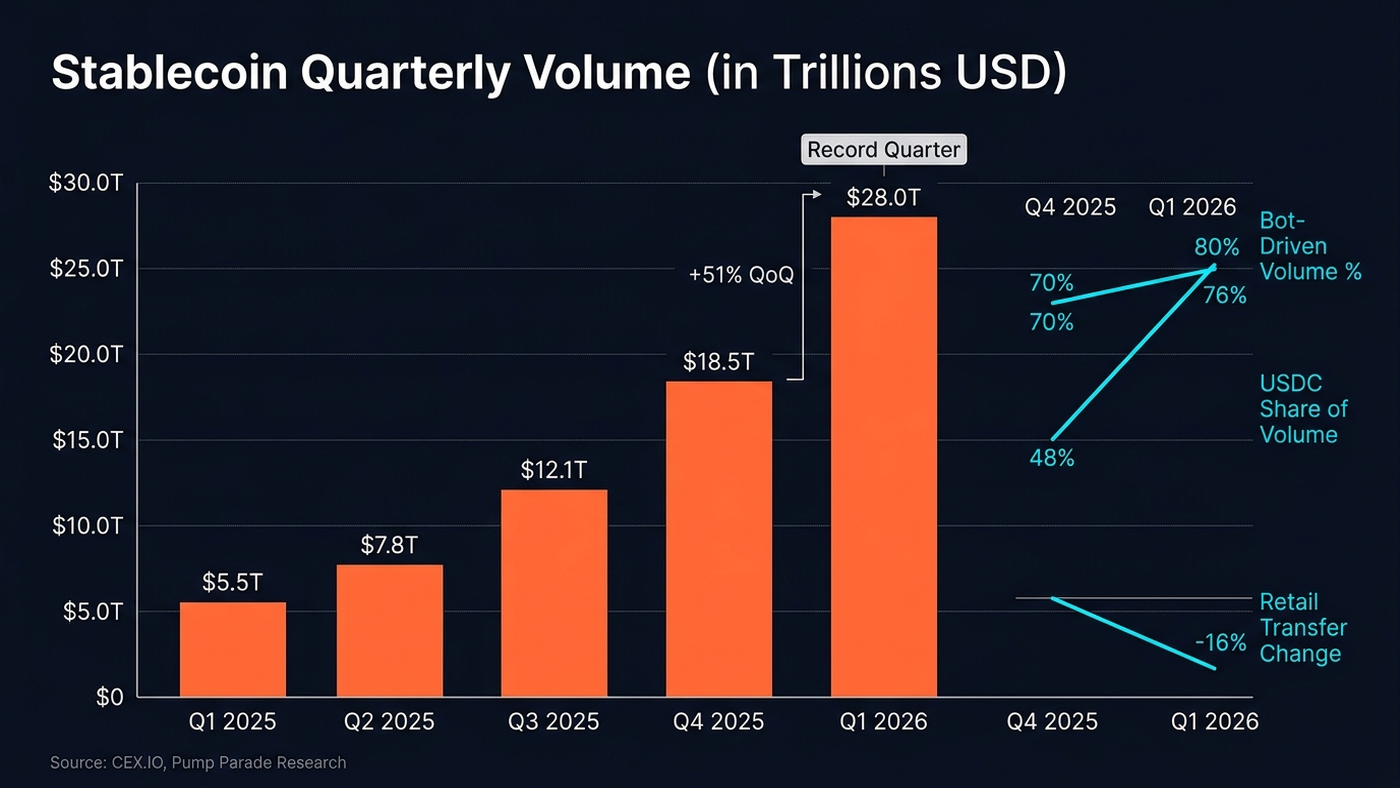
Twenty-eight trillion dollars. That’s how much value moved through stablecoins in the first quarter of 2026 – a 51% jump from Q4 2025 and more than the GDP of every country on Earth except the United States and China. In a single quarter, stablecoins processed nearly double Visa’s entire annual transaction volume.
And yet, here’s the number that should actually stop you: 76% of that volume was generated by bots.
Not people sending money. Not remittance users in Lagos or traders in Seoul. Bots – arbitrage algorithms, MEV extractors, automated settlement engines, and DeFi yield optimizers running 24/7 across Ethereum, Tron, and Solana. Meanwhile, retail stablecoin transfers dropped 16% in Q1, the steepest decline on record. The stablecoin economy is booming. The human stablecoin economy is shrinking.
This isn’t a scandal. It’s a structural transformation – and it changes what “stablecoin adoption” actually means.
The Quarter in Context
Stablecoin transaction volume hit $28 trillion in Q1 2026, according to CEX.IO’s quarterly report. For context, total stablecoin volume for all of 2025 was $33 trillion. We’re on pace to nearly quadruple that in 2026.
Total stablecoin supply crossed $315 billion by the end of Q1 and has since pushed past $320 billion as of mid-April 2026. Stablecoin trading volume accounted for 75% of all crypto trading volume in Q1 – the highest share ever recorded.
The growth isn’t spread evenly. USDC had a breakout quarter. USDT didn’t.
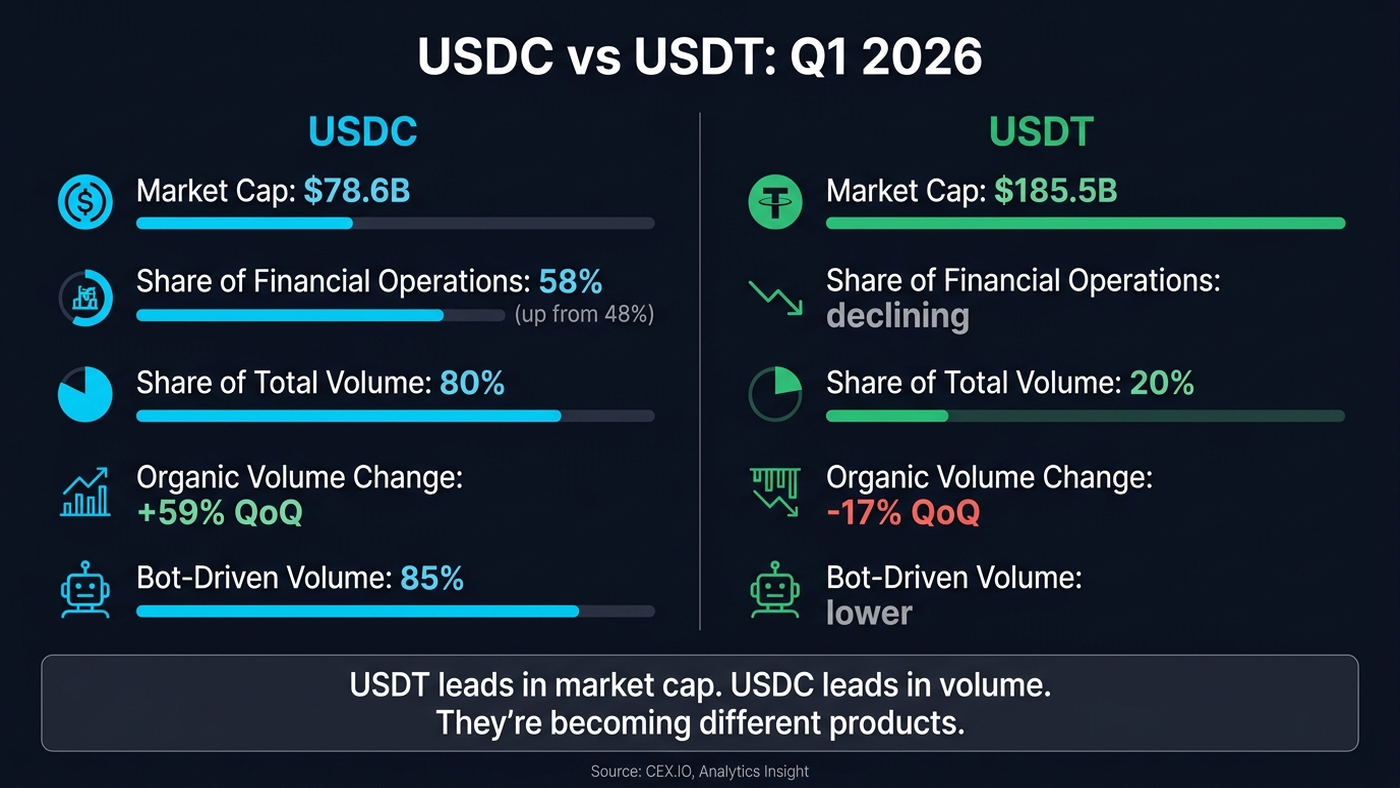
USDC’s share of stablecoin financial operations surged from 48% to 58% in a single quarter. It now handles 80% of total transaction volume despite having less than half of USDT’s market cap. For the first time since 2019, USDC overtook USDT in organic (adjusted) transaction volume, capturing roughly 63% of organic volume on an annualized basis, per Analytics Insight.
USDT’s organic volume, meanwhile, declined 17% – one of its steepest drops on record.
The volume-versus-market-cap divergence is the story here. USDT remains dominant in raw supply. But USDC is becoming the default rails for institutional settlement and automated infrastructure.
The Bot Economy Nobody’s Talking About
Here’s where the data gets interesting – and uncomfortable.
Approximately 76% of all stablecoin transaction volume in Q1 2026 was bot-driven, up from 70% in Q4 2025 and the highest level since Q2 2024. For USDC specifically, the number is even starker: 85% of its volume comes from automated systems.
Ethereum recorded its highest-ever level of bot-driven stablecoin activity at 72%. Tron hit 54%. Both were all-time highs.
What are these bots actually doing?
They’re not wash trading or manipulating prices (though some inevitably are). The majority of bot-driven stablecoin volume falls into a few categories: arbitrage across DEX pools and CEX order books, MEV (Maximal Extractable Value) extraction on Ethereum, automated DeFi yield optimization and vault rebalancing, institutional settlement and treasury management, and increasingly, AI agent wallet transactions – autonomous software agents using stablecoins to pay for compute, data, and services.
This is infrastructure activity. The same way high-frequency trading dominates traditional equity markets (estimates suggest 50-70% of US stock volume is algorithmic), stablecoins are becoming the settlement layer for an increasingly automated financial system.
The uncomfortable implication: when someone cites “$28 trillion in stablecoin volume” as proof of mainstream adoption, they need an asterisk. The volume is real. The growth is real. But the majority of it represents machine-to-machine transactions, not person-to-person payments.
Retail is moving in the opposite direction. Retail-sized stablecoin transfers fell 16% in Q1 2026 – the largest decline on record, per CEX.IO’s data. Fewer individual humans are transacting with stablecoins even as total volume hits record highs. The gap between infrastructure adoption and consumer adoption is widening, not closing.
USDC vs. USDT: They’re Becoming Different Products
The volume flip tells a bigger story than which stablecoin is “winning.” USDC and USDT are diverging into functionally different products serving different markets.
USDC is becoming institutional plumbing. Its dominance in bot-driven volume (85%), its regulatory positioning under the incoming GENIUS Act framework (Circle is a US-regulated entity), and its growing use in automated settlement make it the default for institutional and programmatic use cases. When banks, trading firms, and DeFi protocols need a stablecoin that won’t create regulatory headaches, they reach for USDC.
USDT remains the retail and emerging-market standard. Its $185 billion market cap – more than double USDC’s – reflects its dominance in retail trading pairs on centralized exchanges and its role in cross-border remittances, particularly across Asia, Africa, and Latin America. In markets where regulatory clarity matters less than availability and liquidity, USDT is still king.
The regulatory landscape is accelerating this split. The GENIUS Act – which saw new proposed rules from both the FDIC and Treasury in April 2026 – establishes a federal framework for “permitted payment stablecoin issuers” with strict reserve, redemption, and AML requirements. The FDIC’s April 7 proposal requires stablecoin redemption within two business days and mandates custodial safekeeping standards. Circle, already US-regulated, is positioned to comply seamlessly. Tether, incorporated in the British Virgin Islands, faces a different calculation.
Meanwhile in the EU, MiCA enforcement has already pushed USDT off European exchanges. As both frameworks tighten through 2026, the USDC-for-institutions, USDT-for-retail split will likely deepen.
Where the Stablecoins Live
The chain distribution of stablecoin supply adds another layer to this story.
Ethereum still holds the majority of stablecoin supply – roughly $180 billion – but it’s bleeding outflows. In February 2026, Ethereum recorded its largest net stablecoin outflow on record, losing over $2 billion. Tron, by contrast, added $1.6 billion in the same month, driven almost entirely by USDT.
Solana quietly emerged as the second-largest net gainer, adding an estimated $700-900 million in stablecoin supply in February – though the Drift Protocol exploit in April ($285 million drained) may cool institutional confidence in Solana DeFi near-term.
The chain story mirrors the USDC/USDT split: Ethereum and its L2s (particularly Base) are becoming USDC’s domain. Tron is USDT territory. Solana is contested ground.
The Bull Case and the Bear Case
The bull case is structural.
$28 trillion in quarterly volume isn’t speculation – it’s infrastructure adoption. Stablecoins now process more value per quarter than Visa handles in an entire year (Visa’s fiscal year 2025 volume was approximately $16.7 trillion). The GENIUS Act and MiCA are bringing regulatory clarity that will attract bank-issued stablecoins and institutional capital. Bot-driven volume isn’t fake – it’s the foundation of a programmable financial system. And the shift is accelerating: stablecoin supply grew $8 billion in Q1 alone, pushing past $315 billion.
The conviction version: stablecoins are becoming the settlement layer of digital finance, and Q1 2026 is the quarter the data made that undeniable.
The bear case is compositional.
When 76% of volume is automated and retail transfers are declining at record pace, “adoption” doesn’t mean what most people think it means. If bot activity contracts – whether from regulatory crackdowns on MEV, a DeFi volume decline, or reduced arbitrage opportunities in a less volatile market – the headline volume numbers could drop dramatically. High automation also concentrates value extraction in sophisticated operators, not everyday users. The stablecoin economy is growing, but the benefits are accruing disproportionately to infrastructure players, not the retail users that adoption narratives typically promise.
And there’s a fragility risk: USDC’s 80% volume share means a single regulatory action against Circle – or a technical failure on Ethereum – could disrupt the majority of stablecoin settlement.
The Takeaway
The $28 trillion quarter is real, and it matters. Stablecoins are no longer an experiment – they’re processing more value than most traditional financial networks. But the composition of that volume should change how we talk about stablecoin adoption.
When three-quarters of the volume is bots and retail activity is declining, the stablecoin revolution is real – it’s just not the one that was advertised. It’s an infrastructure revolution, not a payments revolution. At least, not yet.
The traders, builders, and holders who understand the difference between headline volume and organic adoption will be better positioned as both the GENIUS Act and MiCA reshape the rules this summer.
Stablecoins aren’t replacing banks. They’re becoming the plumbing that banks, bots, and protocols all run on. That’s arguably more important – even if it’s less exciting to tweet about.
Related: USDC Just Passed USDT in Volume. Now Regulators Are Picking Sides.
Disclaimer: This article is for informational and educational purposes only and should not be construed as financial, investment, or trading advice. Cryptocurrency markets are highly volatile, and past performance does not guarantee future results. The analyses presented here are based on AI models, technical indicators, and available data at the time of writing – they are not guarantees. Always conduct your own research (DYOR) and consult with a qualified financial advisor before making any investment decisions. Pump Parade and its authors do not assume liability for financial losses incurred based on information provided in this article.
Research Sources
- CEX.IO: Stablecoins in Q1 2026 – Rising Similarities With 2022
- Analytics Insight: USDC Leads Stablecoin Transactions, Captures 64% of Adjusted Volume
- KuCoin: Stablecoin Supply Reaches $315B in Q1 2026
- Bitcoin.com: Stablecoin Market Crosses $320B
- Bitcoin.com: Adjusted Stablecoin Volume Shows USDC Outpacing USDT
- FDIC: Notice of Proposed Rulemaking – GENIUS Act Requirements
- Treasury: NPRM on State Oversight of Stablecoin Issuers
- MEXC: Tron Led Stablecoin Growth in February
- CoinGecko: Stablecoins by Market Cap
- Phemex: Stablecoins Surpass Visa with $33 Trillion Processed in 2025
Pump Parade is an AI-powered crypto research platform. We combine real-time price predictions, technical analysis tools, and editorial content to help traders make smarter, data-backed decisions.
Try our tools: pumpparade.com | Follow us: @PumpParade