If you trade derivatives on Solana, you have probably heard of Drift Protocol. It is one of the largest decentralized perpetual futures exchanges on the network, with billions in cumulative volume and a unified margin engine that lets you trade perps, spot, and lending from a single account. But 2026 has not been kind. After a $285 million exploit in April that drained more than half of the protocol’s TVL, traders are asking the obvious question: is Drift still worth using?
This Drift Protocol review covers what the platform actually offers in 2026, how its fees and leverage compare, what the recent security incident really means for users, and whether you should put real capital on the line today.
TL;DR Verdict
Rating: 3.7 / 5
Drift remains the most feature-complete on-chain perps venue on Solana. The unified cross-margin design, JIT auction model, and tight execution times are genuinely best-in-class for a DEX. Fees are competitive once DRIFT staking discounts kick in, and traders get up to 101x leverage on perps with deep liquidity in BTC, ETH, and SOL markets. The April 2026 exploit, however, is a serious mark against the protocol. The team has secured roughly $147.5M in recovery support from Tether and partners, is rebuilding the codebase with OtterSec and Asymmetric Research audits, and is rolling out a community-governed multisig. New users should size positions cautiously while the relaunched stack proves itself in production. Power users who already understand the platform will find Drift’s tooling hard to beat anywhere else on Solana.
What is Drift Protocol?
Drift is a decentralized trading protocol built on Solana that bundles perpetual futures, spot trading, and a lend and borrow market into one cross-margined account. Every asset you deposit can act as collateral, earn yield through the borrow market, or back a leveraged perp position, without the constant juggling required on most other DEXs.
The team launched the original v1 product in late 2021 and shipped a major v2 redesign that introduced an on-chain orderbook and a Just-in-Time (JIT) liquidity auction model. The current v3 stack pushed execution further, with an internal write up describing fills on roughly 85% of market orders within a single Solana slot (about 400 milliseconds) and slippage on large orders compressed to as little as 2 basis points. For an on-chain perps venue, that level of execution quality is unusual.
By the end of Q1 2026, Drift had crossed 175,000 unique traders and more than $150 billion in cumulative trading volume, making it the dominant perps DEX in the Solana ecosystem and one of the larger derivatives venues across all of crypto.
Drift Protocol Key Stats at a Glance
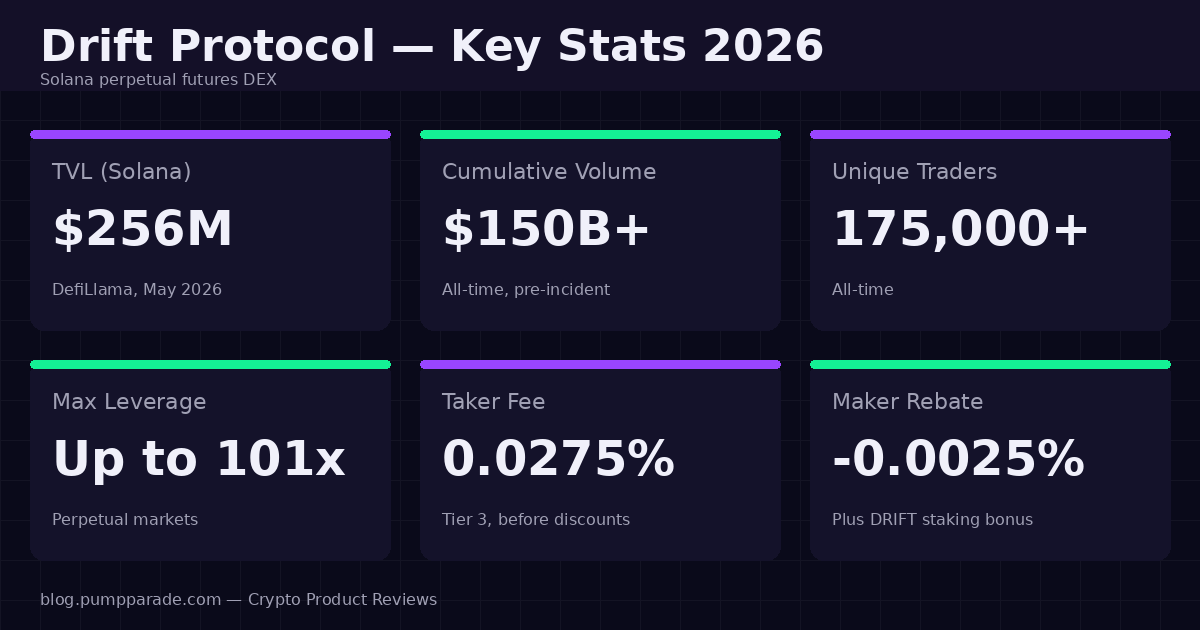
Two notes on these numbers. TVL of around $256 million reflects the post-exploit reality, down from roughly $550 million before April 1, 2026. Volume and trader counts are cumulative and largely pre-incident. Fee numbers are the starting Tier 3 rate before any DRIFT staking discounts are applied.
Features Deep Dive
Unified Cross-Margin Account
The headline feature is also the one most users underestimate. On Drift, your spot balances, lending positions, and perp collateral all live in the same risk engine. Deposit SOL and it earns lending yield, serves as margin for a long ETH-PERP, and can be borrowed against to short a memecoin in spot, all at the same time. The cross-margin design is closer to what professional CEX traders are used to than to the siloed sub-account model on most DEXs.
Perpetual Futures with up to 101x Leverage
Drift supports perps on the major reference assets (BTC, ETH, SOL) plus a long tail of Solana ecosystem and altcoin markets. Leverage tops out at 101x on certain perp markets, with risk parameters tuned per market. Funding payments use a standard predictive funding model so positions are pulled toward the index price over time.
Spot Markets and Margin Trading
Spot trading is available with up to 5x leverage by borrowing against deposited collateral. Because spot and perps share the same orderbook architecture and JIT auction, fills tend to be tight even on smaller assets relative to AMM-only venues.
Just-in-Time (JIT) Liquidity
Every market order on Drift kicks off a roughly 5-second Dutch auction. Market makers compete to fill the order at or better than the auction price, which decays from the better side of the book toward a worse end price. The model means retail orders frequently fill inside the visible spread, and it lets professional makers participate without needing to maintain dense passive orderbook quotes.
Lending and Borrowing
The same vault that backs perp settlement also runs a spot lending market. Suppliers earn variable yield, borrowers pay interest, and rates are set algorithmically based on utilization. For traders, this means you can carry idle stablecoins on Drift and earn while waiting to deploy.
Vaults and Strategies
Drift Vaults let users delegate capital to professional managers running market making, basis trading, and other quant strategies on the platform. It is a passive way to participate in Drift if you do not want to actively trade.
Fees and Pricing
Drift uses a tiered taker and maker fee schedule based on 30-day volume and DRIFT staking. The starting rates for retail traders look like this:
- Taker fee: 0.0275% on perps at Tier 3 (the entry tier). With the 20% DRIFT staking discount applied, the effective rate falls to roughly 0.022%.
- Maker rebate: -0.0025% at the entry tier, which becomes -0.003% with the staking discount. Stakers can stack up to 40% extra rebates on top.
- Spot trading: Spot taker fees are typically lower than perps, with details varying per market.
- Borrow rates: Algorithmic and variable, set per asset by utilization curves.
For comparison, most centralized exchanges charge taker fees in the 0.04% to 0.075% range for retail tiers, so Drift undercuts CEX taker fees by a meaningful margin once you factor in DRIFT staking. Maker rebates on Drift are unusual for a DEX and one of the reasons professional market makers have stayed engaged.
The catch is that fee discounts via DRIFT staking only apply to perpetual contract fees, not to spot or lending. Active perp traders get most of the benefit.
The April 2026 Exploit and What Comes Next
Any honest Drift review in 2026 has to address the elephant in the room. On April 1, 2026, attackers drained roughly $285 million from the protocol in about 12 minutes, making it the largest DeFi hack of the year and the second largest security incident in Solana history.
The exploit was not a smart contract bug in the strict sense. According to incident reports, North Korean DPRK-linked actors spent roughly six months socially engineering Drift contributors, eventually compromising developer devices through a malicious code repository and a fake TestFlight build. They then pushed code that listed a fake collateral token (CarbonVote / CVT), inflated its valuation through manipulated oracles, and used it as bogus margin to drain real assets from the vaults.
Drift’s TVL fell from about $550 million to roughly $252 million in the immediate aftermath. To stabilize the protocol, the team announced a recovery package totaling around $147.5 million, with Tether contributing up to $127.5 million and other partners providing an additional $20 million. The structure includes a $100 million revenue-linked credit facility, an ecosystem grant, and dedicated loans to market makers to restore order book depth.
For users, the most important developments are operational rather than financial. Before the relaunched stack goes live, every protocol component will be re-audited by OtterSec and Asymmetric Research. Drift is also introducing a community-governed multisig for core protocol assets, with all signers required to use dedicated devices and verify transaction content outside the primary signing interface. Solana Foundation simultaneously rolled out a broader security overhaul for the ecosystem in the wake of the incident, which is covered in our breakdown of the STRIDE security framework.
None of this fully erases the incident. But the response so far has been credible: clear public communication, a real recovery package, independent audits, and material changes to operational security.
Pros and Cons
Pros
- Best-in-class on-chain execution. Sub-second fills, 2 bps slippage on large orders, and JIT auctions that often improve on visible spreads.
- True unified cross-margin. Spot, perps, and lending share collateral in one risk engine, similar to professional CEX accounts.
- Deep liquidity in major perps markets. BTC, ETH, and SOL perps consistently rank among the deepest on-chain order books on Solana.
- Competitive fees. Taker fees as low as 0.022% with DRIFT staking, plus genuine maker rebates.
- Transparent recovery process. The team has communicated clearly post-incident and brought in OtterSec and Asymmetric Research for full re-audits.
- No KYC. Like most Solana DEXs, Drift is permissionless: connect a wallet and trade.
Cons
- Recent $285M exploit. The April 2026 incident is significant and any user should consider counterparty and protocol risk before allocating large size.
- Complex for beginners. Cross-margin, JIT auctions, and 101x leverage are powerful but easy to misuse if you are new to derivatives.
- Reliance on Solana uptime. Solana network congestion or outages directly affect trading and liquidations on Drift.
- DRIFT staking discounts only apply to perps. Spot and lending do not benefit from the staking program.
- UI density. The trading UI is information-rich, which is great for power users but can overwhelm casual traders.
Security and Trust
Pre-incident, Drift had been audited multiple times and operated for years without a major exploit. The April 2026 attack exploited human and operational weaknesses rather than a single vulnerability in the audited contract logic, which is part of why the recovery plan focuses heavily on signer hygiene, dedicated devices, and a community-governed multisig in addition to fresh code audits.
OtterSec, one of the most respected Solana security firms, is leading the codebase redesign and pre-launch audit. Asymmetric Research is conducting a parallel independent review. Both firms will sign off before the relaunched stack goes live.
For traders, the practical implication is that the recovered protocol should be treated as a new system on its first lap. Start with smaller size, monitor the relaunch closely, and watch for the audit reports to become public.
User Experience
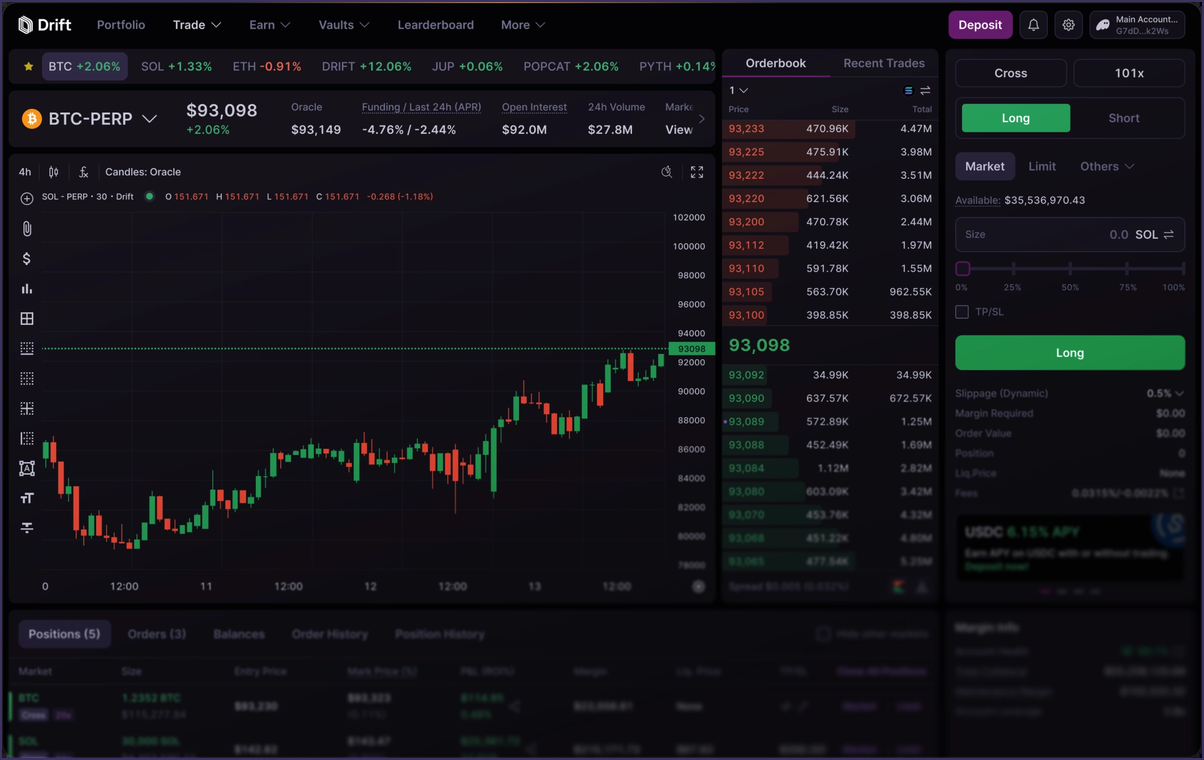
Drift’s web app is one of the more polished trading UIs on Solana. The default layout shows the orderbook, recent fills, and a clean chart from the same provider many CEXs use, with cross-margin balances and open positions docked along the bottom. Order entry supports market, limit, scaled, and trigger orders, and the JIT auction is exposed transparently so you can watch fills land inside the spread.
Mobile users can install the Drift app via TestFlight on iOS or progressive web app on Android. Wallet support covers all major Solana wallets, including Solflare, Phantom, and Backpack. For spot swaps, Drift integrates aggregator routing similar to other Solana venues, so smaller markets are still tradeable with reasonable execution. If you are choosing between spot DEXs first, our Raydium vs Orca comparison covers the AMM side in more depth.
Who Should Use Drift in 2026?
Drift is a strong fit for traders who want serious on-chain derivatives without giving up custody, want to run cross-margin strategies that combine perps and spot, or want to earn maker rebates as a smaller market participant. It is also a fit for passive users who want to allocate to vetted vault strategies.
It is less of a fit for absolute beginners, traders who only need simple spot swaps, or anyone who wants zero-risk exposure to a protocol that is still digesting a major incident. If you fall into the last group, consider sitting on the sidelines until the relaunched audited stack has been live in production for a meaningful period.
Final Verdict
Drift Protocol is, on the merits, still the best on-chain perps platform on Solana in 2026. The unified margin design, JIT execution, deep liquidity, and competitive fee structure are unmatched among native Solana DEXs. The April 2026 exploit is real, painful, and should not be downplayed, but the team’s response (a substantial Tether-anchored recovery package, dual independent audits, and structural changes to operational security) is about as good as a post-incident response gets in DeFi.
Score: 3.7 / 5. Use it, but size positions appropriately while the relaunched stack proves itself.
FAQ
Is Drift Protocol safe to use after the April 2026 exploit?
The protocol has secured a roughly $147.5M recovery package backed by Tether and partners and is re-auditing its codebase with OtterSec and Asymmetric Research before relaunching. It is reasonable to use the platform with appropriately sized positions, but treat the relaunched stack as a new system on its first laps and monitor closely.
What is the maximum leverage on Drift?
Drift offers up to 101x leverage on perpetual contracts and up to 5x leverage on spot trades, with risk parameters and effective leverage varying per market.
How much does it cost to trade on Drift?
Entry-tier perp taker fees are 0.0275% with maker rebates of -0.0025%. Staking DRIFT can lower taker fees by up to 20% and stack additional maker rebates by up to 40% on top of the standard schedule.
What chains does Drift support?
Drift is a Solana-native protocol. All trading, lending, and settlement happens on Solana, so you will need a Solana wallet and SOL for transaction fees.
How does Drift compare to Hyperliquid or dYdX?
Hyperliquid and dYdX run on their own chains and offer competitive perps with their own appchain trade-offs. Drift’s edge is being the leading perps venue native to Solana, which means tight integration with the broader Solana DeFi stack, including liquid staking tokens like the ones covered in our Marinade vs Jito comparison. If you live in the Solana ecosystem, Drift is the obvious choice. If you do not, the comparison gets closer.
Disclaimer: This article is for informational purposes only and does not constitute financial or investment advice. Trading derivatives is high risk and can result in the loss of all deposited capital. Always do your own research before using any DeFi protocol.