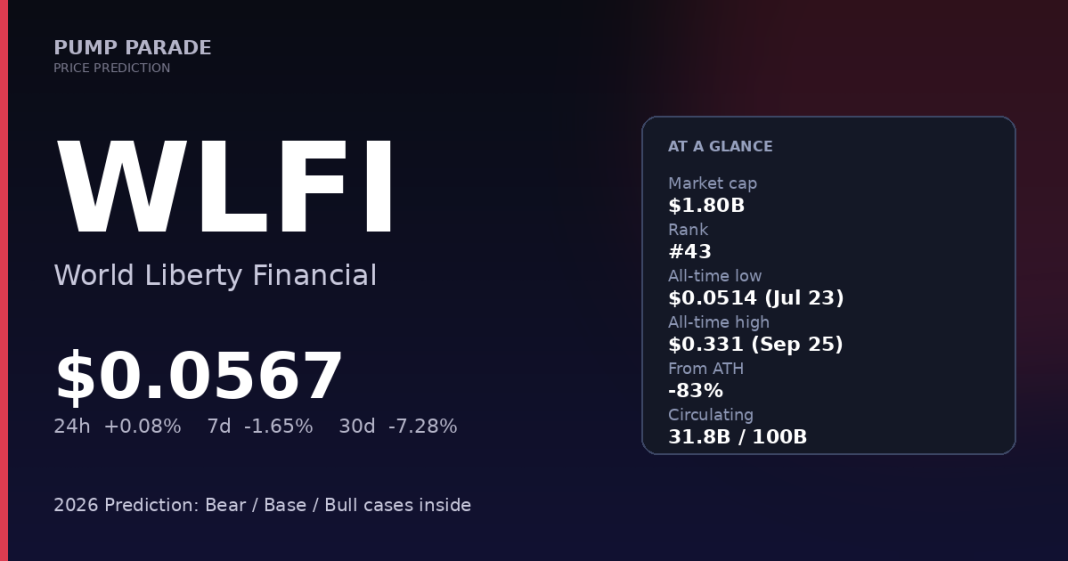
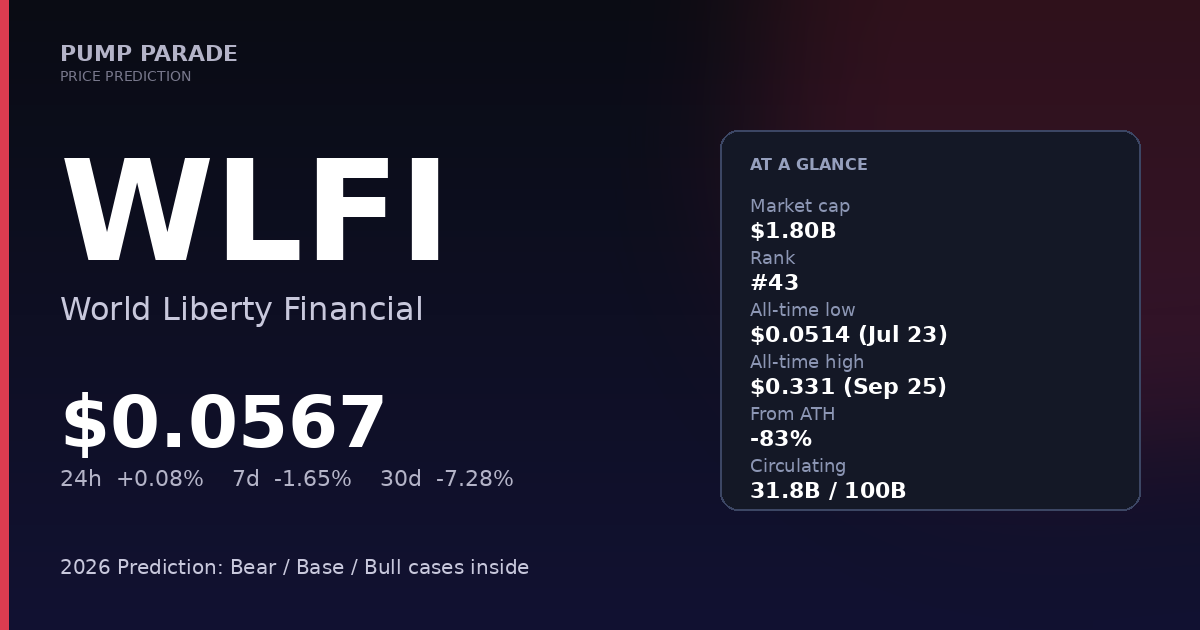
The WLFI price prediction 2026 question just got a lot more interesting. World Liberty Financial hit an all-time low of $0.0514 on July 23, down 83% from its September 2025 peak of $0.331. As of July 25, 2026, WLFI trades at $0.0567 with a $1.80 billion market cap, ranking 43rd by capitalization on CoinGecko. Volume clocks in at $49.6 million over the last 24 hours, thin for a token this politically loaded.
Here is the setup nobody wanted to write about. The token behind the Trump family’s DeFi venture is bleeding, its USD1 stablecoin is quietly scaling past $4.6 billion in circulation, and a 62 billion token unlock is now grinding through vesting schedules. Bulls see a bottom. Bears see the start of a longer capitulation.
This article breaks down where WLFI stands today, why the price is where it is, the bull and bear cases you can actually defend with data, our 2026 targets across three timeframes, how WLFI stacks up against Aave, and the specific triggers that would change our view.
Key Takeaways
- WLFI trades at $0.0567 after hitting an all-time low of $0.0514 on July 23, 2026, down 83% from its ATH.
- USD1, the WLFI-issued stablecoin, has grown to roughly $4.6 billion in circulation and now ranks 7th among all stablecoins.
- A governance proposal passed in April 2026 with 99.5% support, unlocking 62 billion tokens under structured vesting: insiders face a 2-year cliff plus 2-year linear vest, with 10% of team allocation burned.
- Our base case sees WLFI at $0.095 by year-end 2026, with a bull case at $0.150 and a bear case at $0.038.
- The single biggest risk is not price. It is concentration: only 31.8B of 100B total supply is circulating, and future unlocks could dwarf current daily volume.
- Political tailwinds cut both ways. WLFI benefits from a friendlier US regulatory tone but carries reputation risk that most tokens do not.
Where WLFI Stands Today
Before we forecast anything, let’s look at the numbers. All figures are pulled from CoinGecko and CoinMarketCap on July 25, 2026, unless noted otherwise.
| Metric | Value |
|---|---|
| Price | $0.0567 |
| 24h change | +0.08% |
| 7d change | -1.65% |
| 30d change | -7.28% |
| Market cap | $1.80B |
| Fully diluted valuation | $5.66B |
| 24h volume | $49.6M |
| Rank | #43 |
| Circulating supply | 31.77B / 100B (31.8%) |
| All-time high | $0.331 (Sep 1, 2025) |
| All-time low | $0.0514 (Jul 23, 2026) |
| % from ATH | -83% |
Two numbers stand out. The market cap is $1.80B, but the fully diluted valuation is $5.66B. That gap is the story. A little under 32% of the total supply is in circulation, which means every future unlock either has to find fresh demand or push price lower. The 24-hour volume of $49.6M is also modest for a top-50 token. Compare that to Ethena (ENA), which turns over multiples of that number on similar market cap days.
Why is WLFI trading at all-time lows right now?
Three forces are pressing on the price at once.
First, the unlock overhang. On April 15, 2026, World Liberty Financial passed a governance proposal to unlock 62 billion previously locked tokens, per CoinDesk’s coverage. The vote sailed through with 99.5% support. Insiders got a 2-year cliff followed by a 2-year linear vest, with 10% of the founder and team allocation burned. That is disciplined tokenomics by crypto standards, but it also means the market now has a clear schedule of future supply hitting the tape. Traders are pricing that in ahead of the cliff.
Second, the Justin Sun overhang. The TRON founder was an early WLFI backer, then sued the project in April 2026 over $45 million in allegedly frozen tokens. WLFI countersued for defamation in May. Whatever the merits, the news cycle has been net negative and cost the token institutional and retail credibility. If you want the fuller picture on Sun’s own token, our Tron price prediction covers his ongoing situation.
Third, macro softness. Bitcoin sits at $63,961, down 2% on the day. Ethereum is at $1,857. When majors are drifting, small and mid-cap altcoins with political overhangs get sold first. WLFI is at the intersection of “risk asset” and “political proxy,” and it trades like it.
The Bull Case
Before we get accused of writing an anti-WLFI piece, here is the honest bull thesis. There are three catalysts worth taking seriously.
USD1 is quietly becoming a real stablecoin
USD1, the fiat-backed stablecoin issued through WLFI, is doing what most stablecoin launches fail to do. According to CoinMarketCap, USD1 is now the 7th largest stablecoin by market cap at roughly $4.6B, with about 40% of its supply routed through BNB Chain. Reserves sit with BitGo, and short-duration Treasury exposure is managed with BlackRock support. That is a legitimate institutional backend, not vaporware.
If USD1 continues on its current trajectory and pushes past $10B by mid-2027, that changes the WLFI investment thesis materially. The governance token accrues optionality on protocol revenue and voting power over what has become a real payments rail.
The national trust bank application
World Liberty Financial has confirmed it filed a national trust bank charter application. If approved, that shifts the project from “crypto startup with a stablecoin” to “regulated financial institution issuing a dollar substitute.” National trust bank charters are rare, difficult, and highly valuable when they land. Circle’s parallel effort is a useful comparison. Even the announcement of a decision, either way, becomes a WLFI-moving event.
Political tailwind meets crypto policy
Say what you will about the branding, but the current US regulatory environment is markedly friendlier to stablecoins than it was in 2022. The GENIUS Act framework, combined with a permissive SEC, has cleared runway for tokenized products that would have been dead on arrival two years ago. WLFI is not a neutral beneficiary here. It is a first-order beneficiary. That is a real edge as long as the political tide holds.
The Bear Case
Now the other side. This is where the case gets uncomfortable.
Concentration and future dilution
Only 31.8% of WLFI’s 100 billion total supply is circulating. Even under the disciplined vesting schedule, roughly 40.7 billion tokens will unlock over the coming years for insiders alone, plus another 17 billion for early supporters. Daily volume is $49.6M. It is not hard to see how supply-side pressure could dwarf demand for extended stretches. This is the single largest structural headwind, and no catalyst can wave it away.
Reputation and counterparty risk
WLFI once deposited 5 billion of its own tokens as collateral to borrow stablecoins, and DeFi depositors briefly could not withdraw. That is exactly the kind of event that scares off institutional allocators. The Sun lawsuit compounds it. When a token’s protocol behavior looks self-dealing, price discovery gets penalized long after the incident.
Political fragility
WLFI’s upside is tied to a political tailwind that has an expiration date. Trump leaves office in January 2029, and the project’s long-term outlook depends on whether the platform can convert political optionality into durable product-market fit before then. In a 2028 or 2030 political shift, WLFI risks becoming the poster child of the very policies a new administration might want to reverse.
WLFI Price Prediction 2026: Targets by Timeframe
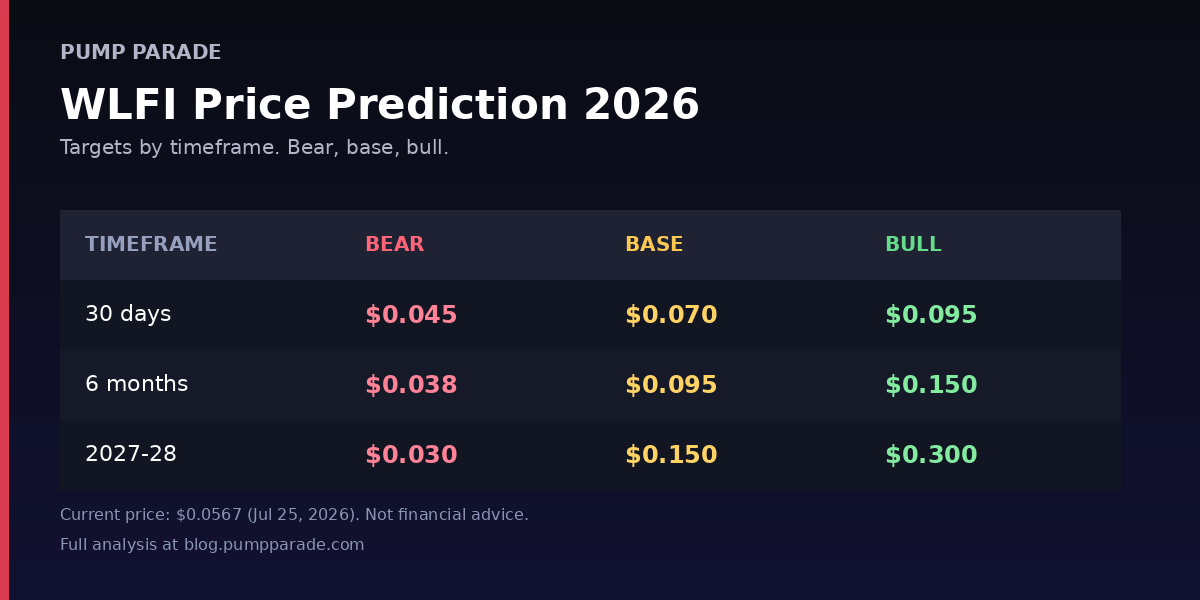
Here is how our model shakes out across three horizons. We are working from current price, 30-day volatility, USD1 growth trajectory, unlock schedule, and analyst comparisons from Cryptopolitan, CoinPedia, and Changelly.
| Timeframe | Bear | Base | Bull |
|---|---|---|---|
| 30 days | $0.045 | $0.070 | $0.095 |
| 6 months | $0.038 | $0.095 | $0.150 |
| 2027 to 2028 | $0.030 | $0.150 | $0.300 |
30-day outlook
Short-term, the tape wants to test the recent low. Bears target $0.045 on a break of $0.051. Base case is a range grind between $0.055 and $0.075 as the market digests the unlock news. The bull scenario needs a catalyst: a USD1 growth print, an ETF filing, or a positive trust bank development. That gets you to $0.095, roughly retesting the $0.10 psychological level.
6-month outlook
By year-end 2026, our base case is $0.095. That assumes USD1 continues to grow at its recent pace, no adverse legal outcomes from the Sun litigation, and BTC holding roughly the $60K to $75K band. The bull case at $0.150 requires either an ETF filing acknowledged by the SEC, USD1 crossing $8B in market cap, or approval of the trust bank charter. Bear case at $0.038 would follow a major legal setback, a broader crypto risk-off event, or unexpected acceleration of the unlock schedule.
2027 to 2028 outlook
Longer horizons get less precise, not more. The unlock cliff is the anchor. If USD1 becomes a real payments rail with $15B-plus in supply and WLFI has resolved its overhangs, $0.30 is achievable, roughly the September 2025 ATH. Analyst averages from Changelly and similar aggregators put comparable 2027 targets in the $0.15 to $0.40 range for tokens with similar profiles. Bear case is that political winds shift, dilution overwhelms demand, and WLFI trades below $0.03. We treat the outer ranges as tail scenarios, not base assumptions.
How does WLFI compare to Aave?
WLFI’s lending product is a fork of Aave V3, so a direct comparison is fair. This is not to say one is better than the other. They are different bets on different theses. Here is how they stack up. For a deeper look at Aave itself, see our Aave price prediction.
| Metric | WLFI | AAVE |
|---|---|---|
| Price | $0.0567 | $91.04 |
| Market cap | $1.80B | $1.40B |
| Rank | #43 | #52 |
| Circulating supply share | 31.8% of max | Roughly 97% of max |
| Stablecoin product | USD1 ($4.6B) | GHO (about $220M) |
| Chains | ETH, BSC, Solana | ETH, Arbitrum, Optimism, Base, and more |
| Track record | Under 2 years | Roughly 6 years live |
| Governance | 180-day staking for votes | Staked AAVE via safety module |
Read the table honestly. WLFI’s fully diluted market cap advantage is entirely a function of political brand and stablecoin scale. Aave has product maturity, decentralized battle-testing, and a slower burn. WLFI has bigger USD1 supply than Aave’s GHO by an order of magnitude. That is the trade.
What would change our view?
Three explicit triggers. If any of these fire, we update the base case within 48 hours.
1. USD1 crosses $10B in circulating supply. That would move USD1 solidly into the top 5 stablecoins and make WLFI a serious protocol-revenue story. It would justify pushing the base case toward $0.15 and the bull case toward $0.40.
2. National trust bank charter approval. Either a formal approval or a highly credible reject that removes the overhang. Approval materially rerates WLFI. A clean rejection cuts the bull case in half.
3. Adverse legal outcome from the Justin Sun litigation. A material judgment against WLFI, or a court-ordered token release, would break the technical picture and force our bear case down to $0.025 to $0.030.
Frequently Asked Questions
Is WLFI a good investment in 2026?
Whether WLFI is a good investment in 2026 depends on your risk tolerance and view on politically branded DeFi. The token carries real optionality if USD1 continues to scale and the trust bank charter progresses, but it also faces heavy dilution risk, reputation risk from ongoing litigation, and concentration in insider hands. It fits better as a small speculative position than as a core holding.
Will WLFI reach $1?
Reaching $1 would require WLFI’s fully diluted market cap to hit $100 billion, which is comparable to Solana’s current market cap. That is not a 2026 target under any of our scenarios. Analyst aggregators like Cryptopolitan and CoinPedia model $1 as a possibility no earlier than 2030 or 2031, and only under a scenario where USD1 becomes a top 3 stablecoin globally.
Why is the WLFI price falling?
WLFI is falling because three headwinds are compounding: the 62 billion token unlock passed in April 2026 with a clear vesting schedule, the ongoing legal dispute with TRON founder Justin Sun, and general risk-off pressure across mid-cap altcoins as Bitcoin drifts. The token hit an all-time low of $0.0514 on July 23, 2026, and is trying to establish support.
Who is behind World Liberty Financial?
World Liberty Financial is a DeFi project publicly associated with the Trump family, with Donald Trump Jr., Eric Trump, and Barron Trump as ambassadors. Co-founder Zach Witkoff runs day-to-day operations. Reserve custody for USD1 sits with BitGo, with BlackRock supporting Treasury management. Sheikh Tahnoon bin Zayed Al Nahyan-linked interests provided a reported $500 million UAE investment.
How does the USD1 stablecoin work?
USD1 is a dollar-pegged stablecoin fully backed by US cash, short-duration Treasuries, and cash equivalents. It launched in March 2025, is custodied by BitGo, and now circulates at roughly $4.6 billion across Ethereum, BNB Chain, and other supported networks. About 40% of USD1 supply lives on BNB Chain, making it a growth engine for that ecosystem alongside BNB itself.
Can WLFI recover from its all-time low?
Recovery is plausible but not guaranteed. The token has real product traction through USD1 and a friendly political environment, so a mean-reversion move back to $0.09 to $0.15 by mid-2027 fits within our base case. Any recovery has to overcome the mechanical drag of scheduled unlocks, which is why we assign a wider dispersion between our bear and bull scenarios than we would for a fully-vested token.
The Honest Take
WLFI is one of the hardest tokens on the market to write about without a bias. Trump association makes it a Rorschach test. Look past that.
What we see is a token with genuine product traction through USD1, a serious institutional backend, real political tailwind, and a genuinely disciplined vesting proposal for a project of its type. We also see meaningful legal overhang, a concentration structure that guarantees selling pressure for years, and a track record that includes at least one self-dealing incident that gave DeFi purists indigestion.
Our best-guess 2026 target is $0.095. Our bull case is $0.150. Our bear case is $0.038. That is a 4x spread from bear to bull, which itself tells you something about how much scenario uncertainty this token carries. Position sizing accordingly. This is a token you build a position in slowly, if at all, not one you ape into on a single narrative.
If you are watching this space anyway, watch USD1 supply, watch the trust bank charter timeline, and watch how the Sun litigation resolves. Those three signals will do more to explain WLFI’s price a year from now than any technical setup we could sketch today.
Disclaimer: This article is for informational and educational purposes only and should not be construed as financial, investment, or trading advice. Cryptocurrency markets are highly volatile, and past performance does not guarantee future results. The price predictions and analyses presented here are based on AI models, technical indicators, and available data at the time of writing. They are not guarantees. Always conduct your own research (DYOR) and consult with a qualified financial advisor before making any investment decisions. Pump Parade and its authors do not assume liability for financial losses incurred based on information provided in this article.