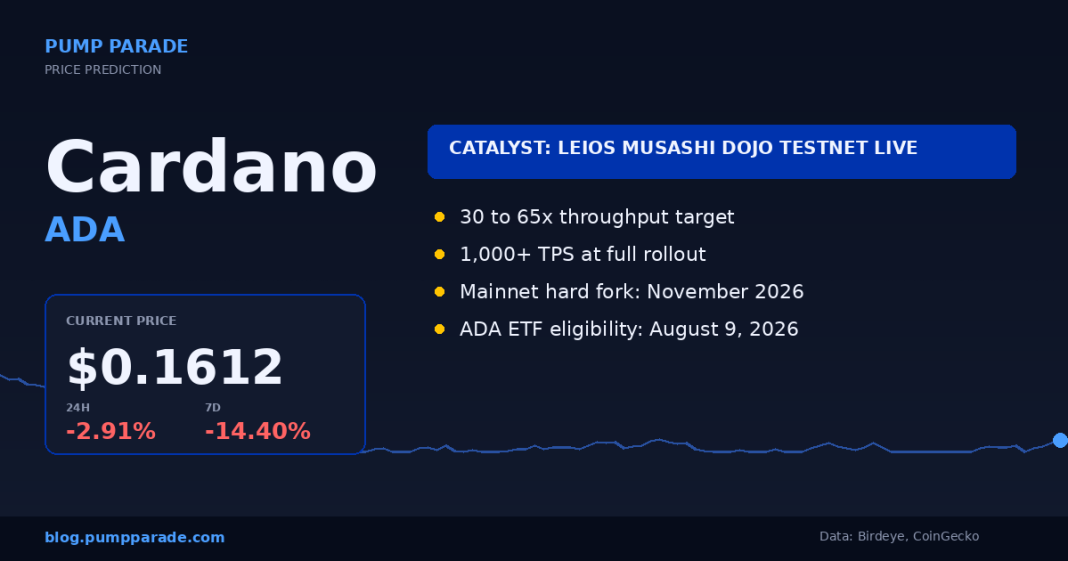
Cardano just shipped its biggest scaling experiment in years. The Leios “Musashi Dojo” public testnet went live on June 23, with a stated goal of pushing the network past 1,000 transactions per second. The market reacted by sending ADA to a fresh five-year low near $0.16.
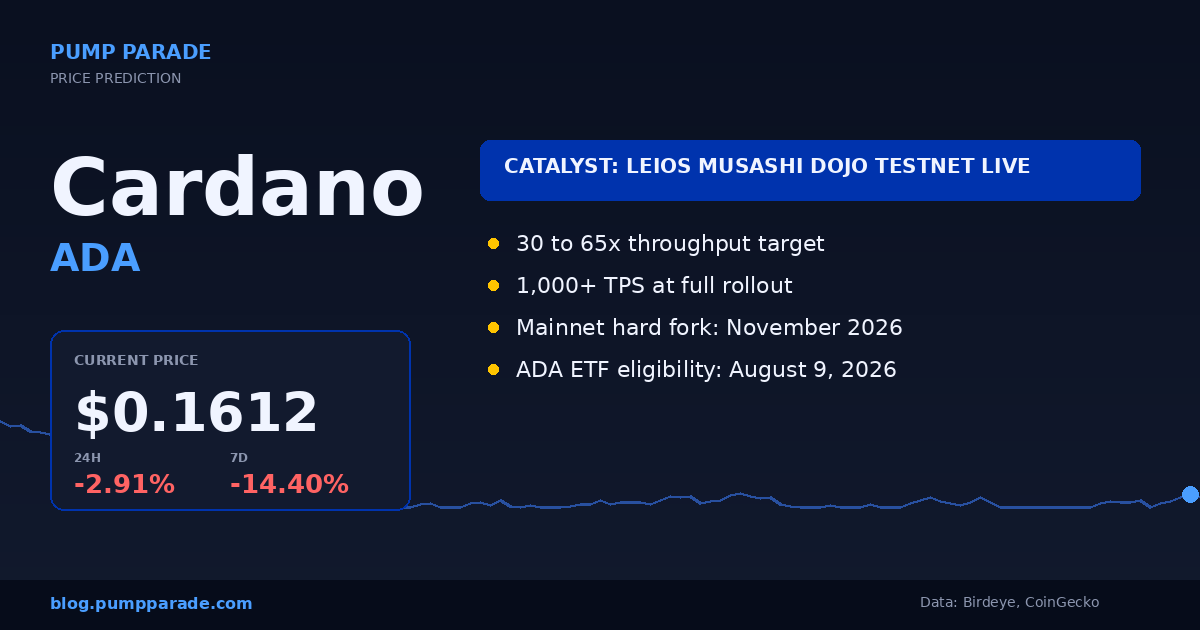
That gap between technical ambition and price action is the story right now. ADA trades at $0.1612 with a $6.04B market cap, down roughly 14% on the week and around a third off its early-June levels. Volume is healthy at $208M in 24 hours, so this is not a thinly traded panic, it is a real repricing.
The question for traders: does the Leios catalyst justify a contrarian setup, or is the testnet news already priced in?
Where ADA Sits Right Now
Cardano is the 20th largest cryptocurrency by market cap and one of the most-traded altcoins outside the top 10. Today’s snapshot, per CoinGecko market data:
- Price: $0.1612 USD
- Market cap: $6.04 billion
- 24h volume: $208.1 million
- 7-day change: -14.4%
- Distance from June high: roughly -33%
The chart is in a clear downtrend. ADA broke below the $0.175 horizontal support that had held since early 2025. Below that, the next visible demand zone sits in the $0.135 to $0.145 range, a level last tested in 2021. Translation: there is not much technical support between current price and that band.
RSI on the daily is hovering near 30, which signals oversold but not yet washed out. In past Cardano cycles, RSI has dipped into the low 20s before sustained bounces. The data suggests sellers still have room to push lower before exhaustion sets in.
The Leios Catalyst: What Actually Shipped
Leios is the name for Cardano’s new consensus upgrade. The public testnet that went live today is called Musashi Dojo, named after the 16th-century samurai Miyamoto Musashi. The five planned phases are Earth, Water, Fire, Wind, and Void, lifted straight from Musashi’s Book of Five Rings.
In plain terms, Leios is an overlay protocol. It sits on top of Cardano’s existing Praos consensus rather than replacing it. The key change is parallel block production. Right now, Cardano processes transactions one block at a time. Leios introduces “endorser blocks” that fire in parallel during periods of high demand. Think of it like adding multiple checkout lanes to a single-line grocery store.
The numbers that matter:
- Target throughput: 1,000+ TPS at full rollout (roughly 30 to 65 times current capacity, depending on the source)
- Initial gain at launch: 2 to 5 times current throughput
- Mainnet hard fork target: November 2026
- Codebase size: 705,000 lines of code
Charles Hoskinson, Cardano’s founder, called the launch a milestone he “could only have dreamed of.” That kind of statement gets eye rolls in crypto Twitter, but the technical scope here is real. Leios has been in research since 2022 and represents the biggest scaling redesign Cardano has attempted.
The Bull Case: Why Some Traders See a Setup
Buyers looking at ADA right now are working from a simple thesis. The fundamentals are improving while the price is collapsing. That divergence sometimes marks a bottom. Sometimes it does not. Here is what is on the bull side of the ledger.
Three Catalysts in a 90-Day Window
Cardano has stacked its biggest catalysts of the year into a tight window:
- Leios Musashi Dojo testnet: Live now (June 23)
- Van Rossum hard fork: Late June 2026, brings Plutus V3 smart contract upgrades
- ADA ETF eligibility: August 9, 2026, when Cardano qualifies for spot ETF filings under updated SEC rules
Any one of these could move the needle. All three landing in roughly 60 days is a different kind of setup. If the ETF window opens and an institutional issuer files, the speculative trade becomes harder to fade.
Oversold Conditions
RSI near 30, price at a five-year low, and sentiment on Crypto Twitter near multi-year bearish extremes. These are not bullish signals on their own. They are the conditions that often precede mean reversion when paired with a credible catalyst.
A Real Technical Story
Unlike many altcoins still hunting for product-market fit, Cardano has shipped working infrastructure. The Leios documentation shows a parallel block design with adversarial testing built into the testnet phases. If the math holds in production, Cardano goes from being a slow chain to a competitive one almost overnight.
The Bear Case: Why the Chart Disagrees
Now the other side. The data is not flattering for ADA right now, and ignoring it is how traders blow up positions.
The Trend Is Broken
ADA broke a horizontal support that had held for over a year. In trading, broken support often becomes resistance. The $0.175 level is now likely a ceiling on bounces, which caps upside even on positive news. Until ADA reclaims that level on volume, the chart says sell rallies.
Testnet Is Not Mainnet
The Leios mainnet hard fork is not scheduled until November 2026. That is roughly five months of “we are testing this.” Crypto markets price catalysts on a curve. The bulk of the upside often gets paid out when the upgrade actually ships, not when the testnet launches. The “buy the testnet, sell the mainnet” trade can work, but it can also chop traders to pieces.
Throughput Without Demand Is a Press Release
Solana, Sui, NEAR, and a half dozen other chains can already do 1,000+ TPS. Cardano catching up matters less than Cardano attracting the developer mindshare and applications that actually need that throughput. DEX volume, stablecoin issuance, and active addresses on Cardano have all trended down in 2026. The pipes get bigger, but the water is not flowing yet.
The ETF Trade May Disappoint
August 9 ETF eligibility is real, but eligibility is not the same as approval. The Solana spot ETF approval took months after eligibility. Even if approved, the inflow profile may be muted given Cardano’s market cap is below most other ETF-eligible assets. Compare this setup to the recent Litecoin ETF test to see how the market handled a similar window.
Price Predictions: ADA Targets by Timeframe
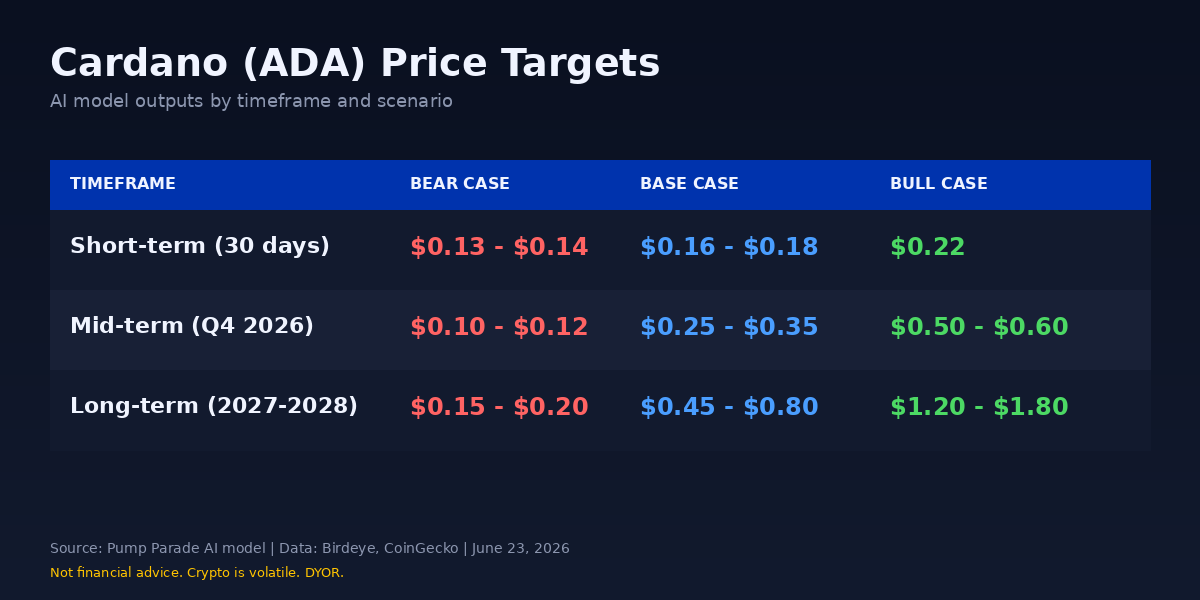
Our AI model weighs technical structure, on-chain activity, catalyst calendar, and macro conditions. Here are the targets it returns for three timeframes. As always, these are probabilities, not guarantees.
Short-Term (Next 30 Days)
- Bear case: $0.13 to $0.14 (retest of 2021 demand zone)
- Base case: $0.16 to $0.18 (range-bound consolidation)
- Bull case: $0.22 (reclaim of $0.175 plus a sentiment shift on the Van Rossum fork)
Most likely outcome in our model: choppy range between $0.15 and $0.19 as the market digests three catalysts in quick succession. Traders looking for cleaner setups may want to wait for either a confirmed breakdown or a confirmed reclaim of $0.175.
Mid-Term (Six Months, Q4 2026)
- Bear case: $0.10 to $0.12 (Leios mainnet delays plus ETF rejection)
- Base case: $0.25 to $0.35 (Leios mainnet ships on schedule, no major macro shocks)
- Bull case: $0.50 to $0.60 (Leios live, ETF approved, broader altcoin rotation)
The November mainnet hard fork is the pivot. If it ships clean, our model gives ADA a credible path to the $0.30 zone by year-end. If it slips into 2027, the base case rolls forward and the bear case becomes more probable.
Long-Term (2027 to 2028)
- Bear case: $0.15 to $0.20 (Leios fails to attract developers, ecosystem stagnates)
- Base case: $0.45 to $0.80 (steady ecosystem growth, throughput becomes a competitive advantage)
- Bull case: $1.20 to $1.80 (Leios drives a Cardano DeFi resurgence, institutional ETF flows compound)
The long-term case for ADA is not about Leios alone. It is about whether the upgrade catalyzes a real ecosystem rebuild. Cardano has the brand, the holder base, and now the throughput. What it needs is applications people use.
What to Watch in the Next Two Weeks
If you are tracking ADA, here are the data points that will tell you whether the trend is shifting:
- Daily active addresses: A sustained move above 80,000 would suggest real network activity returning
- DEX volume on Minswap and Sundaeswap: Watch for a reversal of the 2026 downtrend
- $0.175 reclaim: A daily close above this level on volume is the first technical green flag
- Van Rossum hard fork execution: Smooth deployment versus delays will set the tone for the Leios mainnet expectation
- ETF filing news: Any S-1 filing from a major issuer ahead of August 9 would shift the trade meaningfully
Our Take
This is the kind of setup that splits traders cleanly into two camps. The chart traders see a broken trend and a token that has nothing on the right side of the price action. The fundamental traders see three catalysts stacked into 60 days at a five-year low. Both are looking at the same data and reaching different conclusions, which is usually where the most interesting trades live.
Our base case is that ADA chops between $0.14 and $0.22 over the next 30 days, then breaks decisively one way or the other as the Van Rossum fork and ETF window come into focus. The asymmetric trade here is small position sizing with patience: the downside from $0.16 is maybe 30%, while the upside on a clean catalyst stack could be 100% or more by Q4. That is not a guarantee, it is a risk-reward observation worth watching.
For now, ADA is a token where conviction matters more than timing. If you believe Cardano can convert technical milestones into real network usage, current prices are interesting. If you do not, the chart is giving you every reason to wait.
Disclaimer: This article is for informational and educational purposes only and should not be construed as financial, investment, or trading advice. Cryptocurrency markets are highly volatile, and past performance does not guarantee future results. The price predictions and analyses presented here are based on AI models, technical indicators, and available data at the time of writing, they are not guarantees. Always conduct your own research (DYOR) and consult with a qualified financial advisor before making any investment decisions. Pump Parade and its authors do not assume liability for financial losses incurred based on information provided in this article.