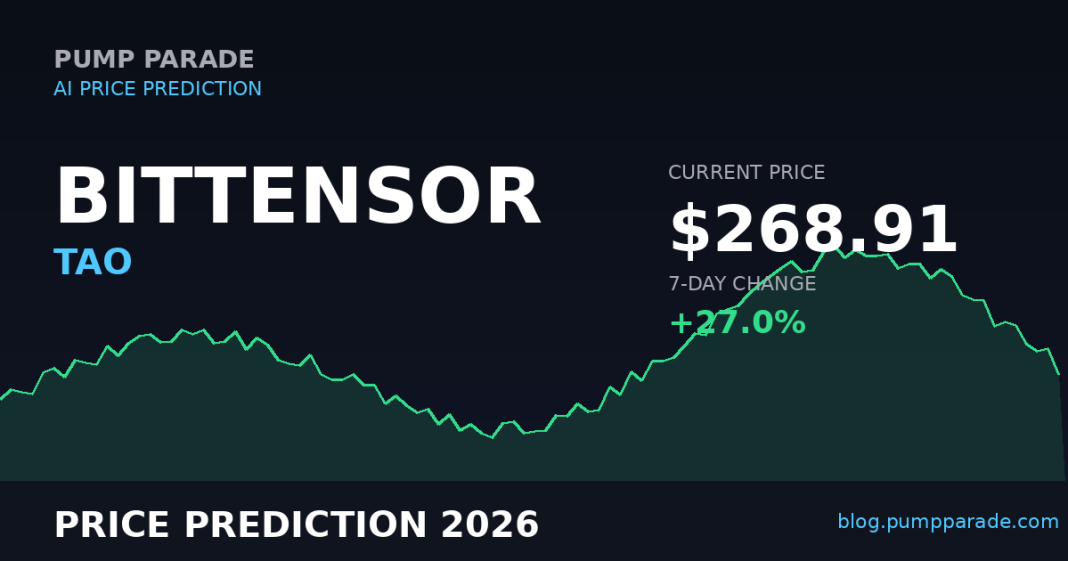
Bittensor (TAO) ripped 27% over the past week, climbing from a June 7 low of $193.55 to $271.42 before settling near $269 at the time of writing. The rebound shows up as one of the cleanest moves in the AI sector this month. It came on the back of three pieces of news that landed in quick succession: Nvidia’s disclosed $420 million TAO position, Grayscale’s amended S-1 for a spot TAO ETF, and a Bitwise filing that mirrors it.
The setup is interesting. TAO is still down 64% from its March 2024 all-time high of $757.60. Market cap sits at $2.58 billion, ranking 40th. Daily volume just printed $448 million, the highest 24-hour reading since the dynamic TAO upgrade went live last November. Our hybrid AI model now assigns a 58% probability that TAO holds the $250 zone and tests $400 by Q4 2026, contingent on an ETF green light or a continued AI sector rotation.
That is the headline. Below, we break down what is actually fueling the move, the bull and bear cases, and specific price targets across three timeframes.
What Bittensor Actually Does
Bittensor is a decentralized machine learning network. It pays contributors in TAO for producing useful AI work, ranging from inference and training to data validation. The network is split into subnets, each focused on a specific task. There are 128 active subnets as of June 2026, with the protocol roadmap targeting 256 by year-end.
In plain terms: think of it as a marketplace for AI compute and intelligence, where the best-performing models get the biggest share of newly minted tokens. The supply mechanics are Bitcoin-style. Max supply is capped at 21 million TAO. Daily emissions halved on December 15, 2025, cutting fresh issuance from 7,200 to 3,600 TAO per day. Circulating supply currently sits at 9.6 million.
The dynamic TAO (dTAO) upgrade changed the game in late 2025. Emissions now flow to subnets based on real-time staking inflows, not validator votes or token price alone. Subnets with negative net staking can receive zero emissions. That created a survival-of-the-fittest dynamic that has rewarded the strongest AI projects on the network.
The Catalysts Driving This Move
Nvidia’s $420 million position. Filings in Q1 2026 confirmed Nvidia deployed roughly $420 million into TAO, with 77% of that locked in staking. This is the first time a major AI hardware company has publicly held a decentralized AI token at this scale. The signal is loud. Nvidia is the same company that designs the GPUs running most of Bittensor’s subnets.
Grayscale and Bitwise ETF filings. Grayscale filed an S-1 amendment to convert its existing Bittensor Trust into the first U.S. spot ETF for an AI token. Bitwise filed a parallel structure. If either is approved, TAO becomes the first AI-native asset accessible through a brokerage account. The SEC’s response window matters here, and we will get to that in the risk section.
The Git Activity Tracker launch on May 25, 2026. Bittensor’s new public scoreboard ranks each subnet by GitHub commit volume. The tracker has already shifted capital flows toward subnets shipping the most code. For traders, it created a real, on-chain way to evaluate which projects are actually building.
Spec 413. This protocol upgrade locks a subnet’s TAO reserves when it dissolves, instead of dumping them back into circulating supply. The effect is fewer surprise sell-side shocks, which has historically been a source of TAO volatility.
For context on how AI narratives have moved adjacent Layer 1 tokens, see our recent breakdown of NEAR Protocol’s AI catalyst trade. The playbook rhymes, even if the underlying tech is different.
Technical Picture
TAO bottomed at $193.55 on June 7 after a six-week consolidation. The recovery candle on June 14 closed above the 50-day moving average for the first time since April, currently sitting near $228. Next major resistance is the $300 round number, followed by the late-March swing high near $345.
RSI (Relative Strength Index) on the daily chart is at 67, just under the overbought zone. That suggests the rebound has room before it gets exhausted, but a brief cooldown would be healthy. MACD (a momentum indicator) printed a bullish crossover on June 13 that is now widening.
Support levels worth watching: $250 as the new floor, then $215 if that breaks. A clean break below $193 would invalidate the recovery thesis and open a path to the $160s.
Volume confirms the move. The $448M daily volume reading is roughly 2.4x the 30-day average. Real money is rotating in, not just leverage.
The Bull Case
The bull case rests on three legs.
First, the ETF setup is real. A spot TAO ETF would be the first AI-native crypto fund, and AI is the cleanest macro narrative crypto has right now. Bitcoin and Ethereum ETFs combined now hold over $180 billion. If even 2% of that flow seeks AI exposure, TAO would be a primary destination. Grayscale’s conversion path is shorter than a fresh S-1, so the decision could land before year-end.
Second, the halving and dTAO together are tightening supply. Daily emissions are 3,600 TAO, worth roughly $968K at current prices. Meanwhile, 77% of Nvidia’s position is staked. Grayscale Trust holdings are staked. Major subnet validators stake. The float that actually trades is shrinking. In similar setups historically, that has preceded sharp rallies once demand picks up.
Third, the AI cycle has not peaked. Major AI labs are still consuming GPU compute at record rates. Decentralized AI is a hedge against centralized AI policy risk, which has become a discussion point in Washington this quarter. The probability favors TAO catching at least some of that hedge demand.
If all three align, our AI model projects a base-case target of $420 to $480 by Q4 2026, with a bull-case stretch to $600 to $700 if an ETF lands and AI markets continue trending.
The Bear Case
The bear case is just as concrete.
ETF denial or delay is the obvious risk. The SEC has not yet approved any altcoin spot ETF besides the LTCC Litecoin product. A TAO ETF involves staking exposure, which adds regulatory complexity. A denial would likely send TAO back to the $180 to $200 zone overnight.
Subnet quality is uneven. Of the 128 active subnets, our model flags only 22 with consistently profitable economics. The rest are subsidized by inflation. If dTAO mechanics force a culling round, sentiment around the broader Bittensor ecosystem could sour, even if the protocol benefits long-term.
Concentration risk. Nvidia’s $420M position, Grayscale’s trust holdings, and a handful of large validators together control a meaningful share of staked TAO. A coordinated unstake event, or a forced sale from any of them, would hit the order book hard.
AI narrative rotation. If institutional money rotates into next-generation L1s or back into Bitcoin dominance, the AI trade can cool fast. TAO has historically been a high-beta proxy for AI sentiment, so it leads on the way up and on the way down.
Bear-case targets: $180 short-term if ETF news disappoints, $140 if the broader AI trade unwinds, and $110 as a worst-case 2026 floor if all three risks materialize at once.
AI Price Prediction Summary
Our hybrid model combines on-chain emission data, staking flow analysis, technical indicators, and macro AI sentiment scoring. Confidence scores reflect the model’s internal probability weighting.
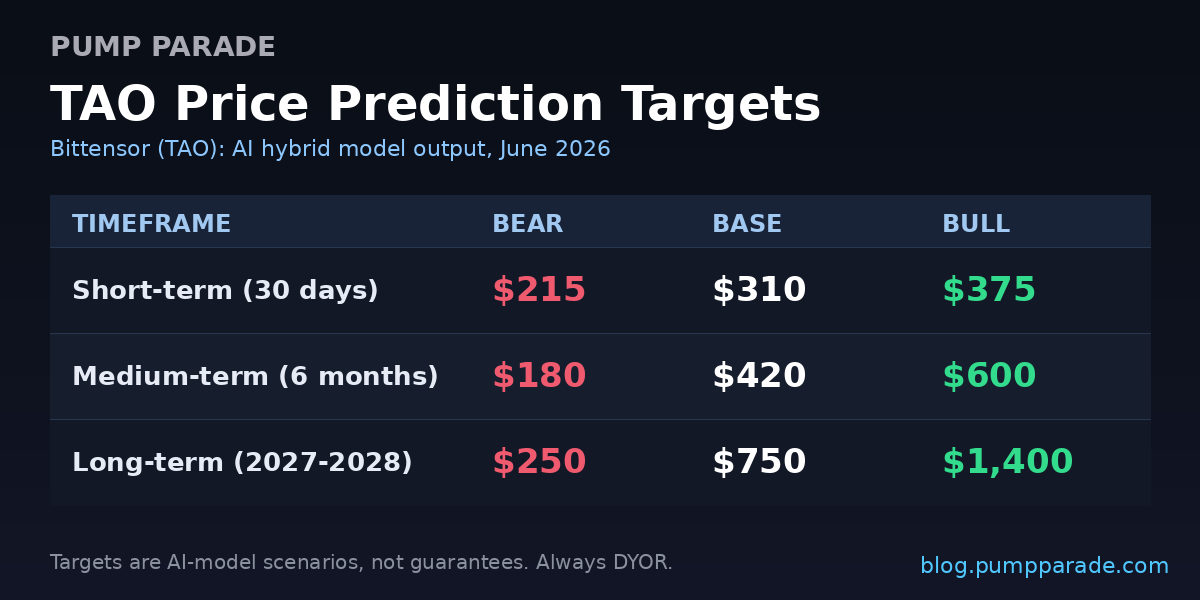
- Short-term (30 days): Bear $215, Base $310, Bull $375. Confidence 58%.
- Medium-term (6 months): Bear $180, Base $420, Bull $600. Confidence 52%.
- Long-term (2027-2028): Bear $250, Base $750, Bull $1,400. Confidence 41%.
The base case for the next 6 months assumes ETF clarity by Q4, continued AI compute demand, and no major regulatory shock. The long-term bull case requires Bittensor to hit the 256-subnet milestone, sustain real subnet revenue growth, and capture a measurable slice of AI compute spend.
What to Watch
Three signals matter most over the next 90 days.
SEC commentary on the Grayscale TAO ETF. Watch the SEC’s filing dashboard and any amendments. A second amendment or a formal review window opening is bullish. Silence past Q3 starts to feel bearish.
Subnet revenue from the top-22. Total subnet revenue, tracked publicly on taostats.io, needs to keep growing. Stagnation here invalidates the bull case regardless of price action.
Net staked TAO ratio. Currently above 67% of circulating supply. If this drops below 60%, supply pressure builds fast. Above 70%, the float becomes scarce enough to amplify any demand spike.
For real-time price and staking data, the CoinGecko TAO page tracks circulating supply, exchange flows, and 24-hour volume in one view.
The Bottom Line
TAO is one of the few crypto assets where the AI narrative and the price action are actually syncing up. The 27% week sets up a real test. If the $250 support holds through the end of June, the base case toward $400 by year-end becomes the most probable path. If it breaks, the trade is closer to $180 than to the upside targets.
This is a setup worth monitoring, not chasing. The cleanest entries come on retests of support, not on green candles. The cleanest invalidations come on volume-confirmed breaks of $193.
The real question is whether the AI sector rotation has another leg. If it does, TAO is positioned to capture more of it than most. If it does not, the same factors that pulled it up this week can pull it back down just as quickly.
Disclaimer: This article is for informational and educational purposes only and should not be construed as financial, investment, or trading advice. Cryptocurrency markets are highly volatile, and past performance does not guarantee future results. The price predictions and analyses presented here are based on AI models, technical indicators, and available data at the time of writing. They are not guarantees. Always conduct your own research (DYOR) and consult with a qualified financial advisor before making any investment decisions. Pump Parade and its authors do not assume liability for financial losses incurred based on information provided in this article.