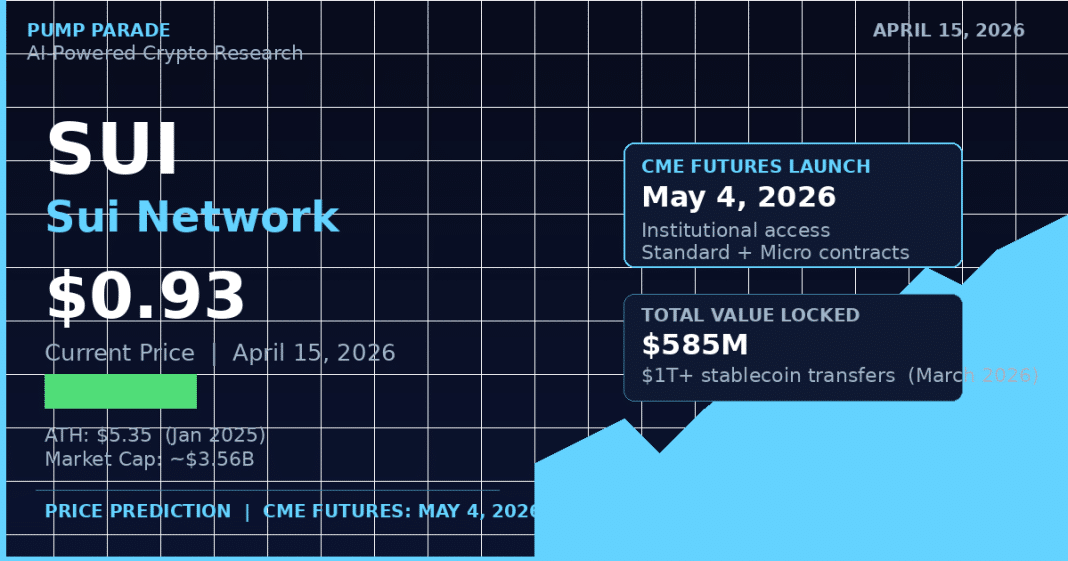
SUI at $0.93: Down 83% From Its Peak, But a Major Catalyst Is Coming
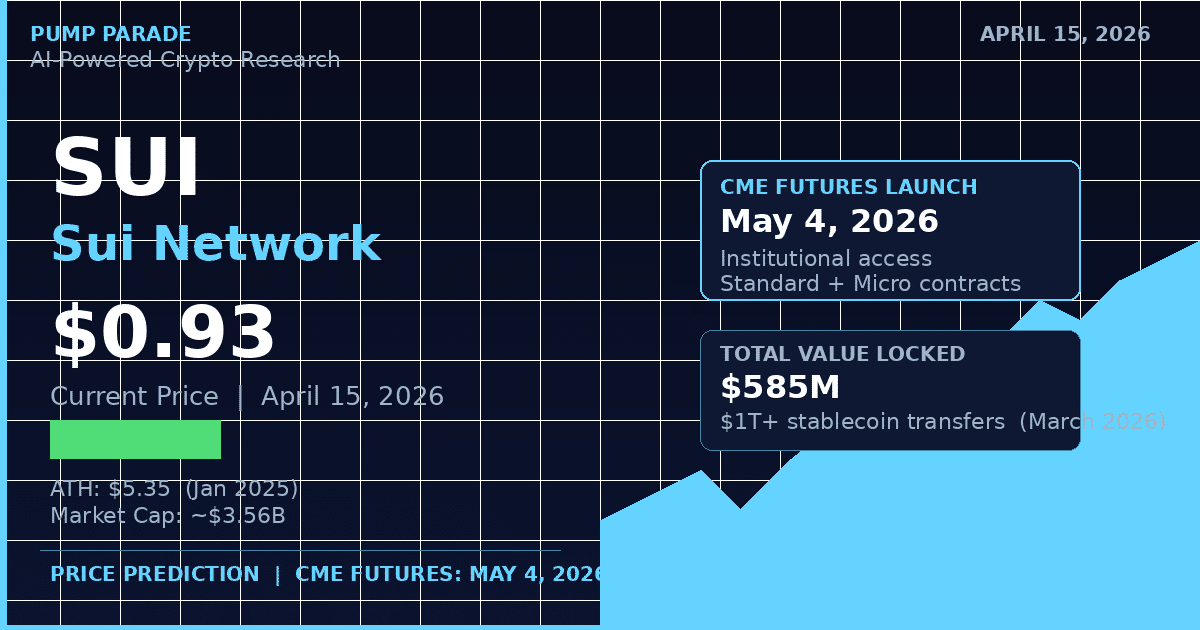
Sui (SUI) is trading at $0.93 as of April 15, 2026. That’s a long way down from its all-time high of $5.35, hit in January 2025. The drop has been brutal. But there’s a reason traders are starting to pay attention again.
On May 4, 2026, CME Group launches regulated SUI futures. That’s less than three weeks away. The last two times CME launched futures for a major crypto asset, Bitcoin in December 2017 and Ethereum in February 2021, price action shifted meaningfully in the months that followed. For SUI, the question is whether history repeats.
In this analysis, we break down SUI’s current market position, the key catalysts building beneath the surface, and what our AI model says about where the price goes from here. Bull case, bear case, and everything in between.
What Is Sui? A Quick Rundown
Sui is a Layer-1 blockchain built by Mysten Labs, a team of former Meta engineers who worked on the Diem blockchain project. The network launched its mainnet in May 2023 and has since grown into one of the more credible Ethereum and Solana challengers in the market.
Sui’s technical edge comes from its object-centric data model and the Move programming language. In plain terms, this architecture allows the network to process simple transactions in parallel rather than sequentially, which leads to much faster throughput than traditional blockchains.
Key metrics as of April 15, 2026:
- Market cap: approximately $3.56 billion (ranked around #22 globally)
- Total Value Locked (TVL): $585 million
- Circulating supply: approximately 3.83 billion SUI
- Stablecoin transfer volume in March 2026: over $1 trillion processed on-chain
That last number deserves emphasis. A trillion dollars in stablecoin transfers in a single month puts Sui in rarefied company. For context, that’s the kind of throughput number that institutional infrastructure teams pay attention to.
Recent Developments: More Than Just a Futures Launch
The CME futures announcement is the loudest recent signal, but it’s not the only one. Sui has had a notable stretch of ecosystem development in early 2026.
CME Futures Launch: May 4, 2026
CME Group confirmed it will offer both standard (50,000 SUI) and micro (5,000 SUI) cash-settled futures contracts. The dual contract structure is designed to bring in both institutional traders looking for size and smaller funds or prop desks that want more flexibility.
What does this mean for price? The historical pattern with CME crypto launches is a “sell the news” dip followed by a sustained re-rating as institutional access and liquidity improve. Neither outcome is guaranteed for SUI, but the precedent is worth knowing.
Native Stablecoins and Protocol Integrations
Two major stablecoin launches happened on Sui in early 2026. Sui Dollar launched in March, and suiUSDe (Ethena’s synthetic dollar) launched in February. Both deepen the DeFi liquidity layer on the network, which is a prerequisite for sustained protocol growth.
Sui also integrated Uniswap and Curve in the first quarter of 2026. These are not small names. Getting the two most battle-tested AMMs in DeFi history to deploy on your chain signals institutional-grade DeFi infrastructure is arriving.
Revolut Staking
Revolut, the European fintech with 45 million users, added SUI staking at 1.93% APY. This is not a price catalyst in the traditional sense, but it increases SUI’s exposure to a mainstream retail audience that would not otherwise interact with a Layer-1 blockchain directly.
Technical Analysis: Key Levels to Watch
SUI’s chart is in a recovery attempt after a steep downtrend that began in January 2025. Here is where the levels sit right now.
Resistance
- $0.96: Immediate overhead resistance. The price has tested this level twice in April and failed to hold above it.
- $1.00: The major psychological barrier. A clean close above $1.00 would likely trigger a wave of short covering and retail re-engagement.
- $1.35: The next significant resistance zone, dating back to Q3 2025 consolidation.
Support
- $0.90: The near-term floor. This level has held on two recent retests.
- $0.83: Secondary support. A drop here would represent approximately an 11% pullback from current levels and would test whether longer-term buyers step in.
- $0.70: The key invalidation level for any short-term bull thesis. A breakdown below here signals that the current recovery attempt has failed.
Momentum Indicators
SUI is up 6.4% over the past seven days, outperforming most large-cap altcoins in the same window. The price has reclaimed its 7-day and 14-day moving averages, which is a constructive signal after months of trending below them.
The Money Flow Index (MFI) has been trending upward, suggesting net capital inflows rather than outflows. The chart structure remains technically bearish on higher timeframes, but the short-term data points are shifting.
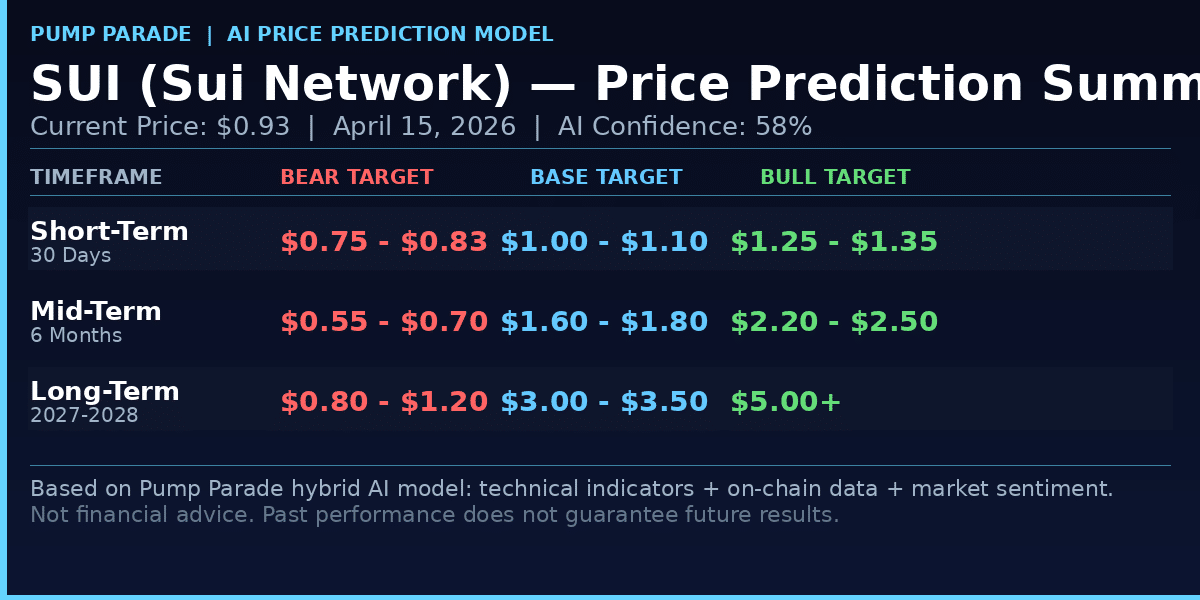
Our hybrid AI model assigns a 58% probability that SUI trades above $1.00 within the next 30 days, contingent on a broader market that holds above key support. The confidence score is moderate, reflecting genuine uncertainty in the macro environment.
The Bull Case for SUI in 2026
The bull case is built on three layers: institutional access, ecosystem growth, and historical CME patterns.
The CME futures launch on May 4 opens SUI to a class of institutional traders who cannot hold spot crypto directly. Asset managers, pension funds, and hedge funds that operate under mandates requiring regulated derivatives exposure now have a vehicle. The inflow doesn’t happen overnight, but the pipeline opens.
The ecosystem metrics support the narrative. A $585 million TVL base, a trillion dollars in March stablecoin transfers, and the integration of Uniswap and Curve all point to a network that is being used, not just speculated on. That kind of on-chain activity creates organic demand for SUI as gas and staking collateral.
If SUI can clear $1.00 convincingly before or shortly after the futures launch, the next technical target is $1.35 and then $1.80. In a sustained bull scenario where broader market conditions remain constructive and CME volumes exceed expectations, $2.50 by the end of 2026 is within the range of realistic outcomes.
Longer term, looking toward 2027 and 2028, the bull case rests on SUI establishing itself as one of two or three dominant non-EVM Layer-1 chains. If the network captures even 10% of Ethereum’s current TVL, the token would need to trade significantly above current levels to support that valuation.
The Bear Case: What Could Go Wrong
Balanced analysis means taking the downside seriously, and the downside for SUI is real.
The chart structure is still bearish on higher timeframes. SUI is down over 83% from its all-time high and has not yet produced a confirmed higher high on the weekly chart. That means every bounce so far has been a lower high within a downtrend.
The CME launch could be a “sell the news” event. When Bitcoin futures launched on CME in December 2017, Bitcoin peaked within days and entered a prolonged bear market. That’s the bear analogy. The bull analogy is Ethereum’s February 2021 CME launch, which preceded a multi-month rally. Both are valid historical references. The outcome depends heavily on macro conditions and broader market appetite at the time.
Competitive pressure is the longer-term risk. Sui competes with Solana, Ethereum, Aptos, and an increasingly crowded Layer-1 landscape. Solana has first-mover advantage and significantly higher liquidity. Ethereum has network effects that dwarf any competitor. Sui needs to continue converting on-chain activity into token demand, and that’s not guaranteed.
If SUI loses $0.83 support and the broader market deteriorates, a retest of the $0.60 to $0.70 range is plausible. A full macro breakdown could push the price toward $0.45, which was a key accumulation zone in mid-2025.
SUI Price Predictions: Short, Mid, and Long Term
Our hybrid AI model runs technical indicators, on-chain data, and macro sentiment across three timeframes. Here is where it lands, along with bear and bull scenario ranges.
For context on our methodology: Pump Parade uses a multi-signal approach that blends momentum indicators, on-chain volume metrics, and market sentiment analysis. These are probability-weighted scenarios, not guarantees.
Short-Term: Next 30 Days
The base case is $1.00 to $1.10 by mid-May 2026, driven by pre-CME momentum and improving sentiment. The bear case is a pullback to $0.75 to $0.83 if the broader market weakens heading into the futures launch. The bull case is a clean break above $1.00 that triggers short covering and runs to $1.25 to $1.35.
Mid-Term: 6 Months (October 2026)
The base case is $1.60 to $1.80 by October, assuming CME volumes are healthy and DeFi TVL continues growing. The bear case is $0.55 to $0.70 if the market rolls over and Layer-1 narratives lose momentum. The bull case is $2.20 to $2.50 if SUI becomes a focal point of the next institutional adoption cycle.
Long-Term: 2027 to 2028
The base case is $3.00 to $3.50 by end of 2027, reflecting a scenario where Sui has established clear product-market fit for institutional DeFi and stablecoin infrastructure. The bear case is $0.80 to $1.20 in a prolonged sideways or bear market. The bull case is $5.00 or above, approaching the previous all-time high, if SUI captures meaningful market share from Ethereum’s DeFi ecosystem.
For a deeper look at SUI’s longer-term trajectory, see our SUI Price Prediction through 2035.
Key Catalysts and Levels to Monitor
If you’re tracking SUI over the next 30 to 90 days, here’s the framework:
- May 4, 2026: CME futures launch. Watch the price action in the 72 hours before and after. A sustained hold above $1.00 post-launch is the key signal.
- $0.96 to $1.00: The make-or-break resistance band. A weekly close above $1.00 changes the technical picture materially.
- TVL growth: Watch whether TVL sustains above $600 million. A consistent upward trend supports the bull case. A drop below $500 million signals ecosystem stagnation.
- CME open interest: After May 4, CME’s reported weekly SUI open interest will be a proxy for institutional conviction. Rising open interest alongside rising price is the setup bulls want to see.
- $0.83 support: The level that invalidates the near-term recovery. A daily close below $0.83 before May 4 likely breaks the pre-CME momentum narrative.
For real-time SUI price data and market stats, you can track current prices on CoinGecko.
The Bottom Line
SUI at $0.93 is a token at a crossroads. The macro picture is mixed, the chart is still recovering, and competition in the Layer-1 space is fierce. But the fundamental story is stronger than the price suggests. Over $1 trillion in stablecoin transfers in March 2026, Uniswap and Curve now live on the network, a native stablecoin ecosystem developing, and institutional futures access arriving in less than three weeks.
The CME launch is not a guaranteed price event. But it is a genuine structural change in who can access SUI exposure. That kind of shift tends to matter over months, not days.
For traders monitoring the space: the $0.90 support and the $1.00 resistance are the two levels that will tell you most of what you need to know in the near term. A clean break above $1.00 before or after May 4 changes the conversation significantly.
Disclaimer: This article is for informational and educational purposes only and should not be construed as financial, investment, or trading advice. Cryptocurrency markets are highly volatile, and past performance does not guarantee future results. The price predictions and analyses presented here are based on AI models, technical indicators, and available data at the time of writing. They are not guarantees. Always conduct your own research (DYOR) and consult with a qualified financial advisor before making any investment decisions. Pump Parade and its authors do not assume liability for financial losses incurred based on information provided in this article.
About our AI predictions: Pump Parade’s price predictions are generated by machine learning models that analyze technical indicators, on-chain data, and market sentiment. These models have limitations and cannot account for black swan events, regulatory changes, or sudden market shifts. Prediction confidence scores reflect the model’s internal assessment, not guaranteed accuracy. Use AI predictions as one input among many in your research.