If you have spent more than a week in crypto, you already know the name. Kraken has been running since 2011, which is basically forever in this space. But 2026 is a completely different market than the one Kraken was born into. Between the return of a full US bull cycle, the launch of tokenized equities, and a wave of new competitors chasing users with zero-fee promises, does one of the oldest exchanges still deserve a spot in your portfolio stack? We put Kraken under a magnifying glass to find out.
Quick Verdict (TL;DR)
Rating: 4.6 / 5
Kraken remains one of the safest, most feature-complete exchanges you can use in 2026. It scores a perfect 10/10 trust score on CoinGecko (rank #3 among centralized exchanges by trust), runs a rock-solid Proof of Reserves system, and now bundles spot crypto, futures, margin, on-chain staking, tokenized US stocks (xStocks), and commission-free equity trading under one roof. The main downsides are the everyday app’s 1% instant-buy fee (steep versus DEX aggregators like trading bots that charge closer to 0.5%) and a slightly dated Kraken Pro UI that still feels engineered for pros first, beginners second. If you want long-term custody with real regulatory backing, Kraken is a strong pick.
Kraken at a Glance
Kraken is a US-based centralized crypto exchange operated by Payward, Inc. It launched publicly in 2013 after two years of stealth development and has grown into one of the largest fiat-to-crypto on-ramps in the world.
- Founded: 2011 (public launch 2013)
- Headquarters: United States
- Trust score (CoinGecko): 10/10, rank #3 globally
- Assets supported: 200+ cryptocurrencies, 11,000+ US stocks and ETFs, plus xStocks tokenized equities
- Leverage: Up to 10x on spot margin, up to 50x on futures
- Regulation: Registered with FinCEN, VASP-registered in multiple EU states, licensed in the UK, Australia, Canada and more
- Website: kraken.com
Features Deep Dive
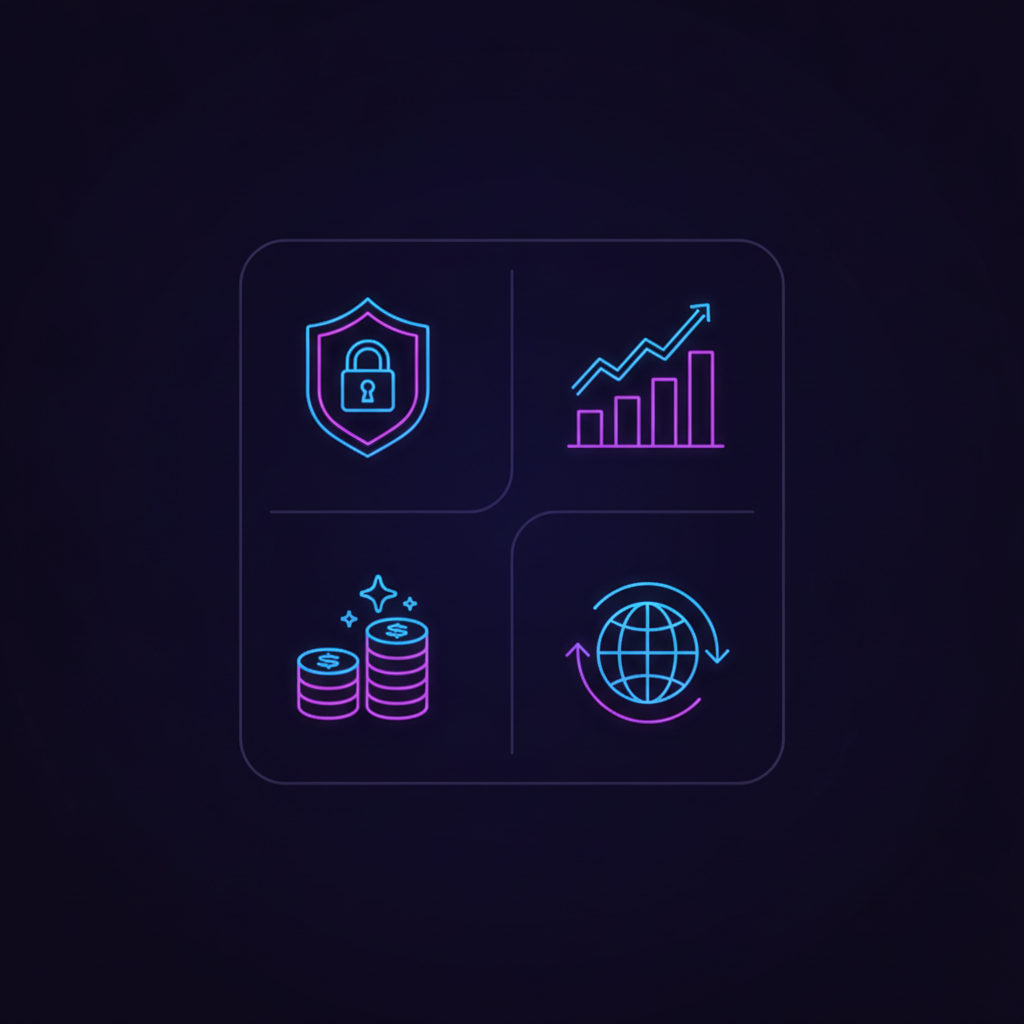
1. Two apps, two audiences
Kraken now runs on a dual-app strategy. The standard Kraken app is the friendly on-ramp: tap a coin, tap Buy, done. The Kraken Pro platform (web and app) is the serious trader’s tool with limit orders, stop losses, iceberg orders, conditional close, and a full order book UI. New users can start on the simple app and graduate to Pro without opening a new account, which is one of Kraken’s better ergonomic moves in the last two years.
2. Spot, futures, margin, and OTC
Kraken Pro supports spot trading, cross-margin trades with up to 10x leverage on eligible pairs, perpetual futures with up to 50x leverage in supported regions, and an over-the-counter (OTC) desk for large block trades that shouldn’t hit the public order book. That is a wider product surface than most retail exchanges offer.
3. On-chain staking with instant rewards
Kraken’s on-chain staking product covers 15+ Proof-of-Stake networks. Rewards accrue instantly with no waiting or bonding period on flexible terms, which is unusual. Kraken takes a 20% commission on flexible staking rewards on assets with an unbonding period, which is fair market rate. Solana, Ethereum, Polkadot, Cosmos and Cardano are all supported.
4. xStocks and tokenized equities
This is the sleeper feature. Kraken now offers xStocks, tokenized versions of major US equities (NVDAx, TSLAx, AAPLx, SPYx, AMZNx and more) that trade 24/5 as blockchain tokens. When you buy xStocks with USDG or USD there are zero trading fees. That is a genuinely category-leading offer for non-US traders who want stock exposure without leaving crypto rails.
5. Commission-free stocks (US only)
For US users, Kraken added commission-free trading on 11,000+ stocks and ETFs in 2025, positioning itself as a Robinhood-style alternative for people who want their crypto and equities in one wallet. Regulatory fees still apply, but the trading commission is zero.
6. Recurring buys and dollar-cost averaging
Simple, well-executed: pick an asset, pick a schedule (daily, weekly, monthly), pick a funding source. Great for people who want to DCA into Bitcoin or Ethereum without thinking about it. See our Ethereum 2026 price outlook for context on why long-term DCA into ETH is still a defensible thesis.
Fees & Pricing
Kraken runs two very different fee models depending on which product you use:
Kraken app (instant buy/sell)
- 1.0% trading fee on instant and recurring trades
- 1.5% fee on custom orders
- Spread included in the quoted price (varies by asset and market conditions)
- 0% trading fees on up to $10,000/month with Kraken+ membership
This is the same tier as Coinbase’s consumer app. It is convenient but expensive if you trade often.
Kraken Pro (spot crypto)
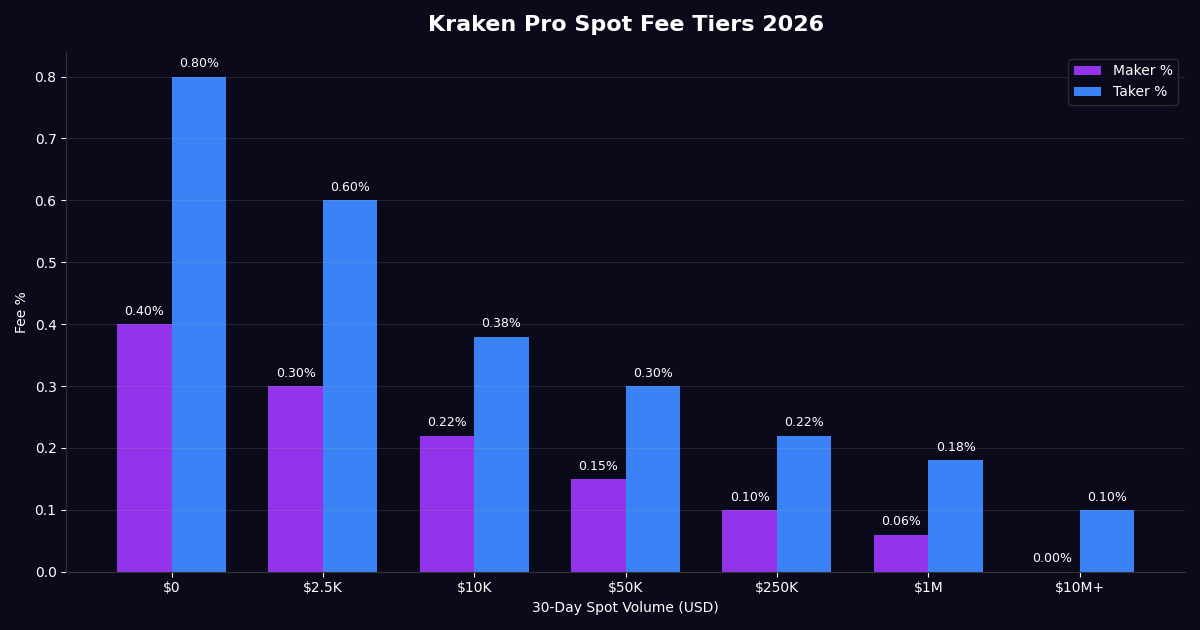
Kraken Pro uses a maker-taker tier system with fees that scale down based on the best of your 30-day spot volume or your Assets on Platform (AoP). Holding assets on Kraken now qualifies you for lower fees, which is a new 2026 change.
| Tier | 30-Day Spot Volume | AoP | Maker | Taker |
|---|---|---|---|---|
| Tier 1 | $0+ | N/A | 0.40% | 0.80% |
| Tier 3 | $10K+ | $20K | 0.22% | 0.38% |
| Tier 5 | $50K+ | $100K | 0.15% | 0.30% |
| Tier 9 | $1M+ | $1M | 0.06% | 0.18% |
| Tier 12 | $10M+ | $10M | 0.00% | 0.10% |
Futures fees (Pro)
Futures fees start at 0.02% maker / 0.05% taker at Tier 1 and drop to negative maker rebates (up to -0.006%) at the Pro 5 tier ($5B+ in 30-day volume). Perpetuals on the main app cost 0.25% to open and 0.25% to close.
Stablecoin and USDG pairs
Stablecoin pairs run at 0.20% maker/taker at Tier 1 and go as low as 0.00%/0.001% at $100M+. USDG pairs are effectively free at 0% maker and 0.01% taker at all volumes, which is one of the cheapest stablecoin fee schedules on any centralized exchange in 2026.
Deposit & withdrawal
Crypto deposit fees depend on the network. Most on-chain deposits are free; withdrawals reflect network gas plus a small Kraken fee. Fiat funding is broad: ACH, wire, SEPA, Faster Payments, Interac and card. Card purchases add a payment processing fee on top of the trading fee.
Security & Trust
Kraken has never been hacked in a way that lost customer funds, which is a real achievement in an industry that has watched Mt. Gox, Bitfinex, FTX, and dozens of smaller exchanges collapse or get drained. The security stack includes:
- Cold storage: The overwhelming majority of assets sit in air-gapped cold wallets in geographically distributed vaults
- Proof of Reserves: Independent, cryptographically-verifiable audits of holdings, refreshed on a rolling schedule
- 2FA everywhere: Google Authenticator, YubiKey and passkey support
- PGP/GPG encrypted email: Optional, still one of the only major exchanges that supports this
- Master Key: Kraken’s account recovery layer that acts as a second password specifically for account settings changes
- SOC 2 Type II certified and regulated in multiple jurisdictions
Kraken published its 2026 Proof of Reserves report earlier this year, and the numbers checked out. That level of transparency is not universal in this industry.
User Experience

The consumer Kraken app (iOS and Android) is genuinely well designed in 2026. Onboarding, buying, staking, and viewing rewards all feel modern and iOS-native. It is not quite as buttery as Coinbase’s main app, but it is a lot deeper. The Kraken Pro web interface, on the other hand, is powerful but dense. Depth of market, customizable layouts, hotkeys, TradingView charting, all there. New users usually bounce off Pro their first time and come back to it once they know what they are doing.
Support is 24/7 live chat plus a very deep knowledge base. In our tests during 2026, response times on live chat averaged under 3 minutes for account-related questions.
Pros & Cons
Pros
- Perfect 10/10 CoinGecko trust score, 15-year track record with no customer fund losses
- Proof of Reserves, PGP email, hardware key support, Master Key
- Aggressive fee tiers that go all the way to 0% maker and 0.05% taker at Pro 5
- USDG pairs at effectively 0% fees are a killer feature for stablecoin routing
- xStocks 0-fee tokenized equities for non-US users
- On-chain staking with 15+ networks, instant rewards
- Kraken Pro futures are competitive with dedicated derivatives venues
- Real regulatory footprint in US, EU, UK, AU, CA
Cons
- 1% instant-buy fee on the consumer app is high, especially compared to Solana DEX aggregators covered in our Nansen vs DexScreener analytics comparison for on-chain traders
- Kraken Pro UI still intimidates first-time users despite the 2025 redesign
- Perps and futures unavailable in the US and some other jurisdictions
- xStocks and Krak app not available worldwide (US notably restricted)
- No native NFT marketplace
Kraken vs Coinbase (Quick Comparison)
The most common question we get is whether Kraken beats Coinbase. In short:
- Winner on fees: Kraken (Pro spot fees start lower and USDG pairs are near-free)
- Winner on beginner UX: Coinbase (still the smoother onboarding)
- Winner on advanced trading: Kraken (Pro plus 50x futures)
- Winner on staking coverage: Kraken (more networks, instant rewards)
- Winner on regulatory clarity in the US: Coinbase (public company, deeper US integration)
For most active crypto users, Kraken wins on total value. For pure beginners in the US who never plan to trade actively, Coinbase’s simpler experience may be worth the higher fees.
Verdict & Rating
Overall: 4.6 / 5
- Security: 5.0 / 5
- Fees (Pro): 4.5 / 5
- Fees (consumer app): 3.5 / 5
- Product breadth: 4.7 / 5
- UX (consumer app): 4.5 / 5
- UX (Pro): 4.0 / 5
- Staking: 4.7 / 5
- Regulation & transparency: 5.0 / 5
Kraken has quietly turned itself into one of the most well-rounded crypto platforms on the internet. Not the flashiest exchange, not the cheapest for casual buyers, but almost certainly the safest way to hold, stake and trade meaningful size in 2026. If you have been sitting on a small Coinbase balance and want a single home for spot, futures, staking and tokenized stocks, opening a Kraken account is a very defensible move.
FAQ
Is Kraken safe to use in 2026?
Yes, by most objective measures. Kraken has a 10/10 CoinGecko trust score, has never lost customer funds, publishes verified Proof of Reserves, holds SOC 2 Type II certification, and offers advanced security features like Master Key and PGP-encrypted email. No exchange is 100% risk-free, so long-term holders should still self-custody a portion of their stack.
What is Kraken Pro and is it free?
Kraken Pro is Kraken’s advanced trading platform (web and mobile) with limit orders, futures, margin, and full order book access. It is free to use; you only pay per-trade maker/taker fees that range from 0.40% down to 0% based on your 30-day volume or assets on platform. Existing Kraken users can switch to Pro without opening a new account.
Does Kraken support Solana staking?
Yes. Kraken offers on-chain SOL staking with rewards that accrue instantly and no bonding period on flexible terms. Kraken takes a 20% commission on rewards for flexible staking, which is standard for custodial staking.
What is Kraken’s biggest downside?
The 1% trading fee on the consumer Kraken app for instant buys and recurring purchases. If you are cost-sensitive, use Kraken Pro instead where fees start at 0.40%/0.80% and drop from there, or join Kraken+ for zero fees on up to $10K/month.
Can US users trade futures on Kraken?
Not currently. Kraken Futures and perpetuals are unavailable in the United States and a handful of other jurisdictions. US users can still trade spot crypto, margin (limited), stocks, xStocks, and stake supported assets.
How does Kraken compare to Binance?
Binance has more listings and higher volume globally, but Kraken has cleaner US regulatory standing, longer track record without incident, and more transparent Proof of Reserves. For users prioritizing safety over exotic altcoin coverage, Kraken is the more defensible choice.
Data sources: CoinGecko, Kraken official fee schedule. This article is for informational purposes only and is not investment advice. Cryptocurrency and tokenized equity trading carries risk of total loss. Always do your own research.