Aster (ASTER) trades at $0.69, sitting 71% below its September 2025 all-time high of $2.41. The CZ-linked perpetual DEX that once briefly outpaced Hyperliquid in daily volume has settled into a slower grind, up 14% over the past 30 days but still down 10% on the week. The Aster price prediction 2026 question is simple: can the fastest-growing perp DEX challenger take enough share from Hyperliquid to justify a $2+ token, or does dilution keep it closer to $1?
ASTER is not a memecoin. It is a revenue-linked token backing a real product that processed more than $2.4 billion in trading volume in its first days live. But the launch euphoria is over. The Aster token now trades on fundamentals: platform fees, open interest, buyback velocity, and whether the supply reduction plan from 8 billion to 3 billion tokens actually materializes. For context on how the perp DEX category is structured, see our deeper review of Drift Protocol, which sits alongside Aster in the second tier of on-chain perp venues.
Here is what the data says, what analysts from Coinpedia, TradersUnion, and Coinbase are modeling, and the bear, base, and bull cases for ASTER through 2026 and into 2027.
- ASTER trades near $0.69 with a $1.86B market cap, ranked #46, and sits 71% below its $2.41 ATH set in September 2025.
- Aster DEX is the fastest-growing perp DEX challenger, but Hyperliquid still commands roughly 70% of on-chain perp open interest as of Q1 2026.
- Analyst 2026 targets vary widely: conservative models point to $0.70 to $0.84, while Coinpedia sees a bullish path to $3.50.
- Base case for ASTER in 2026 is $1.20 to $1.80 if buybacks accelerate and open interest doubles from current levels near $900 million.
- Bull case requires Aster taking measurable market share back from Hyperliquid, plus the token supply cut from 8B to 3B being executed on schedule.
- Bear case is $0.35 to $0.50 if unlocks front-run buybacks and monthly volume slips below $50 billion.
Where Aster Stands Today
The current ASTER snapshot, pulled from CoinGecko and Aster’s own on-chain metrics, tells a mixed story. The token has recovered from post-launch lows but remains far below the September 2025 top. Volume is healthy but no longer eye-popping. Circulating supply is only about 34% of the max, which sets up a multi-year unlock overhang.
| Metric | Value |
|---|---|
| Price | $0.69 |
| 24h change | -1.3% |
| 7d change | -10.5% |
| 30d change | +14.5% |
| Market cap | $1.86B |
| 24h volume | $83M |
| Market cap rank | #46 |
| All-time high | $2.41 (Sep 24, 2025) |
| % from ATH | -71.4% |
| Circulating / Max supply | 2.70B / 8.00B |
The token launched on September 17, 2025, and ripped 1,500% in its first week as traders piled into the newest perp DEX narrative. Then the mean reversion started. Once the initial hype cooled, ASTER settled into a range and has traded between roughly $0.55 and $0.90 for most of 2026. That is the range the bear and bull cases below are anchored against.
Why is ASTER range-bound right now?
Three forces are pinning the price. First, Hyperliquid reasserted its dominance quickly. By January 2026, HYPE processed roughly $40.7 billion in weekly trading volume, and by March 2026, Hyperliquid controlled more than 70% of open interest in decentralized perpetual markets, according to Atomic Wallet’s 2026 perp DEX overview. Aster is firmly in second, but second in a winner-take-most market is a hard sell.
Second, the fee-buyback flywheel is still ramping. Aster’s model routes a share of platform fees to daily ASTER buybacks and staker rewards. That works when volume is high. It sputters when volume compresses. Aster’s average open interest sits near $899.7 million against Hyperliquid’s $5.15 billion, so the raw fuel for buybacks is roughly one-fifth of the leader.
Third, and most important, is dilution. Only about 2.7 billion of the 8 billion max supply is circulating. Even with an aggressive supply reduction plan (see the bull case), token holders live under a persistent unlock cliff that suppresses upside during quiet weeks. Every rally has to absorb a fresh wave of freed tokens.
The Bull Case for Aster
Aster Chain and privacy-first execution
Aster is not just another perp DEX front-end. The team shipped Aster Chain, a purpose-built L1 focused on privacy features that CEX and existing DEX users cannot get elsewhere: hidden orders, MEV protection, and multi-chain settlement. If Aster Chain graduates from testnet into a real fee-generating settlement layer in 2026, ASTER captures L1 rent on top of DEX revenue. That is a fundamentally different token narrative than a pure exchange coin, and it opens the door to ETH-style value accrual arguments.
The supply reduction plan
Aster’s team has publicly committed to reducing max supply from 8 billion to 3 billion tokens, cutting future dilution by more than half. That is the single biggest lever in the entire model. If executed on schedule, fully diluted valuation compresses meaningfully, and the token starts to look cheap relative to platform revenue rather than expensive relative to a bloated future float. Investors should watch the on-chain burn transactions and governance votes over the next two quarters.
Extreme leverage and product velocity
Aster offers up to 1001x leverage on select markets, well above what most competitors will touch. That is a niche product decision, but it maps directly to a specific trader profile: high-frequency degen leverage traders who generate outsized fees. It also gives Aster a wedge against Hyperliquid, which has historically stayed more conservative. If Aster can defend that niche and build sticky routines around it, volume per active user stays high.
The Bear Case for Aster
Hyperliquid’s lead is widening, not narrowing
The most direct threat to any ASTER bull thesis is that Hyperliquid keeps winning. Its HYPE token has been one of the strongest large-cap performers in the sector, and its market share in on-chain perps has grown, not shrunk, since Aster’s launch. Second place in a network-effect business is not always a durable position. If Hyperliquid ships its own privacy features or matches Aster’s leverage tiers, the wedge closes.
Unlock schedule and insider concentration
With only 34% of max supply in circulation, ASTER faces years of scheduled unlocks. Concentration risk is real, and if insiders distribute into strength, rallies get capped quickly. The supply reduction plan helps, but only after execution, and execution is not complete.
Regulatory pressure on high-leverage venues
Offering 1001x leverage attracts regulators. Multiple jurisdictions have tightened rules on retail perpetual futures, and even offshore venues face growing pressure from banking rails and stablecoin issuers. Aster’s core product is exactly the kind of thing that draws attention. A single high-profile enforcement action against a comparable venue could force Aster to cap leverage or geoblock users, both of which would compress fees.
Aster Price Prediction 2026: Targets by Timeframe
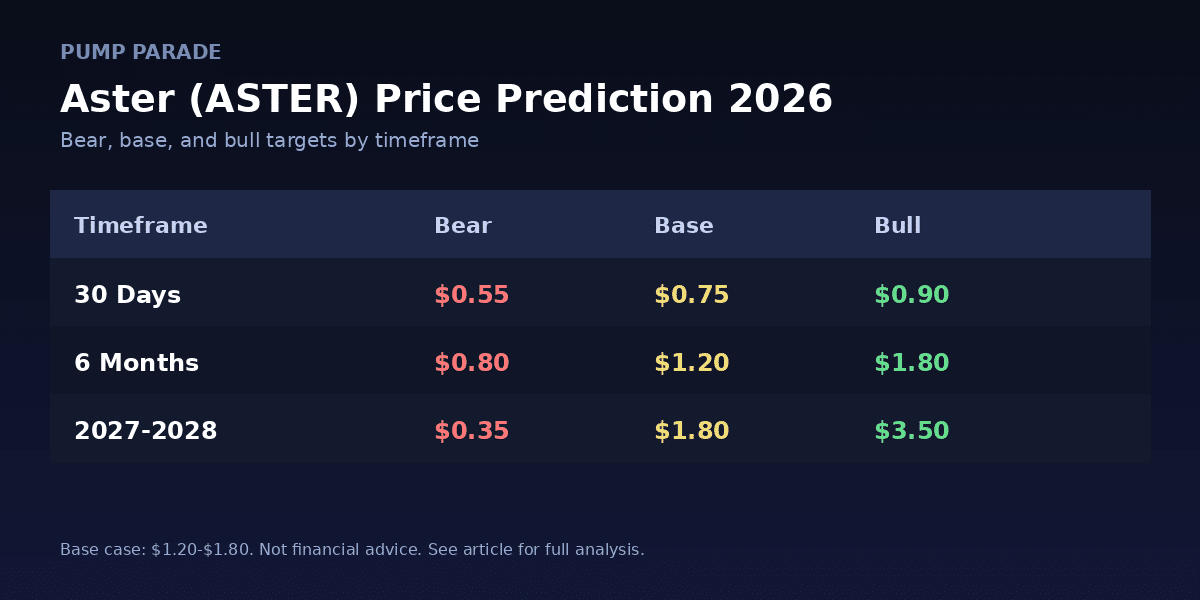
Rather than one point estimate, here are three scenarios with the conditions that would trigger each. Every target below assumes normal market conditions, no major exchange failures, and a Bitcoin range broadly consistent with its current $77K level.
Next 30 days: $0.55 to $0.95
Short term, ASTER is a range trade. The 30-day setup favors a grind higher if Aster reports rising weekly open interest and a new all-time high in monthly volume. Bear case in the next month is a retest of the summer 2026 lows near $0.55 if broader risk assets weaken. Base case is $0.75, roughly the 30-day mean. Bull case is a reclaim of $0.90, which would set up a longer trend change.
6 months (Q1 2027): $0.80 to $1.80
Six-month targets bracket the range where most analyst models converge. TradersUnion’s statistical model projects $0.81 to $0.84 by year-end 2026 on a conservative growth curve. Coinbase and Kraken both anchor near $0.70 using 5% annual growth models, which is a floor, not a forecast. Our base case sits at $1.20 in this window, assuming Aster grows monthly volume 40% and the first tranche of the supply cut executes cleanly.
Long term (2027 to 2028): $0.35 to $3.50
The long-term range is wider because the outcome depends on structural questions that are still open: does Aster Chain ship and gain real usage, does the supply reduction fully execute, and does Hyperliquid’s lead compress or extend? Coinpedia’s bullish 2026 range of $1.00 to $3.50 assumes rapid platform growth. Our bear case of $0.35 assumes a slow-motion loss of relevance to Hyperliquid plus persistent unlock pressure. Base case of $1.80 lines up with a scenario where Aster stays a strong number two and captures 20% to 25% of on-chain perp volume.
How does Aster compare to Hyperliquid?
ASTER is inseparable from its comparison to HYPE. The two tokens back the same product category, and traders and analysts price them relative to each other. For a live look at the leader’s own trajectory, see our Hyperliquid HYPE price prediction for 2026. Here is the head-to-head:
| Metric | Aster (ASTER) | Hyperliquid (HYPE) |
|---|---|---|
| Price | $0.69 | $79.20 |
| Market cap | $1.86B | $17.62B |
| Market cap rank | #46 | #10 |
| Avg open interest | ~$900M | ~$5.15B |
| Approx market share (perps OI) | ~15% | ~70%+ |
| Max leverage | 1001x | 50x |
| Native L1 | Aster Chain (early) | HyperEVM (live) |
| Token model | Fee buybacks, supply cut planned | Fee buybacks, deflationary |
The clean read: Hyperliquid is the incumbent with a bigger book and a more mature settlement layer. Aster is the challenger with a more aggressive product spec and a smaller cap that leaves more room to grow in percentage terms. If you believe on-chain perps as a category expand meaningfully, both tokens can work. If you believe the space consolidates around one leader, HYPE has the stronger position.
Will ASTER reach $2 by end of 2026?
Reclaiming the $2.41 all-time high in 2026 is possible but not the base case. Getting there requires three things happening in sequence: Aster’s monthly volume needs to break above $100 billion consistently, the supply cut from 8B to 3B needs to be at least half executed, and broader crypto market conditions need to be at least as constructive as they are today. A partial version of that, roughly $1.50 to $1.80, is a more realistic bull outcome and still delivers a 2x from here.
What Would Change Our View
The base case above rests on assumptions. Here are the three specific triggers that would move us more bullish or more bearish:
Bullish trigger: Aster reports two consecutive months of open interest above $1.5 billion AND executes a verifiable on-chain supply burn representing at least 20% of the planned reduction. That combination materially changes the token math.
Bearish trigger: Hyperliquid’s share of on-chain perp OI expands above 80% for a full quarter while Aster’s monthly volume drops below $30 billion. That would signal the challenger narrative is failing.
Wildcard: A CEX listing tier upgrade (Coinbase spot, for example) or the launch of an Aster ETF filing by a major issuer would each be worth at least a 40% rerating on their own.
Frequently Asked Questions
Will Aster (ASTER) reach $2 in 2026?
Reaching $2 in 2026 is a bull case, not a base case. It would require sustained monthly volume above $100 billion, verifiable execution of the supply reduction from 8 billion to 3 billion tokens, and Aster taking real market share back from Hyperliquid. Our base case for end of 2026 is closer to $1.20 to $1.80.
Is Aster crypto a good investment in 2026?
ASTER is a high-volatility, high-risk bet on a real product with a revenue-linked token model. It is not suitable for conservative investors, and it depends heavily on execution against Hyperliquid. For traders comfortable with concentrated exposure and unlock risk, it offers asymmetric upside if the supply cut executes and volume growth continues.
Can ASTER overtake Hyperliquid?
Overtaking Hyperliquid by open interest and volume in 2026 looks unlikely based on current trends. Hyperliquid controls more than 70% of on-chain perp OI and its lead has widened, not narrowed, since Aster’s launch. Aster can grow into a durable number two, but flipping the leader is a multi-year proposition that would require a specific catalyst.
What is Aster’s maximum token supply?
Aster’s current max supply is 8 billion ASTER tokens, with circulating supply near 2.7 billion. The team has committed to reducing max supply to 3 billion through buybacks and burns. Execution of that plan is the single most important variable in the token’s long-term valuation model.
Is Aster better than Hyperliquid?
Better depends on the user. Aster offers up to 1001x leverage, privacy features, and a smaller-cap token with more percentage upside. Hyperliquid offers deeper liquidity, a more mature L1 in HyperEVM, and roughly 70% market share of on-chain perps. For most traders, Hyperliquid is the safer default. For those seeking asymmetric bets, Aster is the higher-beta play.
Where can I buy ASTER?
ASTER is available on major centralized exchanges including Binance, KuCoin, MEXC, and Gate, as well as on Aster DEX itself. Because ASTER trades primarily on BNB Chain contracts, on-chain purchases require a BNB Chain-compatible wallet. If you are considering a BNB Chain wallet, our Phantom wallet review for 2026 covers the multi-chain options available for perp DEX traders. Always verify contract addresses via CoinGecko before trading.
The Honest Take
ASTER is a compelling story with a hard ceiling. The product is real, the revenue model is real, and the challenger narrative is real. But being second in a network-effect market is a structurally uncomfortable place to sit, and the token faces years of supply pressure that only aggressive execution can offset.
The base case is that ASTER grinds to $1.20 to $1.80 by end of 2026, which is a respectable return from here but not the 3x-4x that launch-week buyers were pricing in. The bull case of $2+ requires nearly everything going right, including catalysts that are not yet on the calendar. The bear case of $0.35 to $0.50 is not extreme; it is what happens if unlocks front-run buybacks and Hyperliquid keeps taking share.
For traders who like asymmetric bets and can stomach 30% drawdowns, ASTER is worth monitoring. For lower-risk perp DEX exposure, Hyperliquid remains the cleaner large-cap play. Serious positions should watch on-chain burn transactions and monthly OI prints more than the daily chart.
The probability favors ASTER staying below $2 through most of 2026 with a real shot at reclaiming it if the supply reduction executes on schedule. That is the trade.
Disclaimer: This article is for informational and educational purposes only and should not be construed as financial, investment, or trading advice. Cryptocurrency markets are highly volatile, and past performance does not guarantee future results. The price predictions and analyses presented here are based on AI models, technical indicators, and available data at the time of writing, they are not guarantees. Always conduct your own research (DYOR) and consult with a qualified financial advisor before making any investment decisions. Pump Parade and its authors do not assume liability for financial losses incurred based on information provided in this article.