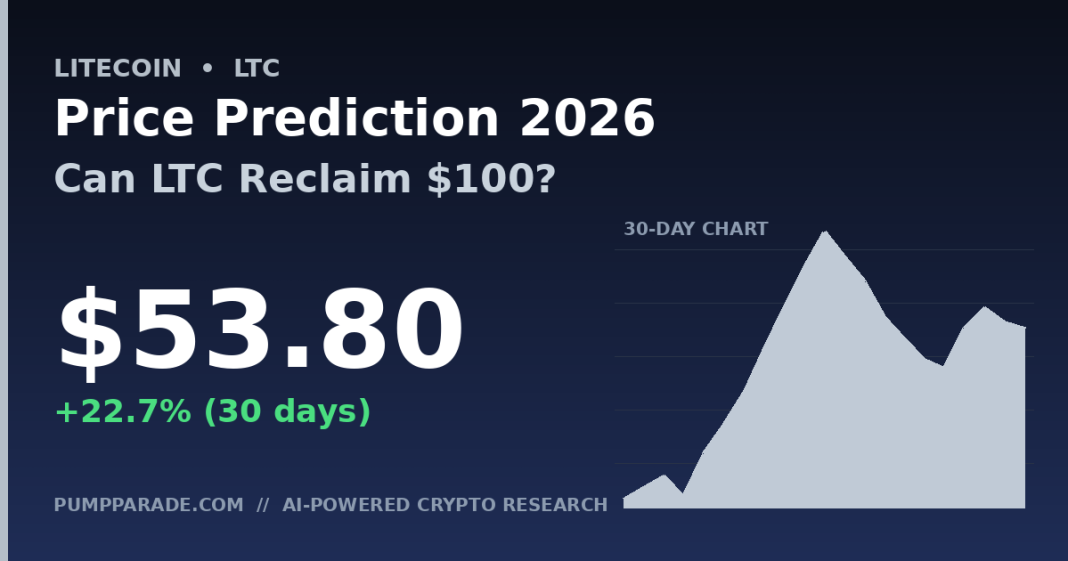
Any honest Litecoin price prediction 2026 starts with the tape: Litecoin (LTC) trades at $53.80 as of September 13, 2026, up 22.7% over the past 30 days after a summer bounce off the $43 zone. That kind of move used to feel routine for LTC. This year, it feels like a comeback. Litecoin is still down roughly 53% from its 52-week high near $136, and the last 12 months have punished holders who stayed in cash-flow altcoins and AI narratives.
But three things are happening at once. Canary Capital’s spot Litecoin ETF (ticker LTCC) is live on Nasdaq and quietly building assets. MWEB privacy addresses just crossed an all-time high near 519,000 LTC. And LitVM, the EVM-compatible Layer 2 that plants smart contracts on top of Litecoin, is on track for Q4 2026 mainnet. Stack those on top of a halving that arrives in July 2027, and the setup for the next 6 to 12 months looks structurally different than the one that put LTC in the penalty box for most of this year.
So here is the real Litecoin price prediction 2026 question that ranking Google articles keep dodging: can LTC actually reach $100 by year end, or is that just recency bias from a 30-day bounce? Below, we break down the current setup, the bull and bear cases with specific catalysts, side-by-side comparisons, and where the honest numbers land.
Key Takeaways
- Litecoin trades at $53.80 as of September 13, 2026, up 22.7% in 30 days but down 53% year over year.
- The Canary Litecoin ETF (LTCC) is live on Nasdaq, giving institutions a regulated wrapper for the first time.
- LitVM, an EVM-compatible Layer 2 for Litecoin, is scheduled for Q4 2026 mainnet, opening the door to DeFi on LTC.
- The next Litecoin halving is projected for July 27, 2027, cutting block rewards from 6.25 to 3.125 LTC.
- Analyst 2026 targets range from Coinbase’s conservative $44.73 to Coinpedia’s $100 to $150 band.
- Our base case: $75 by year end 2026. Bull case: $100 to $120 if LitVM ships and ETF inflows accelerate.
What Is Litecoin (LTC) Worth Today?
Before we get to targets, let’s ground the analysis in numbers. Here is the LTC snapshot at time of writing.
| Metric | Value |
|---|---|
| Price | $53.80 |
| 24h change | -0.65% |
| 30d change | +22.7% |
| Market cap (approx) | $4.1B |
| 24h spot volume (LTC/USDT) | $8M |
| Market cap rank | ~25 |
| All-time high | $412 (May 2021) |
| % from ATH | -87% |
| 52-week high / low | $135.99 / $39.28 |
Numbers matter, but so does the shape of the tape. LTC printed a 52-week low at $39.28 in early summer, rebounded to $59.46 last month, and is now consolidating near $54. That is a textbook higher-low, higher-high sequence on the daily chart, the sort of base-building that historically precedes Litecoin’s longer trend moves.
Why Is Litecoin Rallying Right Now?
Ask ten traders and you get three answers: ETF flows, LitVM anticipation, and general small-cap L1 rotation. The truth is all three are showing up in the data.
The Canary Litecoin ETF has been trading under LTCC on Nasdaq for months. It is not a headline product like the spot Bitcoin ETFs, but it removes the last real objection institutions had to touching LTC: where do we hold it and how do we report it. Every week LTCC accumulates coins is a week LTC’s float thins slightly. Combine that with MWEB balances near 519,000 LTC (about 0.6% of supply) sitting in privacy-preserving addresses, and the freely tradable supply is meaningfully smaller than the circulating number suggests.
Then there is LitVM. If the mainnet launches on schedule in Q4, Litecoin gets its first credible pitch for DeFi and stablecoin activity in years. That is not a guarantee of price appreciation. It is the first genuinely new narrative Litecoin has had since MWEB shipped in 2022.
Why Could Litecoin Reach $100 in 2026?
1. LitVM Ships and Actually Gets Used
Litecoin has been the “digital silver” for so long that most traders forgot it has a development roadmap at all. LitVM changes that. An EVM-compatible Layer 2 means any Ethereum dApp can be redeployed on Litecoin with minimal code changes. Uniswap-style DEXs, lending protocols, stablecoin issuers, all technically shippable.
The bull case is not that LitVM becomes the next Arbitrum overnight. It is that Litecoin gets a permanent yield venue, which means holders no longer have to sell LTC to earn on their capital. That fundamentally changes the sell pressure math. Even 10% of LTC supply being productively deployed on LitVM would tighten the market.
2. ETF Flows Compound Ahead of the Halving
The 2027 Litecoin halving cuts block rewards from 6.25 to 3.125 LTC on approximately July 27, 2027. Historically, LTC has front-run its halvings by 6 to 9 months. If that pattern repeats, Q4 2026 and Q1 2027 are exactly the window where the “halving trade” starts. Layer on ETF-driven demand from LTCC and any additional filings that catch bids, and you have a supply-demand imbalance forming at the same time as the miner reward cut.
3. Payments Narrative Comes Back Into Fashion
Stablecoins have eaten most of the “crypto as payments” mindshare. But Litecoin still processes cheap, fast, non-custodial payments in a way that USDC on Base cannot: no counterparty risk on the settlement layer, MWEB privacy where it matters, and a 14-year uptime record. If regulatory scrutiny on stablecoin issuers intensifies over the next 90 days (a real possibility given ongoing CLARITY Act debates and Treasury attention), Litecoin becomes a plausible backup rail for merchants who want crypto payments without stablecoin dependency.
The Bear Case for Litecoin
1. Nobody Actually Builds on LitVM
Ship it and they will come is a myth. Ethereum has L2s dying every quarter despite proven demand. Litecoin lacks a native DeFi user base, has no existing dApp ecosystem to fork, and competes with much better-funded EVM chains for developer attention. If LitVM ships in Q4 to crickets, the “smart contract Litecoin” narrative collapses within 60 days and LTC re-rates back toward the $40s.
2. Bitcoin Sucks All the Oxygen Out of the Room
Litecoin is a levered play on Bitcoin. That works both ways. If BTC rallies hard, LTC amplifies. If BTC chops sideways and capital rotates into AI tokens, DePIN, or new narratives, LTC gets left behind. The last 12 months are exhibit A: LTC underperformed BTC by roughly 40 percentage points because the flows just went elsewhere.
3. ETF Wrapper Is Not a Demand Machine
The spot Bitcoin ETFs pulled in billions because there was pent-up institutional demand waiting for a regulated wrapper. There is no equivalent wall of money waiting for spot LTC exposure. LTCC could accumulate for years and still not move the price meaningfully if RIAs, family offices, and pensions do not care to allocate. This is the risk baked into most of the moderate 2026 forecasts (Coinbase at $44.73, Kraken at $50.69).
Litecoin Price Prediction 2026: Targets by Timeframe
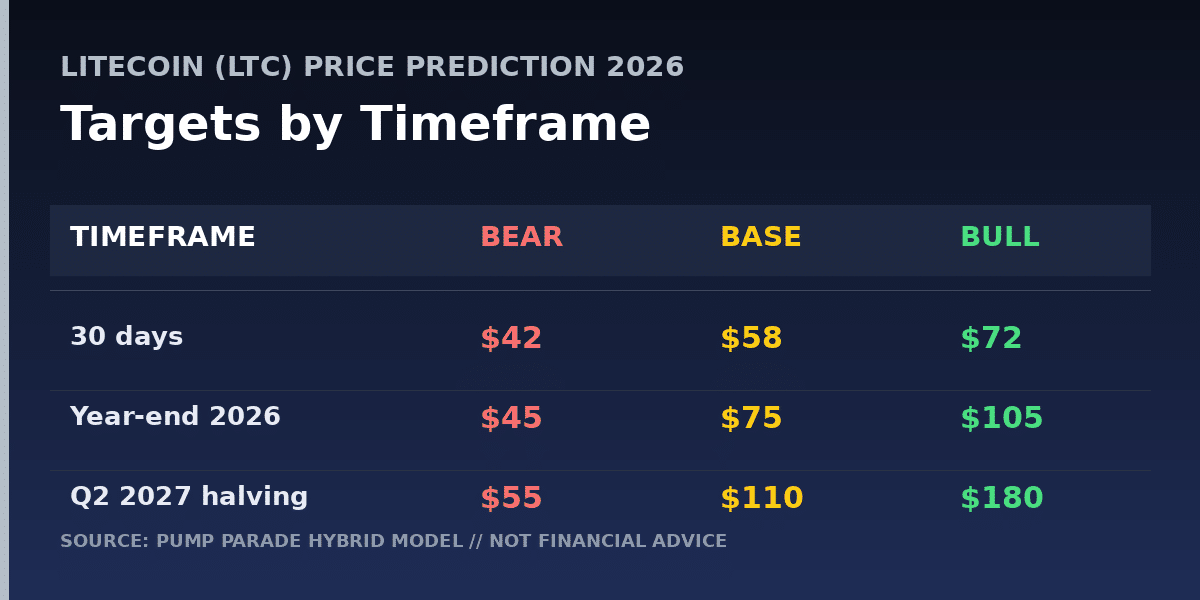
Here is how we are framing the Litecoin price prediction for 2026 across three timeframes and three scenarios. These are conditional targets, not guarantees.
| Timeframe | Bear | Base | Bull |
|---|---|---|---|
| 30 days | $42 | $58 | $72 |
| Year-end 2026 | $45 | $75 | $105 |
| Q2 2027 (halving run-up) | $55 | $110 | $180 |
Short-term (30 days)
LTC is consolidating between $50 and $60. A daily close above $60 opens a run to $70. A breakdown below $48 reopens the $42 to $45 support zone that held twice this summer. Our base case is a range trade between $52 and $65 as the market waits for confirmation on LitVM’s release schedule.
Medium-term (year-end 2026)
Base case is $75 by December 31. That assumes LTCC continues to accumulate coins at the current pace, LitVM ships in Q4 without major delays, and BTC stays above its 200-day moving average. Bull case at $100 to $120 requires LitVM launch to spark actual on-chain activity, plus BTC rally that lifts the whole complex. Coinpedia’s $100 to $150 range fits this window. For context, Coinpedia’s own model also lands in the $100 zone as its 2026 midpoint.
Long-term (halving cycle, mid-2027)
Halving in July 2027 is the anchor event. History suggests LTC starts pricing in the supply cut 6 to 9 months out, meaning Q1 2027 into Q2 2027 is where the parabolic phase typically begins. Base case is $110 into the halving. Bull case is $180 if the whole altcoin complex reflates and Litecoin captures a bigger share of the “regulated crypto exposure” narrative.
For comparison, Standard Chartered’s crypto research desk has flagged multiple mid-cap L1s and payment coins as candidates for outsized 2027 gains, though the desk’s specific LTC number moves around. Treat any single analyst target as one input, not the answer.
How Does Litecoin Compare to Bitcoin?
LTC has been called “digital silver to Bitcoin’s digital gold” for a decade. That framing is still the cleanest way to understand the trade. Here is the side-by-side.
| Metric | Litecoin (LTC) | Bitcoin (BTC) |
|---|---|---|
| Block time | 2.5 minutes | 10 minutes |
| Max supply | 84M | 21M |
| Hashing algorithm | Scrypt | SHA-256 |
| Next halving | July 2027 | April 2028 |
| Native privacy | MWEB (opt-in) | None on base layer |
| Smart contracts | LitVM (Q4 2026) | Limited (Taproot, Ordinals) |
| Spot ETF | Yes (LTCC) | Yes (multiple) |
| Typical cycle beta vs BTC | 1.4x to 2.0x on the way up | 1.0x reference |
For a comparable payments-focused chain with a very different design philosophy, our Stellar (XLM) price prediction 2026 covers the tokenized-securities angle Litecoin cannot really touch. And for enterprise settlement rails, our Hedera (HBAR) 2026 outlook examines the permissioned-side of that same market. Litecoin sits between them: neutral, permissionless, and starting to grow a DeFi surface.
What Would Change Our View
Three concrete triggers would flip the base case, in either direction.
Bullish flip: LitVM launches on time in Q4 2026 with two or more real DeFi protocols going live in the first 30 days, and LTCC’s assets under management crosses $500M. That combination would justify moving the year-end base case from $75 toward $100 to $110.
Bearish flip: LitVM slips into 2027, LTCC assets stall below $200M, and BTC breaks its 200-day moving average to the downside. That combination pushes LTC back to the $40 to $45 range and puts $30 in play.
Neutral no-op: LitVM ships but activity is muted, ETF flows are steady but small, and BTC ranges. LTC drifts in a $50 to $70 channel through year-end. This is arguably the most likely single outcome.
Frequently Asked Questions
Can Litecoin reach $100 in 2026?
Reaching $100 by year-end 2026 is achievable but not a base case. It requires LitVM to launch on schedule in Q4, LTCC ETF flows to accelerate meaningfully, and Bitcoin to stay in a supportive uptrend. Our base case is $75 by December 31, with $100 to $120 as the bull scenario. History says LTC tends to run into halvings, so early 2027 is a stronger $100 window than year-end 2026.
Is Litecoin a good investment in 2026?
Litecoin is a higher-conviction bet than most alt L1s because it has a live spot ETF, a scheduled halving in 2027, and an imminent smart-contract launch. It is also a lower-upside bet than newer AI or DePIN tokens with smaller market caps. LTC fits a portfolio slice for investors who want regulated crypto exposure beyond BTC and ETH without taking on venture-scale risk.
When is the next Litecoin halving?
The next Litecoin halving is projected for July 27, 2027, at block 3,360,000. It will reduce block rewards from 6.25 LTC to 3.125 LTC per block. LTC has historically front-run its halvings by 6 to 9 months, so Q1 2027 is when the “halving trade” typically begins.
What is LitVM and why does it matter for LTC price?
LitVM is an EVM-compatible Layer 2 built on top of Litecoin, scheduled for Q4 2026 mainnet. It matters for LTC price because it opens Litecoin to DeFi activity for the first time. If protocols and users show up, it creates ongoing yield use cases for LTC holders that reduce sell pressure. If nobody builds, it becomes a footnote.
Does Litecoin have a spot ETF?
Yes. The Canary Litecoin ETF trades under ticker LTCC on Nasdaq. It gives institutions a regulated wrapper for spot LTC exposure. Cumulative flows have been modest compared to the spot Bitcoin ETFs, but the product’s existence removes a key barrier for RIAs, family offices, and pensions that previously could not touch LTC directly.
How does Litecoin compare to Bitcoin?
Litecoin is a Bitcoin fork with 4x faster block times, 4x the max supply (84M vs 21M), a different mining algorithm (Scrypt vs SHA-256), and optional privacy via MWEB. In most bull cycles, LTC trades with a beta of 1.4x to 2.0x versus BTC on the way up. In sideways or bearish tape, it typically underperforms.
The Honest Take
Litecoin is boring in a market that pays for excitement. That has been the story of the past 12 months and it explains the 53% year-over-year drawdown. But boring is not the same as broken. LTC still processes blocks every 2.5 minutes without fail, still has real privacy tech in production, and now has both a regulated ETF wrapper and an incoming smart-contract Layer 2. That is a more complete stack than most of its 2018-vintage peers can claim.
The Litecoin price prediction 2026 setup breaks down cleanly. The base case, $75 by year end, requires modest execution and no macro disaster. The bull case, $100 to $120, requires LitVM to actually attract builders and ETF flows to compound. The bear case, back to the $40s, requires the setup to unwind, mostly by way of BTC weakness. None of these are hidden alpha. They are all conditional bets on catalysts that are already in flight.
If you already hold LTC, this is a setup worth monitoring rather than panic-selling into the recent bounce. If you are looking at Litecoin fresh, the next 90 days will tell you whether the LitVM narrative has legs. Watch the mainnet launch, watch first-week TVL, and watch how much ETF flow shows up in the last two months of the year. Those three data points are worth more than any analyst target, including ours. For a directly comparable tokenization-and-institutional-flow trade with a different risk profile, our Ondo (ONDO) price prediction 2026 covers the RWA angle.
Disclaimer: This article is for informational and educational purposes only and should not be construed as financial, investment, or trading advice. Cryptocurrency markets are highly volatile, and past performance does not guarantee future results. The price predictions and analyses presented here are based on AI models, technical indicators, and available data at the time of writing, they are not guarantees. Always conduct your own research (DYOR) and consult with a qualified financial advisor before making any investment decisions. Pump Parade and its authors do not assume liability for financial losses incurred based on information provided in this article.