Any serious Solana price prediction 2026 has to start with one number: SOL trades at $73.63 as of August 7, 2026, up 0.7% on the day and holding a $42.9 billion market cap at rank #7. Yet the token still sits roughly 75% below its January 2025 all-time high of $294.
That gap between current price and prior peak is the whole story. Since Morgan Stanley launched its spot Solana ETF on July 28, cumulative SOL ETF inflows have climbed to $1.15 billion. Meanwhile, the Solana Foundation is racing to ship Alpenglow, the consensus overhaul that would slash finality from 12 seconds to 150 milliseconds. The bull case for SOL to reclaim $150 in 2026 is being written in real time. So is the bear case. This article walks through the numbers, the catalysts, the risks, and what would need to happen for SOL to double from here.
Key Takeaways
- SOL trades at $73.63 with $42.9B market cap, down 75% from its $294 ATH.
- Morgan Stanley's spot SOL ETF pulled $19M in its first day; cumulative SOL ETF AUM sits at $878M.
- Alpenglow mainnet activation (150ms finality) is targeted for Q3 2026, the dominant near-term catalyst.
- Standard Chartered's $250 target anchors the bull case; Coinpedia's $130-$200 range anchors the base case.
- Key risks: validator centralization, MEV extraction complaints, and continued Bitcoin weakness.
- Base case for December 2026: $95-$140. Bull case with Alpenglow ship + ETF acceleration: $180-$220.
Where Solana Stands Today
SOL has spent most of Q3 2026 grinding sideways in the $65-$80 range, with volume normalizing after the Morgan Stanley ETF launch. Here is the live snapshot from Birdeye and CoinPaprika:
| Metric | Value |
|---|---|
| Price | $73.63 |
| 24h change | +0.73% |
| 7d change | +0.07% |
| Market cap | $42.9B |
| 24h volume | $6.96B |
| Rank | #7 |
| All-time high | $294.16 (Jan 2025) |
| % from ATH | -74.98% |
| 24h unique wallets | 652,740 |
Two data points matter more than the price itself. Daily active wallets crossed 650,000, up 2.7% week-over-week, meaning the base of on-chain users is still expanding despite the drawdown. And 24-hour DEX volume of $6.96 billion continues to eclipse Ethereum mainnet by a factor of two-plus on most days. Whatever the price screens say, network usage did not collapse with the token.
Why is Solana Range-Bound Right Now?
Three forces are locking SOL between $65 and $80. First, macro liquidity remains tight, with Bitcoin oscillating in a similar consolidation pattern and pulling the entire risk complex with it. Second, roughly 74% of holders bought in above current levels, creating overhead supply every time SOL rallies. Third, the market is pricing in Alpenglow risk. Traders are waiting to see the upgrade ship before repricing.
The result: derivatives funding stays neutral, spot flows are steady but not explosive, and open interest keeps rebuilding after every liquidation flush. This is coiling behavior, not capitulation.
The Bull Case for SOL in 2026
Alpenglow Mainnet Activation
Alpenglow is the most consequential Solana upgrade since the Firedancer client. It replaces the current Tower BFT consensus with Votor and Rotor, targeting sub-200 millisecond finality. In practice, that means order-matching engines, prediction markets, and high-frequency DeFi apps get latency that beats most centralized exchanges. Anatoly Yakovenko has publicly targeted Q3 2026 for mainnet. If the beta clusters continue to hold through August testnet, activation becomes the single biggest fundamental catalyst SOL has ever had.
Institutional ETF Flow Compounding
The Morgan Stanley spot SOL ETF is doing what the Bitcoin spot ETFs did in early 2024: quietly compounding institutional exposure. Cumulative SOL ETF net assets sit at $878.33M, and the fund is passing 95% of staking rewards to shareholders. That yield-plus-price structure is a first for a large-cap ETF product and is drawing pensions and RIAs that skipped Bitcoin ETFs entirely. If flow velocity matches the Bitcoin ETF launch curve, cumulative SOL ETF AUM could clear $5B by year-end 2026.
DePIN and Firedancer Decentralization
Firedancer from Jump Crypto now runs a growing share of validator infrastructure. Client diversity was the standing critique from institutional buyers, and it is being systematically addressed. In parallel, DePIN protocols like Helium and Hivemapper anchor Solana as the default chain for physical-world coordination. This is the boring, structural bull case that is hardest to price but easiest to defend.
The Bear Case for SOL in 2026
MEV and Validator Concentration
Jito and its validator clients now capture the majority of block rewards, and MEV extraction complaints have reached the point where Solana Foundation research is publicly debating protocol-level mitigations. Any regulatory intervention or a botched MEV rework could rattle validator economics and, by extension, staking yield. Institutions notice.
Token Unlock and Foundation Selling
Solana Foundation and early-investor unlocks continue on a monthly cadence through 2027. Even with ETF inflows, the market must absorb steady structural supply. Analysts at K33 have flagged this as the single largest overhang, arguing that SOL needs sustained $500M+ monthly ETF inflows just to offset scheduled unlocks at current prices.
Bitcoin Correlation Risk
SOL's 90-day beta to Bitcoin sits above 1.4. If BTC breaks below its own consolidation range, SOL likely tests $50 before it tests $100. Historical drawdowns during BTC weakness have averaged 1.6x the reference move, and there is nothing about 2026 rhyming with 2023 that suggests this decoupling.
What Are the Solana Price Targets for 2026?
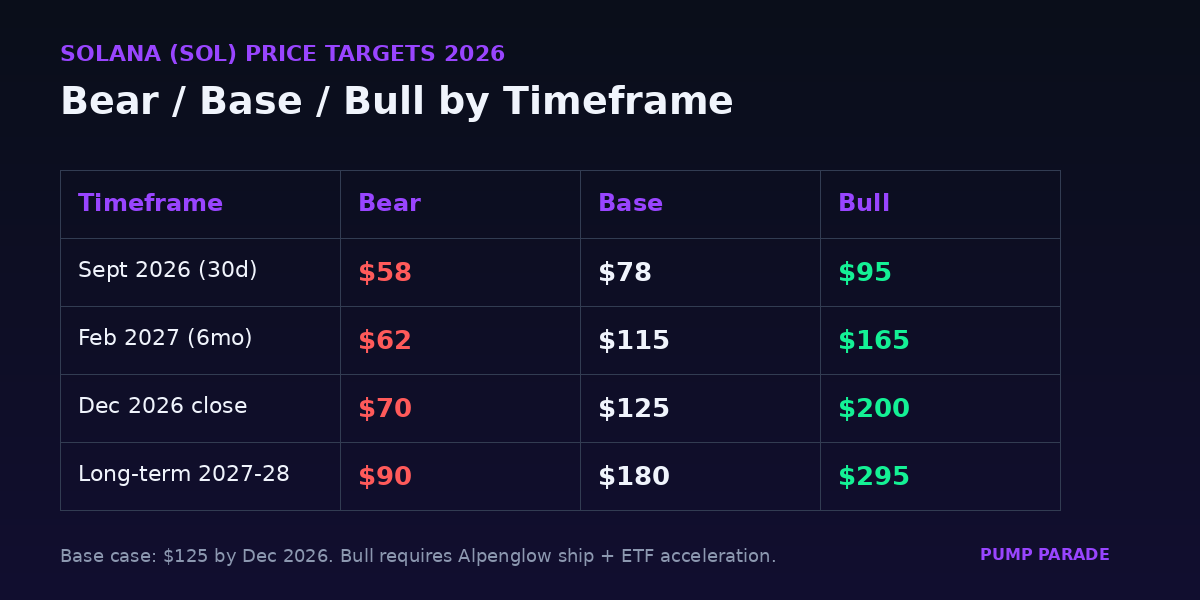
Below is our house view, cross-checked against Standard Chartered, Coinpedia, and CoinMarketCap consensus. All targets assume no black-swan macro event.
| Timeframe | Bear | Base | Bull |
|---|---|---|---|
| 30 days (Sept 2026) | $58 | $78 | $95 |
| 6 months (Feb 2027) | $62 | $115 | $165 |
| Dec 2026 close | $70 | $125 | $200 |
| Long-term (2027-28) | $90 | $180 | $295 |
30-Day Outlook (September 2026)
Base case: SOL grinds toward $78-$82 as Alpenglow testnet milestones hit and ETF flows compound. A daily close above $79 (the 100-day EMA cluster) opens $95. Bear case: Bitcoin loses $85K and SOL revisits $58, where the June low sits.
6-Month Outlook (February 2027)
By early 2027, Alpenglow should be live and initial post-upgrade validator behavior priced in. If daily transaction throughput stays above 5,000 real TPS (excluding vote transactions) and ETF AUM crosses $3B, $115-$140 becomes a defensible base. The bull scenario, requiring both a broader crypto risk-on move and continued institutional bid, brings $165 into play.
Long-Term (2027-2028)
Standard Chartered's $250 target and Doo Prime's $336 upside case are meaningful but require compounding assumptions: Alpenglow adopted, Firedancer running majority of validators, ETF AUM comparable to Ethereum ETFs, and Bitcoin above $150K. Base case: SOL retests $180-$200. A new ATH above $295 is possible but requires everything to go right.
How Does Solana Compare to Ethereum in 2026?
The fair comparison is not SOL versus every L1. It is SOL versus ETH, because that is the trade institutional allocators are actually making. Recent Pump Parade coverage of the Ethereum price outlook for 2026 laid out the ETH bull case at $4,000. Here is how the two stack up today:
| Metric | Solana (SOL) | Ethereum (ETH) |
|---|---|---|
| Price | $73.63 | $1,911 |
| Market cap | $42.9B | $230B |
| % from ATH | -75% | -61% |
| Daily active wallets | ~652K | ~450K |
| Real DEX volume (24h) | $6.96B | $2.4B |
| Staking yield (net) | ~6.8% | ~2.9% |
| Median tx cost | <$0.001 | ~$0.35 |
SOL loses on absolute size and institutional maturity. It wins on user activity, throughput, cost, and yield. If you believe the next crypto cycle is retail-heavy and application-driven, that mix favors Solana. If you believe institutional capital continues to reward the incumbent smart-contract chain, ETH is your trade. Most large-cap allocators are running both, and independent research from K33 Research supports the barbell approach for 2026.
For traders looking at the perp side of Solana's ecosystem, our Hyperliquid vs GMX comparison is worth a read to understand where the on-chain derivatives flow is actually settling. For a broader view of SOL's liquid staking ecosystem, our Jito review unpacks the validator layer that now underpins most institutional SOL exposure. Official Alpenglow technical specs are on the Solana Foundation blog, and live token stats can be verified on CoinGecko.
What Would Change Our View
Three explicit triggers would force a rewrite of this outlook:
- Alpenglow slippage past Q4 2026. If the upgrade misses its Q3 window and pushes to 2027, we would cut the 6-month base case by 20% and lean toward the bear range. The market is already pricing in on-time delivery.
- Cumulative SOL ETF outflows for a full month. Sustained outflows would signal that the institutional bid has stalled and would put $58-$62 back in play. So far, every July session closed net-positive.
- Any protocol-level MEV overhaul that disrupts staking yield. If validator economics fall meaningfully below current levels, the ETF product loses its differentiator and inflows likely decelerate.
Frequently Asked Questions
Will SOL reach $150 in 2026?
Reaching $150 in 2026 is our bull-case scenario, requiring Alpenglow to ship on schedule, sustained ETF inflows above $500M per month, and Bitcoin holding above $90K. Base case sees SOL closing 2026 between $95 and $140. A $150 print is possible but not the median outcome.
Is Solana a good investment in 2026?
Solana offers a rare combination of large-cap liquidity, real on-chain usage, and a defined catalyst calendar. The setup favors patient buyers on drawdowns rather than momentum chases at highs. Risk-adjusted, SOL screens better than most top-10 alts right now, but position sizing matters given 60-70% drawdowns are historically routine.
What is the Solana price prediction for 2027?
By 2027, base case targets sit at $150-$200 assuming Alpenglow adoption, Firedancer running majority validators, and continued ETF momentum. Standard Chartered's $250 target is the bull anchor for late 2027. A new all-time high above $295 requires everything to go right, including a broader crypto bull cycle.
Why is SOL down so much from its all-time high?
SOL peaked at $294 in January 2025 during peak meme-coin activity on Pump.fun. When that speculative flow collapsed in Q2 2025, SOL de-rated with it. The current $73 handle reflects normalized on-chain activity and a market that has not yet priced in Alpenglow. The drawdown is severe but consistent with prior cycle behavior.
When does Alpenglow launch on Solana?
The Solana Foundation targets Q3 2026 for Alpenglow mainnet activation. Beta clusters are running on testnet through August 2026, and validator upgrade coordination is underway. Slippage risk exists, but current signals point to on-schedule delivery. Watch the Solana Foundation blog for the official activation date.
How does Solana staking work with the ETF?
The Morgan Stanley spot SOL ETF stakes underlying SOL and passes 95% of staking rewards to shareholders, currently yielding around 6.5% net of fees. This is a structural improvement over spot Bitcoin ETFs, which offer no yield component, and is a primary driver of the ETF's $878M in net assets since launch.
The Honest Take
SOL at $73 is neither the layup buy of the cycle nor a value trap. It is a large-cap crypto asset with a clear, dateable catalyst (Alpenglow), a compounding institutional flow (ETFs), and identifiable structural risks (unlocks, MEV, BTC beta). If you already own SOL, holding through Alpenglow makes sense given the risk-reward. If you do not own it, dollar-cost averaging into the $65-$78 band with defined stops below $58 is a reasonable framework.
The trade that does not make sense is levered chasing at $95 hoping for $150. That is the trade the ETF-era market punishes hardest. Watch flow, watch upgrade cadence, and let the setup come to you.
Disclaimer: This article is for informational and educational purposes only and should not be construed as financial, investment, or trading advice. Cryptocurrency markets are highly volatile, and past performance does not guarantee future results. The price predictions and analyses presented here are based on AI models, technical indicators, and available data at the time of writing, they are not guarantees. Always conduct your own research (DYOR) and consult with a qualified financial advisor before making any investment decisions. Pump Parade and its authors do not assume liability for financial losses incurred based on information provided in this article.