
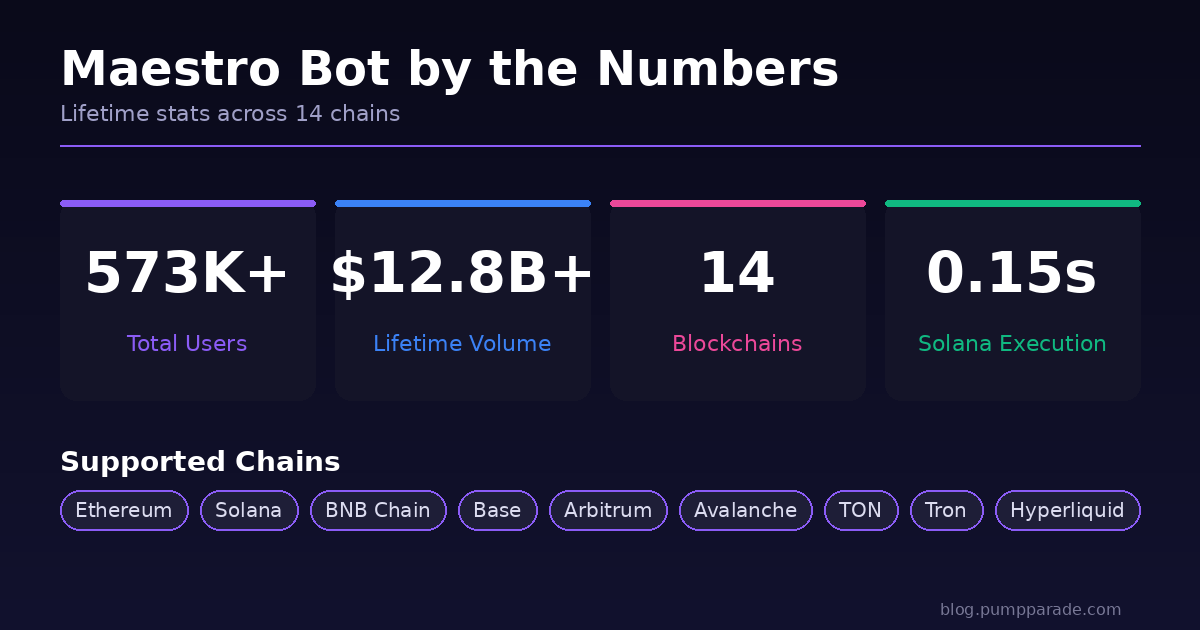
Maestro Bot is one of the few Telegram trading bots that has actually survived the last two market cycles. While the top of the sniper-bot leaderboard has churned through Unibot, Banana Gun, Sigma, GMGN, and a wave of pump.fun-era Solana copies, Maestro has quietly compounded users on Ethereum, BNB Chain, Base, Solana, and nine other networks. In 2026 the team publishes 573,000+ total users and $12.8B+ in lifetime volume across 14 chains, verified on-chain via Dune dashboards.
The question this review answers: is Maestro still the right pick if you trade EVM chains and want a single bot for sniping, copy trading, and portfolio tracking, or has the market moved on? We opened a Maestro account, funded it, ran real trades on Ethereum and Base, and compared the fee math against alternatives. Here is what we found.
Quick Verdict
Rating: 4.2 / 5. Strong Buy for Active EVM Traders.
Maestro is the most mature multi-chain Telegram trading bot on the market. The 1% per-trade fee is average for the category (not the cheapest, not the most expensive), but the coverage across 14 chains, the anti-rug engine, and the copy-trading module justify it for anyone who trades across multiple networks. The main knock is that Maestro is custodial (the bot holds your keys), so it should be treated strictly as a hot wallet, never as long-term storage.
If you trade primarily Solana memecoins, dedicated Solana bots like Photon or BullX have a slight edge on execution speed and interface polish. If you trade EVM, Maestro is the default answer.
What Is Maestro Bot?
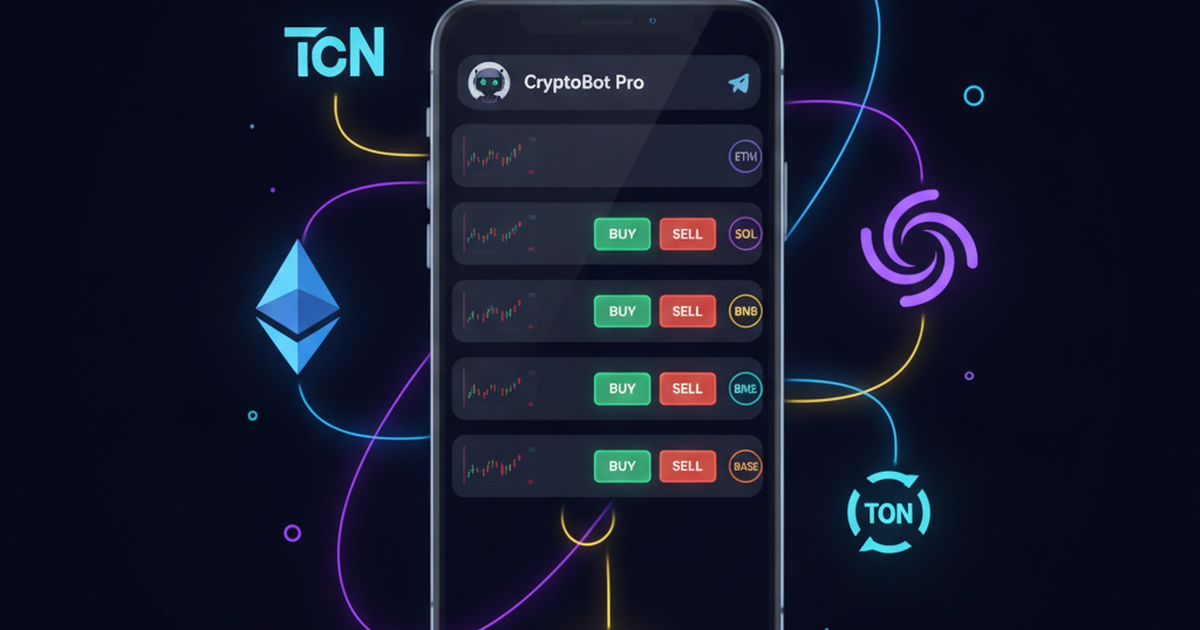
Maestro is a suite of Telegram bots (Sniper, Wallet, Whale, and Buy) that let you snipe token launches, execute swaps, copy other wallets, and manage positions across 14 blockchains, all from inside a Telegram chat. You send commands as messages, the bot signs and broadcasts transactions in the background, and results come back as chat replies.
The product was launched in mid-2022 during the peak of the Telegram bot bull run, and unlike most of its competitors from that era, it has continued shipping updates through the 2024 bear market and into the 2025 to 2026 memecoin cycle. In terms of active user counts and cumulative volume, it now sits in the top three multi-chain trading bots alongside Banana Gun and BonkBot.
Chain coverage in 2026 includes Ethereum, Solana, BNB Chain, Base, Arbitrum, Avalanche, TON, Tron, Hyperliquid, Blast, Polygon, Optimism, Linea, and Scroll. Auto Sniper (the pre-signed launch buyer) currently runs on Ethereum, BSC, Base, Arbitrum, and Solana.
Features Deep Dive
Sniper and Auto Sniper
Sniper is the flagship module. You paste a contract address or a token ticker, set your buy size and slippage, and the bot fills the trade in the next block. Community benchmarks put Maestro’s execution at roughly 0.25 seconds on EVM chains and 0.15 seconds on Solana, which is in the same tier as Banana Gun and slightly behind the fastest Solana-only bots like Photon.
Auto Sniper is a different beast. You point it at a token address before launch, set your max buy and slippage rules, and Maestro monitors the mempool for the liquidity-add transaction. The moment it appears, the bot fires a pre-signed buy in block zero. On EVM chains that means competing for the same block as the deployer, and Maestro’s private-mempool routing gives it a fair shot at inclusion without being sandwiched.
Copy Trading
Copy Trading lets you mirror any public wallet’s buys and sells. You paste the wallet address, set a copy ratio (for example, buy 10% of whatever the target buys), and configure per-token exclusion filters. The bot then watches that wallet on-chain and replicates trades automatically.
The 2026 version added multi-wallet copy trading (up to 20 wallets per subscription) and a leaderboard of publicly-followed traders sorted by 30-day PnL. The leaderboard is useful for finding candidates but you should treat it with skepticism. Wallets on it tend to be aggressive traders whose returns are highly path-dependent.
Call Channels
Call Channels is a feature that connects Maestro to alpha Telegram groups. When a group posts a contract address in a formatted “call,” Maestro can automatically buy it based on your rules. This is the most controversial feature in the product because it makes it trivial to get rugged by malicious channels. Maestro’s Anti-Rug engine mitigates but does not eliminate this. Use with caution and small size only.
Limit Orders 2.0
Limit Orders 2.0 rolled out in Q1 2026 and is genuinely useful. You can now set multiple take-profit levels (for example, sell 33% at 2x, 33% at 5x, 34% at 10x) plus a trailing stop-loss, all in one order. Previously you had to chain manual sell commands. The new order system runs entirely on Maestro’s off-chain execution engine and fires on-chain when price triggers hit.
Anti-Rug and Anti-MEV
Anti-Rug is a static-analysis system that inspects a token contract before buy execution and flags common rug patterns: honeypots, hidden mint functions, blacklist calls, and sudden tax hikes. It is not perfect (nothing catches every rug), but it catches the obvious ones and will hard-block a buy on tokens flagged as honeypots.
Anti-MEV routes your EVM transactions through private mempools (Flashbots Protect on Ethereum, and equivalent relays on BSC and Base) to keep them out of public sight until inclusion, blocking sandwich attacks. This is on by default and costs no extra fee. On Solana, MEV protection is handled via Jito bundles.
Positions Ledger
Positions Ledger is a unified view of everything you hold across all 14 chains in a single Telegram message. It shows cost basis, current value, unrealized PnL, and 24-hour change per position. It is the closest thing Maestro has to a proper portfolio dashboard, and it is one of the reasons multi-chain traders keep coming back. You do not need to bounce between block explorers to see what you own.
Fees and Pricing
Maestro’s fee structure is simple: 1% per successful trade, no subscription tier required to start, no gated features behind higher tiers. Failed trades are not charged. Additional network gas fees apply as normal (Solana priority fees, EVM gas, etc.), and Maestro passes those through at cost.
Two things worth knowing:
- Cashback: Traders can claim up to 30% of their fees back via the
/cashbackcommand. The exact percentage scales with 30-day trading volume, and cashback is credited to your bot wallet weekly. - Referrals: The referral program pays 35% of referred users’ fees for the first month, then 25% for life. This is one of the more generous programs in the category and is a major reason Maestro’s user base has kept growing.
How does 1% compare?
- Photon: 1.00%
- BullX: 1.00%
- GMGN: 1.00%
- Banana Gun: 0.5% base (0.75% for snipes, 1% for manual buys)
- Trojan: 0.9%
- Maestro: 1.00% (net ~0.7% after cashback for high-volume users)
For a $10,000 monthly trading volume, Maestro’s fee is $100 gross, or roughly $70 after cashback. That is competitive but not the cheapest option in the market.
Pros and Cons
Pros:
- Widest chain coverage of any Telegram trading bot (14 networks, 5 with Auto Sniper)
- Mature product with 4+ years of live trading and no major security incidents on the core bot
- Anti-Rug engine catches most obvious honeypots and blacklist scams
- Anti-MEV is on by default with no extra fee
- Cashback and referral programs meaningfully reduce effective fee
- Limit Orders 2.0 is best-in-class for multi-level exits
- Positions Ledger is a rare unified multi-chain portfolio view inside a Telegram bot
Cons:
- Custodial by default (the bot holds your keys); should not be used for long-term storage
- 1% fee is higher than Banana Gun’s base 0.5% for spot trading
- Execution speed on Solana slightly trails dedicated Solana bots like Photon and BullX
- UI is Telegram-native, which means no charts, no advanced order book views, and a steeper learning curve than web terminals like Photon
- Call Channels feature makes it easier to get rugged if you follow the wrong groups
Security and Trust
Maestro is custodial. When you create an account, the bot generates a wallet on your behalf and stores the private key server-side, encrypted with your Telegram-linked session. This is the standard model for Telegram trading bots and it is what enables the sub-second execution. It also means you are trusting the Maestro team not to be compromised, not to be malicious, and not to lose your keys.
Track record so far is clean. Maestro has run since mid-2022 without a public compromise of user funds. The team is pseudonymous but publicly active, publishes regular updates on their official X account, and has integrations with major infrastructure providers (Flashbots, Jito, BloXroute). There is no public third-party security audit of the wallet code, which is a real gap compared to non-custodial wallets like Solflare or Phantom.
Practical security guidance: Treat your Maestro wallet as a hot wallet. Keep only the capital you actively trade in it. Use the /withdraw command to move profits to a hardware wallet regularly. Never store more than a week’s trading float in the bot.
User Experience
Maestro lives entirely inside Telegram, and that is both the strength and the limitation. The strength: you already have Telegram open, the bot is one tap away, and every command is text-based (easy to script, easy to muscle-memorize). The limitation: there are no charts, no depth-of-market views, and no way to see your positions visually. Every action is a message.
Onboarding takes about two minutes. You open Telegram, search for @MaestroSniperBot, tap Start, and the bot walks you through creating a wallet and funding it. The default settings work for most first trades. Advanced settings (per-chain slippage, priority fee tiers, MEV routing preferences) are available through the /settings menu.
Mobile experience is excellent (Telegram is a mobile-first app). Desktop works but feels less native. There is no browser extension or standalone web app, which is a real gap if you want candlestick charts alongside your buys. Most active traders pair Maestro with a chart tool like Birdeye or DexScreener open in another tab.
Verdict and Use-Case Recommendations
Best for: Multi-chain EVM traders who want one bot for Ethereum, Base, BSC, and Arbitrum. Copy traders who want to mirror multiple wallets across chains. Any trader who values Anti-MEV routing being on by default.
Skip if: You trade only Solana memecoins (Photon or BullX are faster and have real charts). You want a non-custodial setup (use Phantom + Jupiter instead). You need advanced order types beyond limits (use a real DEX aggregator or a perp DEX).
Overall: Maestro is the safe, boring, competent choice. In a category full of bots that spin up during a memecoin wave and vanish six months later, Maestro has kept shipping for four years. The fee is not the cheapest, and the UX is not the prettiest, but the combination of chain coverage, feature depth, and operational track record makes it the strongest all-around Telegram trading bot in 2026.
Frequently Asked Questions
Is Maestro Bot safe to use?
Maestro is safe in the sense that it has a four-year clean track record with no public compromise of user funds. It is custodial, meaning the bot holds your private keys, so you are trusting the team’s operational security. Treat it as a hot wallet: keep only your active trading capital in it and withdraw profits regularly.
What chains does Maestro Bot support?
As of 2026, Maestro supports 14 chains: Ethereum, Solana, BNB Chain, Base, Arbitrum, Avalanche, TON, Tron, Hyperliquid, Blast, Polygon, Optimism, Linea, and Scroll. Auto Sniper (the pre-launch buyer) runs on Ethereum, BSC, Base, Arbitrum, and Solana.
How much does Maestro Bot cost?
Maestro charges 1% per successful trade, with no subscription tier required to access core features. Failed trades are not charged. High-volume traders can claim up to 30% of their fees back through the /cashback command, bringing the effective fee down to roughly 0.7% for active users.
Maestro vs Banana Gun: which is better?
Banana Gun has a lower base fee (0.5% for spot trades vs Maestro’s 1%) and slightly faster execution on Ethereum. Maestro has wider chain coverage (14 chains vs Banana Gun’s 5) and better copy-trading and limit-order features. If you trade only Ethereum, Banana Gun is cheaper. If you trade across multiple chains, Maestro wins on coverage.
Can I use Maestro without connecting my main wallet?
Yes, and you should. Maestro generates a fresh custodial wallet when you sign up. You never connect your main hardware or software wallet. You fund the Maestro wallet by transferring in from your main wallet, trade with it, then withdraw profits back out. This isolation is one of the reasons the bot’s security model works despite being custodial.
Related reading on PumpParade: Banana Gun Review 2026: Fees, Features and Verdict, GMGN vs Trojan: Best Solana Trading Bot 2026, and Photon vs BullX: Best Solana Trading Bot 2026.
Sources: maestrobots.com, on-chain data via Dune Analytics, CoinGecko Learn, community benchmarks from live pump.fun and Raydium launches. Not financial advice.