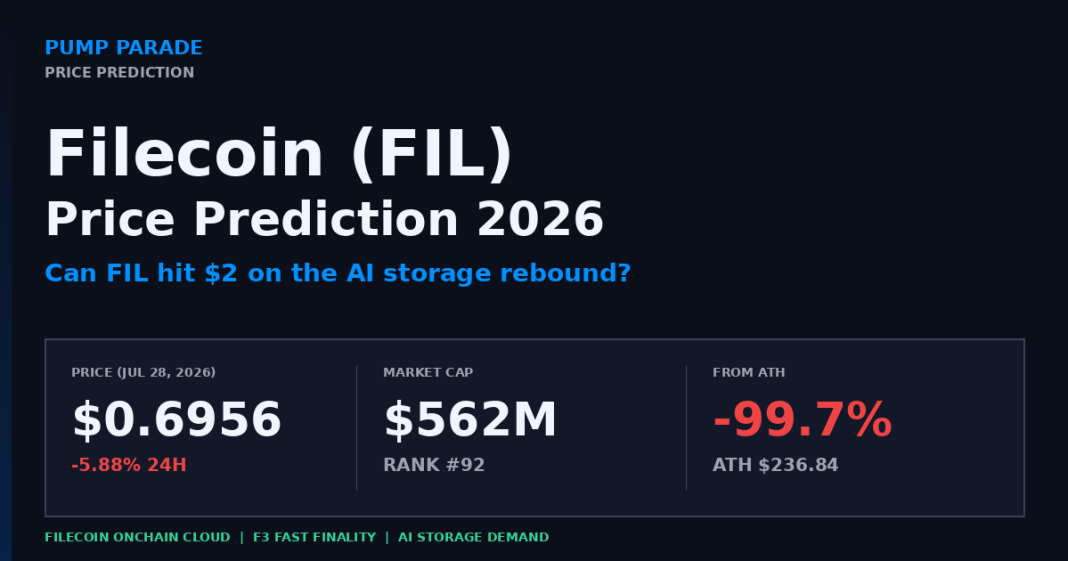
Filecoin price prediction 2026 is a search that keeps getting louder for a reason. FIL trades at $0.70 at time of writing, down 5.9% on the day, 7.8% on the week, and roughly 99.7% from its April 2021 all-time high of $236. On paper, this is one of the deepest drawdowns in the top 100. In practice, that gap between price and network progress is exactly what is bringing traders back.
Filecoin is quietly shipping the biggest architectural upgrade in its history. The Filecoin Onchain Cloud (FOC), the F3 Fast Finality rollout, and a wave of AI storage partnerships are lining up in the second half of 2026. October also marks the completion of a major vesting cliff that has weighed on FIL supply for years.
Below, we break down where FIL stands today, why it is priced the way it is, the specific catalysts that could push it toward $2 in 2026, the risks that could keep it pinned under $1, and what would change our view.
Key Takeaways
- FIL trades near $0.70 with a $562M market cap, rank 92 by market cap and roughly 99.7% below its 2021 ATH.
- The 2026 catalyst stack is real: Filecoin Onchain Cloud, F3 sub-60-second finality, and paid AI storage deals.
- Our base case sees FIL between $1.10 and $1.60 by year-end 2026 if paid storage revenue accelerates.
- The bull case targets $2.00 to $2.75, aligned with Token Metrics’ $2.67 forecast and lower-end Coinpedia projections.
- Bear case: $0.45 to $0.55 if AI storage demand stalls and vesting overhang keeps pressure on supply.
- Watch the October 2026 vesting completion, quarterly paid-storage revenue, and Filecoin Plus verified deals.
Where Filecoin Stands Today
Filecoin is the largest decentralized storage network by capacity, built by Protocol Labs and Juan Benet, the same team behind IPFS. The token pays for storage deals, incentivizes storage providers, and secures the network through Proof-of-Spacetime consensus. Backers include Sequoia Capital, Andreessen Horowitz (a16z), Union Square Ventures, and Coinbase Ventures.
The market has been unforgiving. FIL has traded in a tight $0.69 to $0.81 range over the past 30 days and continues to fade on light volume.
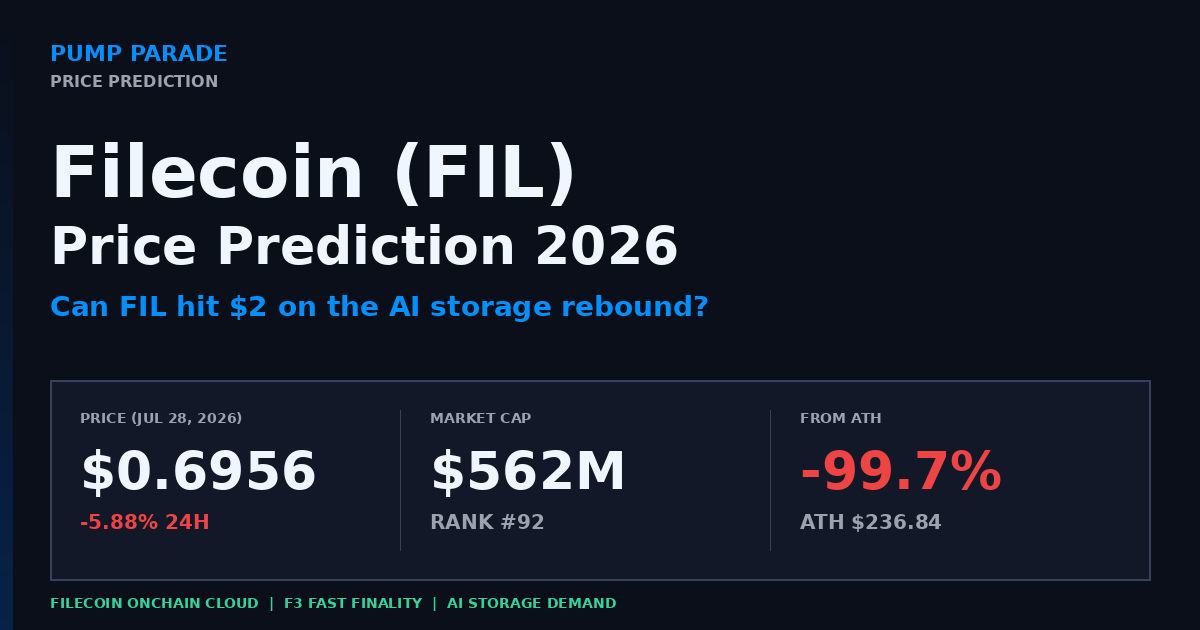
| Metric | Value |
|---|---|
| Price (July 28, 2026) | $0.6956 |
| 24h change | -5.88% |
| 7d change | -7.77% |
| 30d change | -5.66% |
| Market cap | $562M |
| Market cap rank | #92 |
| 24h volume | $69M |
| Circulating supply | 808M FIL |
| All-time high | $236.84 (April 2021) |
| % from ATH | -99.71% |
Data sources: CoinGecko and network stats from the Filecoin Foundation.
Why is Filecoin range-bound right now?
Three forces explain the flat price action. First, macro. Bitcoin dropped 2.7% in the same 24-hour window, and mid-cap altcoins have been getting hit harder than the majors. FIL is not immune. Second, vesting. The Filecoin protocol still has structural token unlocks scheduled through October 2026, which puts a persistent bid-ask imbalance on the token. Third, narrative rotation. Traders spent the first half of 2026 chasing modular blockchains and perp DEX plays. Decentralized storage did not make the cut.
That last point is where the setup gets interesting. When narratives rotate back to AI infrastructure, and they always do, the storage layer becomes an obvious rebound trade. FIL is one of the few tokens with a live product, real revenue, and blue-chip venture backing that is still trading like it is forgotten.
What could push FIL higher in 2026?
Catalyst 1: Filecoin Onchain Cloud goes live
The Filecoin Onchain Cloud (FOC) is the network’s biggest developer-experience overhaul. It hides the heavy cryptography (Proofs-of-Replication, sector sealing, deal-making) behind clean APIs. Translation: developers can plug decentralized storage into apps the same way they use AWS S3, without needing a PhD in zero-knowledge proofs. If FOC ships on schedule and developer signups grow through Q3 and Q4 2026, that flips the network from a “protocol for storage providers” into a “cloud service anyone can use.” That is a meaningful re-rating catalyst.
Catalyst 2: F3 Fast Finality
F3, the Fast Finality upgrade, cuts Filecoin’s transaction finality from roughly 7.5 hours to under 60 seconds. This is not a marginal change. Sub-minute finality opens the door to interactive apps, real-time payments, and cross-chain messaging. For context, competing storage networks like Arweave settle in blocks measured in seconds. F3 closes the gap and removes one of the loudest bearish arguments against FIL as a serious L1 storage layer.
Catalyst 3: AI storage demand
AI training and inference workloads generate mountains of data that need to be stored, verified, and retrieved cheaply. Filecoin has quietly signed on partners including Aethir for verifiable dataset storage, plus Titan Network and Swan Chain for AI compute integrations. If even one of these partnerships translates into recurring paid storage deals at meaningful scale, FIL revenue accelerates and the token gets a fundamental floor. Standard Chartered’s analyst desk has not published a formal FIL target, but similar infrastructure tokens like Chainlink have been re-rated on much thinner enterprise adoption stories. If you want a deeper dive on how oracle infrastructure gets re-priced on partnership news, our Chainlink DTCC tokenization piece walks through the same dynamic.
What could keep FIL pinned under $1?
Risk 1: Vesting overhang through October 2026
Filecoin’s total supply is 1.96B tokens against a circulating supply of 808M. That means more than half of the total supply is still locked or vesting. October 2026 is the completion of a major vesting cliff, and the run-up to that date typically sees front-running by miners and early investors who are legally required to sell. Until this overhang clears, every rally has to absorb sell pressure that other tokens do not face.
Risk 2: Storage competition intensifies
Filecoin is not the only decentralized storage game in town. Arweave targets permanent storage with a one-time payment model. Storj targets enterprise cloud storage with an S3-compatible API. Both have shipped faster on developer experience in the past 12 months. Meanwhile, centralized cloud providers keep cutting prices. If AWS, Google Cloud, and Cloudflare’s R2 keep undercutting the market, decentralized storage risks getting boxed into a niche verifiability use case rather than mass-market adoption.
Risk 3: Weak paid storage adoption
Filecoin Plus (the network’s incentive program for verified deals) has been the primary demand driver. If verified deals stall or the incentive structure changes, storage utilization could drop and the “AI storage narrative” becomes a story without financials. This is the most cited bearish argument from analyst desks including Token Metrics and it is not unreasonable.
Filecoin Price Prediction 2026: Targets by Timeframe
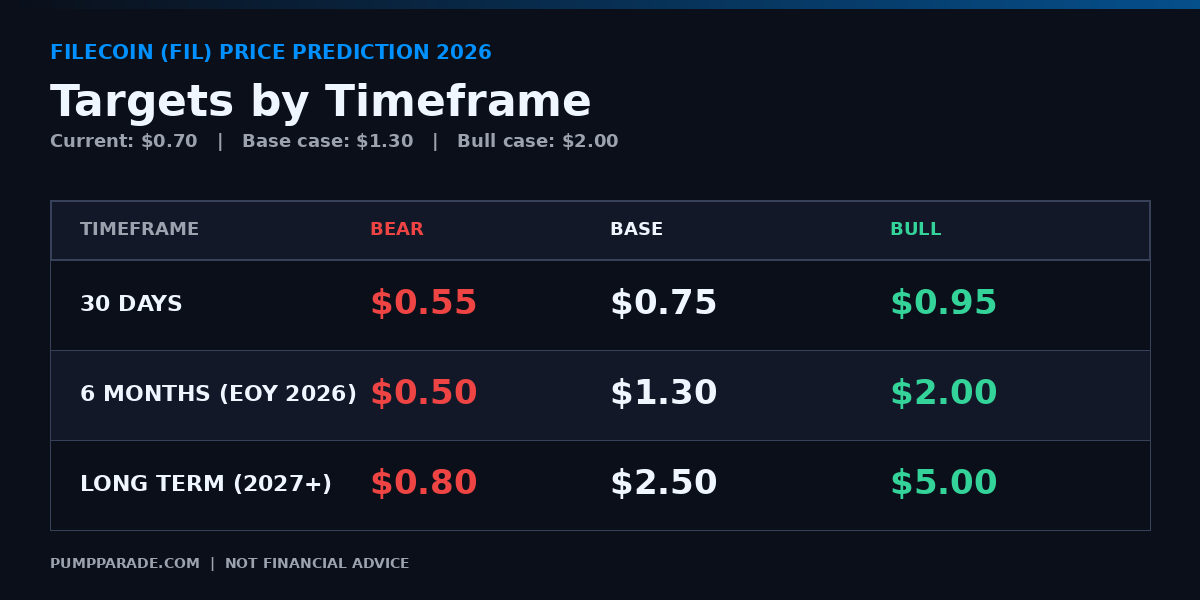
Our analysis combines on-chain data, comparable-token multiples, and analyst desk consensus. Here is how we see the paths playing out.
Short term (30 days)
The most likely scenario is continued range trading between $0.65 and $0.85. FIL has strong technical support near the $0.69 zone (multi-week base) and stiff resistance at $0.81 (30-day high). A break above $0.85 on volume opens the door to a $1.00 psychological retest. A breakdown below $0.65 puts $0.55 in play quickly.
Medium term (6 months, through year-end 2026)
| Scenario | Target | Trigger |
|---|---|---|
| Bear | $0.45 to $0.55 | Vesting sell pressure, weak paid-storage growth, AI narrative fizzles |
| Base | $1.10 to $1.60 | FOC ships on schedule, F3 lives up to spec, one major AI storage deal |
| Bull | $2.00 to $2.75 | Vesting completes, paid-storage revenue doubles YoY, multiple AI partnerships convert |
Our base case sits in the middle at roughly $1.30. This aligns with the moderate end of analyst targets: Changelly’s average projection near $1.26, Token Metrics’ $2.67 upper bound, and Coinpedia’s $2.76 median 2026 target. On the bull end, if AI storage demand accelerates the way it has for compute tokens (see our Render price prediction for a comparable playbook), $2 becomes the reasonable floor rather than the ceiling.
Long term (2027 and beyond)
If the Onchain Cloud actually works and Filecoin becomes the default verifiable storage layer for AI, targets in the $4 to $10 range from analysts like Coinpedia and MEXC start looking less speculative. But that requires everything to go right: enterprise adoption, sustained developer growth, and no regulatory shocks. Realistic long-term thinking assigns a wide distribution here rather than a single number.
How does Filecoin compare to Arweave?
Arweave (AR) is the closest architectural competitor to Filecoin. Both target decentralized storage, both have real usage, and both trade well below their 2021 highs. Here is how they stack up.
| Metric | Filecoin (FIL) | Arweave (AR) |
|---|---|---|
| Storage model | Time-based paid deals | One-time payment, permanent |
| Consensus | Proof-of-Spacetime | SPoRA (blockweave) |
| Finality | 7.5h today, sub-60s with F3 | Roughly 2 minutes |
| Developer APIs | FOC in progress | Arweave.js, Bundlr live |
| Enterprise partnerships | Aethir, Titan, Swan | Meta, Solana projects |
| Market cap (approx) | $562M | ~$310M |
| Circulating vs total supply | 41% circulating | ~99% circulating |
The key takeaway: Filecoin is larger and has bigger enterprise ambitions, but carries more supply overhang. Arweave has cleaner tokenomics but a narrower product story. For an AI storage narrative trade, FIL is the higher-beta bet. Traders playing the broader AI infrastructure rotation should also watch tokens like Bittensor (TAO), which trade on similar AI-adjacent flows.
What Would Change Our View
Three explicit scenarios would force us to rewrite this analysis.
Bullish trigger: Filecoin paid-storage revenue prints a quarter above $10M in on-chain deal volume, or a Fortune 500 AI lab publicly signs a multi-year Filecoin storage contract. Either would signal that the AI storage thesis is monetizing, and FIL should trade at a materially higher multiple.
Bearish trigger: The Onchain Cloud launch slips past Q4 2026 with no clear timeline, and Filecoin Plus verified deals decline for two consecutive quarters. That combination would suggest the roadmap is stalling and the AI narrative is not converting to revenue.
Neutral pivot: The token completes the October vesting cliff cleanly, sell pressure eases, but no fundamental catalyst materializes. FIL would likely consolidate in a $0.80 to $1.20 range and become a “wait for the next narrative” trade rather than an active thesis.
Frequently Asked Questions
Will Filecoin reach $10 in 2026?
Very unlikely. Reaching $10 would require FIL to trade at roughly 14x current price, implying a market cap near $8B. That level of re-rating has happened for tokens with much stronger catalyst stacks. The most bullish credible 2026 target is closer to $2.75, from analysts including Token Metrics and Coinpedia. Save the $10 target for a 2027-2028 scenario if adoption accelerates.
Is Filecoin a good investment in 2026?
Filecoin is a high-risk, high-conviction bet on decentralized storage becoming a real cloud infrastructure category. It has real usage, top-tier VC backing, and a shipping roadmap. But it also has a heavy supply overhang and fierce competition from both decentralized and centralized cloud players. Treat it as a long-term infrastructure position, not a short-term trade.
What is the Filecoin price prediction for 2026?
Analyst targets for 2026 range from $0.45 (bear case) to $10 (aggressive bull). Our base case is $1.10 to $1.60 by year-end 2026, aligned with Changelly’s $1.26 average and the moderate end of Coinpedia’s projections. The bull case of $2 to $2.75 requires visible AI storage revenue traction.
Can FIL hit $2 in 2026?
Yes, but not without help. FIL would need the Filecoin Onchain Cloud to launch on schedule, at least one major AI storage partnership to convert to paid deals, and the October vesting cliff to complete without a supply shock. That is a plausible but not base-case combination. Probability rank: bull case, roughly 25 to 30%.
Why is Filecoin price falling?
Three reasons. Macro weakness across altcoins pulls FIL down with the tape. Structural vesting through October 2026 puts persistent sell pressure on the token. And narrative rotation has favored modular chains, perp DEXs, and memecoins over decentralized storage. None of these are permanent, but all three need to reverse for FIL to break out.
Is Filecoin dead?
No. Filecoin is one of the most active infrastructure networks in crypto by storage capacity and continues to ship major protocol upgrades. Price action does not equal project health. That said, “not dead” is different from “will pump.” The next 6 to 12 months are about execution, not survival.
The Honest Take
Filecoin is a classic “infrastructure token trading like it is forgotten” setup. The fundamentals are quietly getting stronger while the price sits near multi-year support. If the Onchain Cloud lands and AI storage revenue starts printing, FIL has a plausible path to $2 by end of 2026. If it does not, this stays a sub-$1 trade for another year.
The bull case is credible but not consensus. The bear case is well-priced in but not resolved. For traders, the setup favors patient accumulation in the $0.65 to $0.80 zone with clear invalidation below $0.60. For long-term believers in decentralized infrastructure, FIL at current prices is one of the cheapest ways to own AI storage exposure with real venture backing behind it.
Just remember: the price does not care about your thesis until the numbers show up on-chain. Watch the paid-storage revenue prints. That is the tell.
Disclaimer: This article is for informational and educational purposes only and should not be construed as financial, investment, or trading advice. Cryptocurrency markets are highly volatile, and past performance does not guarantee future results. The price predictions and analyses presented here are based on AI models, technical indicators, and available data at the time of writing. They are not guarantees. Always conduct your own research (DYOR) and consult with a qualified financial advisor before making any investment decisions. Pump Parade and its authors do not assume liability for financial losses incurred based on information provided in this article.