
If you are holding SOL and not staking it, you are leaving roughly 5 to 6% in annualized rewards on the table every year. Native staking is great, but it locks your SOL for an unstaking epoch and gives you nothing to do with it in DeFi. That is why liquid staking has eaten the majority of staked SOL on the network, and two protocols dominate the conversation: Jito and Marinade.
The two are not the same product. Jito is the largest Solana liquid staking token by a wide margin, with deep MEV-tip pass-through and a polished governance market in JTO. Marinade is the original liquid staking protocol on Solana, with a longer audit history, three live staking products and a validator marketplace that delegators can shape directly. So which one should you actually park your SOL in for 2026?
This review compares them across TVL, APY, fees, security, validator policy, MEV, governance, DeFi integrations and user experience, with live data from DeFiLlama, CoinGecko and the protocols themselves.
Quick Verdict (TL;DR)
- Want the highest passive APY with minimal thinking? Use JitoSOL. As of May 2026 it is paying around 5.76% APY, mostly because MEV tips are baked into the price of the token rather than skimmed off the top.
- Want full control over which validators secure your stake, plus the deepest audit trail? Use Marinade. mSOL pays around 5.16% APY and Marinade Native gives you direct delegation with no smart contract risk at all.
- Holding SOL on a hardware wallet and not touching DeFi? Marinade Native is the cleanest answer. JitoSOL only makes sense if you plan to use it as collateral somewhere.
- Liquidity matters more than yield? JitoSOL wins, with roughly 3x the on-chain TVL and broader integrations across Kamino, Drift, Orca and Jupiter routes.
Both protocols are battle-tested. There is no obvious wrong answer here; it really comes down to what you optimize for.



Marinade and Jito: Two Different Schools of Liquid Staking
Both protocols solve the same core problem: SOL holders want staking rewards without locking up their assets. You deposit SOL, you receive a liquid receipt token (mSOL or JitoSOL), and that token automatically appreciates against SOL as staking rewards accrue. You can sell, swap, lend or use it as collateral at any time.
Where they differ is in how the protocol allocates your SOL across validators and what it does with the extra revenue.
Marinade: validator marketplace and three staking flavors
Marinade launched in 2021 as the first liquid staking protocol on Solana. Today it actually offers three products under one roof:
- Marinade Liquid Staking (mSOL): deposit SOL, receive mSOL, the receipt token used across Solana DeFi.
- Marinade Native: stake SOL directly to a basket of validators selected by Marinade’s algorithm. No smart contract is involved, so the surface area for protocol risk is essentially zero.
- Marinade Select: an institutional-grade product that lets large depositors curate their own delegation strategy with custom validator sets.
Combined Marinade TVL across these three products sits around $588M as of May 2026, with about $274M in mSOL alone. The defining feature is the Stake Auction Marketplace: validators bid for delegations, MNDE governance shapes the rules, and the algorithm rebalances stake based on commission, performance and decentralization scores. That makes Marinade the most “Solana-decentralization-friendly” choice on the market.
Jito: MEV-enhanced staking with the largest TVL
Jito takes a different approach. It runs a modified Solana validator client that captures MEV (maximum extractable value) from off-chain auctions and routes those tips back to JitoSOL holders. JitoSOL launched in late 2022 and has grown into the largest liquid staking token on Solana, with around $846M TVL in the LST product itself and another $17M in the newer Jito Restaking product (per DeFiLlama).
The Jito Network also operates a parallel governance and revenue-share economy through the JTO token, which has a market cap of roughly $179M today. Jito’s pitch is simple: by staking through JitoSOL, you do not just earn vanilla staking rewards, you also collect a share of MEV that other validators are quietly capturing for themselves anyway.

TVL and Adoption: Jito Has Pulled Ahead
Twelve months ago, Marinade and Jito were closer competitors on TVL. Today, Jito is clearly in the lead:
- Jito Liquid Staking TVL: ~$846M
- Marinade Liquid Staking TVL: ~$274M
- Marinade Native TVL: ~$238M
- Marinade Select TVL: ~$76M
The chart below tracks the last twelve months of liquid staking TVL for both protocols. Note that both have come down meaningfully from their late-2025 highs, which reflects SOL’s price action more than any flight from the protocols. The relative gap, however, has widened in Jito’s favor.
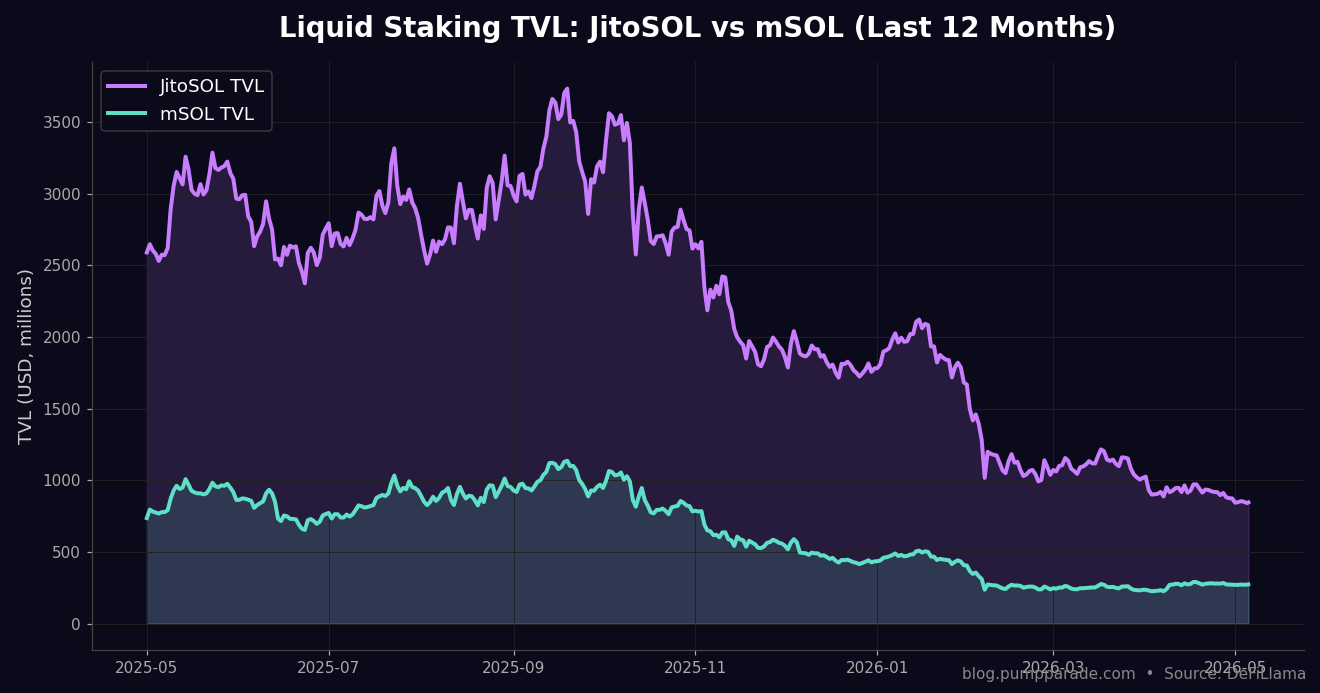
Jito’s TVL lead matters for two practical reasons. First, JitoSOL has more liquidity in DEX routes, so you can size in and out of larger positions with less slippage. Second, more lending markets accept JitoSOL as collateral with higher loan-to-value ratios, simply because the underlying market is deeper.
APY and Fee Breakdown
This is where Jito’s MEV pitch shows up in the numbers.
| Protocol | Live APY (May 2026) | Headline Fee | MEV Included? |
|---|---|---|---|
| Jito (JitoSOL) | 5.76% | ~4% of staking rewards (validator commission averaged across the Jito set) | Yes, MEV tips routed to stakers via the price of JitoSOL |
| Marinade Liquid (mSOL) | 5.16% | ~6% of staking rewards (split between validator commission and a small protocol fee) | Limited; some Marinade validators run Jito-Solana client, but it is not a uniform pass-through |
| Marinade Native | ~6.0% gross before validator commission | 0% protocol fee, validator commission only | Depends on validator |
A 60 basis point gap between JitoSOL and mSOL might not sound like much, but on $100,000 of staked SOL it is roughly $600 per year, every year. Compounded over multiple years, that is real money. The catch is that Jito’s APY is more variable than Marinade’s because MEV revenue oscillates with on-chain activity. In a quiet market, JitoSOL can underperform; in heavy trading weeks, it can pull ahead by 100 to 150 bps.
If you want the simplest fee story, Marinade Native wins outright: there is no protocol fee at all, only the validator commission, because there is no smart contract sitting between you and the validator.
Security & Audits
Both protocols have a long uptime track record on Solana mainnet, no known exploits, and reputable auditors. Marinade has a slight edge on audit depth and history.
- Marinade audits: Neodyme, Ackee Blockchain and Kudelski Security. Reports are linked publicly from the marinade.finance site.
- Jito audits: based on the Solana SPL stake-pool program (which itself has a long audit history) plus a Neodyme review of the Jito-specific MEV extraction layer.
Marinade Native sidesteps the question entirely because no custom smart contract is involved. Your stake account is created directly with the chosen validator, identical in architecture to staking through a wallet. This is the lowest-risk option in the entire comparison.
JitoSOL relies on the SPL stake pool program plus Jito’s own MEV plumbing. The MEV layer is well audited, but it is more code surface than vanilla SPL pools, which is something to be aware of. Neither protocol has been hacked or paused since launch.
Validator Selection & Decentralization
This is the most ideologically loaded part of the comparison.
Marinade’s stake auction marketplace
Marinade runs a continuous auction in which validators submit bids and the protocol allocates stake based on a transparent formula that includes commission, vote performance, geographic distribution, and what the validator pays back into the marketplace. MNDE governance can adjust the weights. The result is one of the more egalitarian stake distributions on Solana, and a meaningful chunk of stake flows to small and mid-sized validators who would otherwise struggle to get delegations.
Jito’s curated validator set
Jito takes a more centralized approach to validator selection. To be in the JitoSOL stake pool, validators must run the Jito-Solana client and meet performance thresholds. The set is curated rather than auctioned. This produces consistently high MEV capture, but it also concentrates stake among a smaller number of professional operators. Whether you see this as a feature or a tradeoff depends on what you care about.
For solo home stakers and decentralization purists, Marinade is the friendlier home. For yield maximalists who want every basis point of MEV, Jito is the cleaner answer.
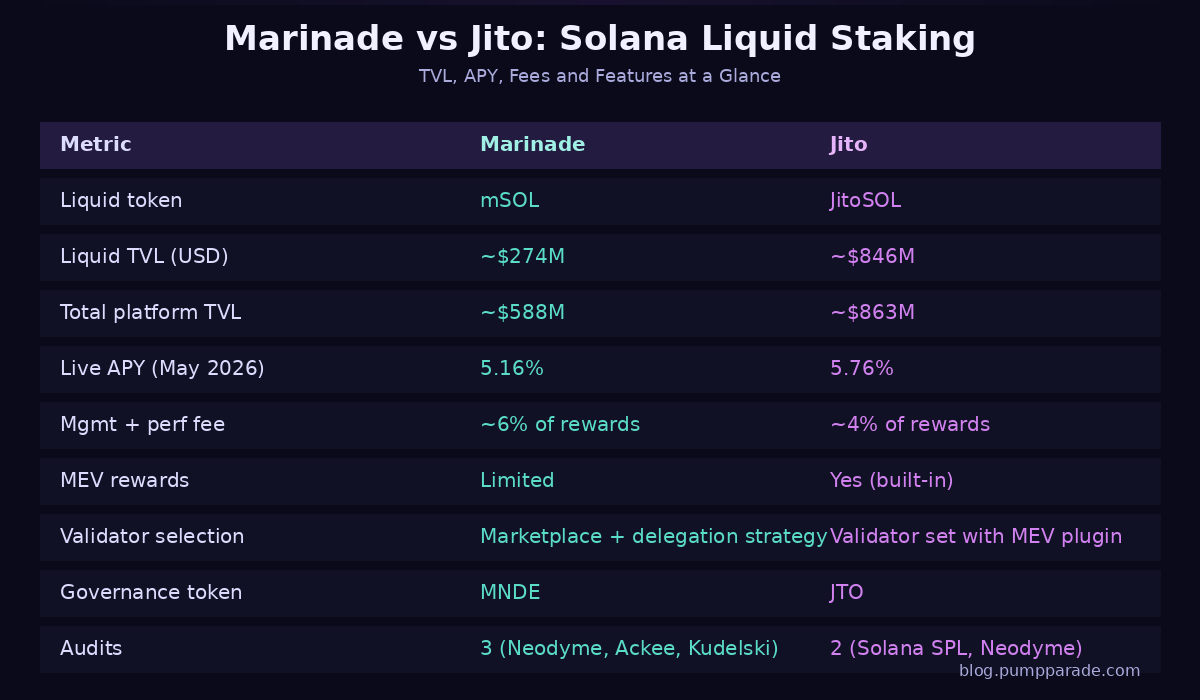
Side-by-Side Feature Comparison
DeFi Integrations and Liquidity
One of the only reasons to hold a liquid staking token rather than stake natively is that you can do something with it. Both tokens are widely supported, but the depth differs.
- JitoSOL: deeply integrated as collateral on Kamino (see our Kamino Finance review) and marginfi, primary base asset on Drift’s perp markets, listed on every major Solana DEX with multi-million-dollar Jupiter routes, and accepted by a long list of yield aggregators. JitoSOL/SOL spot pairs on Orca and Raydium are some of the deepest LST pools on the network.
- mSOL: also supported on Kamino, Drift, marginfi and Jupiter, but with thinner liquidity. mSOL/SOL pools exist but tend to have higher slippage on size. mSOL is still a perfectly fine collateral asset; it just is not the default that JitoSOL has become.
For DeFi power users, JitoSOL is the more practical token to hold because every protocol you are likely to touch already supports it natively. For a long-only HODLer, the difference is mostly invisible.
User Experience
Both web apps are clean, fast, and straightforward to use.
The Marinade staking dashboard walks you through choosing between Native and Liquid in plain language. You connect a wallet, pick an amount, and confirm one transaction. Withdrawals from Marinade Liquid are instant via the on-chain liquidity pool (with a small fee) or epoch-based for free. Marinade Native unstakes follow standard Solana epoch timing.
The Jito staking page is essentially a one-click flow: connect wallet, deposit SOL, mint JitoSOL. Unstaking back to SOL goes through the standard SPL stake pool unstake flow, which takes one to two epochs (roughly two to four days). For instant exits, you swap JitoSOL to SOL on a DEX at whatever the current peg is, which is usually within a few basis points of fair value.
Mobile support on both is good through wallet apps like Phantom, Backpack and Solflare. Neither has a dedicated native mobile app, but they both render cleanly in the in-wallet browser.
Pros and Cons
Jito Pros
- Highest live APY in the comparison thanks to MEV pass-through
- Largest TVL and deepest DEX liquidity
- Default LST collateral on Kamino, Drift and other Solana money markets
- Strong JTO governance economy and revenue share
Jito Cons
- More centralized validator set
- APY is more volatile because MEV revenue varies week to week
- Slightly more code surface than vanilla SPL stake pools
Marinade Pros
- Three flavors (Liquid, Native, Select) to fit different risk profiles
- Marinade Native has zero smart contract risk
- Most decentralization-friendly validator marketplace on Solana
- Longer audit history with three independent firms
Marinade Cons
- Lower APY than Jito by roughly 50 to 60 bps
- Thinner mSOL liquidity in DEX pools
- MNDE governance token has weaker valuation and lower trading volume than JTO
Verdicts by Use Case
Best for passive yield only: JitoSOL. Higher APY, less to think about, set and forget.
Best for hardware wallet HODLers: Marinade Native. No smart contract sits between you and your validator, and the APY is competitive with mSOL.
Best for active DeFi users: JitoSOL. It is supported as collateral or yield primitive everywhere you want to deploy.
Best for decentralization advocates: Marinade. The auction-driven validator marketplace pushes stake toward smaller operators in a way Jito’s curated set does not.
Best for institutions and treasuries: Marinade Select. Custom validator sets, no protocol fee on Native, and direct delegation control. Jito Restaking is also a credible option for treasuries that want extra yield from securing partner protocols, though it is newer and a separate product.
Looking for a deeper Solana staking strategy? See our Jupiter Exchange review for the cleanest way to swap between LSTs, and our Raydium vs Orca breakdown for where mSOL/SOL and JitoSOL/SOL liquidity actually lives.
FAQ
Is JitoSOL safer than mSOL? Both are safe in the sense that neither has been hacked. Marinade has a longer and more diverse audit trail across three firms; Jito has fewer audits but a clean track record and a simpler core stake-pool architecture. Marinade Native is the lowest-risk option of all because it does not use a smart contract.
Can I use JitoSOL or mSOL as collateral? Yes. Both are accepted on Kamino, Drift and marginfi. JitoSOL typically has higher LTV ratios and deeper available borrow liquidity.
Will I lose value when I unstake? Not in normal market conditions. The price of JitoSOL and mSOL versus SOL trends upward as rewards accrue, and any short-term peg deviation on a DEX is usually a few basis points at most. The instant-unstake liquidity pool on Marinade does charge a small fee for immediate exits.
What about MEV centralization concerns? Jito’s MEV auction is more transparent than the alternative of validators capturing MEV privately. Critics argue that it concentrates power in the Jito-Solana client; supporters argue that it democratizes MEV by routing it back to stakers. Both views have merit.
Can I hold both? Absolutely. Many Solana users split between JitoSOL for DeFi collateral and Marinade Native for cold-stored SOL that they do not plan to touch. There is no rule that says you have to pick one.
Final Take
If you want the highest yield with the deepest DeFi integration, Jito is the obvious answer in 2026, and the TVL gap is not closing any time soon. If you care about decentralization, audit depth, or want true zero-smart-contract-risk staking, Marinade, especially Marinade Native, is the protocol that better aligns with those priorities.
Either way, the worst option is leaving your SOL idle.
This article is for educational purposes only and is not investment advice. Always do your own research before staking or interacting with any DeFi protocol.