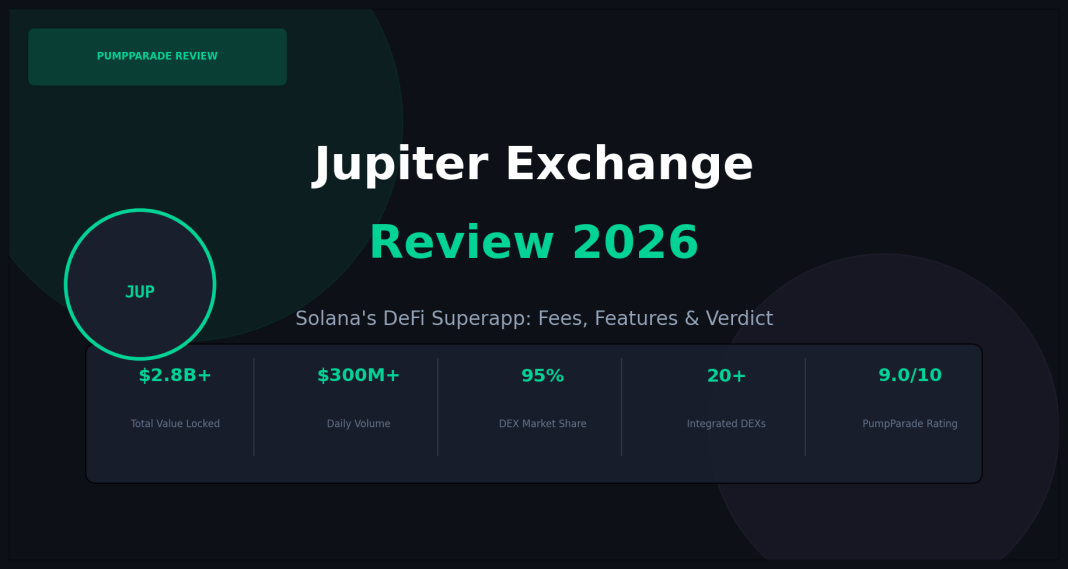
If you trade on Solana, you have almost certainly used Jupiter without even thinking about it. As the dominant DEX aggregator on the network with roughly 95% market share, Jupiter (jup.ag) quietly powers the majority of token swaps happening on Solana today. But in 2026, Jupiter is no longer just an aggregator. It has evolved into a full DeFi superapp, adding perpetual futures, a native stablecoin, a lending market, liquid staking, prediction markets, and a standalone mobile wallet. So is it still the best place to trade on Solana? This review covers everything you need to know.
Quick Verdict / TL;DR
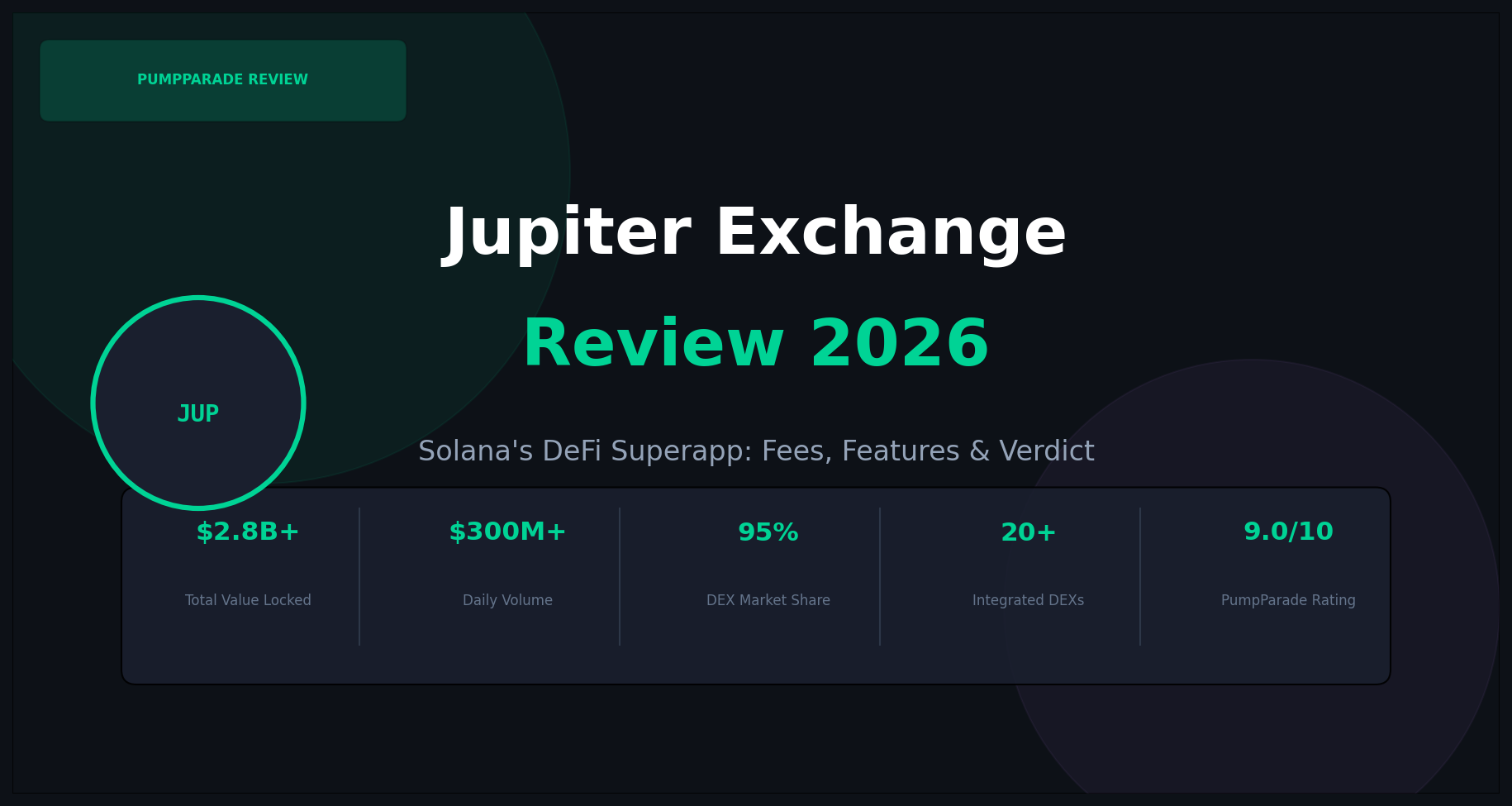
Jupiter earns a 9.0/10 from PumpParade. It is the undisputed default interface for Solana DeFi, offering the best swap rates on the network alongside a growing suite of financial products. Swaps are effectively free for most users (you only pay underlying liquidity pool fees of 0.05-0.30% plus minimal Solana network fees of roughly $0.01). The perpetuals platform now handles over $17 billion in notional volume per month. The biggest caveats are concentrated JUP token ownership and some mobile app instability. For anyone active on Solana, Jupiter is non-negotiable.
What Is Jupiter Exchange?
Jupiter launched in 2021 and was created by a pseudonymous founder known as “Meow.” The core product was a swap aggregator that routes your trade across multiple Solana DEXs simultaneously to find the best price and lowest slippage. What made Jupiter stand out was its smart order routing, which splits large orders across venues like Raydium, Orca, Meteora, and dozens of others to minimize price impact.
Over time, Jupiter expanded aggressively. By 2025, it had added perpetual futures trading with up to 250x leverage, a liquid staking product (JupSOL), a native dollar-pegged stablecoin (JupUSD), a lending and borrowing market (Jupiter Lend), and a fully integrated mobile wallet app. In February 2026, it integrated Polymarket to bring prediction markets directly into the Jupiter interface.
Jupiter’s native token, JUP, is used for governance and protocol fee sharing. As of March 2026, JUP trades at approximately $0.17-0.21 with a market cap in the $600-700 million range.
Key Stats
- Total Value Locked: $2.6-3 billion
- DEX aggregator market share on Solana: ~95%
- Daily swap volume: $270-350 million
- Perpetuals monthly volume: $17.4 billion (trailing 30 days)
- JupSOL TVL: $960 million+
- Jupiter Lend: $1 billion+ in supplied assets (reached in 8 days)
- Integrated DEXs: 20+
- Mobile app users: 1.1 million+
Features Deep Dive
Swap Aggregation
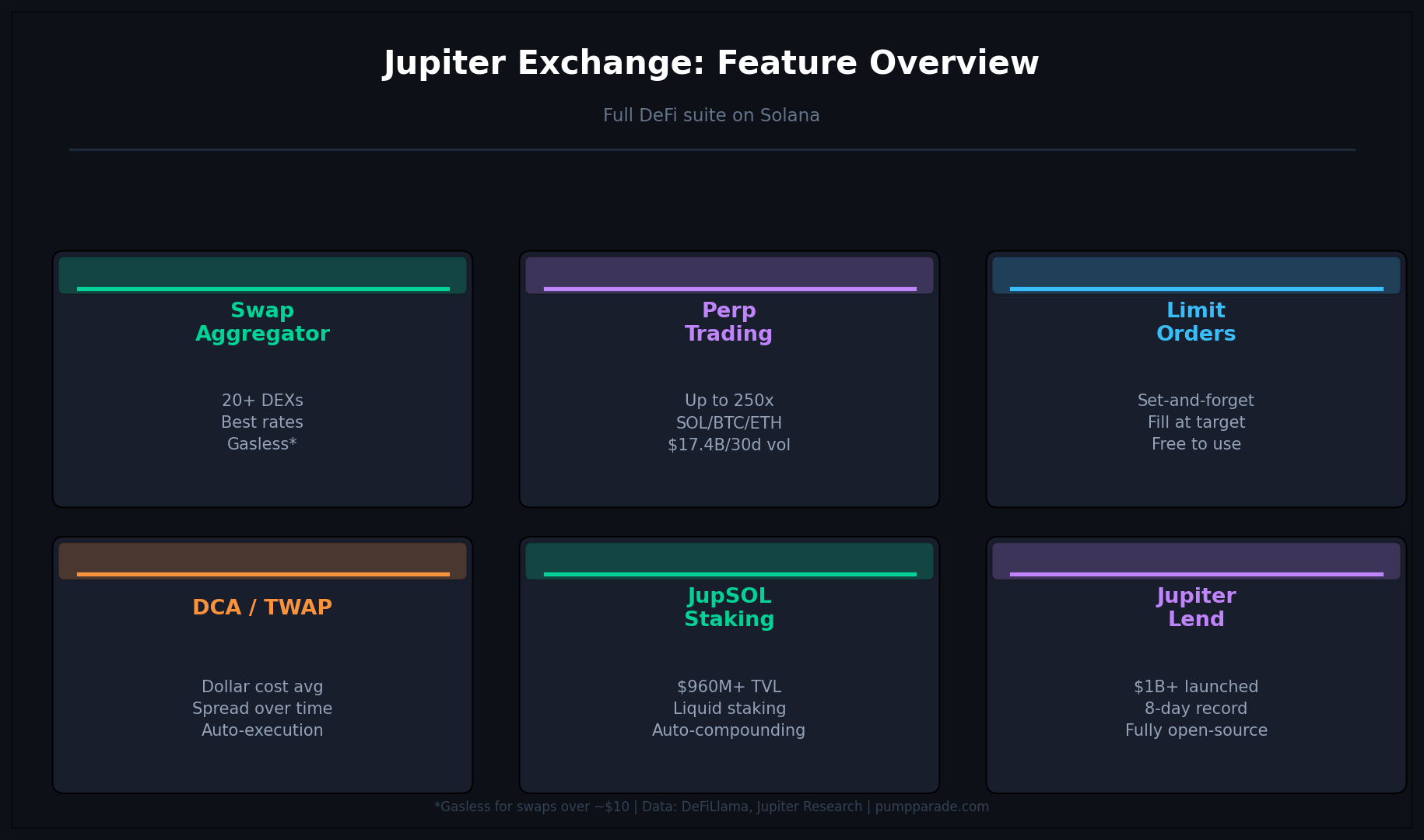
This remains Jupiter’s core product. When you initiate a swap, Jupiter’s routing engine scans 20+ Solana DEXs in real time and constructs an optimal route. For large trades, it splits the order across multiple pools to reduce slippage. Notably, Jupiter covers the Solana network fee (around $0.01) for swaps above approximately $10 in size, making it effectively gasless for most users. You only pay the underlying liquidity pool fees, which typically range from 0.05% to 0.30% depending on the pool and tokens involved. Jupiter itself charges zero platform fees on swaps.
Perpetual Futures
Jupiter Perps launched as one of the first decentralized perpetuals platforms on Solana and has grown into a serious competitor for CEX users. It supports SOL, BTC, and ETH with leverage up to 250x (introduced in the v3 upgrade). Liquidity comes from the Jupiter Liquidity Pool (JLP), which earns fees from traders. Over the trailing 30 days, Jupiter Perps processed $17.4 billion in notional volume and generated roughly $954 million in annualized fees, with about $238 million going directly to the protocol as revenue.
Limit Orders
Jupiter’s limit order system lets you set a target price and walk away. When the market reaches your level, the order executes on-chain automatically. This is particularly useful for swing traders and anyone who does not want to watch charts all day. Limit orders are free to place and are filled by a network of keeper bots.
Dollar-Cost Averaging (DCA)
The DCA tool lets you automate recurring purchases of any Solana token over a specified time horizon. You define the token pair, total amount, order frequency (hourly, daily, weekly), and duration, and Jupiter executes the trades for you. This is one of the most underrated features on the platform and is ideal for building positions in volatile assets without market timing.
JupSOL Liquid Staking
JupSOL is Jupiter’s liquid staking token for SOL. When you stake SOL through Jupiter, you receive JupSOL, which can be used across DeFi while your SOL continues to earn validator rewards. Jupiter is now one of the largest Solana validators, and JupSOL has accumulated over $960 million in TVL. The yield is auto-compounding and competitive with other liquid staking options on the network.
Jupiter Lend
Launched in August 2025, Jupiter Lend is a fully open-source decentralized lending and borrowing protocol on Solana. It reached over $1 billion in supplied assets in its first eight days, making it the fastest-growing Solana lending protocol on record. It integrates with JLP and JupUSD, allowing traders to use collateral from the Jupiter ecosystem across both trading and lending positions.
JupUSD Stablecoin
JupUSD is Jupiter’s native dollar-pegged stablecoin, backed approximately 90% by BlackRock’s BUIDL Fund. It is built on Ethena infrastructure. Jupiter plans to integrate JupUSD across limit orders, DCA (where it earns yield while waiting to fill), the mobile app, perpetuals, and prediction markets. This creates a closed-loop ecosystem where traders can earn yield even while their capital is idle.
Prediction Markets
In February 2026, Jupiter integrated Polymarket, bringing the world’s largest prediction market directly into the Jupiter interface. Users can now trade event contracts on political, financial, and sports outcomes without leaving the app.
Mobile App
Jupiter Mobile launched as a standalone Solana wallet app for iOS and Android. It supports Apple Pay for crypto purchases, Apple ID or email login (no seed phrase required), and full access to Jupiter’s swap and DCA features on mobile. The app has 1.1 million users and holds a 4.9/5 rating on the App Store as of 2026.
Fees Breakdown
| Feature | Jupiter Fee | Notes |
|---|---|---|
| Spot Swaps | 0% | Pay only underlying DEX fees (0.05-0.30%) |
| Network (gas) | ~$0.01 | Covered by Jupiter for swaps above ~$10 |
| Limit Orders | 0% | Free to place; keeper bots earn on fill |
| DCA | 0% | Free automation |
| Perps Opening | 0.06% of position | Charged on open and close |
| Perps Borrow | ~0.01%/hour | Varies by utilization |
| JupSOL Staking | ~10% of staking yield | Taken from validator rewards |
| Jupiter Lend | Protocol fee varies | Interest rate model, market-driven |
For simple token swaps, Jupiter is among the cheapest ways to trade on any chain. The absence of a platform fee on swaps is a key competitive advantage over centralized exchanges, which typically charge 0.10-0.25% per trade.
Pros and Cons
Pros
- Best swap rates on Solana due to 20+ DEX routing
- Zero platform fee on all swaps
- Extremely low transaction costs (Solana network fees under $0.01)
- Comprehensive product suite: swaps, perps, limit orders, DCA, lending, staking, stablecoin
- Fastest-growing DeFi lending protocol on Solana (Jupiter Lend)
- JupUSD offers yield on idle stablecoin capital
- Non-custodial and open-source (especially Jupiter Lend)
- Excellent mobile app with 4.9/5 rating and 1.1M+ users
- Gasless swaps for trades above $10
- Active governance with JUP token holders
Cons
- JUP token concentration: approximately 72% of supply sits in the top 10 wallets
- Significant JUP token unlock events scheduled (including Feb 2026)
- Mobile app has reported bugs including balance refresh issues and chart glitches
- Smart contract risk is inherent; the Feb 2024 perps audit identified issues since addressed
- Solana-only ecosystem (not cross-chain for most features)
- Bridge aggregation available but limited compared to cross-chain native DEXs
Security and Trust
Jupiter had its Perpetuals smart contracts audited by Offside Labs in February 2024. That audit identified several issues including limit order execution risks and slippage protection limitations, which the team addressed before production deployment. Jupiter Lend launched as fully open-source, allowing external developers and auditors to review the code independently.
As a non-custodial protocol, Jupiter never holds your funds. All trades execute directly on-chain via smart contracts, and you retain custody of your private keys (or your social login credentials in the mobile app). The protocol has handled billions in cumulative volume without a major exploit to date.
The main trust risk is smart contract composability: because Jupiter routes through third-party DEX pools, a vulnerability in any integrated pool could theoretically affect routed trades. Jupiter mitigates this by continuously monitoring its routing partners.
User Experience
Jupiter’s web interface at jup.ag is widely regarded as the cleanest swap UI on Solana. The swap interface is one screen with no unnecessary complexity. Advanced features like limit orders, DCA, and perps are accessible via clearly labeled tabs. The interface loads fast and provides real-time quotes with estimated slippage and fee breakdowns before you confirm a transaction.
Onboarding is straightforward for users who already have a Solana wallet (Phantom, Backpack, Solflare, etc.). For newcomers, the mobile app lowers the barrier further with Apple ID login and direct fiat on-ramp via Apple Pay.
The perpetuals interface is more complex but compares favorably to other on-chain perps platforms. Experienced futures traders may miss some order types available on CEXs, but the core functionality of leverage trading with decent UX is well executed.
If you are interested in Solana trading bots as a companion tool, see our Photon vs BullX comparison for on-chain sniping and automation alongside Jupiter’s native DCA and limit orders.
Verdict and Rating
Jupiter is the backbone of Solana DeFi. For spot swaps, it is the default choice and hard to beat on price. The expansion into perpetuals, lending, staking, and stablecoins has turned it into a one-stop financial platform for Solana users. The fee structure is genuinely competitive, and the non-custodial model means you stay in control of your assets throughout.
The JUP token is the weakest link: high whale concentration and unlock pressure create overhead. But as a platform, Jupiter continues to outpace alternatives with consistent product innovation.
| Category | Score |
|---|---|
| Swap Pricing | 10/10 |
| Fee Structure | 10/10 |
| Product Breadth | 9/10 |
| Security | 8/10 |
| User Experience | 9/10 |
| Tokenomics | 7/10 |
| Overall | 9.0/10 |
Best for: Anyone trading on Solana who wants the best execution on swaps, a solid perpetuals platform, and an expanding DeFi suite without switching apps.
Not ideal for: Users who want cross-chain native DEX functionality or are concerned about Solana ecosystem concentration risk.
Frequently Asked Questions
Is Jupiter Exchange free to use?
Yes. Jupiter charges zero platform fees on swaps. You pay only the underlying liquidity pool fees (typically 0.05-0.30%) and Solana network fees of approximately $0.01. For swaps above roughly $10, Jupiter covers the network fee on your behalf, making it effectively free. Perpetuals trading carries a 0.06% opening and closing fee per position.
Is Jupiter safe?
Jupiter is non-custodial, meaning you retain control of your funds at all times. The perpetuals contracts were professionally audited in February 2024, and Jupiter Lend is fully open-source. No major exploit has occurred since launch. Smart contract risk always exists in DeFi, but Jupiter has a strong track record.
What is JUP token used for?
JUP is Jupiter’s governance token. Holders can vote on protocol upgrades, fee parameters, and ecosystem fund allocations. There is ongoing discussion in the community about adding fee-sharing mechanisms that would distribute protocol revenue to JUP stakers.
How does Jupiter get the best prices?
Jupiter routes your swap across 20+ Solana DEXs simultaneously. Its smart routing algorithm evaluates all available paths and splits your order across multiple pools when necessary to minimize price impact and slippage. This is the same principle as a TradFi smart order router but executed on-chain in milliseconds.
Does Jupiter have a mobile app?
Yes. Jupiter Mobile is available on both iOS and Android. It functions as a full Solana wallet and DeFi interface. You can sign up with Apple ID or email (no seed phrase required) and buy crypto directly with Apple Pay. The app has over 1.1 million users and holds a 4.9/5 App Store rating as of 2026, though some users have reported occasional bugs in recent versions.