Picking between two top-tier crypto exchanges in 2026 is no longer a question of who has the better logo. Both Bybit and OKX sit at the very top of the global volume tables, both publish monthly proof-of-reserves, and both have spent the last twelve months pouring resources into copy trading, on-chain wallets, and tokenized assets. So which one actually deserves your USDT?
This Bybit vs OKX comparison breaks down fees, features, security and user experience in detail, then declares a winner for each kind of trader. If you only have thirty seconds, jump to the verdict box below. If you want the receipts, keep reading.
Quick Verdict: Which Exchange Wins in 2026?
Bybit wins on simplicity, perpetual futures liquidity, and a slightly cleaner trading UI. If you live in BTC and ETH perps and you want a no-fluff derivatives terminal, Bybit is hard to beat.
OKX wins on breadth. It has a deeper options book, a better Web3 wallet, an integrated DEX aggregator, an active NFT marketplace, and a much more aggressive push into regulated markets after Intercontinental Exchange (ICE) took a board seat at a $25 billion valuation in March 2026. If you want one app for CeFi, DeFi and tokenized real-world assets, OKX is the more complete platform.
Overall verdict: OKX is the better all-rounder for 2026. Bybit is the better pure-play derivatives venue. Most active traders will end up with both.
Bybit Overview: The Derivatives Specialist
Bybit launched in 2018 in the British Virgin Islands and rebuilt itself around perpetual futures during the 2020 derivatives boom. By the end of 2025 it was the second-largest exchange globally with roughly 9.5% market share and around $1.5 trillion in annual volume, according to CoinGecko data. As of April 2026, Bybit reports more than 70 million registered users and a 24-hour spot-plus-derivatives volume that regularly clears $54 billion.
The platform is anchored by USDT and USDC perpetual contracts, but Bybit has also built out spot, options, copy trading, launchpad, P2P, and a respectable Web3 wallet. The brand is sponsorship-heavy (you have probably seen the logo on a Formula 1 car), and the UI is built for traders who want fewer clicks between a deposit and a position.
It is worth being upfront about the elephant in the room: in February 2025, Bybit suffered a $1.5 billion ETH cold wallet exploit, the largest exchange hack in crypto history. The team made all users whole within hours by tapping a combination of reserves, a bridge loan, and post-mortem treasury operations. Twelve months later, market share has fully recovered and proof-of-reserves coverage is back above 100%. It is still a part of the story you should know.
OKX Overview: The Web3 All-Rounder
OKX (formerly OKEx) was founded in 2017 in the Seychelles and has since become the closest thing crypto has to a one-stop platform. As of early 2026 OKX serves over 50 million users, holds roughly 16% of centralized exchange spot volume, and runs a derivatives book that averages $42 billion in daily volume according to its Q1 2026 metrics.
What separates OKX from the rest of the top 5 is the depth of its non-trading stack. The OKX Wallet is a non-custodial, multi-chain wallet supporting more than 100 blockchains, with a built-in DEX aggregator (X Routing), an NFT marketplace, and a dApp browser. The exchange also runs a staking marketplace, structured products, and a “Jumpstart” launchpad. In March 2026, ICE (the parent of the New York Stock Exchange) took a strategic stake at a $25 billion valuation and announced a joint plan to bring tokenized NYSE-listed equities to OKX users.
OKX also has a cleaner regulatory record than most: it has never been hacked, holds a CertiK “AA” security score, and publishes monthly Proof-of-Reserves audits via Hacken. It did settle a $500 million U.S. compliance case in 2024, but that has since cleared the way for an aggressive U.S. relaunch with new fee tiers introduced in February 2026.
Bybit vs OKX: Side-by-Side Comparison
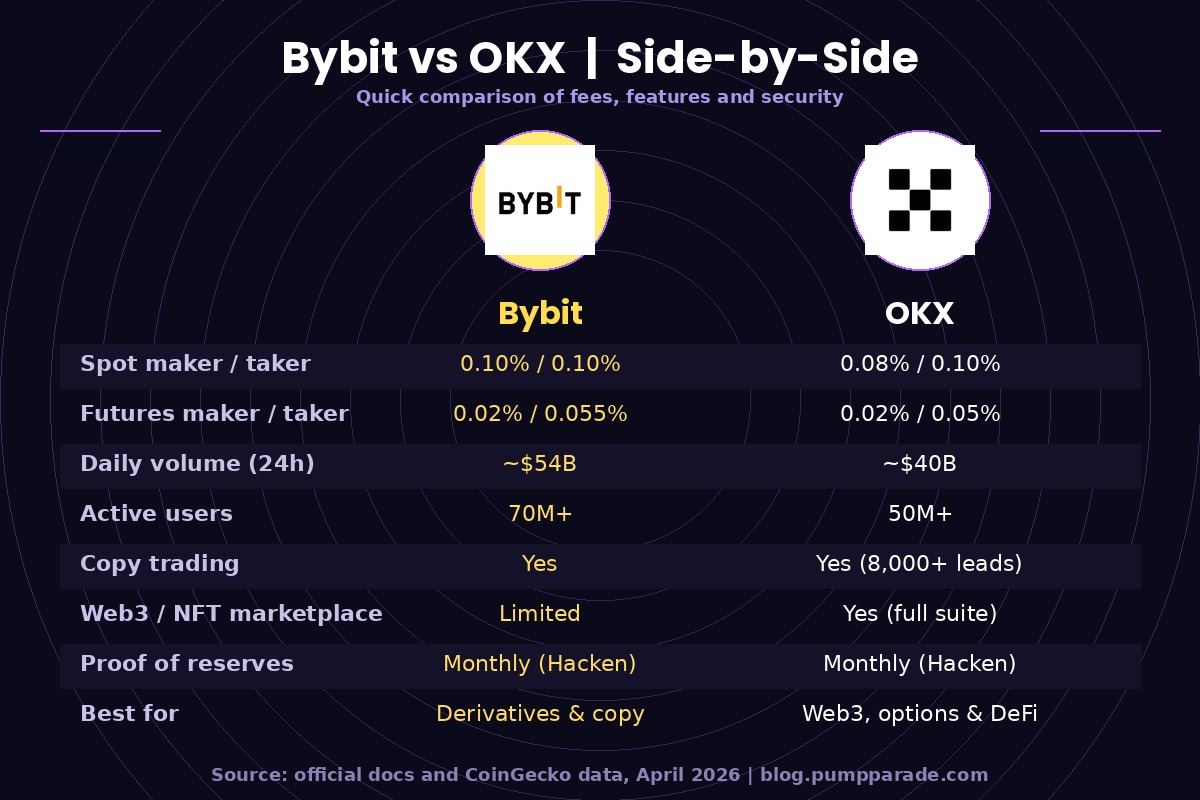
Both exchanges are functionally world-class, but the small differences in fee structure and product breadth add up if you trade actively. Below is a closer look at where each one pulls ahead.
Trading Fees: Where Every Basis Point Matters
If you trade size, fees are the single biggest cost line you can control.
Spot trading. Bybit charges 0.10% maker and 0.10% taker at the base tier, dropping to 0.06% / 0.08% at VIP 1 and as low as 0.01% / 0.03% at the top tiers. OKX is slightly cheaper out of the gate at 0.08% maker / 0.10% taker, with VIP rates dropping faster than Bybit at moderate volume. If you do less than $1 million a month in spot, the practical difference is a couple of basis points per round trip.
Perpetual futures. This is where Bybit has historically held an edge. Base fees are 0.02% maker / 0.055% taker on Bybit versus 0.02% maker / 0.05% taker on OKX. OKX nominally has the lower taker fee at base tier, but Bybit’s VIP discounts kick in earlier on perpetual volume and frequent-trader rebates close the gap.
Options. OKX is the clear winner. Standard tier options fees are 0.03% maker / 0.03% taker on OKX versus 0.02% maker / 0.03% taker on Bybit, but OKX’s order books are 3 to 5 times deeper on BTC and ETH options, which matters far more than the half-basis-point fee delta.
Withdrawal fees. Both are free to deposit. Bybit uses fixed per-asset withdrawal fees, OKX scales by network. For USDT on TRC20, OKX charges 2.6 USDT versus a comparable 2 USDT on Bybit. For BTC on the native chain, OKX is 0.0004 BTC versus 0.0001 BTC on Bybit. Bybit is consistently a touch cheaper on withdrawals.
Features Deep Dive
Copy Trading
Both exchanges offer copy trading and both treat it as a flagship product. OKX has the larger network at over 8,000 lead traders and a “Smart Sync” feature that automatically matches your position size to the leader. Bybit has fewer leads but its copy trading covers spot and derivatives natively in one terminal, which is genuinely rare. Slight edge: OKX for selection, Bybit for unified execution.
Trading Bots
OKX ships 12 pre-built strategies (Grid, DCA, Arbitrage, Recurring Buy, Smart Portfolio and more) and exposes a clean visual builder. Bybit offers Spot and Futures Grid bots and is rapidly catching up, but for a beginner who wants ready-made strategies, OKX is more turn-key.
Web3 and DeFi
This is OKX’s biggest moat. The OKX Wallet supports 100+ chains, runs a DEX aggregator that routes across 400+ DEXs, and integrates with an NFT marketplace and dApp browser. Bybit’s Web3 wallet exists, but it is shallower and feels bolted on. If you actually live on-chain, OKX is in a different league.
Asset Coverage
OKX lists 350+ cryptocurrencies and 500+ trading pairs. Bybit lists roughly 700 spot pairs and is faster to list memecoins and Solana ecosystem tokens. For early-stage Solana plays, Bybit usually gets there first.
Earn and Yield
OKX offers multi-token staking, structured products, and crypto-backed loans. Bybit has Bybit Earn with Flexible and Fixed savings but no native crypto loans product as of April 2026. Edge: OKX, especially for users who want everything inside one app.
Security and Trust
Both exchanges meet the modern bar: cold storage for the bulk of user funds, monthly Hacken-audited Proof-of-Reserves, two-factor authentication, withdrawal whitelists, and anti-phishing codes. Both publish reserve coverage above 100% on BTC, ETH, USDT and USDC.
OKX has the cleaner historical record. It has never been hacked, holds CertiK’s “AA” rating (the highest possible), and stores more than 95% of user assets in geo-distributed offline wallets.
Bybit’s February 2025 cold wallet exploit cost the exchange $1.5 billion in ETH, but the response (full reimbursement within 72 hours, transparent post-mortem, and a security overhaul that segregated cold and warm signing infrastructure) is widely considered best-in-class incident handling. As of April 2026, Bybit’s reserves are back over 100% and external auditors have cleared the new architecture. The hack matters historically; it is not a reason to avoid the exchange today.
For data sources, you can verify reserve coverage via CoinGecko trust scores or directly through the published Hacken proof-of-reserves audits.
User Experience
Bybit’s interface is famously clean. New users land on a focused Spot/Derivatives toggle, the order entry panel hides advanced options behind a single click, and the mobile app is one of the smoothest in the industry. If you have never used a crypto exchange before, Bybit is the easier first day.
OKX is denser. The trading interface is configurable, but the sheer surface area (Spot, Margin, Futures, Options, Convert, Earn, Bots, Copy Trade, Jumpstart, Wallet, NFT, DEX) means there is more to learn. For experienced users who want everything in one place, this is a feature, not a bug. For everyone else, expect a steeper learning curve.
Both apps support biometric login, dark mode, and customizable layouts. Both push notifications work reliably. Bybit edges ahead on raw simplicity; OKX wins on flexibility.
Who Wins for Each Trader Type?
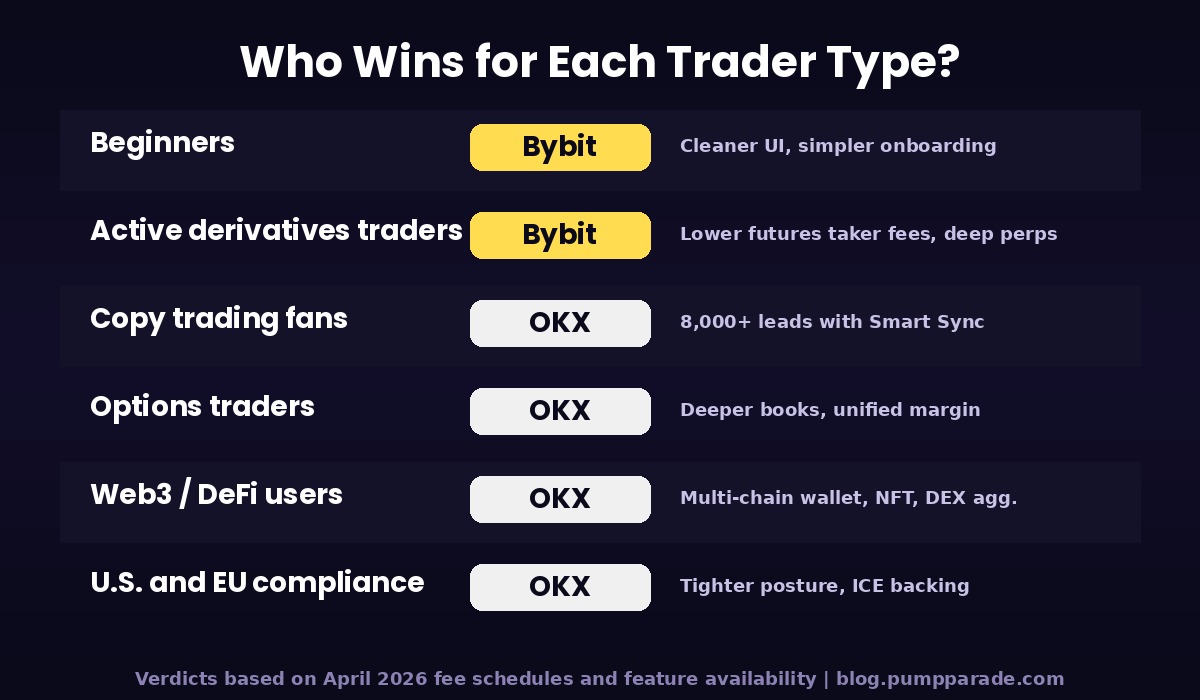
The honest answer to “which is better” depends entirely on what you want to do. The graphic above sums up the practical winners. In short: Bybit is the cleaner derivatives terminal, OKX is the more complete crypto platform.
Pros and Cons
Bybit
Pros: Industry-leading perpetual futures liquidity, very low futures maker fees, exceptionally clean UI for new users, fast memecoin and Solana ecosystem listings, free spot trading via Alpha trading promotions, strong copy trading with unified spot and derivatives execution.
Cons: Smaller options book than OKX, weaker Web3 wallet, no crypto-backed loans, history of the February 2025 hack (now resolved), restricted in several jurisdictions including the U.S.
OKX
Pros: Best-in-class Web3 stack with multi-chain wallet and DEX aggregator, deepest options order books outside Deribit, never hacked, CertiK AA rating, ICE-backed institutional credibility, full U.S. fee framework launched February 2026, broadest product surface (Earn, Bots, Loans, NFT, Jumpstart).
Cons: Steeper UI for beginners, slightly higher BTC and USDT withdrawal fees, fewer fast-track memecoin listings than Bybit, $500 million U.S. compliance settlement on its record (now resolved).
Final Verdict and Use-Case Recommendations
If you want a single answer, OKX takes the 2026 crown as the better all-around exchange. The Web3 stack, options depth, and ICE-driven institutional roadmap simply give OKX more places to grow with you as your portfolio matures. The integrated wallet alone replaces three or four standalone tools.
However, if you trade BTC and ETH perpetuals as your primary activity, Bybit is still the platform of choice. Lower futures fees at moderate volume, a faster UI for high-frequency entries, and unified copy trading make it a sharper tool for derivatives specialists.
The smartest play for serious 2026 traders is to use both: Bybit for derivatives flow and OKX for spot, options, Web3 and yield. Custody is split, jurisdictional risk is hedged, and you get the best of both fee schedules.
Ratings (April 2026): Bybit 4.5 / 5, OKX 4.7 / 5.
FAQ
Is OKX safer than Bybit in 2026?
By historical record, yes. OKX has never been hacked and holds the highest CertiK security rating. Bybit recovered fully from its February 2025 cold wallet incident, and current reserve coverage is above 100%, but the historical scoreboard still favors OKX.
Which exchange has lower fees, Bybit or OKX?
For spot trading at the base tier, OKX is fractionally cheaper (0.08% / 0.10% vs 0.10% / 0.10%). For perpetual futures, OKX edges out at base tier (0.05% taker vs 0.055%), but Bybit’s VIP discounts kick in earlier and most active traders end up paying less on Bybit perps.
Can I use Bybit or OKX in the United States?
OKX launched a fully regulated U.S. platform in February 2026 with a dedicated fee framework. Bybit remains restricted for U.S. residents as of April 2026. If you are based in the U.S., OKX is currently the only one of the two you can use legally.
Does either exchange support copy trading?
Both do. OKX has more lead traders (8,000+) and a “Smart Sync” auto-matching feature. Bybit has a smaller leaderboard but is the only major exchange where copy trading covers both spot and derivatives in a single product.
Which is better for beginners?
Bybit. The UI is cleaner, the onboarding is shorter, and the mobile app is more focused. OKX is more powerful but has a much bigger feature surface to learn.
For broader market context on Solana products and DeFi venues, see our deep dives on the best Solana DEXs of 2026 and the pump.fun launchpad review.
Disclaimer: This article is for educational and informational purposes only. It is not financial advice. Cryptocurrency trading carries significant risk, including the potential loss of your entire investment. Always do your own research before using any platform.