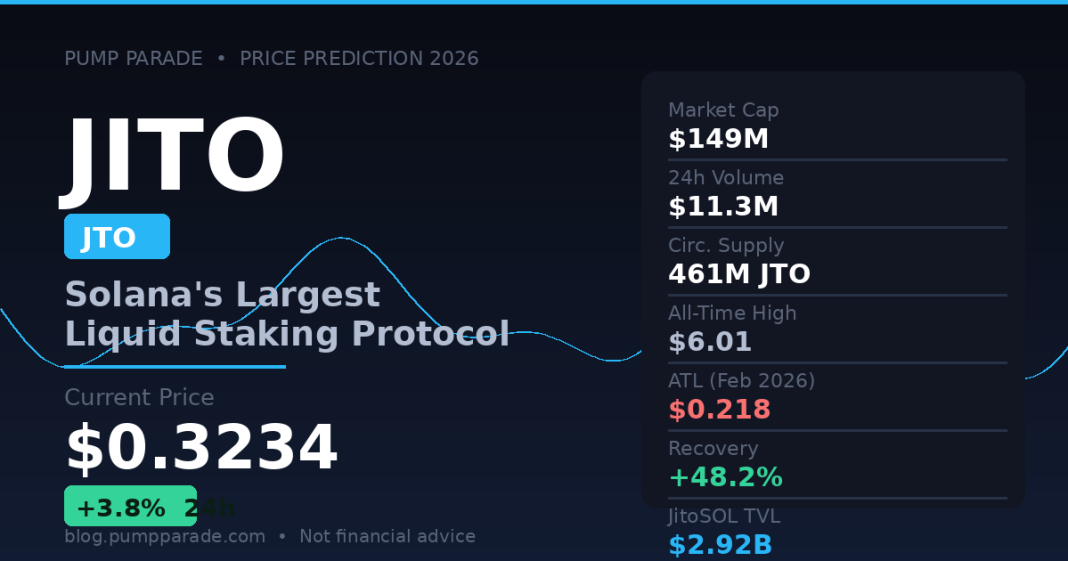
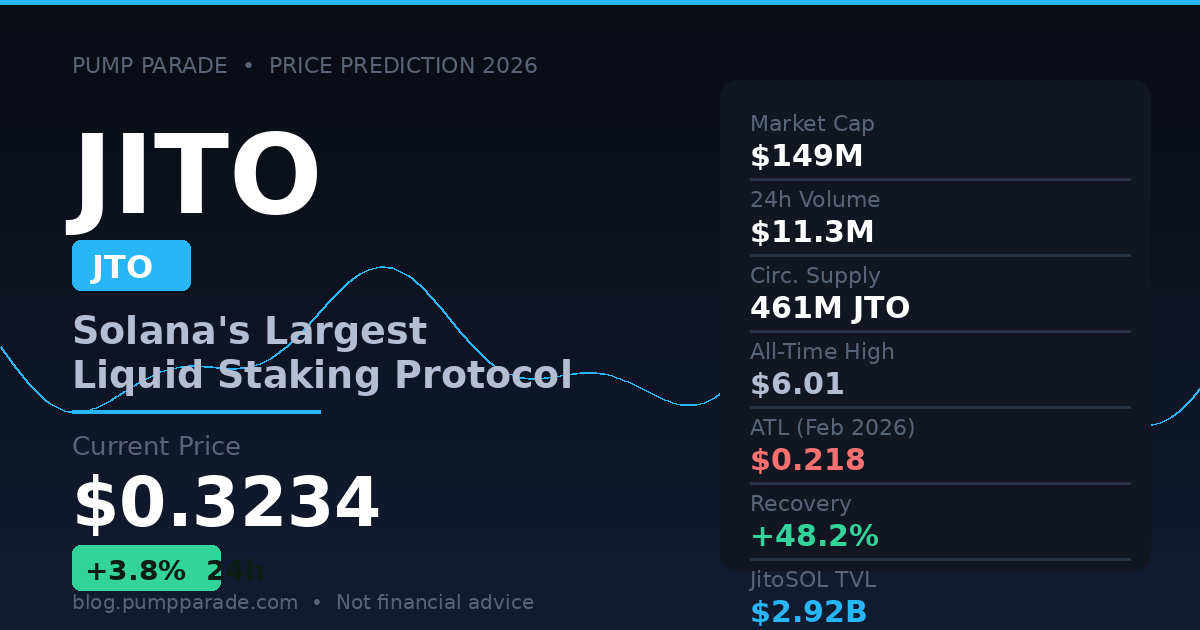
Jito (JTO) is trading at $0.3234 as of April 20, 2026. That is a 48% recovery from the all-time low of $0.2181 hit in February. But it is still down more than 94% from the December 2023 all-time high of $6.01.
The gap between where JTO is and where it has been is enormous. The question is whether the catalysts arriving in April 2026 are enough to start closing it. There are three worth examining closely: a new institutional partnership in South Korea, a fee governance vote that could send cash flows directly to the DAO treasury, and growing AI agent activity boosting the MEV revenue that makes JitoSOL one of Solana’s most attractive yield assets.
This article breaks down the data, the bull case, the bear case, and what our AI model currently targets across three time horizons.
What Is Jito? A Quick Primer
Jito is a liquid staking and maximum extractable value (MEV) protocol built on Solana. When you stake SOL through Jito, you receive JitoSOL in return. JitoSOL maintains liquidity while earning two yield streams simultaneously: standard Solana staking rewards and a portion of MEV captured by Jito’s block engine.
That dual-yield structure is Jito’s core competitive advantage. JitoSOL currently yields approximately 7.2 to 7.8% APY, compared to 5.9 to 6.6% for native Solana staking. The difference is MEV. Jito’s block engine processes validator tips and bundles for about 80% of Solana’s stake-weighted validators, giving the protocol unmatched MEV capture at the infrastructure level.
As of April 2026, DeFiLlama shows Jito’s liquid staking TVL at $2.92 billion, with roughly 14.5 million SOL staked. That makes Jito the largest liquid staking protocol on Solana by a wide margin.
The JTO token is Jito’s governance token. Holders vote on fee structures, delegation strategy, treasury management, and protocol upgrades. Governance votes have historically not had a direct price catalyst. That is changing with JIP-24.
April 2026 Catalysts
1. The KODA Partnership (April 13)
Jito Foundation signed a memorandum of understanding with KODA, a regulated digital asset custodian in South Korea. The deal targets institutional investors by creating compliant custody and staking pathways for JitoSOL.
South Korea is one of the most active crypto retail and institutional markets globally. If the KODA integration moves past MoU into live product, it opens Jito to a new institutional demand pool that has had no regulated on-ramp to Solana liquid staking until now.
This is not a guaranteed price driver. MoUs often stall. But it signals that Jito is actively building the compliance infrastructure needed for institutional scale, and it is arriving at a time when South Korean regulators are actively creating frameworks for crypto products.
2. JIP-24 and the Fee Accrual Mechanism
JIP-24 is a governance proposal that would route 100% of Block Engine and BAM (Block Auction Mechanism) fees directly to the Jito DAO treasury. Based on current network activity, that could generate up to $15 million annually in real cash flows.
Treasury cash flows create optionality: buybacks, staking rewards, grants, or reserves. More importantly, they give JTO a fundamentals-based valuation floor. At $149M market cap with $15M annual revenue flowing to the DAO, that is roughly a 10x price-to-revenue ratio. For a protocol controlling $2.92B in TVL, that is a compelling setup if the vote passes.
3. AI Agents and MEV Growth
One underappreciated catalyst: AI trading agents are generating significantly more on-chain activity on Solana. More transactions mean more MEV opportunities for Jito’s block engine. On April 16, MEXC identified JTO as one of five altcoins outperforming Bitcoin in April, citing specifically that AI agent volume is boosting MEV revenue for JitoSOL holders.
If Solana’s AI agent ecosystem continues to grow, the fundamental case for JitoSOL yield improves. Higher yield attracts more TVL. More TVL means more protocol revenue. More protocol revenue supports a higher JTO valuation.
Technical Analysis
JTO’s technical picture is improving, though it is early. Here is what the data shows at time of writing.
Price: $0.3234
24h change: +3.8%
7-day performance: +17% (whale accumulation visible on-chain)
All-time low: $0.2181 (Feb 6, 2026)
Recovery from ATL: +48.2%
RSI: Approximately 61. This means momentum is building, but the token is not overbought. There is room for bulls to push further before hitting typical reversal territory above 70.
Key resistance levels: The immediate ceiling is around $0.3376. A clean break above that targets the $0.38 to $0.40 zone, where open interest spiked 21% in the past week. Beyond that, $0.50 becomes the next meaningful resistance.
Key support levels: $0.27 to $0.28 is the first meaningful support. Below that, $0.21 to $0.22 sits near the February lows. A break below $0.21 would be a bearish structural failure.
On-chain data shows early-stage whale accumulation. Open interest jumped 21% to $14.26 million last week, signaling fresh capital entering the market rather than short-term rotation.
The Bull Case
The bull case for JTO rests on three interconnected pillars.
First, Solana itself is recovering. SOL is currently at $85, up from lows near $50 in early 2026. A continued Solana recovery drives more liquid staking demand, more TVL, and higher MEV revenue for Jito. JTO historically moves at a multiplier to SOL during Solana bull phases.
Second, institutional adoption is starting to materialize. The KODA deal, the Blockworks IR platform partnership (April 16), and JIP-24 treasury mechanics are all signals that Jito is maturing from a retail DeFi product into institutional infrastructure. Institutional adoption compresses discount-to-TVL ratios over time.
Third, the AI agent narrative is accelerating Solana’s on-chain volume. Jito’s infrastructure sits at the base layer of that activity. It is one of the few protocols that benefits mechanically from higher transaction count, regardless of which specific applications are generating volume.
In a bull scenario, JTO could reach $0.80 to $1.00 within six months if SOL breaks above $120 and JIP-24 passes with strong participation.
The Bear Case
The bear case is real and should not be dismissed.
JTO is still 94.6% below its all-time high. Recovering that kind of drawdown requires a sustained bull market, growing TVL, AND improving fundamentals, all at the same time. That is a lot to ask.
Token unlock pressure remains a concern. The April 7 unlock of 11.31 million JTO was relatively small at $2.97M. But the total supply is 1 billion JTO, with only 461 million currently circulating. Future unlocks will continue adding sell pressure to the market for months ahead.
JTO is also tightly correlated to SOL. If Solana faces another network outage, regulatory headwind, or broader market correction, JTO will fall harder than SOL. The leverage cuts both ways.
Finally, competition in Solana liquid staking is real. Marinade Finance, Sanctum, and other protocols are all competing for the same TVL. Jito’s MEV advantage is genuine, but not permanent if rivals develop comparable infrastructure.
In a bear scenario, a macro correction sending SOL back toward $50 to $60 could push JTO back to the $0.19 to $0.22 range, retesting February lows.
Jito (JTO) Price Predictions 2026
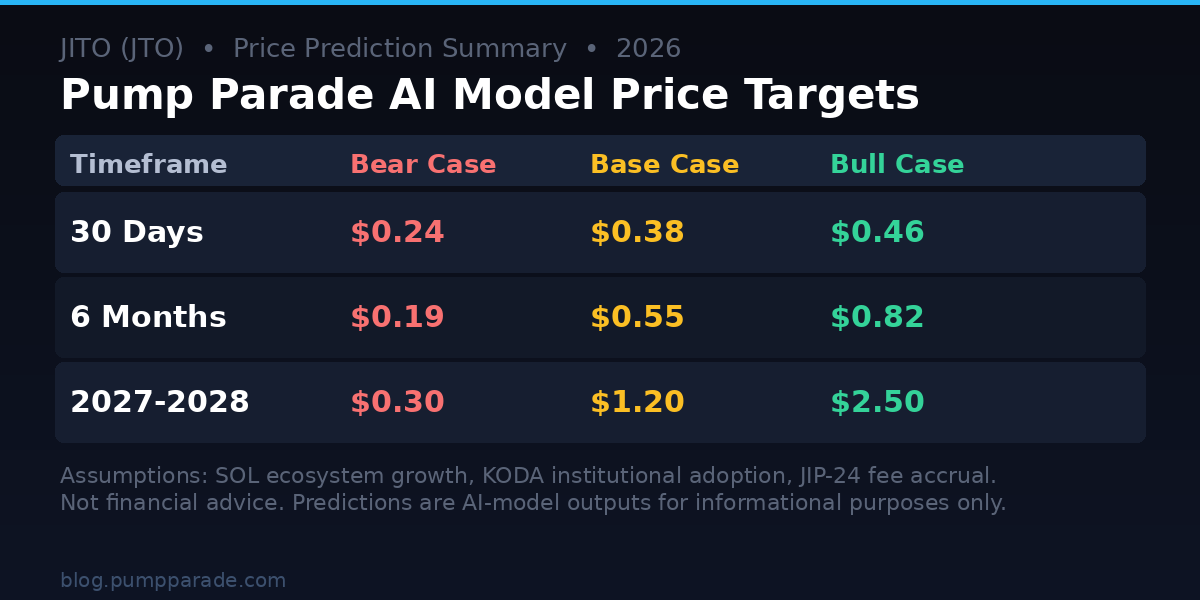
Our hybrid AI model analyzes technical indicators, on-chain metrics, governance signals, and macro context. Here are the current price targets across three time horizons.
Short-Term (30 Days)
The immediate catalyst is the $0.3376 resistance level. A clean break above it, supported by continued whale accumulation and SOL holding above $80, targets $0.38 to $0.46 in the base and bull scenarios. The bear case assumes a macro pullback pushing JTO back to $0.24.
Medium-Term (6 Months)
The six-month picture depends heavily on JIP-24 passing and the KODA partnership converting from MoU to live product. If both happen, institutional demand entering through regulated South Korean channels could push JTO toward $0.55 to $0.82. The bear case, where macro conditions deteriorate and SOL falls, targets $0.19.
Long-Term (2027-2028)
In the long term, our model assigns a base case of $1.20 for JTO, predicated on Solana maintaining its position as the leading high-throughput blockchain and Jito capturing continued institutional staking flows. The bull case of $2.50 requires a full crypto bull market with institutional ETF exposure to Solana. The bear case of $0.30 assumes Jito loses market share to competitors or Solana faces a structural challenge.
For context on how Solana ecosystem DeFi tokens tend to behave in recovery cycles, see our Sui (SUI) price prediction for 2026, which covers similar dynamics in a competing Layer 1 ecosystem.
What to Watch
Three signals matter most for JTO over the next 90 days.
SOL price trajectory. If SOL breaks above $100 and holds, it is structurally positive for every Solana DeFi token, especially one capturing MEV at the validator layer.
JIP-24 governance vote result. A passed vote with strong participation would be a direct fundamental catalyst, creating the first clear cash-flow-to-token-holder mechanism in Jito’s history.
KODA adoption metrics. Watch for any announcements about JitoSOL product launches in Korea. Institutional TVL growth would show up on DeFiLlama and would be an unusually clean data signal in a space full of noise.
Final Take
JTO is a fundamentally credible protocol trading at a significant discount to both its historical peak and its TVL. The $2.92B in assets under management, combined with $15M in potential annual treasury revenue from JIP-24, gives it more economic substance than most governance tokens at this market cap.
The risks are real: SOL dependency, token unlock overhang, and the sheer scale of the drawdown from ATH. But the combination of institutional catalysts, improving on-chain metrics, and a mechanical MEV revenue story makes JTO one of the more interesting setups in the Solana ecosystem right now.
This is not a prediction that JTO recovers to $6.00. It is a probability-weighted case that $0.32 is a more attractive entry than it looks, conditional on Solana’s ecosystem continuing to develop.
Disclaimer: This article is for informational and educational purposes only and should not be construed as financial, investment, or trading advice. Cryptocurrency markets are highly volatile, and past performance does not guarantee future results. The price predictions and analyses presented here are based on AI models, technical indicators, and available data at the time of writing. They are not guarantees. Always conduct your own research (DYOR) and consult with a qualified financial advisor before making any investment decisions. Pump Parade and its authors do not assume liability for financial losses incurred based on information provided in this article.
About our AI predictions: Pump Parade’s price predictions are generated by machine learning models that analyze technical indicators, on-chain data, and market sentiment. These models have limitations and cannot account for black swan events, regulatory changes, or sudden market shifts. Prediction confidence scores reflect the model’s internal assessment, not guaranteed accuracy. Use AI predictions as one input among many in your research.