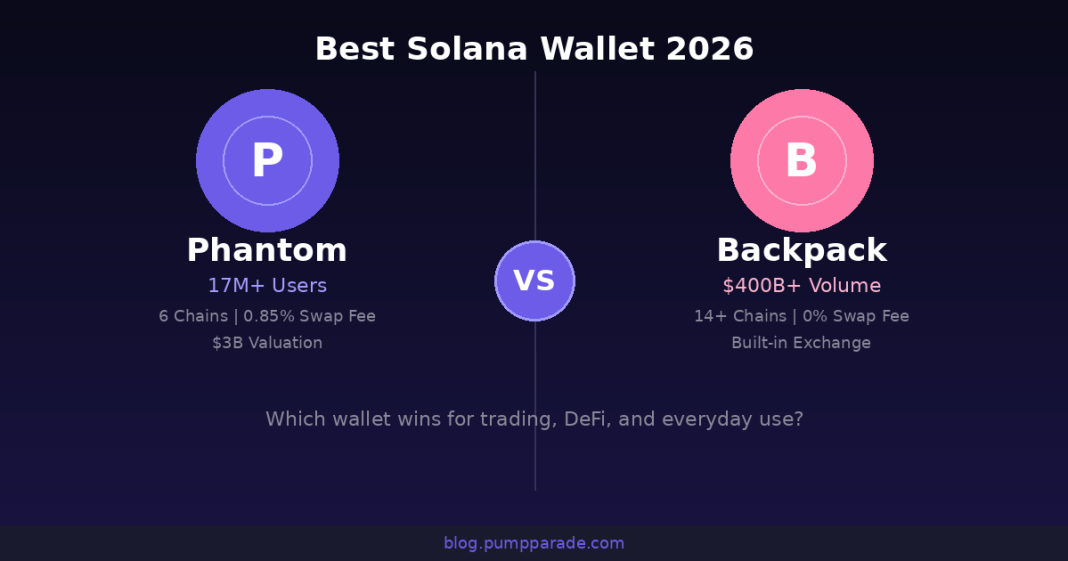
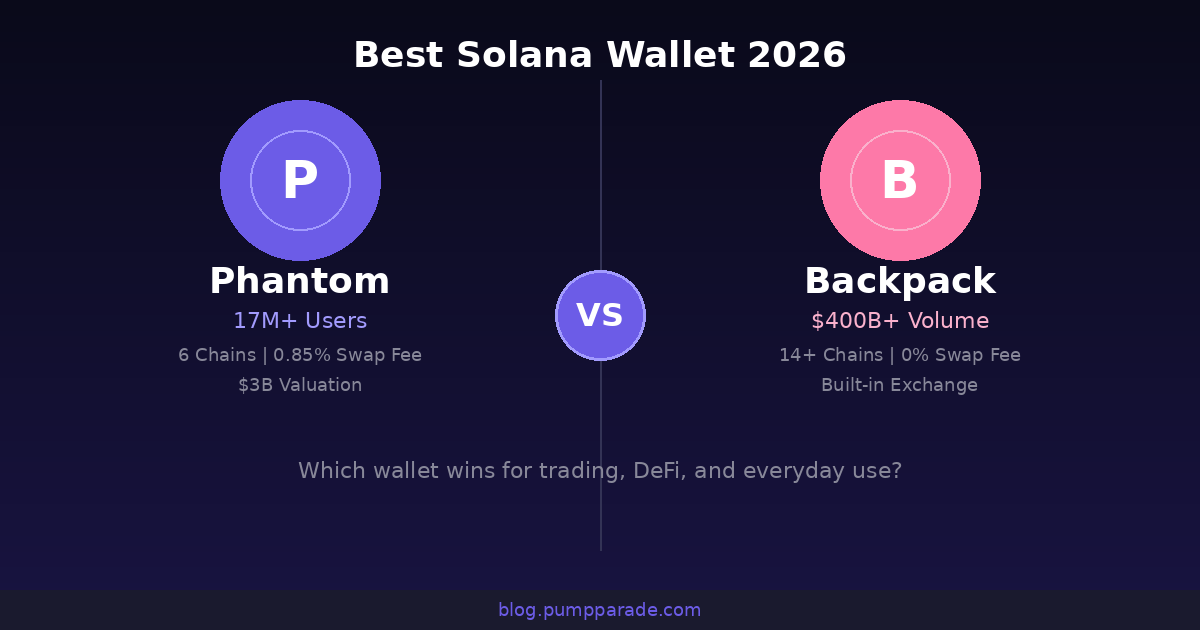
Phantom has 17 million monthly active users. Backpack just launched its $BP token to a community that drove over $400 billion in cumulative trading volume. Both wallets claim to be the best way to interact with Solana and beyond. But they take fundamentally different approaches to what a crypto wallet should be.
Phantom is the established market leader with a 39.4% share of the Solana wallet ecosystem, a $3 billion valuation, and support across six blockchains. Backpack is the challenger that bundles a wallet with a regulated exchange, supports 14+ chains, and charges zero platform fees on swaps. If you’re choosing between them in 2026, the right pick depends on how you actually use crypto.
Here’s the full breakdown.
Quick Verdict: Who Wins?
Choose Phantom if you want the most battle-tested Solana wallet with the largest dApp ecosystem, beginner-friendly interface, and a proven security track record. Phantom is the safer default choice for most users.
Choose Backpack if you’re an active trader who wants zero swap fees, built-in exchange access, support for 14+ chains, and features like NFT locking. Backpack offers more raw value for power users willing to adopt a newer platform.
Bottom line: Phantom wins on trust and ecosystem reach. Backpack wins on fees and trader-focused features. Neither is a bad choice, but they serve different users.
Product Overview
Phantom
Phantom launched in 2021 as a Solana-native wallet and quickly became the ecosystem’s dominant self-custodial option. In January 2025, it closed a $150 million Series C at a $3 billion valuation. By early 2026, it reports nearly 17 million monthly active users and has processed over 850 million on-chain transactions in a single year.
The wallet has expanded to support six blockchains: Solana, Ethereum, Bitcoin, Polygon, Base, and Sui. In March 2026, Phantom secured a no-action letter from the CFTC, clearing a path for wallet-level access to regulated derivatives markets. That’s a regulatory milestone no other consumer wallet has achieved.
Phantom is available as a browser extension (Chrome, Firefox, Brave, Edge) and mobile app (iOS and Android).
Backpack
Backpack started as an xNFT wallet built around executable NFTs, then pivoted to become a combined wallet-and-exchange ecosystem. The Backpack Exchange launched with regulatory licenses in multiple jurisdictions and the wallet acts as a seamless gateway to that exchange.
On March 23, 2026, Backpack held its Token Generation Event for $BP, distributing 100% of its initial circulating supply to the community. The total supply is 1 billion tokens. The platform also introduced an on-chain IPO access service, allowing users to participate in initial public offerings settled through Solana.
Backpack supports 14+ blockchains including Solana, Ethereum, Base, Monad, Sui, Aptos, BNB Chain, Arbitrum, Polygon, Sei, Optimism, and Berachain. It’s available as a browser extension and mobile app.
Features Deep Dive
Swaps and Trading
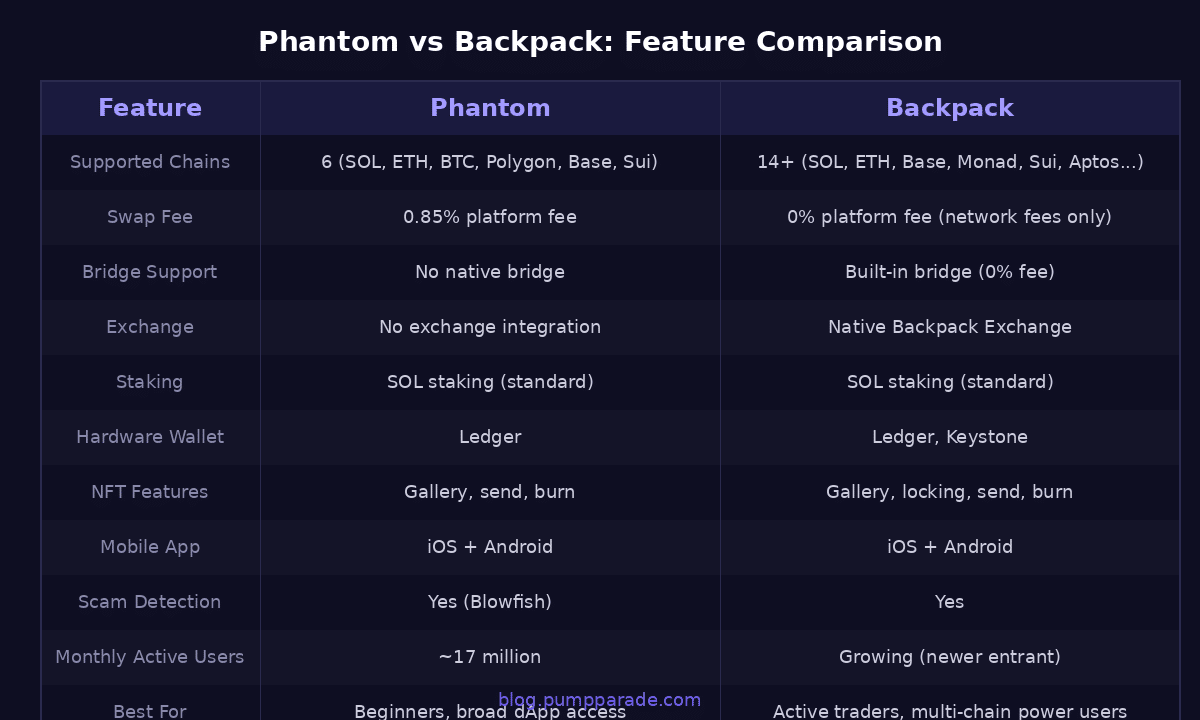
This is where the two wallets diverge most sharply. Phantom charges a 0.85% platform fee on in-app swaps, plus network gas fees. On Solana mobile, gasless swaps are available at a 1.5% all-in fee when the trade qualifies. Cross-chain swaps add a bridge provider fee of approximately 0.3%.
Backpack charges 0% platform fees on swaps and bridges within the wallet. Users pay only Solana network fees and liquidity-related costs. For frequent traders, that 0.85% difference adds up fast. On $10,000 in monthly swap volume, you’d save roughly $85 per month with Backpack.
Multi-Chain Support
Backpack supports more than double the chains Phantom does. With 14+ networks versus Phantom’s 6, Backpack covers emerging ecosystems like Monad, Aptos, Berachain, and HyperEVM that Phantom doesn’t touch yet. If you’re active across DeFi on newer L1s and L2s, Backpack gives you a single interface for all of them.
That said, Phantom’s chain coverage includes Bitcoin (native and Taproot), which Backpack doesn’t offer. If you hold BTC alongside your SOL and ETH, Phantom is the only option here that consolidates everything.
Exchange Integration
Backpack’s built-in exchange connection is a feature Phantom simply doesn’t have. You can move funds between your Backpack wallet and the Backpack Exchange without bridging or withdrawal fees. For traders who need both a self-custodial wallet and centralized exchange access, this is a significant workflow advantage.
Phantom has no exchange integration. To move funds to a CEX, you send a standard on-chain transfer like you would from any other wallet.
Bridging
Backpack includes a native bridge at 0% platform fee. Phantom does not have a built-in bridge. If you need to move assets between chains in Phantom, you’ll use a third-party bridge like Wormhole or deBridge, which means extra steps and potentially higher fees.
NFT Features
Both wallets offer NFT galleries, sending, and burning. Backpack adds NFT collection locking, which prevents unauthorized transfers of specific collections. This is a niche but valuable security feature if you hold high-value NFTs. Phantom includes scam NFT detection powered by Blowfish, automatically flagging suspicious airdrops.
Staking
Both support standard SOL staking through validators. Neither offers a meaningfully differentiated staking experience. If advanced validator selection and staking controls matter to you, Solflare (a Solana-only wallet) is actually the better option in that specific category.
Fees and Pricing
| Fee Type | Phantom | Backpack |
|---|---|---|
| Swap Fee | 0.85% | 0% |
| Gasless Swap (Solana Mobile) | 1.5% | N/A |
| Bridge Fee | No native bridge (~0.3% via third party) | 0% |
| Cross-Chain Swap | 0.85% + ~0.3% bridge | Network fees only |
| Network Gas | Standard (user pays) | Standard (user pays) |
| Staking Fee | Validator-dependent | Validator-dependent |
Backpack has a clear fee advantage across every category. The 0% swap fee is particularly notable because most competing wallets charge between 0.5% and 1%. Phantom’s 0.85% is in line with the industry but above what Backpack offers.
Pros and Cons
Phantom
Pros:
- Largest user base (17M+ MAUs) with the most extensive dApp compatibility on Solana
- $3 billion valuation and $150M Series C signals long-term stability
- CFTC no-action letter positions it for regulated financial products
- Bitcoin support (native + Taproot) in addition to EVM and Solana
- Blowfish-powered scam detection with proven track record
- Tax software integrations (Koinly, CoinTracker) save time at tax season
- Biometric authentication on mobile (Face ID, fingerprint)
Cons:
- 0.85% swap fee is higher than several competitors
- No built-in bridge, requiring third-party solutions
- Only 6 chains supported vs. competitors with 14+
- No exchange integration for quick CEX access
- No NFT locking feature
Backpack
Pros:
- 0% platform fee on swaps and bridges is best-in-class
- 14+ chain support covers more ecosystems than almost any competitor
- Native exchange integration eliminates friction for active traders
- NFT collection locking adds unique security layer
- On-chain IPO access is a novel feature not available elsewhere
- $BP token with community-first distribution (100% at TGE)
- Hardware wallet support includes both Ledger and Keystone
Cons:
- Smaller user base and newer track record compared to Phantom
- No Bitcoin support
- Exchange-wallet integration creates dependency on Backpack Exchange’s stability
- Fewer dApp integrations in some Solana ecosystem corners
- Less established security audit history
Security and Trust
Both Phantom and Backpack are self-custodial wallets, meaning you control your private keys. Neither platform can access your funds.
Phantom has the longer track record. It has processed hundreds of millions of transactions since 2021 without a major security breach affecting user funds. Its Blowfish integration scans transactions before you sign them, flagging malicious contracts and suspicious token approvals. Phantom also received the CFTC no-action letter in March 2026, which signals regulatory credibility.
Backpack is newer but has been audited and holds regulatory licenses for its exchange operations. It offers scam detection and the unique NFT locking feature. However, its shorter operational history means there’s less real-world security data to evaluate.
For users prioritizing proven security track records, Phantom has the edge. For users who want specific security features like NFT locking, Backpack offers more granular controls.
User Experience
Phantom’s interface is clean and beginner-friendly. The onboarding flow guides new users through wallet creation, and the main dashboard clearly displays token balances, NFTs, and recent activity. Swap functionality is accessible in two taps. The mobile experience mirrors the desktop extension closely.
Backpack’s interface is slightly more complex due to its exchange integration and broader feature set. The learning curve is steeper if you’re new to crypto, but experienced users will appreciate having exchange, wallet, bridge, and DeFi tools in one place. The UI is modern and well-organized, though the sheer number of supported chains can make the network selector feel busy.
Both wallets support hardware wallet connections (Ledger), biometric authentication on mobile, and offer dark mode by default.
Verdict: Which Should You Choose?
For beginners and general Solana users: Go with Phantom. The larger ecosystem, simpler interface, and longer security track record make it the lower-risk choice. If you’re holding SOL, a few NFTs, and occasionally swapping tokens, Phantom does everything you need.
For active traders and DeFi power users: Backpack is the stronger pick. Zero swap fees, 14+ chains, built-in exchange access, and native bridging save both money and time. If you’re executing multiple trades per day or working across several chains, those savings compound quickly.
For Bitcoin holders: Phantom is your only option here, since Backpack doesn’t support BTC.
For multi-chain DeFi explorers: Backpack’s support for Monad, Aptos, Berachain, and other emerging chains makes it the better choice if you’re farming yields or testing new ecosystems.
Both wallets are free to download and self-custodial. There’s nothing stopping you from using both, keeping Phantom as your primary Solana wallet and Backpack for multi-chain trading. Many users do exactly that.
FAQ
Is Phantom or Backpack safer?
Both are self-custodial, so you control your keys in either case. Phantom has a longer operational history and a larger user base (17M+ MAUs), which gives it more real-world security validation. Backpack is newer but holds exchange regulatory licenses and offers unique features like NFT locking. Neither has experienced a major security breach affecting user funds.
Can I use both Phantom and Backpack at the same time?
Yes. Both install as browser extensions and mobile apps. You can use Phantom for Solana dApps and Backpack for multi-chain trading or exchange access. Many users run both wallets simultaneously.
Why does Backpack charge 0% swap fees?
Backpack monetizes through its integrated exchange (trading fees) and the broader $BP token ecosystem rather than charging wallet-level fees. This makes the wallet itself a free acquisition tool for their exchange platform.
Does Phantom support Backpack Exchange?
No. Backpack Exchange is directly integrated only with the Backpack wallet. To use Backpack Exchange with Phantom, you’d need to transfer funds to a Backpack wallet or deposit directly to the exchange from Phantom via an on-chain transfer.
Which wallet has better NFT support?
Phantom has the more mature NFT gallery with Solana-native features and scam NFT detection. Backpack offers NFT collection locking, which prevents unauthorized transfers. If NFT security is your priority, Backpack’s locking feature is unique. For general NFT browsing and management, both are capable.
Looking for trading tools to pair with your wallet? Check out our Photon vs BullX comparison for the best Solana trading bots, or read our Jupiter Exchange review for the top Solana DEX aggregator.
Disclaimer: This article is for informational and educational purposes only and should not be construed as financial, investment, or trading advice. Cryptocurrency markets are highly volatile, and past performance does not guarantee future results. The analyses presented here are based on publicly available data at the time of writing. Always conduct your own research (DYOR) and consult with a qualified financial advisor before making any investment decisions. Pump Parade and its authors do not assume liability for financial losses incurred based on information provided in this article.