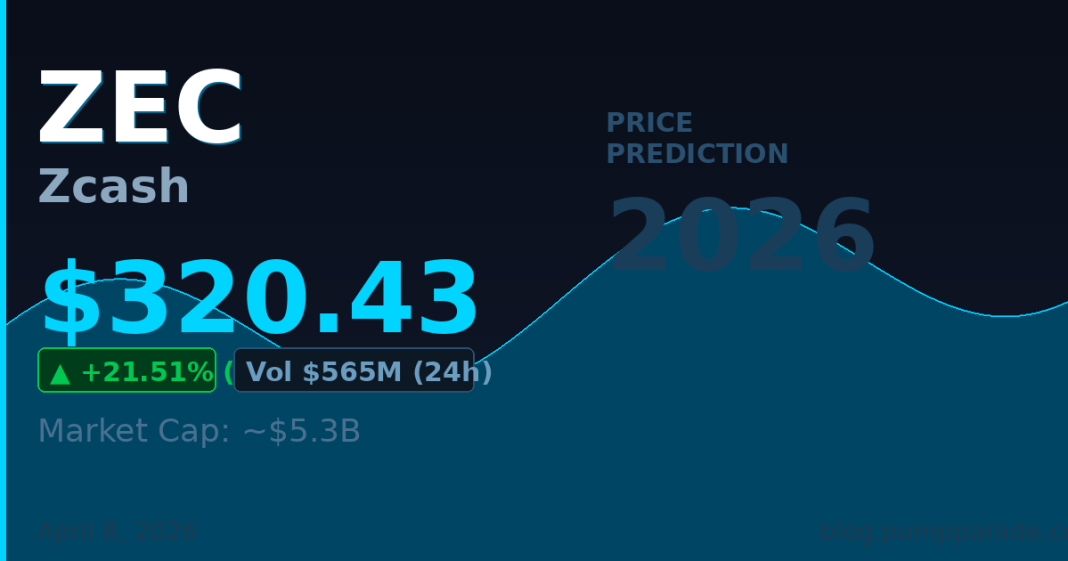
Zcash (ZEC) is up 21.5% in the last 24 hours, trading at $320 at time of writing. That puts it among the best-performing major assets today. Volume has spiked to over $500 million across exchanges, the highest single-day figure for ZEC in over a year.
This isn’t a random pump. Three major developments have converged to push ZEC into the spotlight: the SEC closed its investigation into Zcash in January 2026, Grayscale filed to convert its Zcash Trust (ZCSH) into a U.S.-listed spot ETF, and the Zcash Open Development Lab raised $25M from Paradigm and a16z just weeks ago. Privacy coin narratives are back, and ZEC is leading the charge.
So is this the start of a sustained rally, or a liquidity event that fades by Friday? Our AI model breaks down both scenarios, with specific price targets for the next 30 days, 6 months, and 2027-2028.
What Is Zcash?
Zcash is a privacy-focused cryptocurrency that launched in 2016 from the work of cryptographers at Johns Hopkins, MIT, and other top institutions. It uses a cryptographic technique called zk-SNARKs (zero-knowledge succinct non-interactive arguments of knowledge) to allow users to transact with full privacy, meaning neither the sender, receiver, nor transaction amount needs to be visible on-chain.
In plain terms: Zcash lets you send money without anyone knowing who sent it, who received it, or how much. For users who prioritize financial privacy, that’s a powerful proposition.
ZEC runs on its own proof-of-work blockchain with a maximum supply of 21 million coins, mirroring Bitcoin’s cap. About 16.5 million ZEC are currently in circulation. The project is developed by the Electric Coin Company and supported by the Zcash Foundation.
Current Market Context
ZEC’s 24-hour move of 21.5% to $320 puts it up roughly 54% over the past 30 days. The broader crypto market is mixed right now, with the total market cap around $2.3 trillion and Bitcoin dominance at 58.5%. This is classic “Bitcoin season” territory, when altcoin moves tend to be narrative-driven and selective.
ZEC fits that pattern. Privacy coins are not a broad altcoin rotation play. They are catching a specific tailwind driven by regulatory clarity and institutional demand. The Grayscale ETF filing, in particular, signals that institutional appetite for ZEC is real, not speculative.
Key market data at time of writing (April 8, 2026):
- Price: $320.43
- 24h Change: +21.51%
- 24h Volume: $565 million (cross-exchange)
- Market Cap: ~$5.3 billion
- Circulating Supply: ~16.5 million ZEC
- 30-day Change: +53.8%
For live data, you can track ZEC on CoinGecko.
Key Catalysts Driving the Rally
SEC Clears Zcash: No Enforcement Action
On January 15, 2026, the SEC officially closed its investigation into Zcash without recommending enforcement action. This was a significant overhang that had weighed on ZEC since 2023, when regulators began scrutinizing privacy coins more aggressively. The all-clear removes a meaningful risk from the thesis.
Grayscale Files for Spot ZEC ETF
Grayscale has filed with the SEC to convert its Grayscale Zcash Trust (ZCSH) into a U.S.-listed spot ETF on NYSE Arca. The trust already holds a meaningful position in ZEC. This mirrors the playbook Grayscale used successfully with Bitcoin and Ethereum. If approved, a spot ETF would open ZEC to a new class of institutional and retail investors who prefer regulated wrappers over direct crypto custody.
Grayscale has also been actively accumulating. Reports indicate the firm added approximately $46 million in ZEC to its trust ahead of the filing, a signal of conviction rather than passive management.
Zcash Open Development Lab Raises $25M
In late March 2026, the Zcash Open Development Lab announced a $25 million raise from Paradigm and Andreessen Horowitz (a16z). Two of the most respected names in crypto venture putting capital into Zcash ecosystem development is a strong signal. The funds are earmarked for protocol development, privacy tooling, and ecosystem growth, including integrations with major wallets and DeFi protocols.
Foundry Launches Institutional ZEC Mining Pool
Foundry Digital, one of the largest Bitcoin mining operations in North America, announced it will launch an institutional ZEC mining pool in April 2026. This is its first move beyond Bitcoin mining. Institutional mining infrastructure adds a layer of legitimacy and liquidity to the ZEC ecosystem that it previously lacked.
Technical Analysis
ZEC’s chart is showing bullish momentum, but some caution is warranted after a 21% single-day move.
Key levels to watch:
- Support: $280-$300 (previous resistance, now flipped support), $234 below that
- Resistance: $340-$360 (first major overhead zone), then $420-$450
- 50-day moving average: Trending up, ZEC is trading well above it
The RSI (Relative Strength Index, a momentum measure from 0-100 where above 70 is considered overbought) is likely in the 75-80 range after today’s move. That means short-term pullback risk is elevated. A consolidation or retest of the $280-$300 zone would be healthy and expected before any continuation higher.
The broader pattern looks like a breakout from a multi-month base. ZEC spent most of late 2025 and early 2026 consolidating in the $180-$260 range. The confluence of catalysts has triggered a clean technical break. Historical breakouts from similar setups have seen 60-120% follow-through over the next 3-6 months, though past patterns are not predictive guarantees.
Volume confirms the move. Over $500 million in 24-hour trading volume is not retail-driven noise. That is institutional and large-wallet activity.
Bull Case for ZEC
The bull case rests on a convergence of three factors: regulatory clarity, institutional access, and a renewed privacy narrative.
If the Grayscale spot ETF is approved, ZEC gains access to a distribution channel that could bring hundreds of millions in new capital. The Bitcoin ETF approved in early 2024 drew $12 billion in net inflows in its first 90 days. ZEC is orders of magnitude smaller, so even a fraction of that impact would be transformative.
The $25M raise from Paradigm and a16z also matters for developer activity. Protocol improvements, better wallet integrations, and DeFi composability could drive ZEC adoption beyond its current niche of privacy-focused traders.
If the broader altcoin market sees a rotation in the second half of 2026, ZEC, with its cleaner regulatory profile and ETF optionality, is positioned to outperform. Our AI model’s bull case target for end-2026 sits at $700, which would represent roughly 2.2x from current levels.
Bear Case for ZEC
Privacy coins face a structural headwind that is easy to underestimate: regulatory pressure globally. While the SEC cleared Zcash in the U.S., the EU’s Markets in Crypto-Assets (MiCA) framework has provisions that complicate privacy coin listings in Europe. Several exchanges have already delisted Monero (XMR) in European markets. ZEC could face similar pressure.
There is also the question of whether the Grayscale ETF filing will actually be approved. A spot ZEC ETF would require SEC comfort with a privacy-first asset. That comfort is not guaranteed, even with the investigation closure. Approval timelines could stretch well into 2027.
On the technical side, a failure to hold $280 would be bearish. A breakdown below $234 would suggest the rally was a liquidity event rather than the start of a trend, and could trigger a retest of the $180-$200 zone where ZEC spent much of late 2025.
Macro risk is also real. Geopolitical tensions (the Iran-Strait of Hormuz situation) have already put pressure on risk assets this week. If macro deteriorates, even strong fundamental stories get sold.
Our bear case for end-2026: $200-$240 if catalysts fail to materialize.
Zcash Price Predictions: Short, Mid, and Long-Term
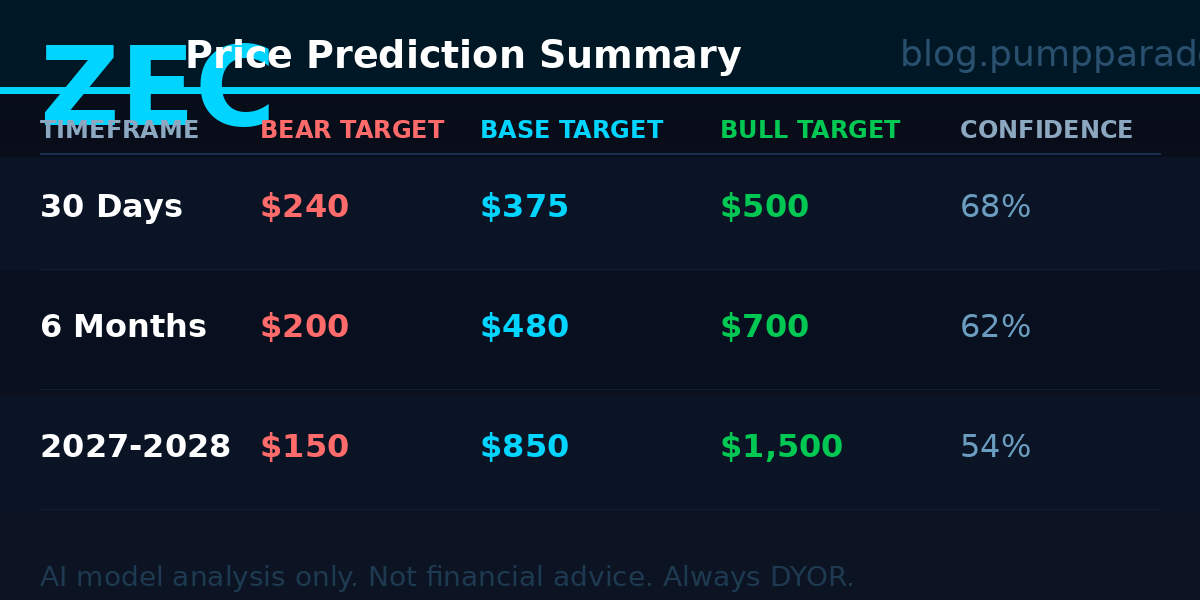
Our hybrid AI model analyzes technical indicators, on-chain metrics, sentiment data, and fundamental catalysts to generate probability-weighted price ranges. These are not guarantees. They are scenario maps.
Short-Term (30 Days): April-May 2026
After a 21% single-day move, a short-term consolidation or pullback is the base case. The $280-$300 zone is the key support level to watch. If ZEC holds that zone and volume remains elevated, the path toward $400-$420 opens over the next 30 days.
- Bear target: $240 (if macro deteriorates or rally fades)
- Base target: $350-$380 (consolidation then continuation)
- Bull target: $450-$500 (if ETF news accelerates and altcoin rotation begins)
Mid-Term (6 Months): October 2026
The 6-month window is where the ETF story plays out. If Grayscale makes regulatory progress, ZEC has a clear path toward $500-$650. If ETF approval stalls and macro headwinds persist, a retracement to $200-$250 is the more likely outcome.
- Bear target: $200
- Base target: $480
- Bull target: $700
Long-Term (2027-2028)
Long-term ZEC predictions depend heavily on two things: whether privacy becomes a mainstream crypto use case, and whether ZEC maintains its technical and community edge over competitors like Monero. If the Paradigm and a16z investment delivers on developer adoption and the ETF creates sustained institutional flows, ZEC could test its previous highs and beyond.
- Bear target: $150 (if privacy coins face regulatory delisting pressure)
- Base target: $750-$900
- Bull target: $1,500 (full ETF + institutional adoption cycle)
What to Watch
A few specific things to monitor over the coming weeks and months:
- SEC response to Grayscale ETF filing: Any comment letter or approval timeline update from the SEC will move ZEC price significantly.
- $300 support level: If ZEC pulls back after today’s surge, how it handles $300 will tell you whether the move has legs.
- Foundry pool launch: The institutional mining announcement is a data point worth tracking. More institutional infrastructure typically means more OTC demand and liquidity depth.
- Broader altcoin rotation: Bitcoin dominance at 58.5% means alts are still fighting for capital. Watch for any shift in dominance below 55% as a signal that capital is rotating.
- Monero (XMR) delisting announcements: Any additional exchange delistings of Monero in European markets could cut both ways for ZEC, either as a contagion risk or as capital rotating from XMR to ZEC.
If you are weighing how ZEC fits into a broader altcoin strategy, our XRP price prediction for 2026 covers another major asset with a similar “regulatory clarity unlocks upside” thesis.
The Bottom Line
ZEC is not a random pump. It has real catalysts: regulatory clearance, an ETF filing with institutional backing, and serious venture capital in the ecosystem. The 21% move today is loud, but the underlying thesis is quieter and more durable.
The risk-reward here is asymmetric. If the ETF moves forward, ZEC could see multiples from current levels by the end of 2026. If it stalls, the downside is real but contained by a clearly defined support structure around $280-$300.
For traders watching privacy coins, ZEC is worth a close look. Not as a speculation, but as a fundamentals-driven setup with a clear catalyst pipeline and defined levels on both sides of the trade.
Disclaimer: This article is for informational and educational purposes only and should not be construed as financial, investment, or trading advice. Cryptocurrency markets are highly volatile, and past performance does not guarantee future results. The price predictions and analyses presented here are based on AI models, technical indicators, and available data at the time of writing and are not guarantees. Always conduct your own research (DYOR) and consult with a qualified financial advisor before making any investment decisions. Pump Parade and its authors do not assume liability for financial losses incurred based on information provided in this article.
About our AI predictions: Pump Parade’s price predictions are generated by machine learning models that analyze technical indicators, on-chain data, and market sentiment. These models have limitations and cannot account for black swan events, regulatory changes, or sudden market shifts. Use AI predictions as one input among many in your research.