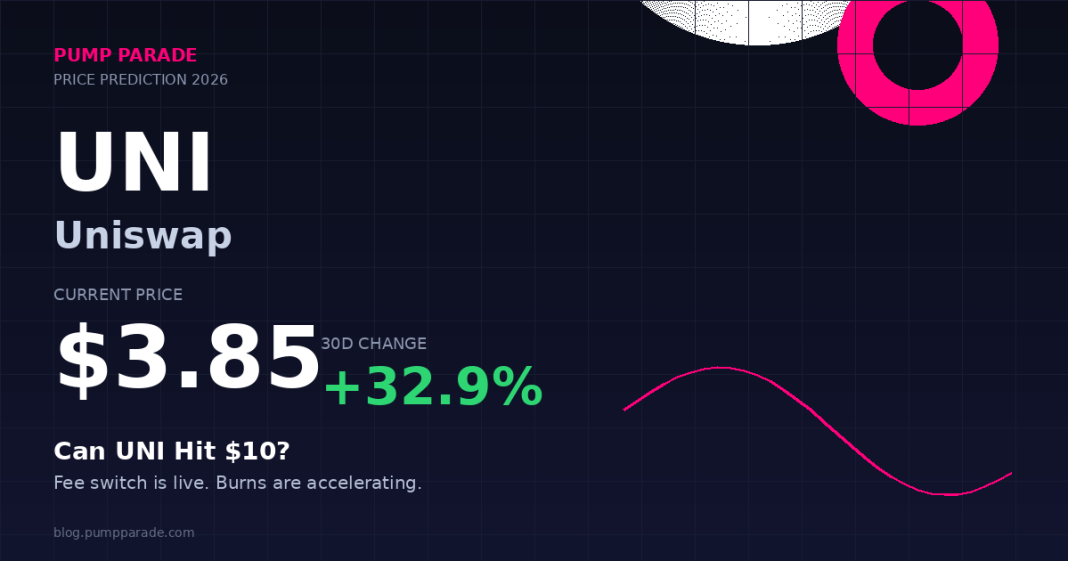
Uniswap (UNI) trades at $3.85 as of July 24, 2026, up roughly 33% over the last 30 days and 9% over the last week. That is not a random pump. It is the market repricing UNI as a real cash-flow asset for the first time since the token launched in 2020.
Here is what changed. The fee switch is on. UNI is being burned every day. Standard Chartered has a $6.50 year-end target on the table. And the Uniswap price prediction 2026 conversation just moved from “when does governance finally do something” to “how much revenue can the protocol actually generate before v4 hooks eat the rest of DEX volume.”
Below: current price context, why UNI is running, the bull and bear cases with specific catalysts, our 30-day, 6-month, and long-term targets, a head-to-head comparison with the closest competitor, and the FAQs Google keeps sending searches for.
Key Takeaways
- Current price: UNI is at $3.85, up 33% in 30 days, still 91% below its May 2021 all-time high of $44.92.
- Deflationary now: The fee switch activated December 28, 2025. A 100 million UNI burn worth roughly $596M was executed in January 2026.
- Base case for end of 2026: $5.50 to $7.50, consistent with third-party analyst forecasts and current burn-rate math.
- Bull case: $9 to $12 if v4 hook volume compounds and protocol revenue clears $1B annualized.
- Bear case: $2.20 to $2.80 if fee-switch governance stalls or L2 aggregators strip Uniswap’s directed order flow.
Where Uniswap Stands Today
Before the forecasts, the tape. UNI has clawed back a real bid this month, and the trigger is the July governance vote that expanded protocol fees to seven networks. Volume followed. Here is the snapshot from CoinGecko and Birdeye at time of writing.
| Metric | Value |
|---|---|
| Price | $3.85 |
| 24-hour change | -0.3% |
| 7-day change | +9.4% |
| 30-day change | +32.9% |
| Market capitalization | $2.41B |
| 24-hour trading volume | $152M |
| Market cap rank | #39 |
| Circulating supply | 625.2M UNI |
| All-time high | $44.92 (May 2021) |
| Distance from ATH | -91.4% |
Two things stand out. UNI is a top-40 asset by market cap, but it is trading at a fraction of ATH while protocol fundamentals are at record highs. And the 30-day move is happening on stronger, not weaker, volume, which usually rules out a low-liquidity squeeze. For deeper on-chain metrics on Uniswap, DefiLlama tracks its TVL and revenue in real time.
Why is Uniswap Rallying Right Now?
The short answer: UNI is being repriced as a cash-flow asset. For years, holders complained that Uniswap was the biggest DEX in crypto and its token accrued nothing. That thesis broke on December 28, 2025, when a 17% protocol fee went live on Ethereum pools. In March 2026, it expanded to Optimism, Arbitrum, Base, Zora, and XLayer. The July governance push aims to push it further, into Robinhood Chain v2 and v3 pools and additional v4 deployments.
The mechanics are simple. Protocol fees fund automated UNI buybacks. Those tokens are burned. UNI supply directly shrinks as swap volume grows. Bitget News reported that with the fee switch active and 100 million tokens already burned, UNI is now structurally deflationary for the first time in its history.
The Uniswap Foundation’s back-of-envelope math is not subtle. If Uniswap can hold a 0.05% average protocol fee on $1 trillion of annual volume, that is $500M per year flowing into the burn mechanism. At current prices, that clears roughly 24% of circulating supply annually. Even a 40% haircut on those assumptions still implies meaningful, structural buy pressure.
The Bull Case
Three catalysts anchor the bullish thesis.
Catalyst 1: Fee Switch Revenue Compounds
Uniswap generated roughly $600M in annualized fees before the switch flipped. With protocol fees now active on Ethereum plus five L2s, and July governance moving toward seven-chain coverage, the addressable revenue base grows every month. If just half of that annualized fee base flows to burns, that is $300M of programmatic buy pressure with no discretionary decision-making. That kind of flywheel is what turned MakerDAO’s MKR into a real cash-flow token in 2023 and 2024.
Catalyst 2: V4 Hooks Are Winning the Builder War
Uniswap v4 is live on 15 or more networks and has overtaken v3 as the default deployment target for new DEX experiments. Hooks let developers write custom logic (dynamic fees, on-chain limit orders, MEV protection, LP rebate schemes) directly into pool contracts. The killer stat: creating a v4 pool is a state update, not a contract deployment, which cut pool creation costs by roughly 99%. Angstrom, from Sorella Labs, is using hooks to batch trades and return MEV to LPs. Aggregator hooks from Uniswap Labs went live on Tempo in March 2026. Every hook-native app deployed on v4 is a distribution channel for Uniswap liquidity, and eventually for protocol fees.
Catalyst 3: Wall Street’s Coverage Is Getting Louder
Standard Chartered’s Geoff Kendrick set a UNI target of $6.50 by end of 2026 and $100 by end of 2030. That is not the frothiest call on the tape, but it is one of the most credible: Standard Chartered is the same bank that called Bitcoin’s 2024 ETF-driven rally. When a Tier-1 bank puts a stepped price target on a DeFi token, allocators start paying attention. For the broader DeFi tape, our Aave price prediction 2026 lays out how the money-market side of the same trend is developing.
The Bear Case
Three risks to hold in mind.
Risk 1: Aggregator Cannibalization
Most retail swaps route through 1inch, CowSwap, Matcha, or Jupiter (on Solana). If aggregators keep improving their price execution by pulling from a wider pool of venues, Uniswap becomes a liquidity backstop rather than a destination. Fees still accrue, but at compressed take rates. This is the same dynamic that pressured centralized exchange fee revenue after Binance forced spot-fee compression across the industry.
Risk 2: Governance Execution Risk
The July 2026 fee-switch expansion required a governance vote. So does every future chain rollout, parameter change, and bridge cleanup. UNI governance has historically been slow, hard to whip, and captured by a handful of large delegates. If the current momentum stalls out into another eighteen-month debate cycle, the burn narrative loses credibility fast.
Risk 3: L2 Volume Migration to Native DEXs
Base has Aerodrome. Arbitrum has Camelot. Solana has Jupiter and Raydium (see our Raydium review 2026 for the state of that stack). Every chain has a locally optimized DEX that captures a rising share of native flow. Uniswap’s cross-chain footprint is a moat, but not an insurmountable one. If Ethereum L2 activity keeps rotating toward native venues, Uniswap’s cross-chain volume compounding thesis weakens.
Uniswap Price Prediction 2026: Targets by Timeframe
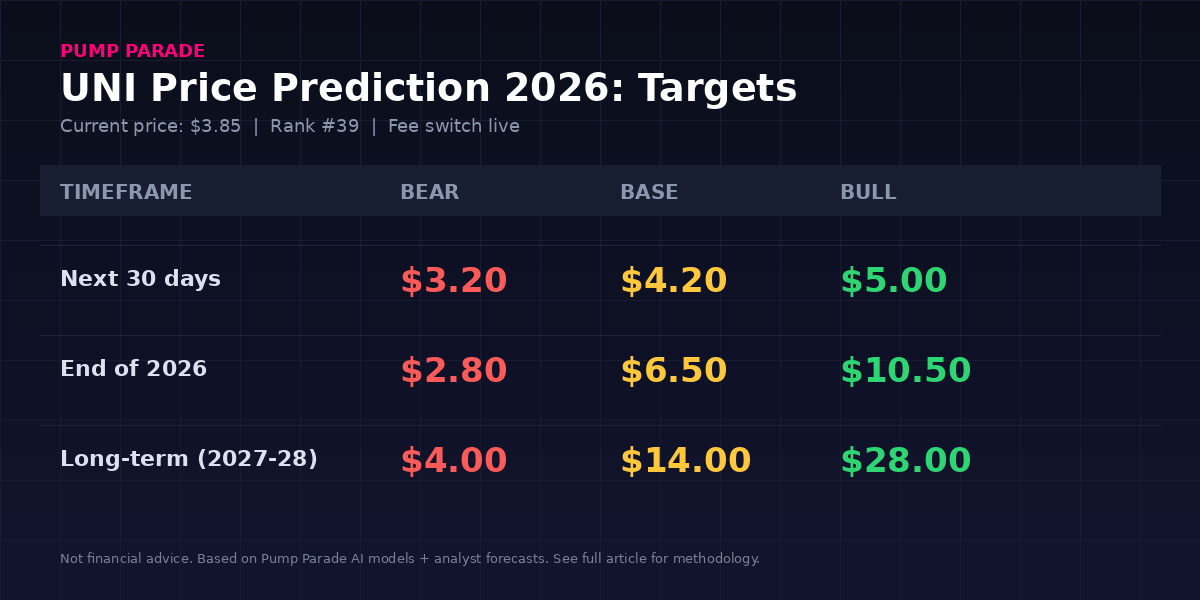
Here is how we are framing it. All targets assume current macro (BTC in the $60K to $75K band, no aggressive rate cuts, no US recession call). Every target has an invalidation level attached because that is what a real forecast looks like.
| Timeframe | Bear | Base | Bull |
|---|---|---|---|
| Next 30 days | $3.20 | $4.20 | $5.00 |
| End of 2026 (6 months) | $2.80 | $6.50 | $10.50 |
| Long-term (2027 to 2028) | $4.00 | $14.00 | $28.00 |
Short-term (Next 30 days)
Base case: $4.20. The July 26 governance vote is the near-term catalyst. If it passes cleanly and burn volume steps up, momentum traders will chase. We would fade rallies into the $5 zone until we see confirmation of higher weekly closes. On the downside, a rejection at $4.20 with a break of $3.40 would open the door to a retest of the $3.10 to $3.20 breakout base.
Medium-term (End of 2026)
Base case: $6.50, roughly matching Standard Chartered’s target. This assumes the fee switch expands to at least six additional venues, quarterly burn totals settle into the 20 to 30 million UNI range, and BTC stays above $60K. Bull case at $10.50 requires v4 hook volume to accelerate into Q4 2026, plus a broader altseason rotation into DeFi. Bear case at $2.80 is the “governance stalls, Ethereum L2 revenue disappoints, no rate cuts” scenario.
Long-term (2027 to 2028)
Base case: $14.00. If Uniswap holds 40 to 50% of on-chain DEX volume across major L1s and L2s, sustains protocol fees on the bulk of that volume, and burns 15 to 20% of supply cumulatively over two years, $14 is a reasonable multiple on projected discounted fee flows. Bull case at $28 is essentially Standard Chartered’s staged path toward its 2030 $100 target extrapolated back. Bear case at $4.00 is a world where DEX volume flattens and Ethereum L2 activity fragments across native venues.
How Uniswap Compares to SushiSwap
SushiSwap remains the most direct comparison because both are governance-forward AMM DEXs, but the divergence in fundamentals is now stark.
| Metric | Uniswap (UNI) | SushiSwap (SUSHI) |
|---|---|---|
| Market cap | $2.41B | $140M range |
| Rank | #39 | ~#380 |
| Chains deployed | 15+ (v4) | 30+ (but low volume on most) |
| Fee switch | Live, buyback and burn | Kanpai active, xSUSHI rewards |
| Custom liquidity logic | V4 hooks (thousands of pools) | Trident, RouteProcessor |
| Annual fee revenue | ~$600M+ | Under $30M |
| 30-day price change | +32.9% | Low single digits |
Translation: Uniswap is not competing with SushiSwap anymore. It is competing with the underlying chains themselves for volume and with aggregators for routing. That is a much harder fight, but it is also why the reprice-as-cash-flow-asset thesis has real legs.
What Would Change Our View
Three scenario triggers to watch. These are the specific things that would push us off the base case.
Trigger 1 (bullish shift): Quarterly UNI burns clear 35 million tokens with rising, not falling, average protocol fee take rates. That would signal the buy-and-burn flywheel is working faster than the “fee compression from aggregators” bear counter, and we would move to a $9 to $12 target zone.
Trigger 2 (bearish shift): The July 26 governance vote fails, or passes with heavy amendments that gut the protocol-fee expansion. Combined with UNI failing to hold $3.40 on a weekly close, we would move to a $2.20 to $2.80 range and reassess.
Trigger 3 (macro invalidation): BTC breaks $58K on a monthly close. In that scenario, everything we said above about UNI probably matters less than the broader risk-off rotation. Correlations go to one when the tide goes out.
Frequently Asked Questions
Will Uniswap reach $10 in 2026?
Possible but not our base case. Our bull scenario puts UNI at $10.50 by end of 2026, contingent on the fee switch expanding to at least seven chains, quarterly burns clearing 30M tokens, and a broader DeFi rotation. Base case is $6.50, matching Standard Chartered’s target. A move to $10 requires clean governance execution plus supportive macro conditions.
Is Uniswap (UNI) a good investment in 2026?
UNI now has a real fundamental story for the first time in its history: a live fee switch, structural burns, and dominant market position across major DEXs. That said, it is still a top-40 crypto with 91% drawdown from ATH, meaningful governance execution risk, and stiff competition from aggregators. It is a serious asset to research, not a guaranteed win.
What is the Uniswap price prediction for 2026?
Third-party forecasts cluster in a wide range: some analysts see $4.80 to $5.80, more bullish models point to $7 to $10, and Standard Chartered’s target is $6.50. Our base case is $6.50, bull case $10.50, bear case $2.80. Every forecast assumes no black-swan macro event and continued protocol governance execution.
Why is UNI going up right now?
Three overlapping drivers. First, the protocol fee switch activated in late December 2025 and expanded across L2s in March 2026, turning UNI into a deflationary asset. Second, the July 2026 governance vote proposes to expand fees to Robinhood Chain and additional v4 deployments. Third, v4 hooks are seeing accelerating builder adoption, which locks in future volume growth.
How much will Uniswap be worth in 2030?
Long-term forecasts vary widely. Standard Chartered’s staged target is $100 by end of 2030. More conservative third-party models estimate $20 to $40. If Uniswap sustains its DEX market share and the fee-burn flywheel scales with volume, a range of $35 to $75 by 2030 is defensible. Anything above that requires assumptions about tokenized real-world assets and institutional DeFi that are still speculative.
What is the UNIfication burn mechanism?
UNIfication is the branded rollout of Uniswap’s protocol-fee-funded buyback and burn. Protocol fees collected across supported chains are used to buy UNI on the open market and permanently destroy the tokens. January 2026’s initial burn removed 100 million UNI from supply, worth roughly $596M at the time. Ongoing burns are automated and public on-chain.
The Honest Take
Here is the thing. Every cycle has one or two DeFi tokens that transition from “governance meme” to “real cash-flow asset” and get repriced accordingly. In 2020 it was MKR briefly. In 2024 it was AAVE in the second half of the year. UNI has better fundamentals than either of them right now, but it also has more competition and a bigger existing market cap to work through.
The setup is genuinely interesting. Fee switch is live, burns are on, v4 hooks are winning the builder mindshare fight, and a Tier-1 bank is publishing stepped price targets. The risks are equally real. Aggregator compression, governance execution, and L2 volume migration are all live threats, not hypotheticals.
For traders, the levels to watch are $3.40 on the downside and $4.20 to $5.00 on the upside over the next month. For longer-horizon investors, the two questions that matter are (a) can Uniswap sustain protocol take rates above 0.03% blended across chains, and (b) does the July governance vote signal a repeatable execution cadence or a one-off. If the answers keep coming back yes, our base case drifts higher. If they do not, it drifts lower. That is the trade.
For a broader read on how DeFi tokens with revenue-linked tokenomics are being priced this cycle, see our Pendle price prediction 2026 and our Ethereum price prediction 2026, which frames the L1 side of the same trend. And you can track UNI’s live market data on CoinGecko’s Uniswap page.
Disclaimer: This article is for informational and educational purposes only and should not be construed as financial, investment, or trading advice. Cryptocurrency markets are highly volatile, and past performance does not guarantee future results. The price predictions and analyses presented here are based on AI models, technical indicators, and available data at the time of writing, they are not guarantees. Always conduct your own research (DYOR) and consult with a qualified financial advisor before making any investment decisions. Pump Parade and its authors do not assume liability for financial losses incurred based on information provided in this article.