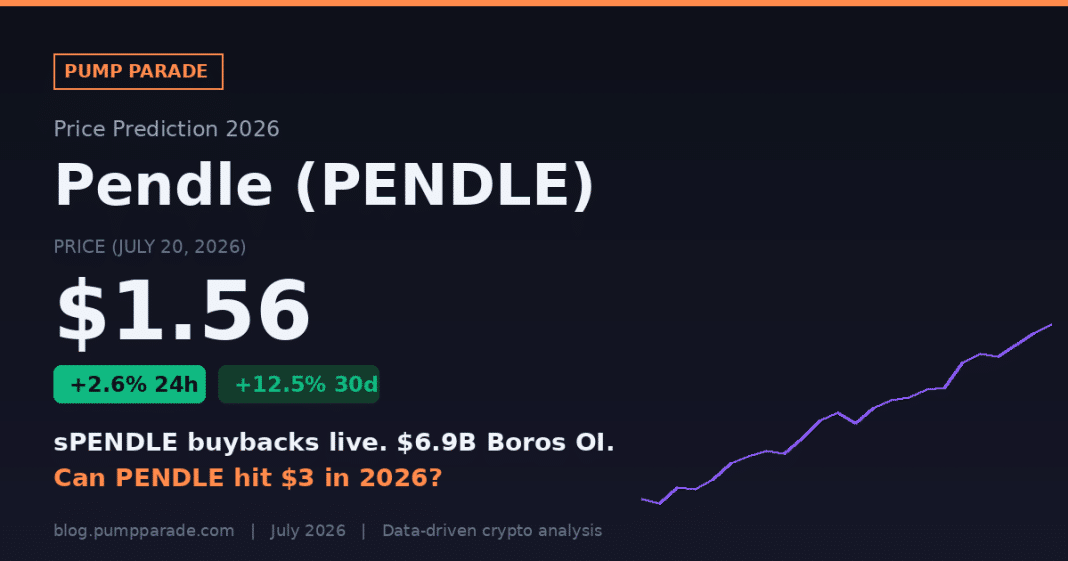
Pendle (PENDLE) trades at $1.56 as of July 20, 2026, up 12.5% over the past 30 days but still down 66% year-over-year. That is not a broken chart. It is a token that has quietly rewired its own tokenomics, plugged into $5 billion of DeFi total value locked (TVL), and just launched the first working funding-rate futures market in DeFi, while the price has barely reacted.
The Pendle price prediction 2026 conversation now sits on top of three concrete catalysts: the sPENDLE staking overhaul, up to 80% of protocol revenue routed to PENDLE buybacks, and the Boros yield-futures platform pulling billions in open interest. So can PENDLE hit $3 in 2026, or is another leg lower more likely first?
Below, we break down current on-chain data, the bull and bear cases, and specific price targets by timeframe.
Key Takeaways
- PENDLE trades near $1.56 with a $267M market cap, ranked 139 by market cap on CoinGecko.
- The January 2026 sPENDLE upgrade routes up to 80% of protocol revenue to PENDLE buybacks and cut emissions by roughly 30%.
- Pendle sits on about $5B in TVL across 11 chains, with Ethena’s USDe accounting for around 70% of that flow.
- Boros, Pendle’s on-chain yield-futures venue, has crossed $2.8B in cumulative volume and $6.9B in open interest.
- Base case for PENDLE by end-2026 lands near $2.10, with bull case $3.20 and bear case $1.05.
- Standard Chartered has not published a specific PENDLE target, but Coinpedia and other analysts model a range of $2 to $6 for 2026.
Where Does Pendle (PENDLE) Stand Today?
Pendle is the largest yield-tokenization protocol in DeFi. It splits any yield-bearing asset into two tradable pieces: a Principal Token (PT) that redeems 1:1 at maturity, and a Yield Token (YT) that captures all future yield until that date. In plain terms, Pendle turned floating DeFi interest rates into a proper fixed-income market, and now it is turning them into futures.
Here is the snapshot as of writing:
| Metric | Value |
|---|---|
| Price (July 20, 2026) | $1.56 |
| 24h change | +2.6% |
| 7d change | +3.9% |
| 30d change | +12.5% |
| 1y change | -66.6% |
| Market cap | $267M |
| Market cap rank | #139 |
| 24h volume | $26.6M |
| Circulating supply | 171.6M PENDLE |
| All-time high | $7.50 (April 2024) |
| Percent from ATH | -79% |
Two things stand out. First, the 30-day trend has flipped positive after a brutal 12 months. Second, the ratio between protocol usage ($5B TVL, $2.8B Boros volume) and market cap ($267M) is unusually stretched. That gap is either a value opportunity or a warning. The rest of this piece is about deciding which.
Why Is PENDLE Range-Bound Despite the Fundamentals?
Pendle’s protocol metrics are up and to the right. The token, until recently, was not. Three reasons why:
Tokenomics reset. The old vePENDLE model locked tokens for up to two years and paid holders a slice of revenue. That model kept aggressive sellers off the market. When Pendle moved to sPENDLE in January 2026, it slashed the lockup to a 14-day withdrawal, unlocked liquidity, and briefly increased sell pressure. Great for long-term flexibility, short-term messy.
Cycle rotation. DeFi tokens have lagged AI and memecoin narratives all year. Even Aave, up 21% in the last 30 days, is only starting to catch a bid. Pendle sits in the same bucket.
Yield compression on the base asset. When funding rates and staking yields compress, so does trader demand for Pendle’s PT/YT products. The Boros launch is a direct hedge against this, but the market has not fully priced it in.
None of these are structural problems. They are cyclical headwinds that fade when the fundamentals compound long enough. Which brings us to the bull case.
The Bull Case for PENDLE
1. sPENDLE buybacks turn revenue into price support
The sPENDLE upgrade, live since January 2026, directs up to 80% of protocol revenue into open-market PENDLE buybacks that flow to stakers. It also cut new PENDLE emissions by roughly 30% via algorithmic allocation. By April 2026, weekly emissions dropped further, and the token enters a terminal 2% inflation rate for ongoing incentives.
Translation: PENDLE is transitioning from an inflationary emissions token to something that behaves closer to a real-yield asset with structural buy pressure. When on-chain analysts can quantify sustained buyback volume above new issuance, the flywheel becomes visible in price data, not just spreadsheets.
2. Boros is a category-creating product
Boros, Pendle’s yield-futures platform launched in August 2025, has already logged more than $2.8B in cumulative volume and $6.9B in open interest. It lets traders take leveraged positions on funding rates and yield curves, something no other DeFi venue offers at scale.
The most important integration: Ethena uses Boros to hedge funding-rate exposure on its USDe reserves. This is not a memecoin partnership. It is a $6B+ synthetic dollar protocol paying Pendle to reduce P&L volatility. When TradFi arrives looking for on-chain interest-rate derivatives, Boros is currently the only credible venue.
3. Ethena and RWA flows keep expanding the TAM
Pendle’s TVL sits near $5B across 11 chains, with Ethena’s USDe generating roughly 70% of it. Every new stablecoin or tokenized T-bill product that lists on Pendle immediately gets a fixed-yield market and a yield-speculation market attached. As Ethena’s ENA and other yield-bearing dollar plays grow, Pendle’s addressable market grows with them almost mechanically.
The Bear Case for PENDLE
1. TVL has already compressed from its 2025 peak
Pendle’s total value locked reached a September 2025 peak above $13B before compressing back toward the $5B range. That is still respectable, but it means the “up and to the right” narrative is oversimplified. If DeFi yields keep compressing or Ethena’s USDe growth stalls, so does Pendle’s fee base.
2. Ethena concentration is a single point of failure
Roughly 70% of Pendle’s TVL sits in USDe-related pools. If Ethena hits a regulatory wall, a de-peg, or a sharp drop in funding-rate income, Pendle’s revenue takes a direct hit. Diversification into RWAs, LSTs, and cross-chain assets helps, but the concentration risk is real and worth watching.
3. Yield-tokenization competition is arriving
Pendle invented the category, but Spectra, Napier, and other fixed-yield protocols are shipping. So are alternative funding-rate venues. Pendle’s moat is real, but not infinite. If a competitor captures the next wave of chains or asset classes, PENDLE’s terminal value shrinks.
How High Can PENDLE Go in 2026?
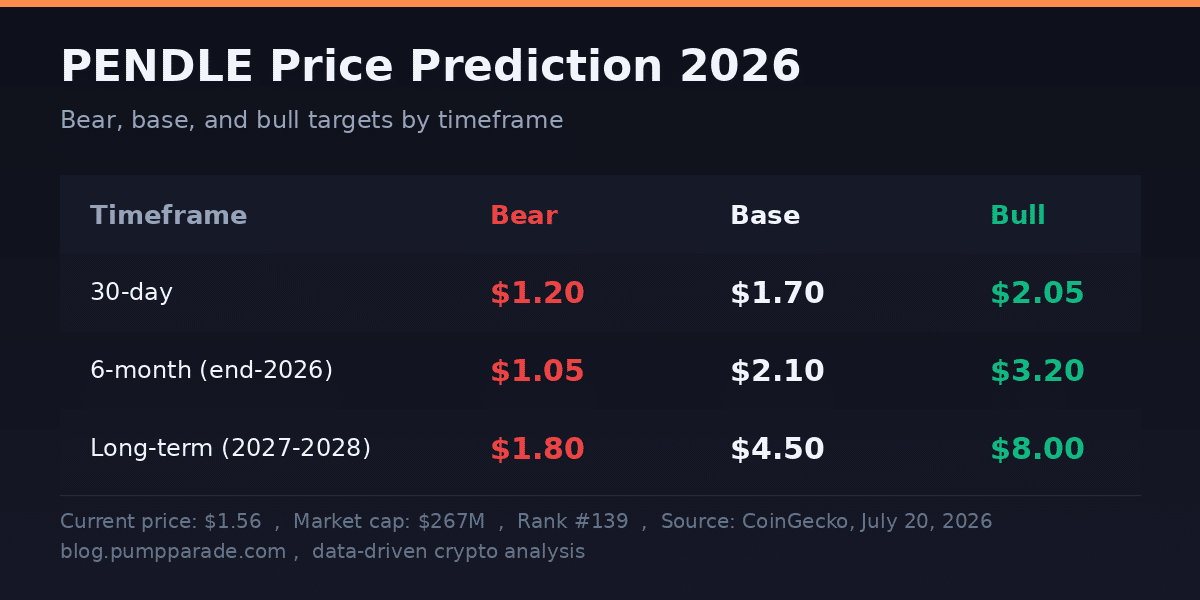
Below is our scenario-based price framework by timeframe. Every number is a scenario, not a promise.
| Timeframe | Bear | Base | Bull |
|---|---|---|---|
| 30 days | $1.20 | $1.70 | $2.05 |
| 6 months (end-2026) | $1.05 | $2.10 | $3.20 |
| Long term (2027-2028) | $1.80 | $4.50 | $8.00 |
30-day outlook
Short-term, PENDLE has broken back above its 50-day moving average and is holding the $1.45 support that acted as the base for the past month. Momentum indicators (RSI at 58, MACD flipping bullish on the daily) support a continuation to the $1.70 to $2.05 zone if broader DeFi bids stay firm. Break below $1.35 invalidates and opens $1.20 as the next test.
6-month outlook (end of 2026)
The end-of-year target range depends almost entirely on two things: whether buyback volume overtakes new issuance in Q3, and whether Boros open interest keeps compounding. Our base case, $2.10, assumes stable DeFi TVL, buybacks reaching ~$8M per month, and Boros open interest doubling from here. Bull case $3.20 assumes a broader DeFi rotation plus a listing wave for tokenized T-bill products on Pendle. Bear case $1.05 assumes DeFi TVL rolls over, Ethena stalls, and the buyback signal fails to show up in price.
Long-term (2027-2028)
If Pendle becomes the default on-chain interest-rate venue and Boros grows into a top-five DeFi derivatives platform, models from Changelly and Coinpedia stretch as high as $6 to $8. That requires Pendle to capture the wave of tokenized RWA yield migrating on-chain, plus continued Ethena growth. The bull case is a legitimate 5x from here. The bear case is a slow bleed to sub-$2 as competition catches up.
How Does Pendle Compare to Aave?
Both are top-tier DeFi tokens with real revenue and real buyback mechanics. Aave is bigger and covers lending. Pendle is smaller and owns the yield-derivatives niche. Here is the side-by-side:
| Metric | Pendle (PENDLE) | Aave (AAVE) |
|---|---|---|
| Price (July 20, 2026) | $1.56 | $90.56 |
| Market cap | $267M | $1.4B |
| Market cap rank | #139 | #55 |
| 30d price change | +12.5% | +21.2% |
| TVL (approx) | $5B | $25B+ |
| Core product | Yield tokenization + futures | Overcollateralized lending |
| Buyback mechanism | Up to 80% of revenue via sPENDLE | Aavenomics buyback + fee switch |
| Chains | 11 | 15+ |
Read it this way: if you already own AAVE for DeFi core exposure, PENDLE is the leveraged bet on the yield-derivatives sub-narrative. Higher beta, higher potential, higher concentration risk. Neither replaces the other. For a lending-focused DeFi peer, our Morpho analysis covers similar ground on the credit side.
What Would Change Our View?
Three specific triggers would move us off the base case:
Bullish trigger. Boros open interest crosses $12B and daily buyback volume for PENDLE exceeds daily emissions for four consecutive weeks. If both happen, the token is structurally deflationary and the base case shifts to $2.75 by year-end.
Bearish trigger. Ethena’s USDe supply drops below $4B, or a serious de-peg event forces Pendle to write down significant TVL. Either would drop the base case toward the $1.20 range and put the $0.95 all-time-low retest in play.
Neutral trigger. DeFi TVL flatlines and PENDLE tracks it. In that case, expect a $1.40 to $1.90 range for the rest of the year, with the fee switch and Boros story rebuilding the setup for early 2027.
Frequently Asked Questions
Will PENDLE reach $3 in 2026?
Reaching $3 requires PENDLE to roughly double from current levels in about five months. That is our bull case. It becomes probable if sPENDLE buybacks visibly outpace emissions, Boros open interest doubles, and DeFi TVL rotates back into leadership. Base case sits closer to $2.10 by year-end 2026.
Is Pendle a good investment in 2026?
Pendle owns a defensible niche (yield tokenization plus yield futures) with real revenue and structural buybacks. It is one of the cleaner DeFi setups by fundamentals. The main risks are Ethena concentration and cycle timing. Whether that fits your portfolio depends on your risk tolerance and DeFi exposure. Nothing here is investment advice.
What is the Pendle Boros platform?
Boros is Pendle’s on-chain yield-futures market. It lets traders take leveraged positions on funding rates and yield curves, starting with BTC and ETH funding on Arbitrum. It has recorded over $2.8B in volume and $6.9B in open interest since its August 2025 launch, and Ethena uses it to hedge USDe funding exposure.
How does sPENDLE staking work?
sPENDLE is a liquid staking token that replaced the old vePENDLE lockup model in January 2026. Stakers earn up to 80% of protocol revenue routed into open-market PENDLE buybacks. Withdrawals take 14 days, versus vePENDLE’s two-year lock, which improved liquidity but briefly increased short-term sell pressure.
How much PENDLE has been staked so far?
Over 100 million PENDLE has been locked into sPENDLE since launch, representing more than half of circulating supply. That reduces effective float and, combined with buybacks, creates the deflationary flywheel the bull case depends on.
Can PENDLE outperform ETH in 2026?
Historically, small and mid-cap DeFi tokens with strong revenue mechanics have outperformed ETH in bullish DeFi rotations by 2x to 5x. Whether Pendle joins that group depends on the buyback signal showing up in price and continued Ethena growth. In a flat or bearish DeFi market, PENDLE is likely to underperform ETH.
The Honest Take
Pendle’s protocol story is stronger than its price chart. That is not a coincidence. Every crypto cycle rewards fundamentals late, and Pendle is early in a category-defining setup: real yield, real buybacks, real derivatives volume. The tokenomics reset was necessary and messy. The Boros bet is the kind of concentrated product wager that either becomes DeFi’s Chicago Mercantile Exchange for interest rates or fades into a footnote.
The base case for end-2026 is $2.10. The bull case is $3.20. Both require the flywheel to become visible in on-chain data before speculators can rotate in. Neither is a certainty. If you are watching PENDLE, the levels to track are $1.35 on the downside and $2.10 on the upside. Everything in between is noise.
Disclaimer: This article is for informational and educational purposes only and should not be construed as financial, investment, or trading advice. Cryptocurrency markets are highly volatile, and past performance does not guarantee future results. The price predictions and analyses presented here are based on AI models, technical indicators, and available data at the time of writing, they are not guarantees. Always conduct your own research (DYOR) and consult with a qualified financial advisor before making any investment decisions. Pump Parade and its authors do not assume liability for financial losses incurred based on information provided in this article.