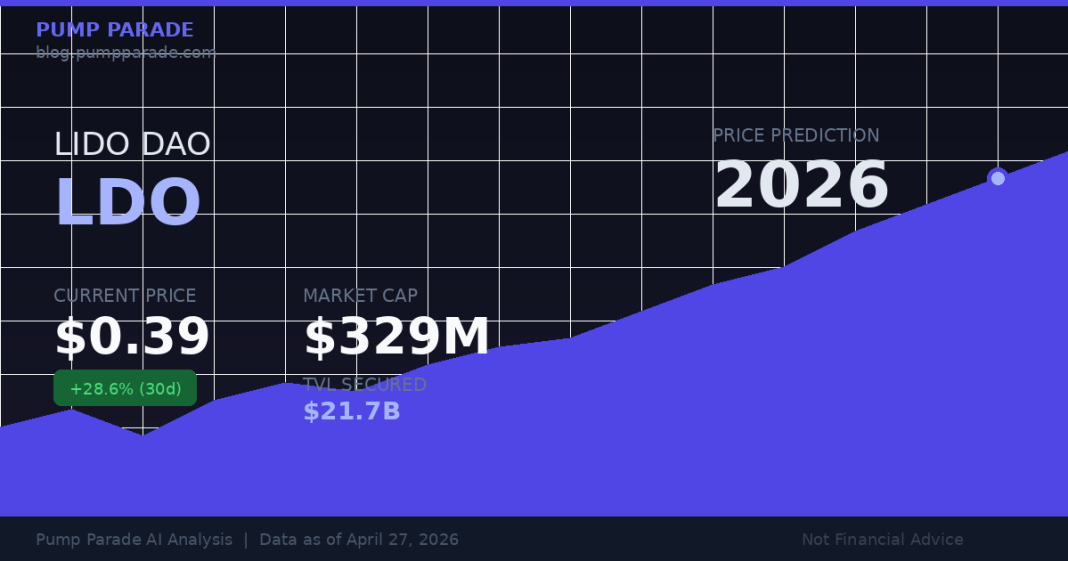
Lido DAO (LDO) hit an all-time low of $0.271 on March 8, 2026. Six weeks later, it is trading at $0.39, up 28.6% over the past 30 days. The intraday high on April 27 touched $0.467, driven by a confirmed technical breakout from a multi-month descending channel. Volume surged to $322 million in the past 24 hours.
That is not a random bounce. Lido V3, launched in January 2026, introduced a new modular staking architecture called stVaults. That product is now live, and early adoption is building. Behind the token sits $21.7 billion in total value locked, making it one of the largest DeFi protocols on Ethereum by assets. The market cap of the LDO token is only $329 million. That mcap-to-TVL ratio of 0.02 is one of the lowest in the sector.
This article breaks down what is driving LDO right now, where the bull and bear cases stand, and what our AI model says about price targets through 2028.
What Is Lido DAO?
Lido is the largest liquid staking protocol on Ethereum. It lets you stake ETH without running a validator yourself. In return, you receive stETH, a token that represents your staked position and earns daily staking rewards.
In plain terms: you deposit ETH, Lido stakes it with professional node operators, and you get a liquid token you can use in DeFi while still earning roughly 3-4% APR. This solved a key problem with Ethereum’s Proof of Stake model, where native staking locks up funds for extended periods.
Today, Lido controls approximately 23% of all staked ETH, making it by far the largest single staking provider on the network. As of April 27, 2026, roughly $21.7 billion in ETH sits in Lido’s contracts.
LDO is the governance token. Holders vote on protocol parameters, fee structures, and validator whitelisting. It does not directly capture protocol fees but acts as a claim on the protocol’s direction and future revenue streams.
What Changed: Lido V3 and stVaults
The most important development for Lido in 2026 is the V3 upgrade. It launched on Ethereum mainnet on January 30, 2026, and introduces a new primitive called stVaults.
stVaults are isolated staking environments. Each vault can customize how rewards are distributed, which validators it uses, and how it interacts with DeFi protocols, all within Lido’s existing liquidity and security framework. The fixed Lido protocol fee is 10%, but for early vault operators, Lido cut its infrastructure fee to 0% on March 31, 2026, to accelerate adoption.
Early integrations are already live. Linea has integrated native yield for bridged ETH. Nansen launched its first Ethereum staking product using stVaults. The goal set in Lido’s GOOSE-3 strategic proposal is to attract 1 million ETH staked through these vaults by the end of 2026.
This is a meaningful shift. Lido is moving from a single-product liquid staking protocol to a modular staking infrastructure layer. The addressable market expands from retail stakers to include institutional operators, L2s, and DeFi protocol builders. See also our analysis of Ethereum’s own price trajectory in 2026, since LDO’s fortunes are tightly correlated with ETH demand.
Technical Analysis: The Breakout Is Real
LDO has been inside a descending channel since mid-2025. On April 27, 2026, analysts confirmed a breakout and completed a breakout-and-retest sequence on the daily chart.
Key levels to know:
- Support: $0.36, aligning with the former channel resistance that is now being retested as support. A close below this invalidates the near-term bull case.
- Next resistance: $0.52, which is the 50-day moving average. LDO needs to reclaim this level to confirm the trend reversal.
- Major resistance: $0.80 to $0.90, a congestion zone from Q4 2025 where previous rallies failed.
The RSI (Relative Strength Index, a momentum indicator) was coming off oversold territory after the March lows. It is now in the mid-50s, meaning momentum is building without being overbought. That is historically a good entry window for continuation moves.
On-chain data from the April 27 breakout day showed 141 new wallet addresses entering the protocol, the strongest network growth in nearly two months. That is organic participation, not just leverage speculation.
Bull Case: Why LDO Could Trade Much Higher
The bull case for LDO in 2026 has three distinct pillars.
1. Extreme undervaluation relative to TVL. A market cap of $329 million sitting on top of $21.7 billion in TVL is a 0.02 mcap/TVL ratio. For context, most mature DeFi protocols trade at 0.05 to 0.15. If Lido re-rates even to 0.05, that implies a market cap of $1.08 billion, roughly 3x current levels. This is not a price target, it is a valuation framework that shows how much compression has occurred.
2. Lido V3 opens new revenue streams. stVaults allow Lido to serve institutional clients, L2s, and DeFi protocols that need customized staking. Lido’s $60 million expansion plan for 2026 targets exactly this market. As TVL grows through vaults and new wrappers like stETH-based ETPs, the case for LDO as the governance token of a growing fee-generating platform improves.
3. ETH staking demand is structurally growing. As ETH price recovers and the staking yield remains attractive at 3-4%, more ETH flows into staking. Lido captures roughly 23 cents of every dollar that goes into Ethereum staking. A sustained ETH bull market is a direct tailwind.
Bear Case: The Risks Are Real Too
The bear case for LDO deserves equal weight.
1. LDO does not directly capture fees. The governance token gives holders voting rights, not a direct claim on protocol revenue. This has been a persistent criticism. If Lido does not implement a fee-sharing mechanism, LDO remains a bet on narrative and speculation, not cash flows.
2. Competition is intensifying. Rocket Pool, Stader, and Frax Ether all compete for ETH staking market share. Ethereum’s planned future upgrades could also make solo staking easier, reducing the market Lido serves.
3. Regulatory risk for liquid staking. Regulators in the US and EU have scrutinized liquid staking products. A ruling that stETH constitutes a security would be a severe negative catalyst for the protocol and LDO alike.
4. The ATH is a long way up. LDO’s all-time high was $7.30 in August 2021. The token is currently down 94.7% from that peak. Even a recovery to $1 represents a significant move, and a full cycle recovery is a multi-year thesis.
LDO Price Predictions 2026
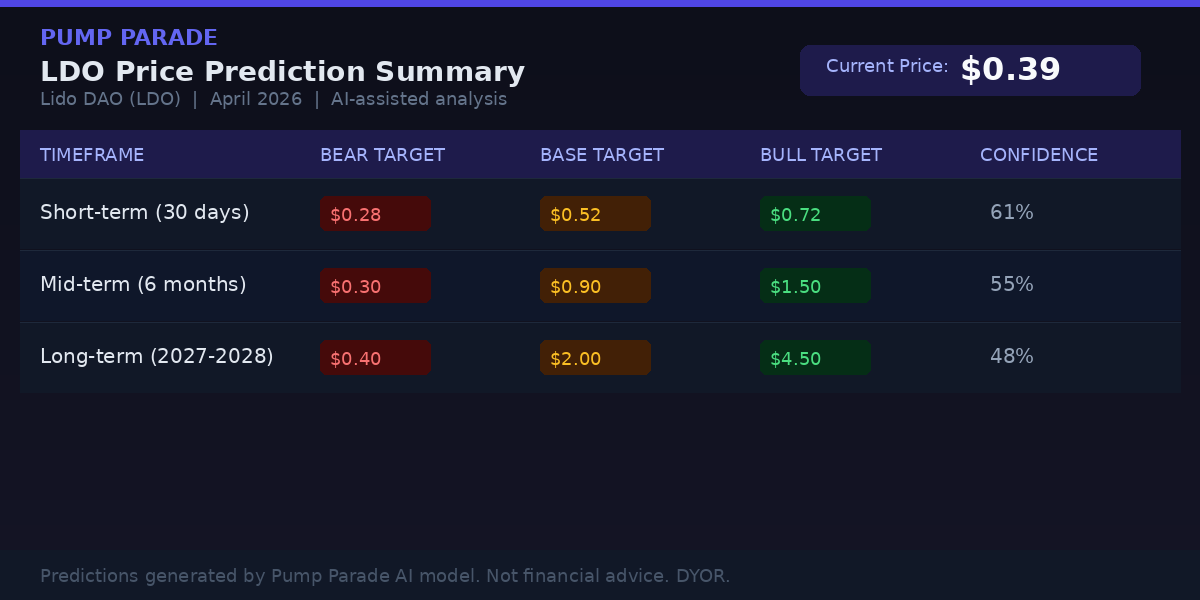
Our hybrid AI model analyzes technical indicators, on-chain data, and market sentiment to generate probabilistic price ranges. These are not guarantees. They are structured scenarios with assigned conditions.
Short-Term (30 Days): May 2026
Bear target: $0.28. A failed retest of the breakout level at $0.36, followed by a macro risk-off event or Ethereum weakness, could push LDO back toward the ATL range.
Base target: $0.52. The most probable scenario. LDO consolidates the breakout and grinds toward the 50-day moving average at $0.52. This requires ETH to hold its current range and no major negative news for Lido specifically.
Bull target: $0.72. If the breakout accelerates and volume sustains, LDO could test the Q4 2025 resistance zone quickly. This would require broad DeFi risk-on sentiment and a continued ETH rally.
Model confidence: 61%
Mid-Term (6 Months): Q4 2026
Bear target: $0.30. A prolonged DeFi bear market, regulatory action against liquid staking, or significant stVaults adoption failure could keep LDO suppressed.
Base target: $0.90. If stVault adoption hits 500,000 ETH by year-end and the broader crypto market holds its current levels, LDO could re-rate meaningfully. $0.90 would still be just 12% of the all-time high.
Bull target: $1.50. This requires a strong ETH bull market, successful institutional product launches via stVaults, and a governance vote to implement some form of fee sharing. Each of these is possible but not guaranteed.
Model confidence: 55%
Long-Term (2027-2028)
Bear target: $0.40. Continued competitive pressure and no fee accrual mechanism keep LDO as a low-utility governance token.
Base target: $2.00. Assumes Lido becomes the dominant staking infrastructure layer, fee-sharing is implemented, and the overall crypto market reaches new cycle highs.
Bull target: $4.50. A full bull cycle with ETH at new highs and Lido positioned as the institutional staking standard. Still well below the 2021 peak of $7.30.
Model confidence: 48%
What to Watch
Three things will define LDO’s trajectory in the months ahead.
First, watch the $0.36 support level. A daily close below this on meaningful volume would suggest the breakout was a false start and the bear trend is intact.
Second, watch stVault TVL growth. Lido publishes on-chain data for V3 deployments. Progress toward the 1 million ETH goal is a direct leading indicator for protocol growth and future fee potential.
Third, watch governance proposals around fee sharing. Any credible proposal to distribute protocol fees to LDO holders would be a significant re-rating catalyst. The community has discussed this for years. V3’s new revenue streams may finally make it feasible.
The Bottom Line
LDO is emerging from its worst drawdown in three years. The technical breakout is confirmed. The fundamental story with V3 stVaults is the most interesting it has been since the protocol launched. The mcap-to-TVL ratio suggests significant undervaluation relative to peers.
At the same time, LDO is down 94.7% from its all-time high, competition is real, and the governance token structure limits direct fee capture. This is not a simple story.
The data currently favors a continued recovery toward $0.50 to $0.90 over the next six months, with upside to $1.50 if catalysts align. The bear case requires a broader DeFi selloff or a specific negative event for Lido. Neither can be ruled out.
Watch the levels, track the stVault adoption numbers, and size accordingly.
Disclaimer: This article is for informational and educational purposes only and should not be construed as financial, investment, or trading advice. Cryptocurrency markets are highly volatile, and past performance does not guarantee future results. The price predictions and analyses presented here are based on AI models, technical indicators, and available data at the time of writing. They are not guarantees. Always conduct your own research (DYOR) and consult with a qualified financial advisor before making any investment decisions. Pump Parade and its authors do not assume liability for financial losses incurred based on information provided in this article.
About our AI predictions: Pump Parade’s price predictions are generated by machine learning models that analyze technical indicators, on-chain data, and market sentiment. These models have limitations and cannot account for black swan events, regulatory changes, or sudden market shifts. Prediction confidence scores reflect the model’s internal assessment, not guaranteed accuracy. Use AI predictions as one input among many in your research.