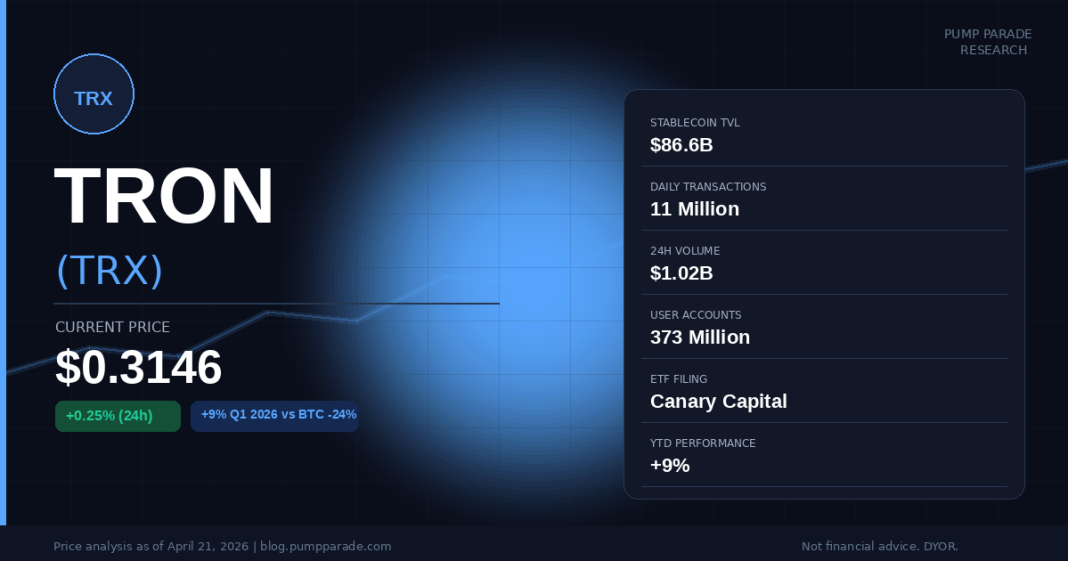
TRON (TRX) is trading at $0.3146 today, April 21, 2026. That might not sound exciting at first glance. But context changes everything.
While Bitcoin dropped 24% in Q1 2026, TRX gained 9%. The TRON network now settles $86.6 billion in stablecoins, second only to Ethereum. Daily transactions hit 11 million, with 373 million user accounts on the network. Then in April, Canary Capital filed for a staked TRX ETF with the SEC, and the agency officially acknowledged the filing.
The question for the rest of 2026 is straightforward: does TRX finally break out of its range, or does it keep grinding sideways while louder tokens steal the spotlight? Let’s look at the data.
What Is TRON?
TRON is a Layer 1 blockchain founded by Justin Sun in 2017. Its original pitch was a decentralized entertainment platform. In 2026, its identity is something completely different: TRON is the world’s dominant stablecoin settlement layer.
The network processes an average of 11 million daily transactions at near-zero fees. That makes it the go-to infrastructure for USDT transfers globally. TRON holds $85 billion of USDT, representing 46% of all USDT in circulation and 27% of the entire stablecoin market.
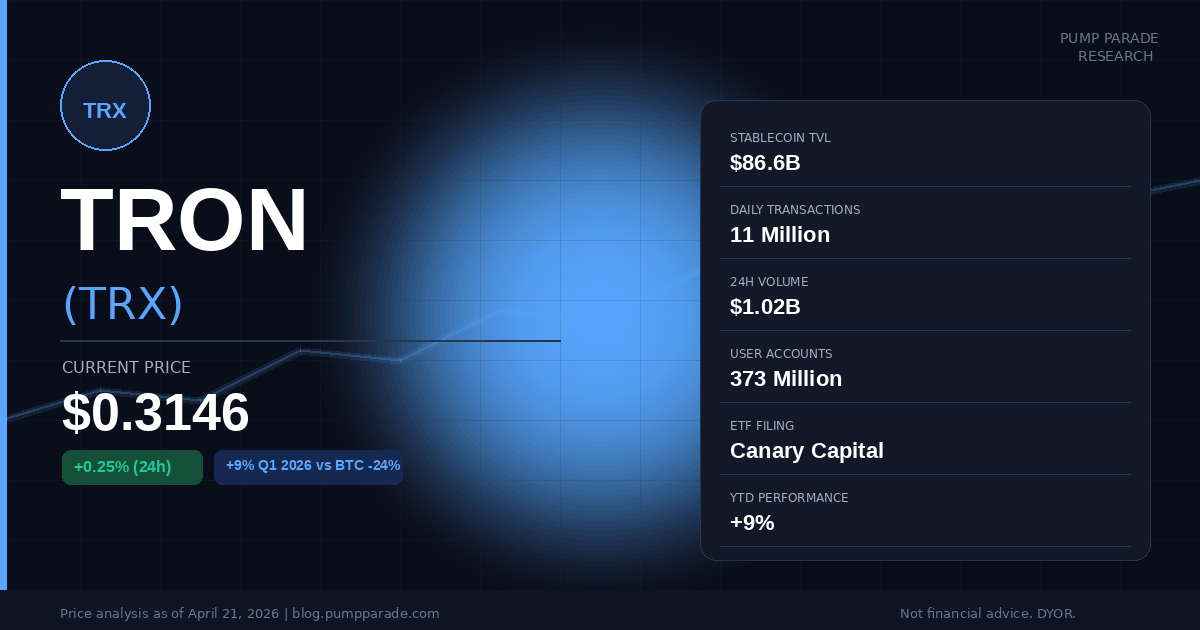
Key metrics at a glance:
- Current price: $0.3146 (April 21, 2026)
- 24-hour trading volume: $1.02 billion
- Daily transactions: 11 million
- Total user accounts: 373 million
- Stablecoin TVL: $86.6 billion
- Q1 2026 performance: +9% (vs. BTC at -24%)
Key Catalysts Driving TRX in 2026
1. Canary Capital Files a Staked TRX ETF
In April 2026, Canary Capital filed an S-1 registration with the SEC for the Canary Staked TRX ETF. The fund would hold and stake TRX, passing roughly 4.5% annual yield to investors. The SEC has officially acknowledged the filing.
This makes TRX one of only a handful of tokens with a spot ETF filing. For context, Bitcoin’s ETF approval in January 2024 preceded a significant multi-month rally driven by institutional inflows. The TRX ETF timeline remains uncertain, but the filing alone signals institutional legitimacy that the market is beginning to price in.
2. Zero Hash Unlocks Institutional Access
On March 31, 2026, TRON integrated with Zero Hash, a regulated compliance infrastructure provider. Regulated enterprises can now access TRX and TRC-20 USDT for custody, trading, liquidity, and settlement in select jurisdictions.
This removes a key barrier for institutional adoption. Previously, regulated firms had limited compliant pathways to access TRON-based assets. Now they have direct access through a licensed partner. That matters more than it sounds in the current regulatory environment.
3. SEC Settlement Brings Legal Clarity
In March 2026, the SEC reached a settlement with TRON and founder Justin Sun. The outcome brought clearer legal standing for TRX in the US market. This was a meaningful shift after years of regulatory uncertainty surrounding both the project and its founder.
Institutional capital typically follows legal clarity. The settlement, the Zero Hash integration, and the ETF filing form a coherent institutional adoption narrative. Each piece reinforces the others.
4. Stablecoin Volumes Hit Record Highs
Q1 2026 saw adjusted stablecoin volume across all chains exceed $4 trillion for the first time. TRON led all chains in year-to-date stablecoin inflows with $6.1 billion added through April, according to Finbold. The GENIUS Act, US stablecoin legislation passed in 2025, is accelerating institutional adoption of stablecoin infrastructure globally.
For more context on this surge, our deep dive covers the full picture: $28 Trillion in 90 Days: Inside Stablecoins’ Record Q1 and the Bot Economy Driving It. TRX sits at the center of that story as the top stablecoin chain by inflows.
5. GreatVoyage Upgrade Targets AI Applications
In February 2026, TRON completed the GreatVoyage-v4.8.1 (Democritus) protocol upgrade. The upgrade improved compatibility with AI applications, broadening TRON’s potential use cases beyond pure stablecoin settlement. Given current market appetite for AI infrastructure tokens, this opens a new narrative for TRX beyond its core utility.
Technical Analysis: Where Is TRX Headed?
TRX has been trading within an ascending channel since early March 2026. The move started from a low of $0.2780 and reached a high of $0.3250 before pulling back to current levels near $0.3146.
Current technical readings:
- Key support: $0.31 (channel lower boundary), $0.295 (secondary support)
- Key resistance: $0.3182 to $0.3229 (SAR and Supertrend convergence zone), $0.335 (channel upper boundary)
- RSI: 42.71, approaching oversold territory on the 30-minute chart. That signals limited downside in the near term.
- 50-day moving average: Below current price and rising. That is a bullish structural signal.
- VWAP: Slightly above current price ($0.3147 to $0.3159), meaning TRX is trading right at its fair value reference point.
The chart pattern is consolidation near support, not a breakdown. TRX is holding above the channel base. A bounce from current levels would target the $0.32 to $0.335 resistance cluster. A break above $0.335 opens the door to a test of $0.38.
The bear case on the technicals is a break below $0.31. That would invalidate the ascending channel structure and target $0.295 as the next meaningful support.
Bull Case and Bear Case
The Bull Case
The bull thesis for TRX rests on three pillars: institutional access, stablecoin dominance, and regulatory clarity.
If the Canary Capital ETF moves toward approval, institutional flows into TRX could be substantial. Zero Hash opens the door for regulated enterprises to allocate directly to TRX. Stablecoin usage on TRON is growing at its fastest pace in years, driven by the GENIUS Act and global demand for dollar-denominated settlement. A break above $0.335 could lead to a run toward $0.50 by year-end if ETF momentum builds and stablecoin demand holds.
The Bear Case
TRX has struggled to hold gains above the $0.30 to $0.32 range for extended periods. The ETF filing does not guarantee approval. Justin Sun remains a reputationally divisive figure in crypto, which could limit institutional appetite despite the settlement. If Bitcoin weakens further and broader risk appetite drops, TRX could see a retest of the $0.25 range. The ascending channel structure is also fragile: one bad week could break it.
TRX Price Predictions: 2026, 2027, and 2028
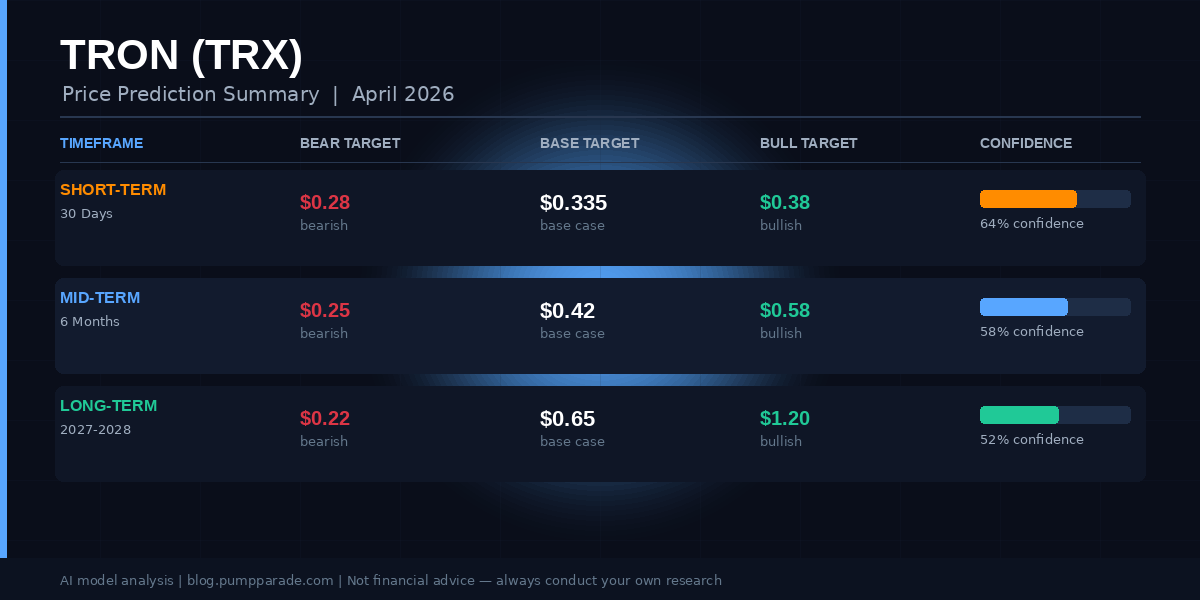
Our AI model analyzed TRON’s technical setup, stablecoin fundamentals, ETF catalyst potential, and broader macro conditions. Here are the price targets across three scenarios and three timeframes.
Short-Term (30 Days)
The immediate range is tight. TRX is consolidating near $0.31 support with RSI approaching oversold. A bounce leads toward $0.335 to $0.38. A breakdown puts $0.28 to $0.295 in play. The base case is a grind back toward the resistance cluster.
- Bear target: $0.28
- Base target: $0.335
- Bull target: $0.38
Mid-Term (6 Months)
Over the next six months, the ETF narrative will either gain traction or stall. If the SEC moves toward approval, institutional interest could push TRX into new multi-year high territory. If macro conditions deteriorate or the ETF is rejected, the base case narrows significantly.
- Bear target: $0.25
- Base target: $0.42
- Bull target: $0.58
Long-Term (2027 to 2028)
The long-term bull case for TRX is structural. If TRON maintains its stablecoin dominance and the ETF receives approval, the token’s role as global settlement infrastructure would need to be reflected in price. The bear case assumes a loss of stablecoin market share to Ethereum or a newer chain.
- Bear target: $0.22
- Base target: $0.65
- Bull target: $1.20
What to Watch
Three things will drive TRX price over the next 90 days:
ETF timeline: Any SEC commentary on the Canary Capital filing, positive or negative, will move price. Watch for a formal review period or comment window from the SEC.
Stablecoin supply growth: If TRON’s USDT supply continues to grow past $87B to $90B, that signals sustained institutional demand for the network. It also strengthens the fundamental case for TRX appreciation.
The $0.31 support level: This is the channel base. If TRX loses $0.31 on a daily close, the ascending channel breaks. That would be a meaningful change in near-term structure. If it holds, the range trade continues with $0.335 as the target.
TRX is not a meme. It is not a narrative play. It is infrastructure. And infrastructure tokens tend to move later in cycles, when real usage catches up with price. The question is whether the ETF catalyst and institutional access tools are enough to pull TRX forward ahead of that broader cycle.
Risk Disclaimer
Disclaimer: This article is for informational and educational purposes only and should not be construed as financial, investment, or trading advice. Cryptocurrency markets are highly volatile, and past performance does not guarantee future results. The price predictions and analyses presented here are based on AI models, technical indicators, and available data at the time of writing. They are not guarantees. Always conduct your own research (DYOR) and consult with a qualified financial advisor before making any investment decisions. Pump Parade and its authors do not assume liability for financial losses incurred based on information provided in this article.
About our AI predictions: Pump Parade’s price predictions are generated by machine learning models that analyze technical indicators, on-chain data, and market sentiment. These models have limitations and cannot account for black swan events, regulatory changes, or sudden market shifts. Prediction confidence scores reflect the model’s internal assessment, not guaranteed accuracy. Use AI predictions as one input among many in your research.