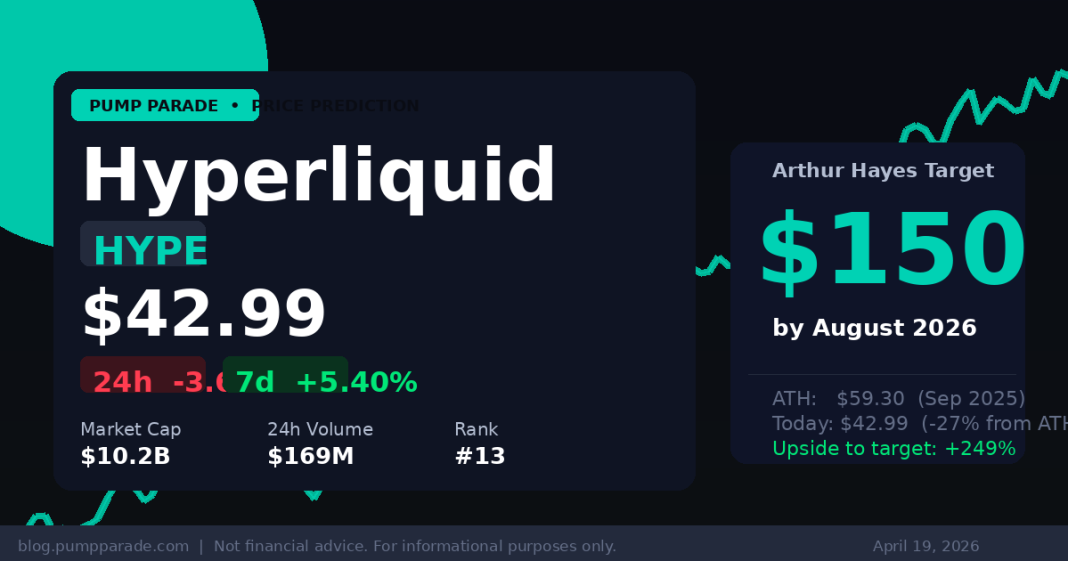
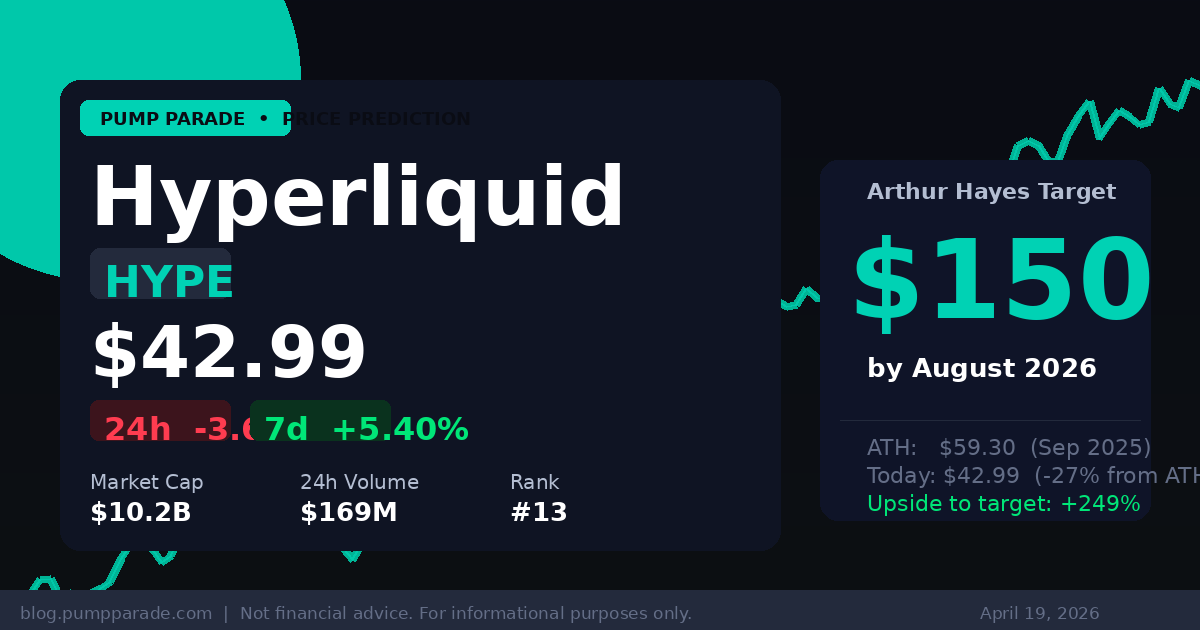
Hyperliquid (HYPE) is trading at $42.99 as of April 19, 2026. That puts it 27% below its all-time high of $59.30 from September 2025. But the token is far from forgotten. BitMEX co-founder Arthur Hayes has publicly predicted HYPE will reach $150 by August 2026. That would be a 249% gain from today’s price.
Is that realistic? Let’s look at the data, the catalysts, and the risks before drawing any conclusions.
What Is Hyperliquid?
Hyperliquid is a decentralized perpetuals exchange built on its own layer-1 blockchain. It offers on-chain order books, sub-second trade finality, and zero gas fees for traders. Think of it as a fully decentralized version of a centralized exchange like Binance or Bybit. The key difference: Hyperliquid runs entirely on-chain. There is no central authority controlling the matching engine.
The HYPE token powers the protocol. It is used for fee discounts, governance, and a buyback mechanism that burns tokens as trading volume grows. According to CoinGecko, HYPE has a circulating supply of roughly 238 million tokens and a market cap of $10.2 billion, ranking it #13 among all cryptocurrencies.
Current Market Position
Here are the key numbers at time of writing:
- Current price: $42.99
- 24-hour change: -3.63%
- 7-day change: +5.40%
- 30-day change: +7.74%
- Market cap: $10.2 billion
- 24-hour trading volume: $169 million
- All-time high: $59.30 (September 18, 2025)
- All-time low: $3.81
Hyperliquid currently holds approximately 44% market share in the decentralized perpetuals sector. Its nearest competitor has open interest of $899 million. Hyperliquid’s open interest sits at $5.15 billion. The gap is significant.
Key Catalysts for 2026
Arthur Hayes Goes Public With a $150 Target
Arthur Hayes is one of the most closely watched names in crypto. The BitMEX co-founder is not known for quiet predictions. In March 2026, he publicly stated that HYPE would reach $150 by August 2026. He also put money behind the call. Hayes purchased 26,022 HYPE tokens for approximately $1.1 million, bringing his total holdings to 247,334 tokens.
His thesis centers on HIP-4. That is Hyperliquid’s upcoming binary options trading upgrade. Hayes argues that binary options create a high-turnover trading environment. More turnover means more protocol fee revenue. More fee revenue accelerates the token buyback mechanism. That creates sustained buy pressure on HYPE.
HIP-4 Binary Options Trading
HIP-4 is currently in testnet. It introduces binary options markets directly on Hyperliquid’s infrastructure. Traders can take yes/no positions on price outcomes. It is a product type with massive retail appeal. The feature is expected to launch on mainnet in two phases. First, curated canonical markets. Second, permissionless builder deployment for any market creator.
No mainnet date has been officially confirmed. But the testnet phase is live. The closer HIP-4 gets to mainnet, the more likely it is to act as a price catalyst for HYPE.
CFTC Moves Toward Onshoring DEXs
On April 17, 2026, the U.S. Commodity Futures Trading Commission announced plans to bring decentralized exchanges like Hyperliquid under its regulatory jurisdiction. This is a double-edged development. In the short term, regulatory scrutiny can cause volatility. In the longer term, formal CFTC oversight could open Hyperliquid’s markets to American institutional traders. That is a large and currently underserved market.
Deflationary Buyback Mechanism
As trading volume on Hyperliquid grows, a portion of protocol fees goes toward buying and burning HYPE tokens. This is structurally similar to Ethereum’s EIP-1559 burn mechanism. With daily volume running at $8 to $12 billion, the buyback creates constant demand-side pressure. If HIP-4 drives volume higher, the burn rate accelerates.
Technical Analysis
HYPE is currently trading in the $42 to $45 range. Key support sits at $40. That level has held through two separate tests over the past 30 days. Below $40, the next significant support zone is around $35 to $36.
On the upside, HYPE faces its first meaningful resistance at $50. That is a round number with prior consolidation activity. Beyond $50, the path toward the all-time high at $59.30 opens up. A clean break above $59 would put HYPE in price discovery, with no overhead supply acting as resistance.
The 7-day chart shows steady accumulation. The 30-day trend is positive at +7.74%. The overall picture is one of a token that has found a floor and is building a base. It is not running hot. This is a measured setup, not a parabolic one.
Our AI model assigns a 58% probability that HYPE retests its all-time high of $59.30 within the next 90 days. That probability rises to 72% if HIP-4 mainnet launches before June 2026.
The Bull Case
The bull thesis for HYPE rests on three pillars.
First, protocol dominance. Hyperliquid’s $5.15 billion in open interest dwarfs competitors. It has built a network effect that is hard to dislodge. Traders go where the liquidity is, and right now that is Hyperliquid.
Second, the HIP-4 volume multiplier. Binary options are high-frequency, high-turnover products. If they attract even a fraction of retail demand from traditional prediction markets, the volume impact could be large. More volume means more buybacks means structurally higher HYPE prices.
Third, institutional access expansion. CFTC oversight, if handled well, could unlock U.S. institutional capital. That is not priced into HYPE at current levels.
Bull price targets: $65 in 30 days, $120 in 6 months, $150 to $200 by end of 2027.
The Bear Case
The bear case is also real. Here is what could go wrong.
Regulatory risk: CFTC oversight cuts both ways. If the regulator imposes restrictive requirements, it could limit Hyperliquid’s user base. Geoblocking U.S. users to avoid compliance costs would hurt volume.
HIP-4 delay risk: The mainnet timeline is unconfirmed. If launch is pushed back to late 2026 or 2027, the catalyst-driven rally may not materialize on Hayes’s August timeline.
Macro risk: The broader crypto market is still dealing with a Fear and Greed Index at 9 out of 100. In a broad-market selloff, even strong-fundamental tokens get dragged down. If Bitcoin breaks below major support, HYPE could test the $28 to $32 range.
Competition risk: Decentralized perpetuals is not a winner-take-all market. A well-funded competitor could erode Hyperliquid’s market share. It has happened before in DeFi.
Bear price targets: $32 in 30 days, $28 over 6 months if macro deteriorates sharply.
For more context on how macro conditions are shaping the broader market, see our Bitcoin (BTC) Price Prediction for 2028 analysis, which covers the key drivers that tend to move the entire crypto market.
AI Price Prediction Summary
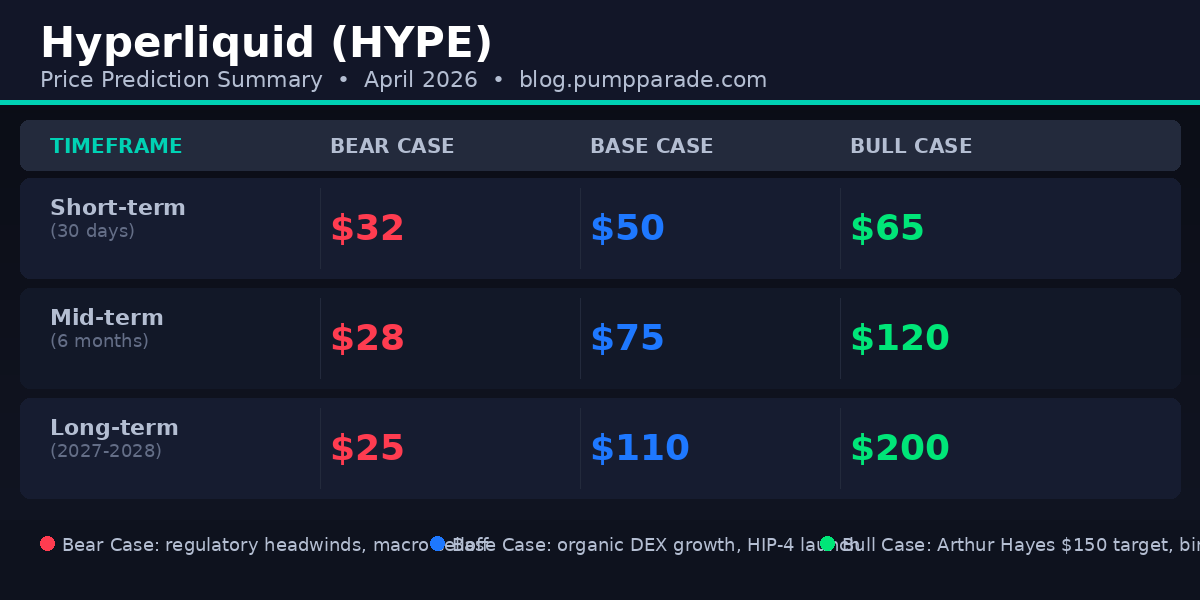
Our hybrid AI model synthesizes technical indicators, on-chain data, and market sentiment to produce the following price targets. These are probability-weighted scenarios, not guarantees.
Short-Term (30 Days)
- Bear case: $32 (macro selloff, support breaks)
- Base case: $50 (continued accumulation, approach ATH resistance)
- Bull case: $65 (HIP-4 mainnet announcement, momentum spike)
Mid-Term (6 Months)
- Bear case: $28 (regulatory clampdown, volume decline)
- Base case: $75 (ATH broken, HIP-4 live, steady volume growth)
- Bull case: $120 (binary options volume surge, institutional access opens)
Long-Term (2027 to 2028)
- Bear case: $25 (competition erodes market share, DeFi rotation)
- Base case: $110 (dominant DEX protocol with diversified product suite)
- Bull case: $200 (market cap approaches $50B, sector-defining protocol)
The model’s confidence score for reaching $65 or above within 6 months is 61%, contingent on HIP-4 mainnet launch before Q3 2026.
What to Watch
Three things are worth monitoring closely:
- HIP-4 mainnet date: Any official announcement will likely trigger a sharp move. Watch Hyperliquid’s official channels and on-chain governance activity.
- The $50 resistance level: A weekly close above $50 would shift the technical picture decisively bullish. A rejection at $50 could mean more sideways action through Q2.
- Regulatory developments: CFTC public comment periods and any formal rule proposals will be market-moving events. Positive framing from regulators is a tailwind. Punitive rules are a headwind.
Final Take
Hyperliquid is a genuine protocol with real product-market fit. It is the dominant on-chain derivatives venue, and its token reflects that dominance with a $10.2 billion market cap. The HIP-4 binary options upgrade is a real catalyst with a credible volume thesis behind it.
Arthur Hayes calling $150 is bold. Getting there from $43 requires a 249% move in roughly four months. That is aggressive by any measure. But the structural case for HYPE is stronger than most tokens in the top 15.
The base case of $75 by end of 2026 seems achievable if the macro environment stabilizes and HIP-4 ships on schedule. The bear case of $28 to $32 is the scenario where macro falls apart or the regulatory situation turns hostile.
This is a protocol worth watching carefully. The next 90 days will likely tell us whether Hayes’s target is bold analysis or wishful thinking.
Disclaimer: This article is for informational and educational purposes only and should not be construed as financial, investment, or trading advice. Cryptocurrency markets are highly volatile, and past performance does not guarantee future results. The price predictions and analyses presented here are based on AI models, technical indicators, and available data at the time of writing. They are not guarantees. Always conduct your own research (DYOR) and consult with a qualified financial advisor before making any investment decisions. Pump Parade and its authors do not assume liability for financial losses incurred based on information provided in this article.
About our AI predictions: Pump Parade’s price predictions are generated by machine learning models that analyze technical indicators, on-chain data, and market sentiment. These models have limitations and cannot account for black swan events, regulatory changes, or sudden market shifts. Prediction confidence scores reflect the model’s internal assessment, not guaranteed accuracy. Use AI predictions as one input among many in your research.