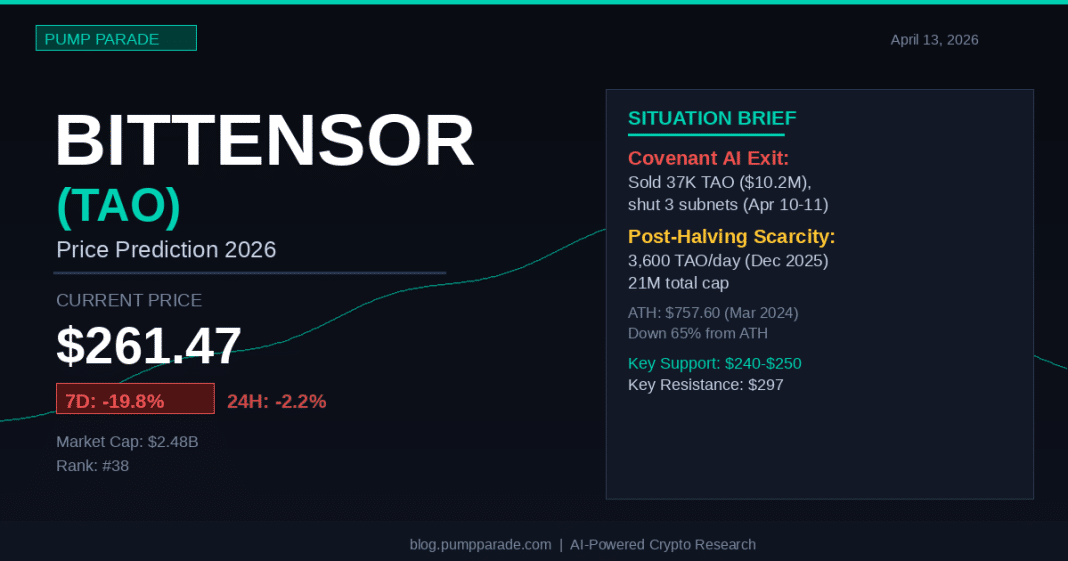
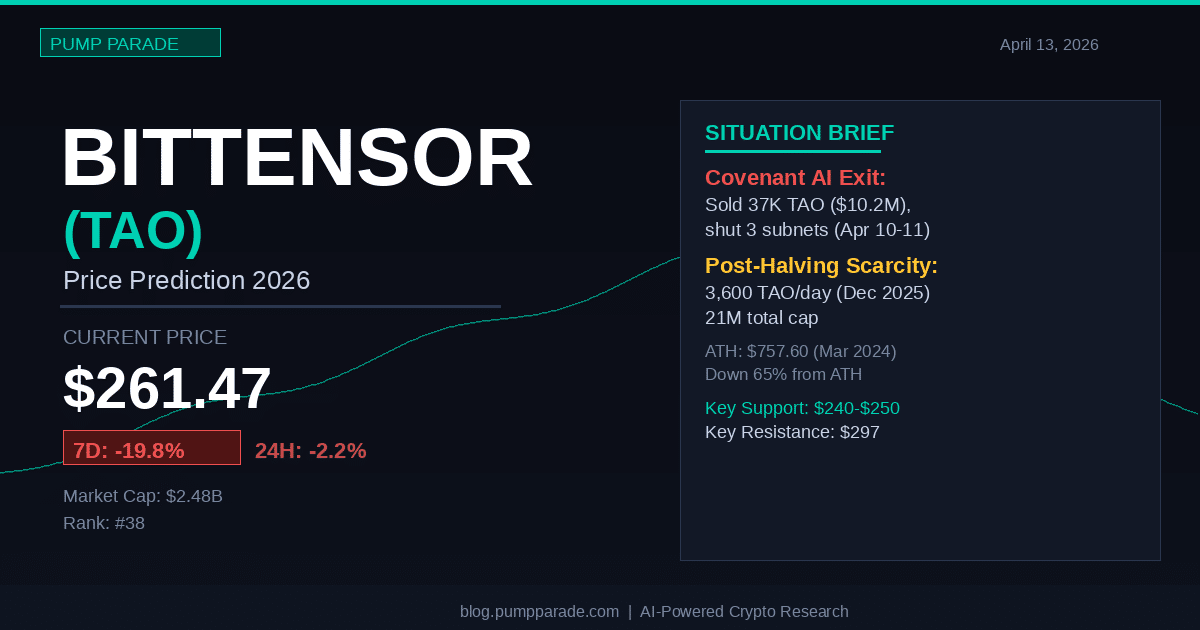
Bittensor (TAO) just had a rough week. After surging 62% in early April 2026 to nearly $332, the AI-powered blockchain network shed 23% in two days after one of its largest subnet operators walked out the door. As of April 13, 2026, TAO is trading around $261, down 66% from its all-time high of $757.60.
The question the market is asking: is this a temporary shakeout, or the start of a longer decline? We ran our AI model, pulled the on-chain data, and looked at both sides of the trade. Here is what we found.
What Is Bittensor?
Bittensor is a decentralized AI network built on its own blockchain. Instead of running AI models in centralized data centers, Bittensor lets anyone contribute computing power or AI models to its network of subnets. Contributors earn TAO tokens for their work.
Think of it like a decentralized version of AWS for AI. Each subnet specializes in a different task: text generation, image recognition, prediction markets, and more. At its peak, Bittensor was running over 60 active subnets with hundreds of validators and miners worldwide.
The tokenomics are designed to mirror Bitcoin’s scarcity model. TAO has a hard cap of 21 million tokens. The first halving occurred on December 14, 2025, cutting daily emissions from 7,200 TAO to 3,600 TAO. With fewer tokens entering circulation each day, the supply side is structurally tightening.
At time of writing, approximately 9.6 million TAO are in circulation, giving it a market cap of roughly $2.5 billion and a rank of #38 by market cap on CoinGecko.
The Covenant AI Exit: What Actually Happened
On April 10-11, 2026, Covenant AI, one of Bittensor’s most prominent subnet operators, announced it was leaving the network. The founder, Sam Dare, published a public statement accusing Bittensor co-founder Jacob Steeves of exercising outsized control over what was supposed to be a permissionless, decentralized protocol.
The specific allegations included:
- Suspending token emissions to Covenant AI’s subnets
- Overriding community moderation decisions
- Unilaterally deprecating infrastructure
- Using large personal token sales to apply economic pressure
Covenant AI did not just walk away. They sold approximately 37,000 TAO (roughly $10.2 million at the time) and shut down three active subnets. The market reacted immediately. TAO dropped from around $332 to a low near $254, a 23% decline in under 48 hours.
Bittensor’s co-founder Jacob Steeves denied the centralization claims. But the damage to market confidence was done. When a project’s largest contributor publicly accuses leadership of undermining the protocol’s core promise, the market does not quickly forget.
Technical Analysis: Where Does TAO Stand?
TAO’s chart tells a story of a token that was building momentum before running into a governance wall.
Key levels to know:
- Current price: ~$261
- 30-day moving average: ~$297 (TAO is trading below this, a bearish signal)
- RSI (Relative Strength Index): 45.52, below 50, indicating bearish momentum but not yet oversold (oversold is typically below 30)
- Support: $240-$250 zone is the immediate floor. Below that, $200 is the next major level.
- Resistance: $273 (first test), $297 (30-day MA), $332 (pre-crash high)
The RSI reading is worth watching closely. At 45.52, TAO has room to fall further before reaching oversold territory. A hold above $250 would be encouraging. A break below $240 could trigger a move toward $200.
The 7-day volume has been elevated, which makes sense given the Covenant AI news. High volume on down moves typically indicates selling pressure, not accumulation. That said, volume has started to stabilize over the past 24 hours, which suggests the panic selling may be subsiding.
The Bull Case: Why TAO Could Still Recover
The governance drama is real, but so are Bittensor’s fundamentals. Here is the case for TAO recovering from this pullback.
1. The halving creates genuine scarcity. With daily emissions now capped at 3,600 TAO, the supply side is tightening every day. If demand holds steady or grows, basic supply economics favor price recovery. Bitcoin’s halvings consistently preceded major rallies, and Bittensor’s design follows the same playbook.
2. The AI narrative is not going away. Decentralized AI infrastructure is one of crypto’s strongest fundamental use cases. Bittensor remains the leading project in this category by market cap and mind share. One subnet operator leaving does not invalidate the thesis, even if it raises governance questions.
3. The network is still running. Despite the exit, Bittensor’s remaining subnets continue to operate. The network processed transactions normally throughout the selloff. Infrastructure resilience matters more than any single operator’s departure.
4. TAO was up 62% in April before the crash. That move suggests real buying interest and a broader AI token tailwind. A correction after a 62% run is not unusual. The question is whether buyers return at the $250-$260 support zone.
Our AI model currently assigns a 54% probability of TAO recovering above $300 within the next 60 days, conditional on holding the $240 support zone.
The Bear Case: What Could Go Wrong
The bull case requires governance trust to hold. Here is where that assumption could break down.
1. Trust is hard to rebuild quickly. Covenant AI’s exit was a public indictment of the protocol’s governance. If other subnet operators share similar concerns but have not spoken up yet, more exits could follow. That is the tail risk the market is pricing in right now.
2. RSI has room to fall further. At 45.52, TAO is not oversold. The absence of a technical floor means there is no automatic bounce signal to lean on. Momentum indicators are pointed down.
3. Macro conditions are not supportive. The broader crypto market has been dealing with elevated oil prices, persistent inflation, and a Federal Reserve that is not cutting rates. Bitcoin dropped 2.71% around the same period. Risk assets across the board are under pressure.
4. The $240-$250 support zone has not been tested yet. If selling pressure increases and TAO breaks below $240, a move to $200 becomes the near-term base case. That would represent a 30% further decline from current levels.
The bear case becomes more likely if TAO closes two consecutive daily candles below $250, or if additional large subnet operators announce exits.
Bittensor (TAO) Price Predictions
These predictions are generated by our hybrid AI model using technical indicators, on-chain data, and market sentiment analysis. They are not guarantees.
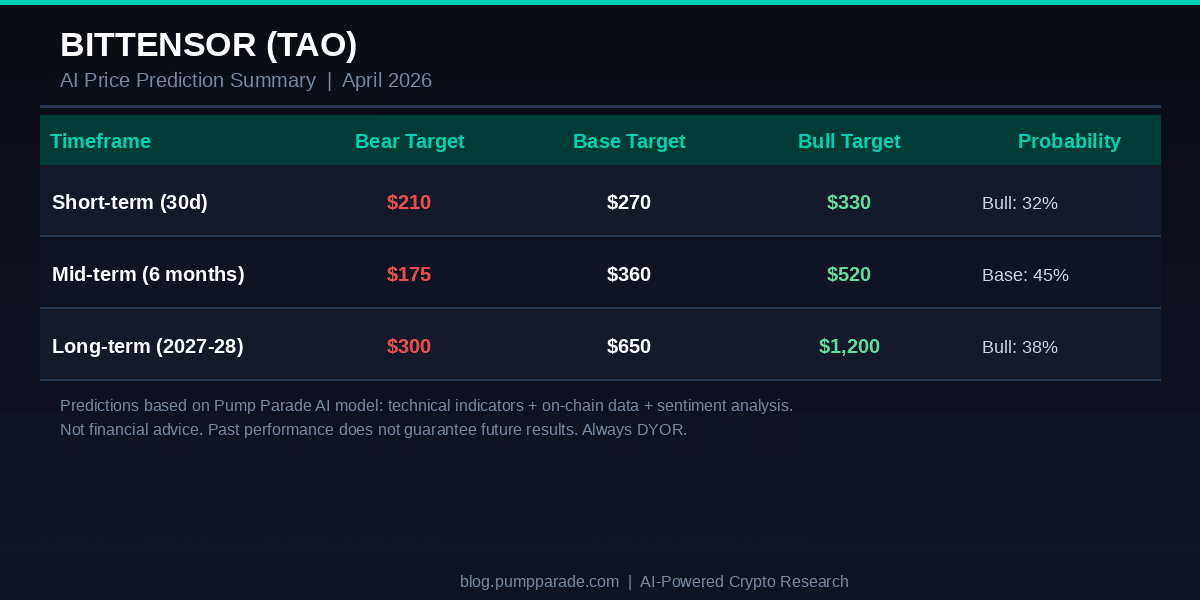
Short-term (30 days): TAO needs to reclaim the $273 resistance to confirm any meaningful recovery. The base case is consolidation between $240 and $280. Our model sets a bull target of $330 (recovery of pre-crash levels) and a bear target of $210 (break below $240 support).
Mid-term (6 months): If Bittensor resolves its governance questions and the AI narrative continues to attract capital, a move toward $400-$520 is plausible by end of 2026. The base case sits around $340-$380. The bear case, if governance continues to deteriorate, is a grind toward $150-$180.
Long-term (2027-2028): This is where the halving thesis becomes most relevant. With emissions continuing to decline and a total supply cap of 21 million TAO, scarcity-driven price appreciation is the core bull argument. Our long-term base case is $600-$700 by 2028. The bull case, assuming continued AI infrastructure demand and resolved governance, is $1,000-$1,200. The bear case, if the network loses critical mass of subnet operators, is $250-$350.
For a comparable AI agent token in the Solana ecosystem, see our recent analysis of AI Rig Complex (ARC), which covers similar dynamics around AI network tokens and governance risk.
What to Watch
Here are the specific signals that will determine which scenario plays out for TAO over the next 30-90 days:
- $240-$250 support zone: This is the key level. A hold here would suggest buyers are absorbing the Covenant AI news. A break below opens the door to $200.
- Subnet operator activity: Watch for announcements from other major subnet operators. Additional exits would validate the governance risk thesis.
- Bittensor Foundation response: Any formal governance reform announcement would be bullish. Silence would be bearish.
- Bitcoin correlation: TAO tends to move with BTC in macro risk-off environments. If Bitcoin reclaims $70,000, altcoins like TAO typically get a tailwind.
- RSI rebound: Watch for RSI to cross back above 50 on the daily chart. That would be the first technical signal that selling pressure is easing.
Disclaimer: This article is for informational and educational purposes only and should not be construed as financial, investment, or trading advice. Cryptocurrency markets are highly volatile, and past performance does not guarantee future results. The price predictions and analyses presented here are based on AI models, technical indicators, and available data at the time of writing. They are not guarantees. Always conduct your own research (DYOR) and consult with a qualified financial advisor before making any investment decisions. Pump Parade and its authors do not assume liability for financial losses incurred based on information provided in this article.
About our AI predictions: Pump Parade’s price predictions are generated by machine learning models that analyze technical indicators, on-chain data, and market sentiment. These models have limitations and cannot account for black swan events, regulatory changes, or sudden market shifts. Prediction confidence scores reflect the model’s internal assessment, not guaranteed accuracy. Use AI predictions as one input among many in your research.