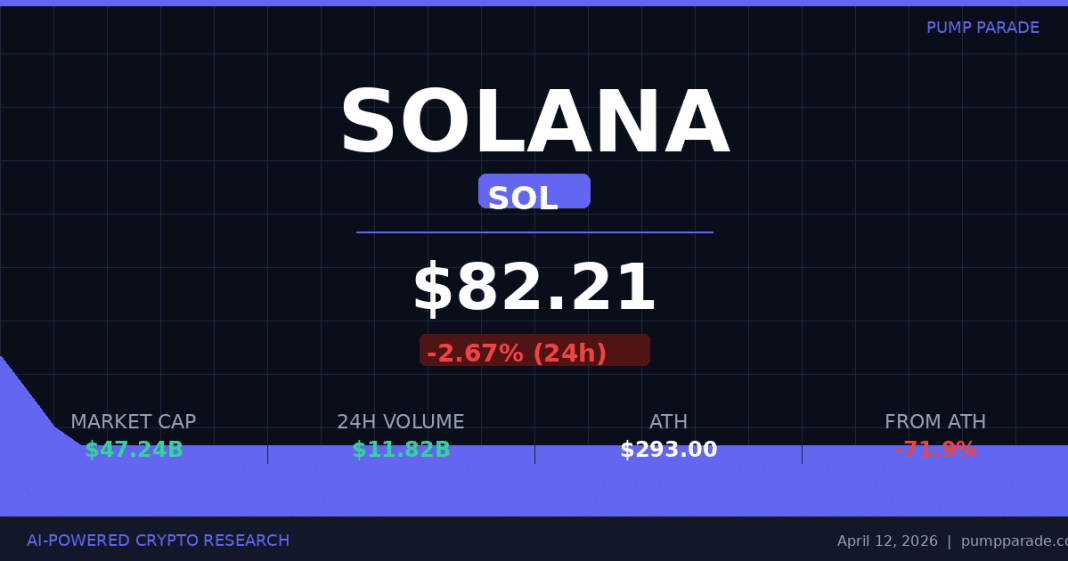
Solana is trading at $82.21 today, April 12, 2026 : down 71% from its all-time high of $293 and nursing a fresh wound from the Drift protocol hack that drained $285 million from Solana DeFi just 11 days ago. On paper, SOL looks beaten up.
But here’s what the bear camp is missing: Solana just hit 167 million monthly token holders : an all-time record, according to Token Terminal data. Daily DEX volume on the Solana ecosystem hit $11.82 billion in the last 24 hours. And the Alpenglow consensus upgrade, which would make Solana 80x faster in transaction finality, is backed by 98% of staked SOL and targeting mainnet by end of 2026.
This is the tension at the heart of Solana right now: record on-chain adoption, a major technical upgrade on the horizon, and a price chart that looks like a disaster. Our AI model has been running the numbers. Here is what we found.
Solana (SOL): What You Need to Know
Solana is a high-performance Layer-1 blockchain designed for speed and low cost. It uses a unique Proof-of-History (PoH) mechanism combined with Proof-of-Stake (PoS) to achieve high transaction throughput. In practical terms, Solana can process thousands of transactions per second with average fees under $0.001.
The network has become the home of choice for memecoins, DeFi protocols, and consumer crypto apps. It hosts Jupiter (the leading Solana DEX aggregator), Raydium, Drift, and dozens of other protocols. The Solana ecosystem also powers some of the most active NFT markets and GameFi applications in crypto.
Key metrics as of April 12, 2026:
- Price: $82.21
- Market cap: $47.24 billion (ranked #7 globally)
- 24-hour trading volume: $11.82 billion
- Circulating supply: approximately 574 million SOL
- All-time high: $293 (January 2025)
- Distance from ATH: -71.9%
- Monthly active token holders: 167 million (all-time high)
What Just Happened: The Drift Protocol Hack
On April 1, 2026, Solana-based DeFi platform Drift Protocol was drained of $285 million. It was the largest DeFi hack of 2026 and the second-largest exploit in Solana’s history.
The attack was sophisticated. Over six months, the attackers (linked to North Korean state actors by Chainalysis) embedded themselves in the Drift contributor community, gained trust, and used a Solana feature called “durable nonces” to pre-sign malicious transactions. Once they had social-engineered real security council members into signing off, they executed the drain in minutes.
The fallout hit SOL hard. The hack triggered a risk-off wave across Solana DeFi. SOL dropped sharply in the days following, and overall sentiment toward Solana’s security model took a hit.
The Solana Foundation responded within a week, announcing a comprehensive security overhaul that includes stricter validator client standards, new auditing frameworks for protocols using durable nonces, and enhanced monitoring for governance attack vectors.
The question for investors: is the Drift hack a one-off security failure at the protocol level, or does it reveal a deeper vulnerability in Solana’s ecosystem? We lean toward the former. The attack exploited social engineering : a human problem, not a protocol flaw. But it is a real risk that any balanced SOL thesis must include.
Technical Analysis: Where SOL Stands Today
The technical picture for SOL is unambiguously bearish on the long-term chart : but potentially setting up a short-term bounce from oversold levels.
Key levels to watch:
- Immediate support: $80 (psychological level, tested multiple times)
- Strong support: $78.30 (Fibonacci swing low)
- First resistance: $85.26 (23.6% Fibonacci retracement)
- Major resistance zone: $91-$92 (supply zone)
- 50-day simple moving average (SMA): approximately $85-$86
- 200-day SMA: approximately $131
RSI analysis: The 14-day RSI (Relative Strength Index : a momentum oscillator that ranges from 0 to 100) sits at approximately 28-30. That is in oversold territory. Historically, SOL bounces have occurred when RSI drops below 30. That said, oversold does not mean bottomed. In prolonged bear trends, RSI can stay below 30 for extended periods.
The bearish technical structure is clear: the 50-day SMA is below the 200-day SMA, a pattern known as a “death cross” that has preceded continued weakness in past cycles. Until SOL reclaims the 50-day SMA around $85-$86 on meaningful volume, any rally is likely to face resistance.
The more constructive read: if SOL holds the $78-$80 support zone and BTC stabilizes above $70,000, the risk-reward for a bounce to the $91-$92 resistance zone is reasonably attractive in the near term.
The Alpenglow Upgrade: SOL’s Biggest Catalyst in Years
If there is one reason the long-term bull case for SOL remains credible despite the current selloff, it is Alpenglow.
Alpenglow (SIMD-0326) is the most significant protocol upgrade in Solana’s history. The core goal: slash transaction finality from 12.8 seconds to approximately 150 milliseconds : an 80x improvement. To put that in context, Visa processes transactions in milliseconds. At 150ms finality, Solana would be competitive with traditional payment rails.
Here’s how it works. Alpenglow replaces two core components of Solana’s consensus mechanism. Votor collapses the current multi-round confirmation process into one or two rounds. When 80% of validator stake is active, finality happens in a single round at around 100ms. Rotor replaces Turbine as the block propagation layer, using stake-weighted relays and erasure coding to remove bandwidth bottlenecks.
The validator community voted 98% in favor of the upgrade. Mainnet deployment is targeted for end of 2026. When it launches, Solana’s use cases expand dramatically: high-frequency trading, real-time consumer apps, decentralized AI agents, and payment processing all become far more viable.
Standard Chartered’s crypto research team has set a year-end 2026 price target of $250 for SOL, citing Alpenglow and the Firedancer validator client (which is expected to push throughput past one million transactions per second) as the primary catalysts.
Bull Case for SOL in 2026
The bull case rests on several converging forces.
First, the adoption metrics are extraordinary. 167 million monthly token holders is not a number you typically see in a dying ecosystem. That is more monthly active participants than many tier-one financial platforms. The gap between SOL’s on-chain adoption and its price performance is historically unusual.
Second, Alpenglow activation could be a major narrative catalyst. Protocol upgrades that deliver real performance improvements have historically driven price re-ratings. When Solana launched Firedancer testnet validators in early 2025, it drove a significant sentiment shift. Alpenglow mainnet would be a bigger event.
Third, if the broader crypto market follows BTC’s historically bullish post-halving trajectory into late 2026, SOL tends to outperform on the upside. In the 2020-2021 cycle, SOL was a top-5 performer. In the 2024-2025 cycle, it reached $293.
Bull case price targets: $110 (30 days), $200 (October 2026), $350 (2027-2028).
Bear Case and Risks
The bear case is not hard to construct right now.
The Drift hack damaged confidence in Solana DeFi. While the attack was a social engineering failure rather than a protocol exploit, the reputational damage is real. Institutional capital flowing into DeFi does not easily distinguish between “human error” and “platform risk.”
The technical structure is weak. The death cross (50-day SMA below 200-day SMA) is in effect. SOL has been trading below both key moving averages for months. A break below $78 would likely accelerate selling toward $65-$70.
Macro risk is elevated. BTC is holding above $70,000, but the broader market has been choppy. If risk-off sentiment returns and BTC retests $60,000, altcoins including SOL would face significant additional downside.
Competition is also intensifying. Ethereum L2s, Sui, and Aptos are competing for the same developer mindshare and TVL. While Solana’s user numbers remain strong, the ecosystem is no longer the only high-performance option in town.
Bear case price targets: $70 (30 days), $75 (October 2026 if hack fallout persists), $95 (2027-2028 floor in prolonged bear scenario).
SOL Price Predictions: AI Model Summary
Our hybrid AI model analyzes technical indicators, on-chain metrics, historical price patterns, sentiment data, and macro correlations. Here is the current output for SOL.
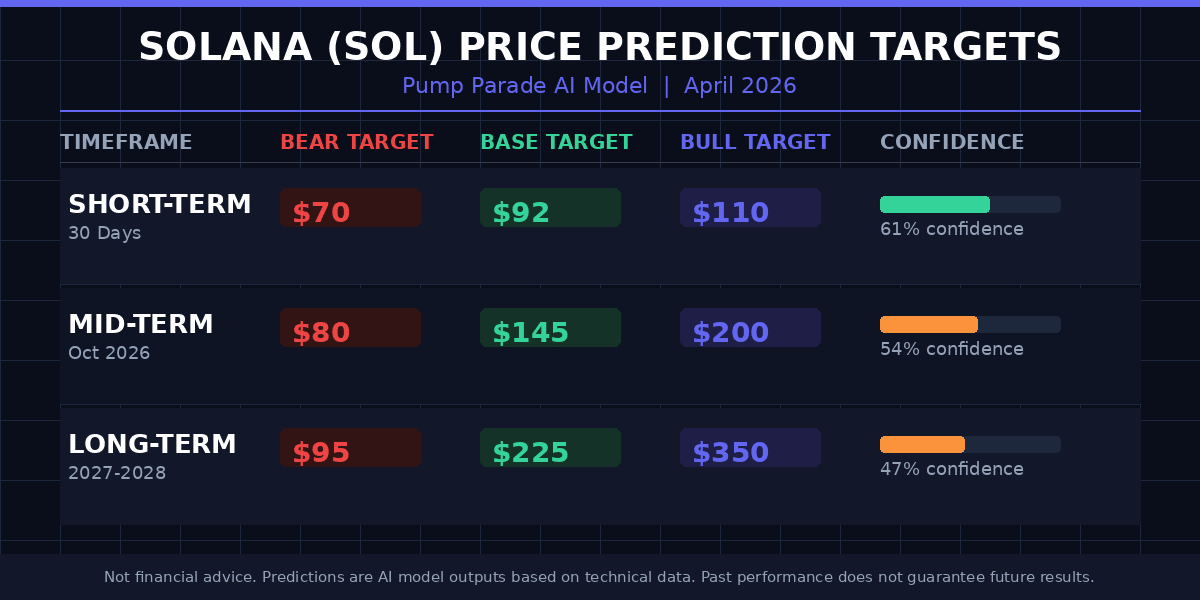
Short-term (30 days, by mid-May 2026): The model assigns a 61% confidence to the base case range of $88-$95. If SOL holds the $78-$80 support zone and BTC stays above $68,000, a bounce to resistance around $91-$95 is the most likely near-term outcome. The bear case ($70) requires a fresh catalyst: another major hack, a BTC breakdown, or broader market deterioration. The bull case ($110) would need Alpenglow-related news flow or a BTC breakout above $80,000.
Mid-term (by October 2026): This is where the thesis hinges most on Alpenglow. A successful mainnet upgrade by Q3 2026 could drive a significant re-rating. The base case of $145 assumes moderate BTC price appreciation and Alpenglow shipping on schedule. The bull case of $200 requires institutional narrative around Alpenglow to drive meaningful new capital inflows. The bear case of $80 reflects a scenario where Alpenglow is delayed, macro conditions worsen, or DeFi security concerns continue to weigh on the ecosystem.
Long-term (2027-2028): The 2028 Bitcoin halving cycle historically lifts the entire market. If Solana maintains its developer activity and Alpenglow delivers the promised performance gains, a retest of the previous ATH range ($250-$300) is plausible. The base case of $225 aligns with Standard Chartered’s view. The bull case of $350 represents a new ATH, which would require a macro bull cycle similar to 2020-2021. For more on how the 2028 halving could impact the broader crypto market, see our analysis of Bitcoin’s price prediction for 2028.
What to Watch
If you are following SOL, here are the key indicators and events to monitor over the next 30-90 days.
- $78-$80 support zone: A daily close below $78 with volume would be a meaningful bearish signal. A bounce from this level sets up a potential recovery to $91-$92.
- Alpenglow deployment timeline: Any developer updates on the SIMD-0326 mainnet timeline will move SOL. Watch the Solana GitHub and official communications from the Solana Foundation.
- Drift recovery: The Solana Foundation’s security overhaul response will be watched closely by DeFi TVL. TVL recovery would be a positive signal for broader ecosystem health.
- BTC correlation: SOL moves with BTC. A sustained BTC rally above $80,000 would likely lift SOL meaningfully. A BTC breakdown below $65,000 would put the $78 support level under serious pressure.
- Firedancer validator adoption: Watch the percentage of validators running Firedancer clients. Higher adoption strengthens both performance and decentralization narratives.
The Bottom Line
Solana at $82 is a genuinely complex situation. The on-chain numbers : 167 million monthly holders, $11.8 billion daily DEX volume : tell a story of a network that users are actively choosing. The price chart tells a different story: a network down 71% from its high, with weak technical structure and a fresh DeFi security scare.
The honest answer is that both stories are true simultaneously. Solana has real adoption. It also has real risks. The Alpenglow upgrade is a credible, technically sound catalyst that could re-rate the asset. The Drift hack is a real reputational setback that will not be forgotten quickly.
Our base case: SOL bottoms in the $75-$85 range through Q2 2026, then rerates higher as Alpenglow deployment approaches. But this is a high-conviction setup only if you believe in Solana’s long-term roadmap and can stomach continued short-term volatility.
The risk-reward here is more interesting than the bear market sentiment suggests. That does not make it easy. It just makes it worth watching closely.
Disclaimer: This article is for informational and educational purposes only and should not be construed as financial, investment, or trading advice. Cryptocurrency markets are highly volatile, and past performance does not guarantee future results. The price predictions and analyses presented here are based on AI models, technical indicators, and available data at the time of writing : they are not guarantees. Always conduct your own research (DYOR) and consult with a qualified financial advisor before making any investment decisions. Pump Parade and its authors do not assume liability for financial losses incurred based on information provided in this article.
About our AI predictions: Pump Parade’s price predictions are generated by machine learning models that analyze technical indicators, on-chain data, and market sentiment. These models have limitations and cannot account for black swan events, regulatory changes, or sudden market shifts. Prediction confidence scores reflect the model’s internal assessment, not guaranteed accuracy. Use AI predictions as one input among many in your research.