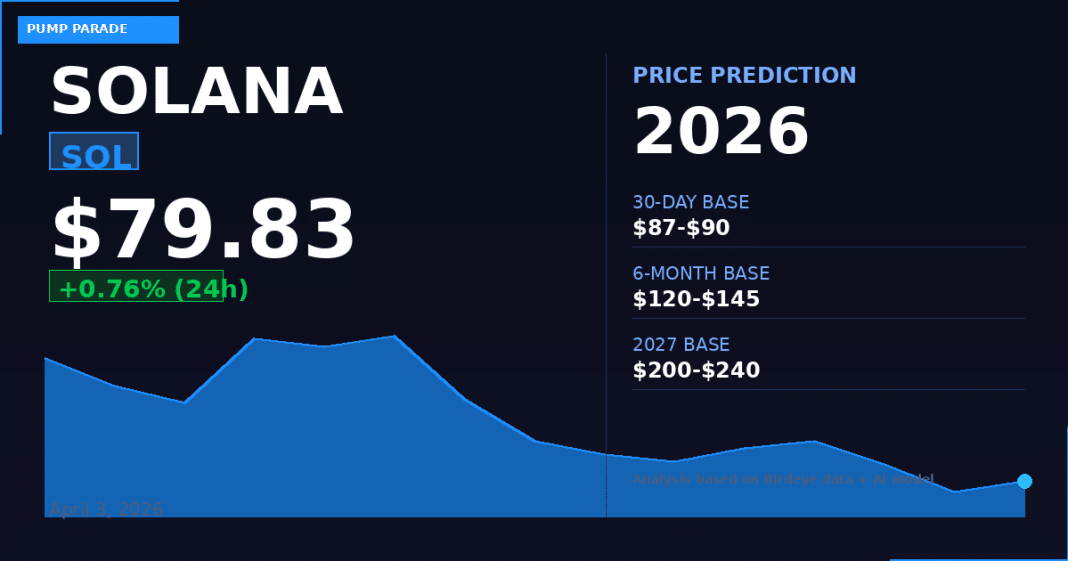
Solana is trading at $79.83 as of April 3, 2026, down more than 72% from its all-time peak of around $289 in early 2025. The market is gripped by extreme fear. The Fear and Greed Index sits at 11. Macro headwinds from global tariff uncertainty, a $270M Drift Protocol exploit that shook ecosystem confidence, and a broader crypto selloff have pushed SOL to a critical support zone. The $80 level is fighting for its life.
But here is the thing: underneath the fear, the fundamentals are arguably the strongest they have ever been. Solana’s Alpenglow upgrade, the largest consensus overhaul in the network’s history, is targeting a mainnet launch in 2026. If it delivers, SOL could look very different by year-end. This article breaks down the data, the technicals, and both sides of the trade.
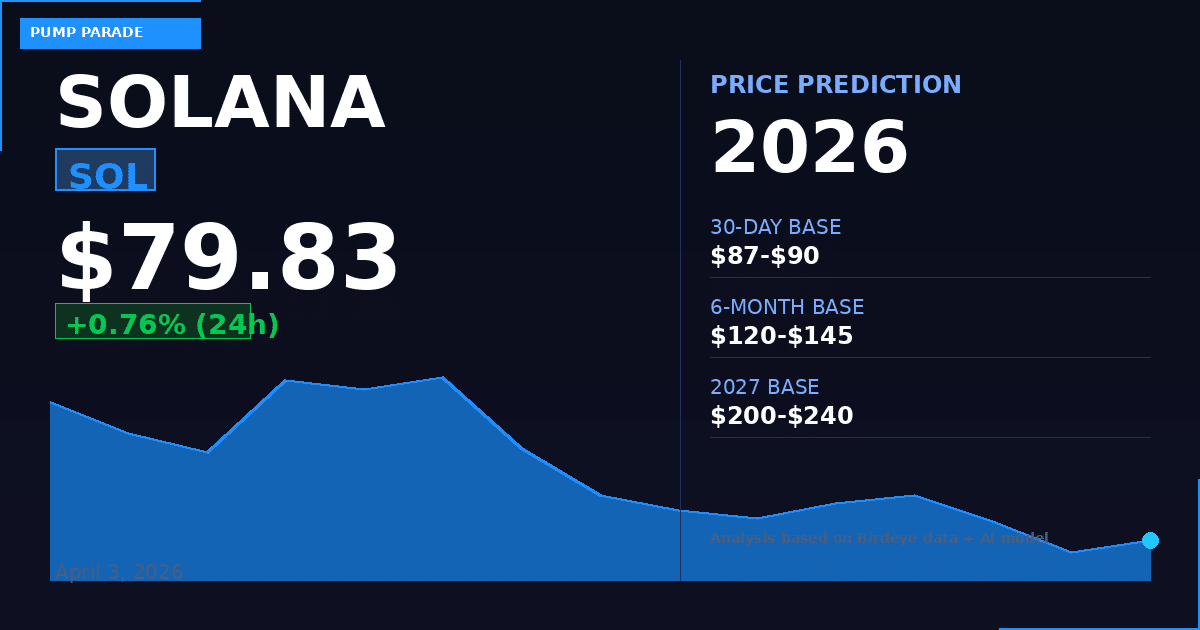
Solana at a Glance: Key Metrics Right Now
Before getting into predictions, here is where Solana stands today based on live on-chain data from Birdeye:
- Current price: $79.83
- 24-hour change: +0.76%
- Market cap: approximately $45.7 billion
- 24-hour trading volume: approximately $13.8 billion
- On-chain liquidity: $5.6 billion
- 14-day price range: $76.66 to $93.44
The volume-to-market cap ratio of roughly 30% signals intense short-term activity. Traders are watching closely. This is not a quiet consolidation period.
What Is Solana?
Solana is a high-performance Layer 1 blockchain designed for speed and low transaction costs. The network processes thousands of transactions per second using a combination of Proof of History and Proof of Stake consensus. It powers a vast ecosystem of decentralized applications, DeFi protocols, memecoins, and NFT markets.
Solana has become the dominant chain for Solana-native memecoins and retail DeFi. Platforms like Raydium, Jupiter, and Drift Protocol process billions of dollars in daily volume on the network. For context on the Solana memecoin ecosystem, see our guide to finding Solana memecoin moonshots.
The network’s biggest upcoming catalyst is Alpenglow, a full overhaul of Solana’s consensus mechanism. The proposal passed with 99.6% validator approval in late 2025. It replaces Tower BFT with a two-component system called Votor and Rotor. The result: transaction finality that drops from around 12.8 seconds today to 100-150 milliseconds. That is a 100x improvement. VanEck has called it the “largest upgrade to Solana’s consensus in its history.”
Technical Analysis: Where Does SOL Stand?
The price chart for SOL tells a story of a sharp rejection followed by a fight over critical support.
SOL reached a recent high of $93.44 on March 25, only to sell off hard over the following week. By April 2, it had touched $76.66, breaking below the psychological $80 level. As of today, April 3, it has crawled back above $79, but the recovery is fragile.
Key Levels to Know
- Critical support: $78-$80. This zone has been tested multiple times. A daily close below $76.66 would signal a deeper correction.
- Secondary support: $68-$72. This is the next meaningful demand zone if $76 breaks.
- Immediate resistance: $85-$86. The previous consolidation area before the April breakdown.
- Strong resistance: $91-$93. This was the recent high and where sellers came in heavily.
Momentum Indicators
With SOL down from $93 to $79 in roughly 10 days, momentum indicators have moved into oversold territory. The Relative Strength Index (RSI), which measures price momentum on a 0-100 scale, has been flagging a “strong sell” signal on shorter timeframes, though daily readings near extreme lows historically precede at least short-term bounces. The MACD (Moving Average Convergence Divergence, a trend-following indicator) is showing bearish momentum, with the signal line still pointing down as of this writing.
The broader crypto market context matters here. Fear and Greed is at 11, which is “Extreme Fear” territory. Historically, this level has coincided with at least temporary bottoms. It does not guarantee one here, but it shifts the probability math.
The Bull Case for SOL in 2026
If you are long SOL, here is the case the data supports.
Alpenglow changes the story. The upgrade is not just a performance improvement. It positions Solana as the fastest, cheapest, and most reliable major chain for consumer applications. If Alpenglow launches successfully in mid-2026, it should attract a new wave of developer activity and institutional attention. Some analysts have noted forecasts ranging from $200 to $350 if adoption and upgrade catalysts land cleanly.
The ecosystem is resilient. Despite the Drift exploit and recent selloff, Solana’s DeFi ecosystem continues to process massive daily volumes. The $13.8 billion in 24-hour volume as of today shows the network remains highly active even in a down market. That kind of deep liquidity is hard to kill.
Oversold conditions and strong support. SOL is down 72% from its peak while the network has arguably never been more technically capable. At $79, the risk-reward profile is asymmetric if macro conditions stabilize. Analysts note the $80 level as a key floor, with a potential rebound to $90-$106 in April alone if the support holds.
Bitcoin correlation as a tailwind. Crypto analysts view the current downturn as a mid-cycle correction rather than a cycle top for Bitcoin. If BTC stabilizes and recovers, SOL has historically amplified BTC’s upside moves by 2-3x.
The Bear Case for SOL in 2026
The bear case is real and deserves full weight.
The $80 support is fragile. SOL already broke below $80 on April 2, touching $76.66 before recovering. If macro conditions deteriorate further, a sustained close below $76 opens the door to $68-$72. A head-and-shoulders pattern that some analysts have identified targets $73 on a breakdown.
Macro headwinds are severe. Global tariff uncertainty is pulling capital out of risk assets across the board. Bitcoin, Ethereum, and Solana are all down 40-72% from their 2025 peaks. The Fear and Greed Index at 11 reflects genuine market-wide distress, not just SOL-specific weakness.
The Drift exploit was a credibility hit. A $270 million security breach on a major Solana-based protocol creates ecosystem uncertainty. It raises questions about security practices across Solana DeFi. Even if Solana’s base layer is not at fault, these incidents damage short-term sentiment.
Alpenglow could slip. Upgrade timelines in blockchain are notoriously unpredictable. If Alpenglow faces delays or implementation challenges, the bullish narrative loses its clearest near-term catalyst. The upgrade still faces technical challenges even with strong validator support.
SOL Price Predictions: Our AI Model Breakdown
Our hybrid AI model combines technical indicators, on-chain data, sentiment signals, and macro factors to generate probabilistic price ranges. Here is the current output for SOL:
Short-Term: Next 30 Days
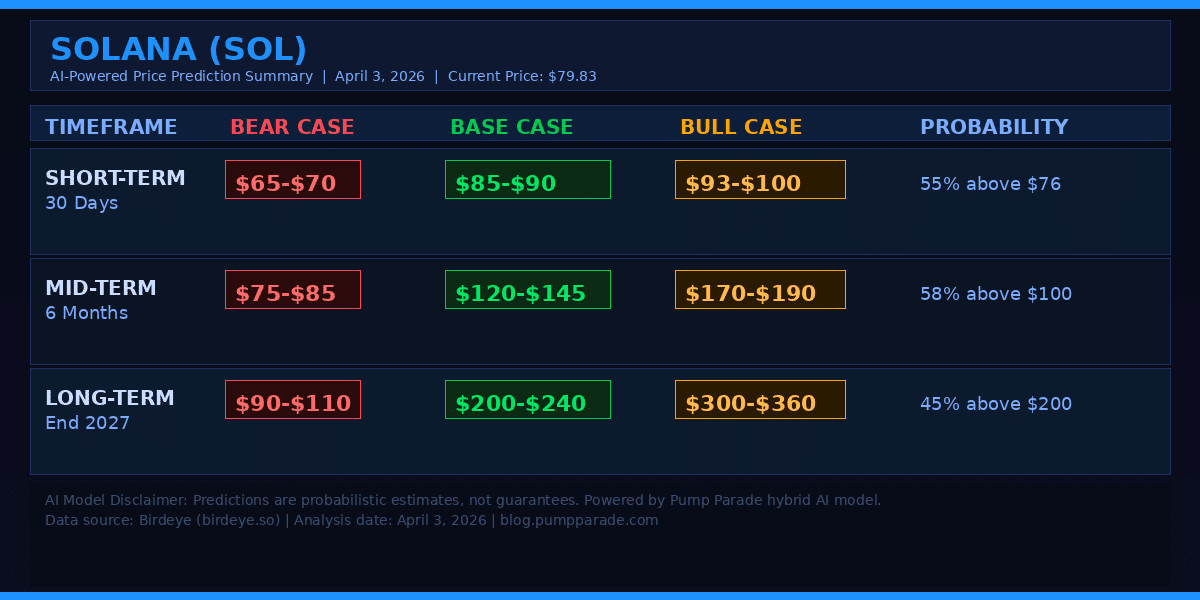
The near-term picture is the most uncertain. SOL is sitting on a critical support level with mixed signals. Our model places a 55% probability that SOL holds above $76 and moves to retest the $85-$90 range. A 45% probability points to a breakdown below $76, targeting $68-$72.
- Bear target (30 days): $65-$70
- Base target (30 days): $85-$90
- Bull target (30 days): $93-$100
The base case requires the $78-$80 support to hold and macro sentiment to stabilize. Expect volatility.
Mid-Term: 6 Months (by October 2026)
Over a six-month horizon, Alpenglow becomes the dominant factor. If the mainnet upgrade launches in Q3 2026 as expected and is received well, SOL could see significant re-rating. Institutional interest in Solana has been growing steadily, and a major technical milestone could accelerate that.
- Bear target (6 months): $75-$85
- Base target (6 months): $120-$145
- Bull target (6 months): $170-$190
The base case reflects a partial macro recovery combined with Alpenglow successfully entering testnet and generating positive developer momentum. Our model assigns a 58% probability to SOL trading above $100 by October 2026.
Long-Term: 2027 and Beyond
Over a 1-2 year timeframe, the range widens significantly. The long-term bull case depends on Alpenglow delivering its promised performance, continued growth of Solana DeFi, and a broader crypto market recovery driven by Bitcoin’s next cycle.
- Bear target (end 2027): $90-$110
- Base target (end 2027): $200-$240
- Bull target (end 2027): $300-$360
The $200+ base case requires Alpenglow to land cleanly, macro conditions to normalize, and BTC to push into a new all-time high range. None of those conditions is guaranteed, but they are all within the realm of historical precedent for this cycle.
What to Watch in the Coming Weeks
If you are tracking SOL, here are the key signals that will determine which scenario plays out:
- $76.66: The April 2 low. A daily close below this level changes the short-term thesis.
- $85-$86: The first real resistance on a recovery. Getting back above this zone cleanly would signal selling pressure is exhausting.
- Bitcoin price action: SOL does not move independently. Watch BTC. A break above $75,000 for BTC would likely pull SOL higher.
- Alpenglow testnet timeline: Any official Solana Foundation announcement about the Alpenglow public testnet date is a potential catalyst.
- DeFi volume stability: If daily DeFi volume on Solana stays above $10 billion per day, the ecosystem is absorbing the shock. A sustained drop below $5 billion would be a warning sign.
Disclaimer: This article is for informational and educational purposes only and should not be construed as financial, investment, or trading advice. Cryptocurrency markets are highly volatile, and past performance does not guarantee future results. The price predictions and analyses presented here are based on AI models, technical indicators, and available data at the time of writing. They are not guarantees. Always conduct your own research and consult with a qualified financial advisor before making any investment decisions. Pump Parade and its authors do not assume liability for financial losses incurred based on information provided in this article.
About our AI predictions: Pump Parade’s price predictions are generated by machine learning models that analyze technical indicators, on-chain data, and market sentiment. These models have limitations and cannot account for black swan events, regulatory changes, or sudden market shifts. Prediction confidence scores reflect the model’s internal assessment, not guaranteed accuracy. Use AI predictions as one input among many in your research.