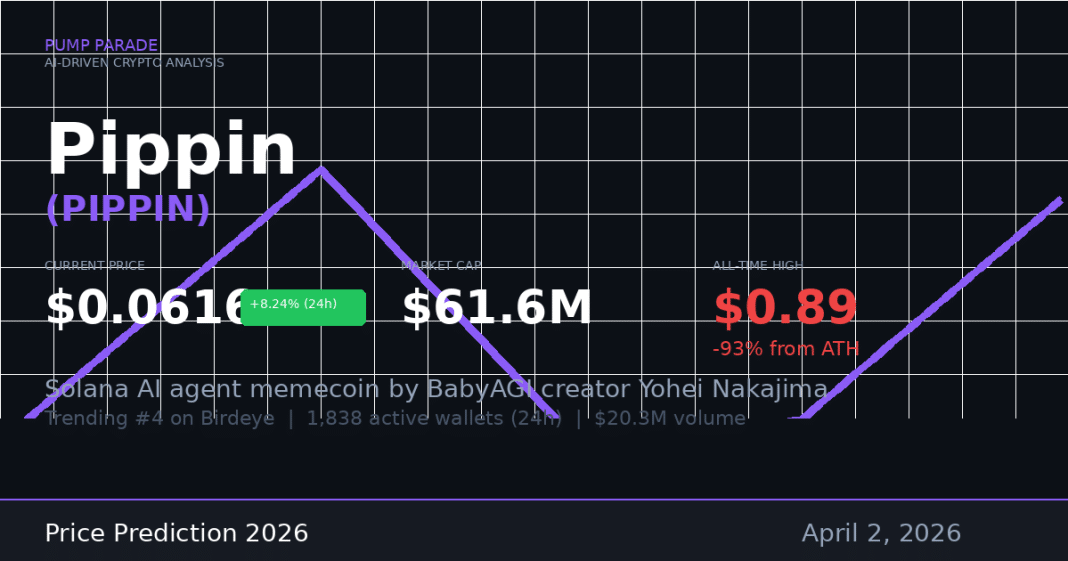
Pippin (PIPPIN) is trading at $0.062 as of April 2, 2026. That puts it 93% below its all-time high of $0.89, set on February 26. Yet today it is trending as the number-four most active token on Birdeye, with 1,838 unique wallets trading it in the last 24 hours and $20.3 million in volume. The question every PIPPIN holder is asking is simple: is this a dead cat bounce, or the start of a real recovery?
This article breaks down the data, the bull case, the bear case, and our AI model’s price targets for the next 30 days, 6 months, and through 2027-2028.
What Is Pippin (PIPPIN)?
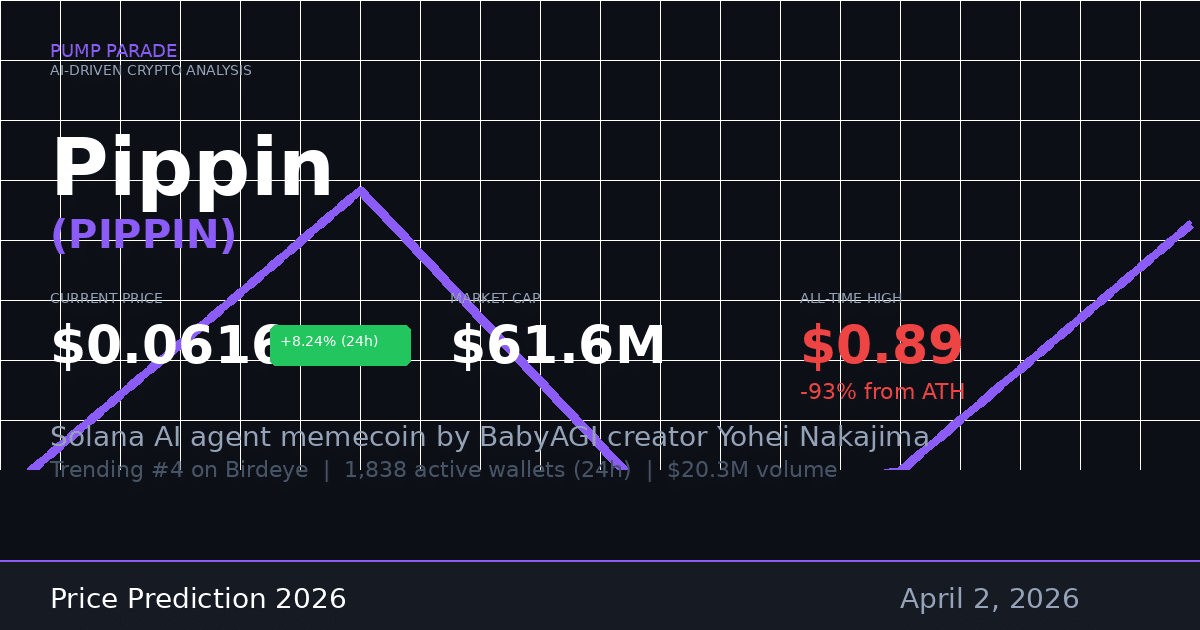
Pippin is a Solana-based AI agent memecoin. It was created by Yohei Nakajima, the venture capitalist behind BabyAGI, the open-source autonomous AI agent framework. In late 2024, Nakajima used ChatGPT to generate an SVG unicorn image, gave it the name Pippin, and built an open-source autonomous agent framework around it on GitHub.
The project sits at the intersection of two of 2024-2025’s biggest crypto narratives: Solana memecoins and AI agents. That combination drove it to a $900 million market cap peak in February 2026. Since then, the market has re-rated the token sharply lower, as investors questioned whether the AI-agent angle was substance or story.
Key metrics as of April 2, 2026:
- Current price: $0.0616
- Market cap: $61.6 million
- Circulating supply: ~1 billion PIPPIN
- Liquidity (on-chain): $5.9 million
- 24-hour trading volume: $20.3 million
- Holder count: 45,492 wallets
- All-time high: $0.89 (February 26, 2026)
You can track the live price and on-chain data on CoinGecko’s Pippin page.
PIPPIN Price History: From $0.89 to $0.06
The PIPPIN chart tells a familiar story in crypto: a euphoric run, a brutal correction, and now a potential base formation.
In early March 2026, PIPPIN was still trading around $0.028-$0.031. Then selling accelerated. By late March, prices had compressed into the $0.011-$0.015 range, a range that held for most of the last two weeks of the month. Volume on high-selling days hit $138 million, suggesting significant distribution took place.
The sharp price decline was not without catalysts. Reporting from CryptoTimes noted that Bubblemaps on-chain data showed a high concentration of supply in interconnected insider wallets. That data spooked holders who were already watching the AI-agent narrative cool. The result: an 85-93% drawdown from peak in under 45 days.
Today’s price of $0.062 is back above the late-March range. Whether that represents new demand or a short-term relief rally is what the technical picture and on-chain signals need to answer.
Technical Analysis: Support, Resistance, and Key Levels
Here is what the chart is telling us right now.
Support Levels
The $0.011-$0.015 zone acted as support throughout late March. PIPPIN tested this band multiple times over two weeks without breaking lower. That establishes it as the key near-term floor. A close back below $0.013 would be a bearish sign and would suggest the bounce has run out of energy.
A secondary support sits around $0.025, which was the last area of consolidation before the late-March sell-off accelerated. If PIPPIN can hold above this level on any pullback, that is a constructive sign.
Resistance Levels
The first major resistance sits at $0.08-$0.10. This was a congestion zone in mid-to-late March before sellers took control. Flipping $0.10 into support would open the door to $0.15.
Above that, the $0.20 level is significant. It was the last area where the price spent meaningful time on the way up to the ATH. Reclaiming $0.20 would change the narrative from “dead project” to “recovery in progress.”
Volume and Momentum Signals
The RSI (Relative Strength Index, a momentum indicator that measures overbought and oversold conditions) came off extremely oversold readings in late March. A bounce from oversold RSI territory is not a buy signal by itself. But the combination of rising price, rising volume, and a trend break above the late-March range gives the bulls a reasonable short-term setup.
The 24-hour volume-to-market-cap ratio sits at roughly 33% today. That is high. It indicates either strong speculative interest or a short squeeze. Either way, it is worth watching.
Bull Case for PIPPIN in 2026
Here is the argument for why PIPPIN could recover meaningfully from current levels.
The AI agent narrative is not dead. Broader AI agent tokens have shown resilience in 2026. Bittensor (TAO) and other AI-native projects have recovered strongly. If the sector rotates back into focus, PIPPIN is one of the more recognizable names in the Solana AI-agent space.
Yohei Nakajima has credibility. The creator of BabyAGI is a genuine figure in the AI research community. His connection to the project gives it more legitimacy than a typical anonymous Solana memecoin. If he continues building the open-source agent framework on GitHub, the project maintains a story beyond pure speculation.
The Solana ecosystem is strong. Solana continues to process more transaction volume than most competing chains. If you are looking for Solana memecoins with genuine on-chain activity, PIPPIN’s liquidity depth of $5.9 million and 45,000-plus holders give it more staying power than typical pump-and-dump tokens.
The price base is forming. After weeks of sideways compression in the $0.011-$0.015 range, the token is showing signs of accumulation. Low-price ranges that hold over multiple weeks often precede trend reversals.
Bear Case for PIPPIN in 2026
The risks here are real and should not be minimized.
High insider concentration. On-chain analysis from Bubblemaps found that roughly 80% of supply is controlled by interconnected wallets. This is a serious red flag. It means a relatively small group of holders can coordinate large sell pressure at any time, regardless of market conditions.
No hard utility. Outside of the AI-agent GitHub framework and community storytelling, PIPPIN has no revenue, no protocol fees, and no DeFi integration. Its price is entirely sentiment-driven. When sentiment fades, there is no floor from fundamentals.
The bounce may not hold. High-volume bounces from deeply oversold territory are common in crypto. Many of them fail within 2-4 weeks as sellers use the recovery to exit positions they could not sell at lower prices. The $0.062 price could mark the top of a dead-cat bounce rather than the start of a recovery.
Broader macro risk. Bitcoin has been showing volatility in early April 2026. If BTC sees a sharp correction, speculative Solana memecoins with no fundamental floor are typically among the hardest-hit assets.
PIPPIN Price Predictions: Short, Mid, and Long Term
Our hybrid AI model combines technical indicator analysis, on-chain volume trends, liquidity data, and comparable-asset modeling. Here are the price prediction scenarios for three timeframes.
Short-Term: 30 Days (by May 2026)
The immediate question is whether the current bounce holds or fails. The data points to a trading range rather than a strong directional move in the next 30 days.
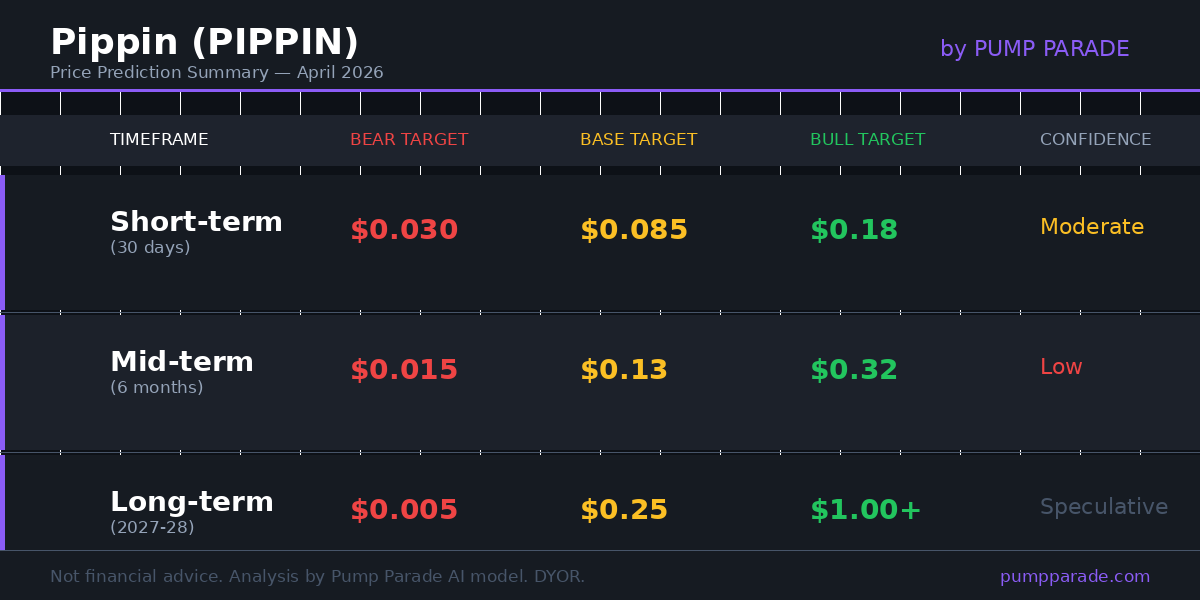
- Bear target: $0.030. A failure to hold above $0.05 support would likely see price drift back toward the late-March lows. $0.030 is a realistic landing zone on renewed selling.
- Base target: $0.085. If volume stays elevated and the token holds above $0.05, a grind toward the first major resistance at $0.08-$0.10 is the most likely near-term path.
- Bull target: $0.18. A positive catalyst (new Nakajima AI-agent announcement, Solana ecosystem momentum, or broad memecoin rotation) could push the token toward its next major resistance zone.
Mid-Term: 6 Months (by October 2026)
At the 6-month horizon, the uncertainty increases significantly. PIPPIN’s fate depends heavily on whether the AI-agent narrative regains momentum and whether the project can build any sustained utility.
- Bear target: $0.015. If broader memecoin sentiment deteriorates and no new catalysts emerge, PIPPIN likely re-tests or breaks the late-March lows. At this level, the project risks becoming illiquid and orphaned.
- Base target: $0.13. Moderate recovery in line with improved Solana sentiment and continued community activity. This would represent roughly a 2x from current levels.
- Bull target: $0.32. If the AI-agent sector sees a strong narrative catalyst and PIPPIN captures the rotation, a recovery toward the 50% Fibonacci retracement from ATH is possible.
Long-Term: 2027-2028
Long-range price predictions for speculative memecoins carry very low confidence. That said, the model can still identify the scenario range.
- Bear target: $0.005 or effectively zero. Most memecoins do not survive 2-3 year cycles without sustained utility development. If PIPPIN fails to build real use cases, it likely fades into irrelevance.
- Base target: $0.25. If the project evolves alongside the broader AI agent ecosystem and maintains a community of active builders, PIPPIN could appreciate meaningfully with crypto market cycles.
- Bull target: $1.00 and beyond. The bull case requires PIPPIN to become the canonical Solana AI-agent mascot and for the AI-agent narrative to drive a fresh wave of capital into the sector. This is a low-probability, high-upside scenario.
What to Watch
If you are tracking PIPPIN over the coming weeks, here are the key signals to monitor:
- Price relative to $0.05: Holding above $0.05 on any pullback is the key near-term health signal.
- Daily volume: Sustained daily volume above $10 million indicates real interest. Volume dropping below $3 million on a recovery attempt is a warning sign.
- GitHub activity: Watch the pippin_moves GitHub repository for new commits. Development activity supports the long-term narrative.
- Insider wallet movement: Monitor Bubblemaps for signs of large wallets distributing into strength. This is the single biggest tail risk for PIPPIN.
- Solana ecosystem flows: PIPPIN tends to outperform on days when Solana sees strong overall volume. If Solana-wide trading activity picks up, small-cap Solana tokens often benefit.
The Bottom Line
PIPPIN is one of the more interesting risk-reward setups on Solana right now, but only for those who understand what they are buying. This is not a project with revenue, product-market fit, or a clear roadmap to utility. It is a speculative AI-flavored memecoin with a recognizable creator, a strong community, and a chart that has just bounced hard from a multi-week base.
The bull case is real: a name-brand creator, genuine on-chain activity, and an AI-agent narrative that may not be finished. The bear case is also real: insider concentration, no utility floor, and a history of vicious drawdowns.
Our model’s base case puts PIPPIN at $0.085 over the next 30 days and $0.13 by October 2026. The bull case targets $0.18 and $0.32 respectively. Neither of those targets looks unreasonable. But the $0.005 long-term bear scenario is just as mathematically possible if sentiment never returns.
Trade the setup you see, not the story you want to believe.
Disclaimer: This article is for informational and educational purposes only and should not be construed as financial, investment, or trading advice. Cryptocurrency markets are highly volatile, and past performance does not guarantee future results. The price predictions and analyses presented here are based on AI models, technical indicators, and available data at the time of writing. They are not guarantees. Always conduct your own research (DYOR) and consult with a qualified financial advisor before making any investment decisions. Pump Parade and its authors do not assume liability for financial losses incurred based on information provided in this article.
About our AI predictions: Pump Parade’s price predictions are generated by machine learning models that analyze technical indicators, on-chain data, and market sentiment. These models have limitations and cannot account for black swan events, regulatory changes, or sudden market shifts. Prediction confidence scores reflect the model’s internal assessment, not guaranteed accuracy. Use AI predictions as one input among many in your research.