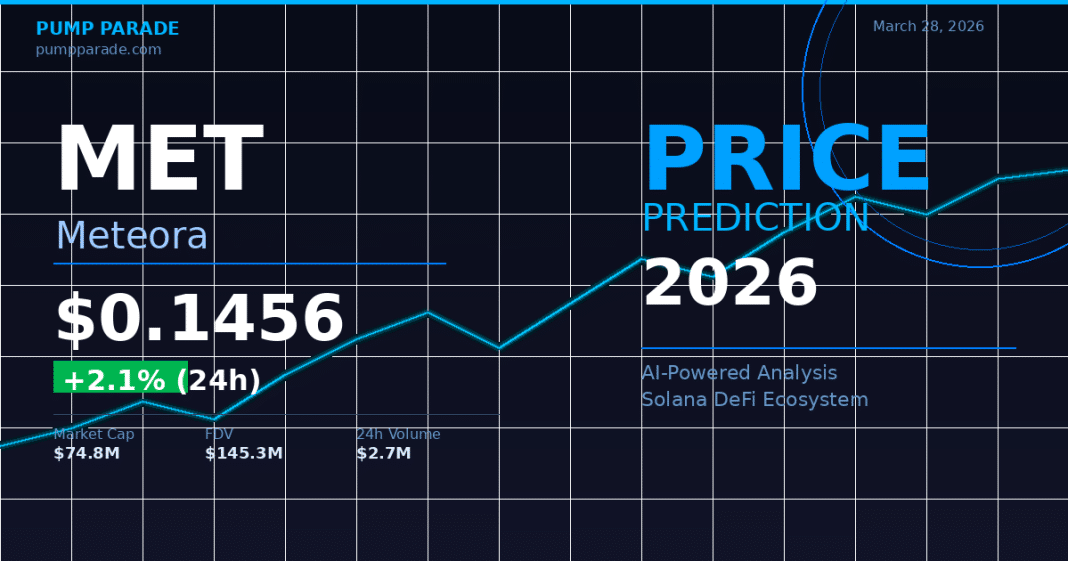
Meteora (MET) is trading at $0.1456 today, March 28, 2026. That is up 2.1% in the past 24 hours, on volume of $2.7 million and with 760 unique wallets active on-chain. On the surface, it looks like a quiet Saturday in crypto. But the bigger picture is harder to ignore: MET is sitting 91.5% below its all-time high of $1.71, set just five months ago in October 2025.
So what happened? And more importantly, where does MET go from here? Meteora is not a memecoin. It is the liquidity backbone of Solana, processing roughly 26% of the network’s DEX volume. The project has real revenue, real buybacks, and a real upgrade on the way. Whether that is enough to push MET back toward its peak is a different question. Our AI model and on-chain data give us a clearer picture than you might expect.
What Is Meteora?
Meteora is Solana’s leading decentralized exchange infrastructure. It powers liquidity through its Dynamic Liquidity Market Maker (DLMM), which allows liquidity providers to concentrate capital around active price ranges. Think of it like a smarter version of a traditional automated market maker. Instead of spreading your funds across every possible price, DLMM puts your money where trading actually happens.
The protocol launched its MET token through an airdrop in late 2024. Since then, MET has served as the governance and value accrual token for the platform. The project’s market cap sits at $74.8 million, with a fully diluted valuation (FDV) of $145.3 million. Circulating supply is 513.8 million MET out of a total supply of 997.7 million. That means roughly half the supply is still locked or unvested. Token unlocks are a real headwind, and we will cover that in the bear case.
Current Market Context: Solana’s DeFi Reset
Meteora’s fall from $1.71 to $0.145 did not happen in a vacuum. It followed a broader collapse in Solana DeFi activity. The memecoin supercycle of late 2024 and early 2025 drove massive volume to Solana DEXs. When that cycle cooled, weekly DEX volume on platforms like Meteora dropped by as much as 83%. Less volume means less revenue. Less revenue means less firepower for buybacks.
That context matters for reading MET’s chart. The token is not just recovering from a bear market. It is recovering from a high that was partly inflated by unsustainable memecoin activity. The real floor for MET is whatever Meteora’s underlying DeFi business justifies. It is not the $1.71 peak that memecoin mania created.
Still, $74.8 million market cap for a protocol handling more than a quarter of Solana’s DEX volume is a number worth paying attention to. MET’s current liquidity depth of $7.1 million is solid for a mid-cap token. And 37,694 holders suggest genuine distribution across the ecosystem.
Technical Analysis: Reading the Chart
MET has been trading in a tight consolidation band between $0.13 and $0.17 for several weeks. The recent bounce to $0.1456 comes with improving momentum signals but not a clean breakout yet.
Key levels to watch:
- Support: $0.12 is the first meaningful floor. Below that, $0.09 is the next hard support zone.
- Resistance: $0.17 is the first barrier. A close above that level on strong volume would signal a shift in trend. $0.22-0.25 is the next major cluster.
The RSI (Relative Strength Index, a momentum indicator that runs from 0 to 100) for MET sits in the mid-40s on the daily chart. That puts it in neutral territory. Not oversold, not overbought. Historically, MET has made its strongest moves when RSI breaks above 55 with volume confirmation. We are not there yet.
The 30-minute unique wallet count is up 163% compared to the prior period. That kind of spike in active traders can precede either a breakout or a shakeout. The 24-hour wallet count is also up 37.7%, reaching 760 unique traders. Volume in the past 24 hours was $2.7 million, a 149% increase over the prior day. Momentum is building. The question is whether it sustains.
The Bull Case for MET
There are three genuine catalysts that could push MET significantly higher from current levels.
Catalyst 1: The DLMM Major Upgrade. Meteora is rolling out its largest DLMM upgrade in Q1 2026. The upgrade adds native on-chain limit orders within any pool, a single-click “zap-in” for liquidity provision, and auto-compounding vaults. These are meaningful quality-of-life improvements for LPs (liquidity providers). If adoption picks up, it drives volume, which drives revenue, which funds buybacks.
Catalyst 2: The buyback program. Meteora spent $10.6 million on MET buybacks in Q4 2025. That represents 88% of the protocol’s $12 million in quarterly revenue. The buybacks accumulated 2.3% of the total MET supply. In a market where most DeFi protocols funnel revenue to teams or treasuries, Meteora is returning capital to token holders in a measurable way. If revenue stabilizes, buybacks continue, and that creates persistent buy pressure against the unlock schedule.
Catalyst 3: Solana ecosystem recovery. Solana is still one of the most active blockchains in crypto. Any recovery in DeFi activity, whether from new use cases or a new memecoin cycle, flows directly to Meteora’s revenue. Meteora does not need memecoins specifically. It needs volume. Higher TVL (total value locked) in Solana DeFi is a rising tide for MET.
The bull case price target for MET over the next 6-12 months is $0.55-0.75 if the DLMM upgrade drives adoption and revenue holds above $10 million per quarter. A full cycle recovery toward $1.00-1.50 by late 2027 is plausible if Solana DeFi reclaims its 2024 peak volumes.
The Bear Case for MET
The risks here are real, and they deserve equal weight.
Risk 1: Token unlocks. Only 51.5% of MET’s total supply is circulating. That means approximately 484 million MET tokens are still locked. As those unlock on schedule, they create consistent sell pressure. Even aggressive buybacks may not fully offset unlock-driven dilution if revenue does not grow.
Risk 2: Legal headwinds. Meteora faced insider-trading investigation allegations in February 2026. These allegations have not been resolved publicly. Legal uncertainty tends to suppress institutional interest and can trigger sharp price drops if the situation escalates.
Risk 3: Coinbase delisted MET perpetuals. In March 2026, Coinbase Advanced suspended trading for MET perpetual futures. This reduces the number of ways traders can express leveraged views on MET. Less derivatives access can mean reduced liquidity and price discovery efficiency.
Risk 4: Revenue is softening. Meteora acknowledged that its buyback pace may not be sustainable if revenue continues to decline from Q4 2025 levels. A buyback program built on high memecoin-era revenue is less reliable than one built on steady DeFi volume.
The bear case price target for MET is $0.07-0.12 over the next 6 months if token unlocks accelerate, legal issues worsen, and Solana DeFi fails to recover meaningfully. Below $0.09, the next support zone is thin.
Traders active in the Solana memecoin ecosystem know how fast things can turn. For a broader look at navigating Solana’s most volatile corner, see our guide on how to find Solana moonshots before they explode.
AI Price Prediction Summary
Our hybrid AI model analyzes technical indicators, on-chain data, and market sentiment to generate probability-weighted price scenarios. Here is the current output for MET.
Short-Term (30 Days)
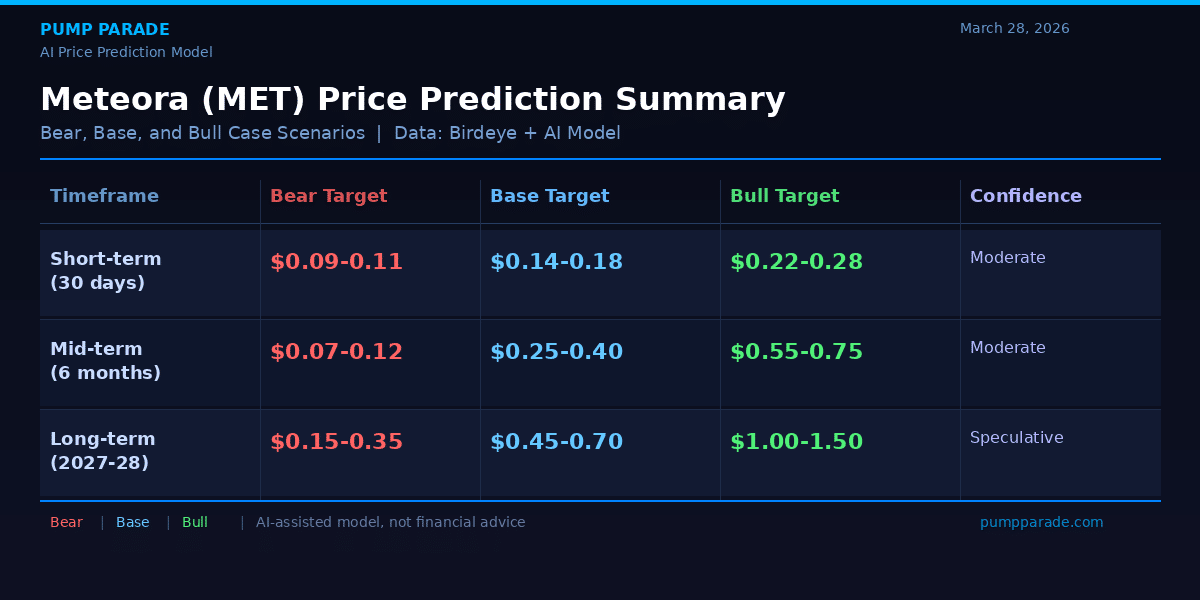
The model assigns a 55% probability that MET holds above $0.13 support and trades between $0.14 and $0.18 over the next 30 days. There is a 25% probability of a move to $0.22-0.28 if volume sustains and the DLMM upgrade gains traction. And a 20% probability of a breakdown toward $0.09-0.11 if broader crypto sentiment turns risk-off.
Mid-Term (6 Months)
Over 6 months, the range widens considerably. The base case is $0.25-0.40, driven by steady buybacks and moderate ecosystem recovery. The bull case is $0.55-0.75 if the DLMM upgrade meaningfully grows Meteora’s TVL. The bear case is $0.07-0.12 under sustained negative catalysts.
Long-Term (2027-2028)
A 2027-2028 recovery scenario where Solana DeFi expands and Meteora maintains its dominant market position could push MET toward $1.00-1.50. That remains conditional on revenue growth and a favorable legal resolution. A continued bear market or competitive pressure from Raydium and other DEX protocols could keep MET in the $0.15-0.35 range through the same period.
You can track MET’s live price and market data on CoinGecko.
What to Watch in the Coming Weeks
If you are monitoring MET, keep an eye on these specific signals:
- DLMM upgrade release date: Any confirmed launch timeline for the Q1 2026 upgrade is a near-term catalyst. Watch Meteora’s official channels for announcements.
- Weekly DEX volume on Solana: If total Solana DEX volume starts recovering, Meteora’s fee revenue follows. A sustained uptick above pre-crash levels is a key leading indicator.
- $0.17 resistance level: A clean daily close above $0.17 with above-average volume would signal the consolidation is breaking to the upside.
- Unlock schedule: Track the MET unlock calendar. Large unlock events tend to create short-term sell pressure regardless of fundamentals.
- Legal updates: Any development in the insider trading investigation will move the price.
Our Take
Meteora is not a speculative memecoin play. It is a protocol with real infrastructure, real revenue, and a real buyback program. At $74.8 million market cap, it is priced like a distressed asset rather than a market leader. That gap between price and utility is either an opportunity or a trap. It depends on what happens next with revenue, unlocks, and legal clarity.
The DLMM upgrade is the most actionable near-term catalyst. If it drives meaningful adoption and volume, the bear case becomes less likely. If revenue continues to soften and token unlocks outpace buybacks, the current support levels will not hold.
Short-term, MET looks like a wait-and-see setup. The momentum data is improving, but there is no clean breakout signal yet. For longer-term positioning, the bull case is credible but conditional. This is a setup worth monitoring, not a conviction buy at any price.
Disclaimer: This article is for informational and educational purposes only and should not be construed as financial, investment, or trading advice. Cryptocurrency markets are highly volatile, and past performance does not guarantee future results. The price predictions and analyses presented here are based on AI models, technical indicators, and available data at the time of writing and are not guarantees. Always conduct your own research (DYOR) and consult with a qualified financial advisor before making any investment decisions. Pump Parade and its authors do not assume liability for financial losses incurred based on information provided in this article.