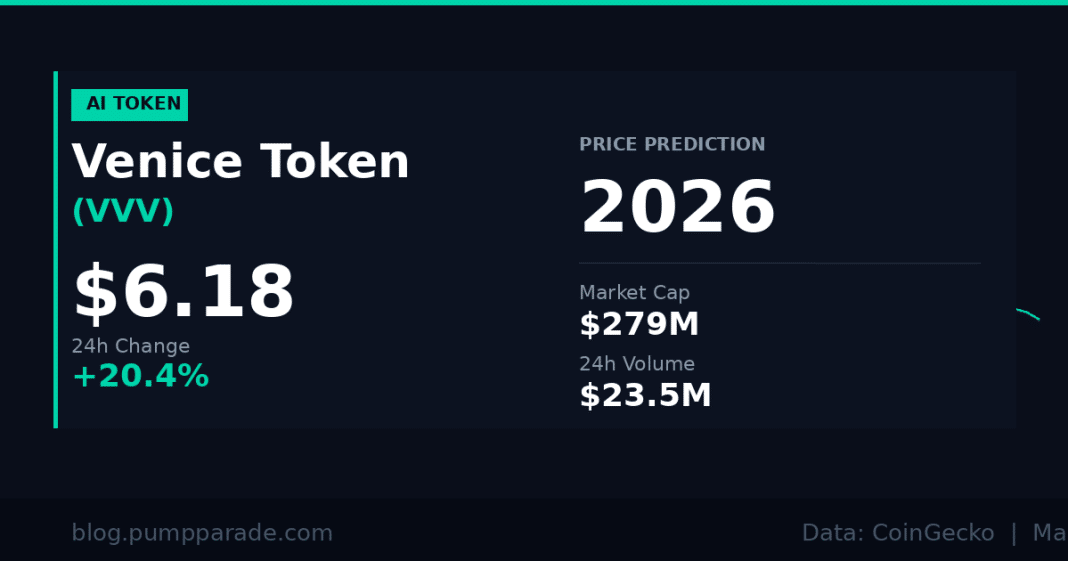
Venice Token (VVV) is up 20% in the last 24 hours. It just crossed a $300 million market cap. And most traders haven’t heard of it yet.
That’s the setup. VVV is the native token of Venice AI: a privacy-focused, uncensored AI inference platform built on Ethereum’s Base network. With AI tokens heating up as a sector in March 2026, and with Venice’s tokenomics improving quarter by quarter, the question isn’t just whether VVV can hold its gains. The question is whether this is the beginning of a much bigger move.
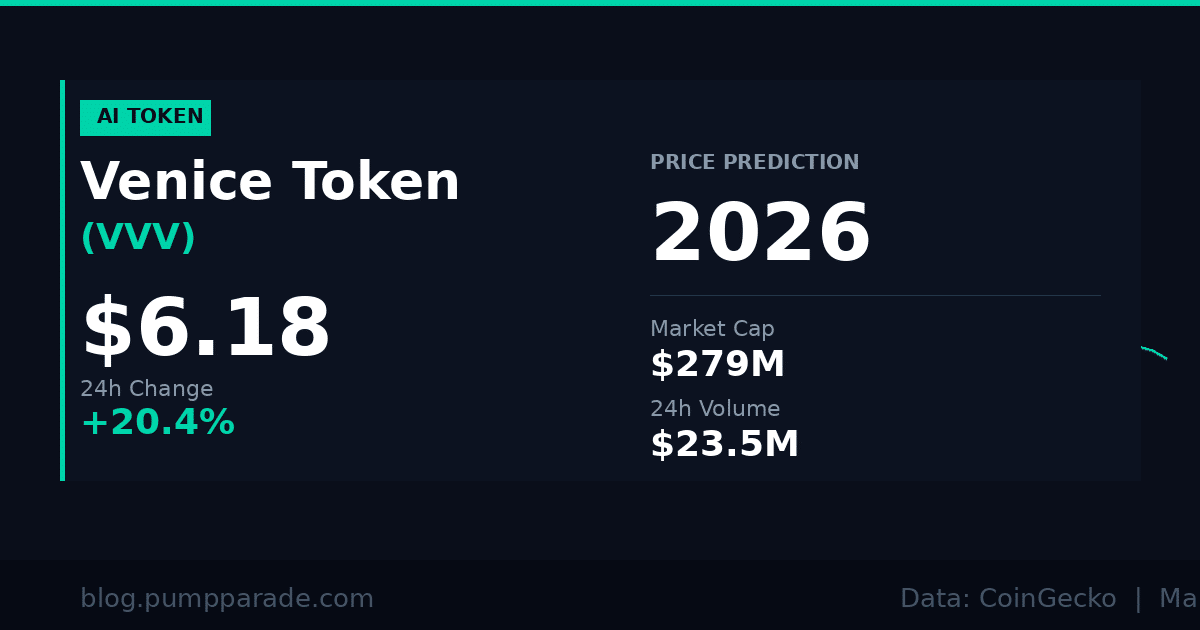
At time of writing, VVV is trading at $6.18, down about 7% from yesterday’s peak: healthy consolidation after the surge. Volume sits at $23.5 million over the past 24 hours. Our AI model has been watching this setup. Here’s what the data says.
What Is Venice Token (VVV)?
Venice AI is a platform that lets users, developers, and AI agents run private AI inference without going through centralized providers like OpenAI or Anthropic. Everything runs locally on the Venice network. Your prompts never hit a corporate server. Your data never trains someone else’s model.
Founded by Erik Voorhees: the same person who built ShapeShift, one of crypto’s early DEX pioneers: Venice has a credible team and a clear thesis. The platform has grown to over 1.3 million registered users, with 50,000 daily active users as of March 2026.
VVV is the token that powers access to this network. Stake VVV and you earn two things: a share of Venice’s AI inference capacity through the Venice API, plus a yield of roughly 18-19% annually. That’s real, protocol-generated utility: not just governance voting rights on a dying protocol.
Key Tokenomics
The numbers here are worth paying attention to. Venice has burned 33.7 million VVV tokens: representing 42.57% of the total supply: as of this month. That’s not a one-time event. The protocol runs an ongoing buyback-and-burn program funded by monthly revenue. The more Venice earns, the more VVV gets permanently removed from circulation.
On top of that, Venice cut its annual token emissions by 25% in February 2026, reducing new supply from 8 million to 6 million VVV per year. Less new supply hitting the market plus ongoing burns equals a structural tailwind for VVV holders.
The total circulating supply sits around 45 million tokens at the time of writing, giving a market cap of approximately $279 million. That’s small for a project with real users and real revenue. For context, Hyperliquid (HYPE): another protocol with strong fundamentals and real fee revenue: traded at similar market cap levels before its breakout run in late 2025. VVV is in that conversation now.
Why VVV Is Moving Right Now
A 20% single-day move needs explaining. Several catalysts are converging this week.
First, the AI token sector is on a hot streak. Venice.ai recently expanded its model lineup and API capabilities. Developers building AI agents: one of crypto’s hottest narratives in 2026: are increasingly using Venice for private inference. The platform doesn’t log prompts. For agents handling sensitive financial data or personal information, that’s not a nice-to-have. It’s a requirement.
Second, Venice’s revenue-based buyback program just completed another burn cycle. Fewer tokens in circulation plus rising platform usage is a simple but powerful combination.
Third, the broader AI crypto sector is getting renewed attention. As centralized AI companies face increasing regulatory pressure around data privacy in 2026, decentralized alternatives like Venice are positioned to benefit. The market is starting to price that narrative in.
Technical Analysis
Let’s look at what the chart is telling us.
VVV hit a local high around $7.10 in yesterday’s surge before pulling back to current levels near $6.18. That pullback is a normal consolidation pattern: the RSI (Relative Strength Index, a momentum indicator that measures whether an asset is overbought or oversold on a scale of 0 to 100) reached high-70s territory during the surge. Cooling back toward the 55-60 range suggests the move was real, not just a flash pump.
Key support levels to watch:
- $5.50: prior consolidation zone and a natural level where buyers stepped in last week
- $4.80: the 200-day moving average, a critical longer-term floor
- $4.20: a breakdown below here would flip the structure bearish
Key resistance levels:
- $7.10: yesterday’s high, first resistance to clear for continuation
- $9.00: psychological level and the 61.8% Fibonacci retracement from the previous swing high
- $11.50: all-time high territory; breaking this would confirm a new leg higher
The MACD (a momentum indicator showing trend direction and strength) is showing increasing bullish momentum. The signal line crossed up in early March and hasn’t reversed. That’s a medium-confidence bullish signal: not a guarantee, but a favorable reading.
The Bull Case
If the AI infrastructure narrative continues to gain traction in 2026, VVV is one of the most differentiated plays in the sector. Here’s why the bull case is real:
Deflationary tokenomics with real yield. The combination of burns, reduced emissions, and staking yield creates a compelling holding argument. Stakers earn roughly 18% annually just for locking up tokens. That acts as a natural floor for selling pressure.
User growth with a credible team. 50,000 daily active users is not trivial for a crypto-native AI platform. Erik Voorhees has built and exited major crypto projects before. He understands tokenomics and long-term community trust. That matters when retail and institutions are doing due diligence.
Regulatory tailwinds for privacy tech. As data privacy regulations tighten globally, Venice’s uncensored and non-logging AI infrastructure becomes a competitive moat. The EU’s AI Act and US AI regulation debates are both increasing the appeal of privacy-preserving alternatives.
Low market cap relative to peers. At $279M, VVV is a fraction of the market cap of centralized AI infrastructure plays. If Venice executes on its roadmap and expands its agent-facing API, a 3-5x from here over a 12-18 month timeframe isn’t an unreasonable base case: it just requires the narrative to mature.
The Bear Case
The bull case is real. So are the risks. Here’s what could go wrong:
Narrative dependency. VVV’s recent surge is partly driven by AI sector enthusiasm. If the broader AI token narrative cools: as it did briefly in January 2026: VVV would likely retrace harder than fundamentals justify. Market sentiment can override project quality in the short run.
Competition from better-funded alternatives. Venice competes with centralized AI giants and other decentralized inference projects. A well-funded competitor launching with superior models could erode Venice’s user growth.
Liquidity is thin at the edges. A $279M market cap means VVV is still a small-cap token. Large orders can move the price significantly. This cuts both ways: fast up moves, but also fast drawdowns if a large holder exits.
The staking yield could compress. As more tokens get staked and total staked supply grows, individual staking yields typically decrease. A decline from 18% to single digits would reduce one of VVV’s most compelling holding arguments.
VVV Price Predictions: Short, Mid, and Long Term
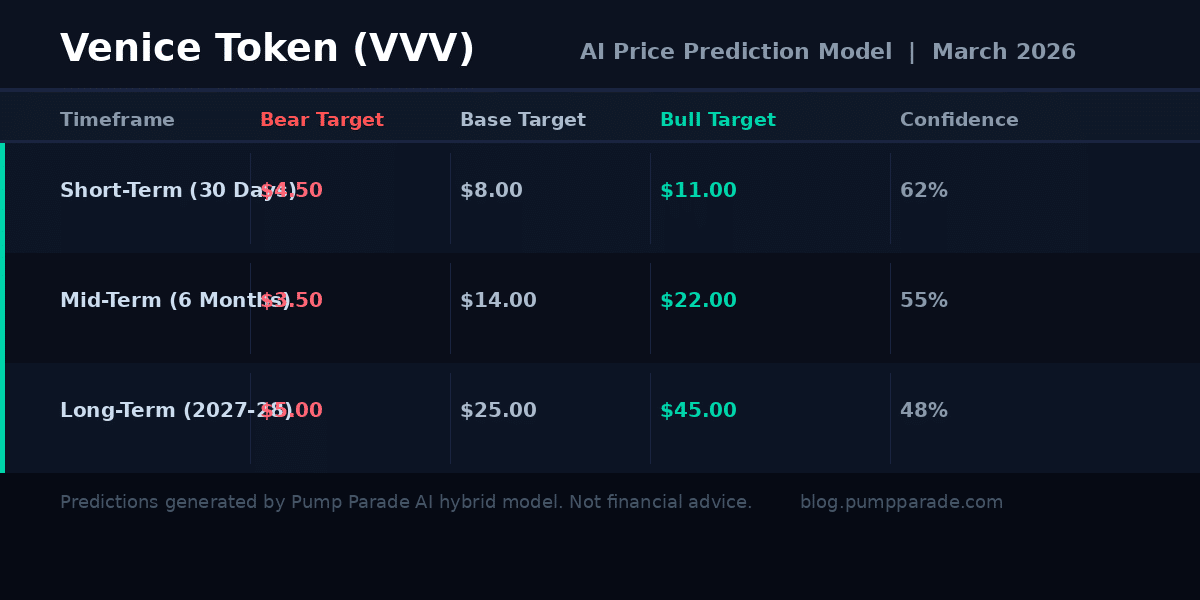
Our hybrid AI model analyzes on-chain data, technical indicators, sentiment, and comparable token trajectories. Here are the price targets across three timeframes:
Short-Term (30 Days)
The consolidation after the 20% surge looks healthy. If VVV holds above $5.50 support and the AI token sector stays active, a test of the $7.10 recent high within the next 30 days is the base case. A more muted market could see a retest of $5.00-5.50 before any extension. Downside risk sits at $4.80 if macro conditions worsen.
Medium-Term (6 Months)
The 6-month view depends heavily on two things: Venice’s user growth trajectory and the overall AI narrative in crypto. If the platform passes 2M registered users and continues its buyback program, the data supports a range of $12-$18 in the base-to-bull scenario by September 2026. The bear case: a market downturn or stalled growth: keeps VVV in the $4-6 range.
Long-Term (2027-2028)
This is where VVV gets interesting. If Venice becomes a meaningful layer of AI agent infrastructure: which its current trajectory suggests is plausible: the token could see a significant re-rating. Our model’s long-term bull case projects $35-$45 by end of 2027, assuming continued burns and user expansion. The base case is $20-$28. The bear case, if the AI infrastructure narrative fails to materialize, is $5-$8.
These are scenarios, not guarantees. Treat them as frameworks, not trading signals.
What to Watch
Here are the key things to track if you’re researching VVV:
- Monthly burn announcements: Venice publishes buyback-and-burn data monthly. Larger burns signal stronger revenue and reduce supply pressure.
- Daily active user count: the 50K DAU metric needs to keep growing. A plateau here would weaken the growth narrative.
- $7.10 resistance: a daily close above yesterday’s high would be the first technical confirmation that the move is continuing, not just a one-day spike.
- AI sector sentiment: VVV moves with the AI token category. Watch tokens like Bittensor (TAO) and Render (RNDR) as broader sentiment indicators.
- Venice API developer adoption: the long-term bull case requires developers to actually build on Venice. Watch for new agent integrations and API usage stats from the team.
Final Take
Venice Token is not a hype play. It’s a small-cap with real users, real revenue, and tokenomics that are genuinely improving. The 20% surge this week wasn’t random: it reflects growing awareness of a project that’s been quietly building. At $6.18 with a $279M market cap, the risk-reward is more favorable than most AI token comparables trading at higher multiples on weaker fundamentals.
That said, this is still a $279M market cap token in a volatile sector. Size your position accordingly. The $4.80 support is the key level to watch on the downside. A break below there would require revisiting the thesis.
The data suggests patience here is rewarded: either by a retest of $5.50 that provides a better entry, or by a continuation push toward $9 that confirms the breakout. Either way, VVV is worth monitoring closely.
Disclaimer: This article is for informational and educational purposes only and should not be construed as financial, investment, or trading advice. Cryptocurrency markets are highly volatile, and past performance does not guarantee future results. The price predictions and analyses presented here are based on AI models, technical indicators, and available data at the time of writing: they are not guarantees. Always conduct your own research (DYOR) and consult with a qualified financial advisor before making any investment decisions. Pump Parade and its authors do not assume liability for financial losses incurred based on information provided in this article.